AI tool
Warren
Warren turns coding-agent runs into operational workloads that run beyond a developer terminal. It handles workspaces, run dispatch, limits, event history, recovery, and delivery, and is built for developers and teams running agent harnesses like ...
About Warren
Warren is an open-source infrastructure tool for running coding-agent workloads. It manages agent harnesses as isolated, observable workloads on infrastructure you control, handling the workspace, run lifecycle, limits, events, recovery, and Git delivery. It launched this week and is currently at version 0.18.0, pre-1.0.
Review
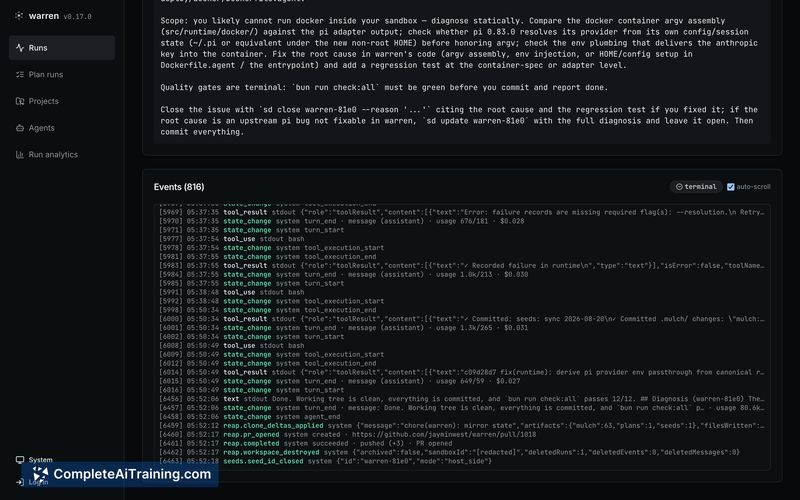
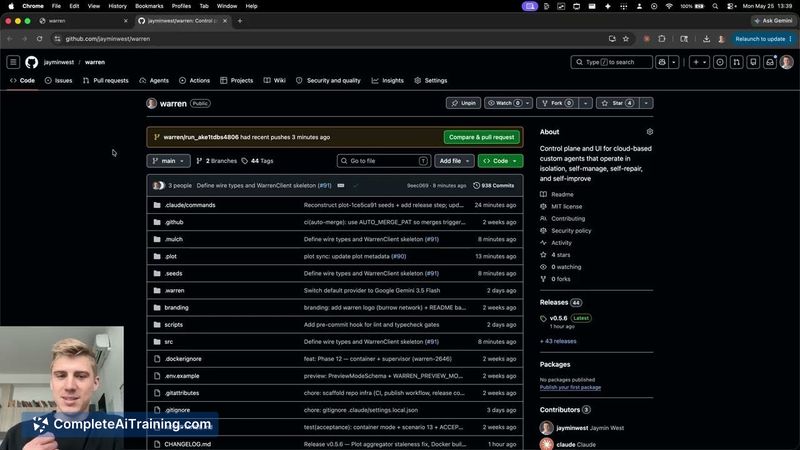
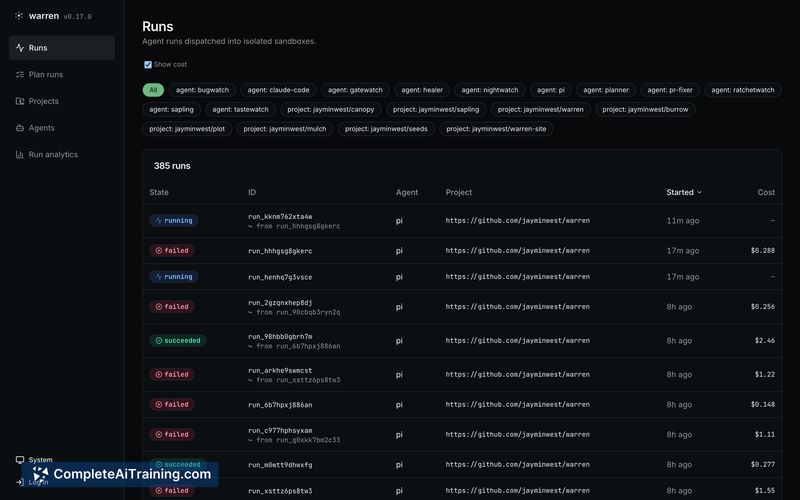
Warren addresses a specific operational gap: what happens when a coding-agent run needs to outlive a terminal session. The tool treats agent runs as workloads with defined boundaries, rather than interactive processes. Its public run history at app.warren.run lets anyone inspect real projects and live event streams without logging in.
Key Features
- Workspace materialization: Warren creates the repository and an isolated working environment for each run.
- Multiple runtimes: a single lifecycle dispatches workloads locally, in a sibling Docker container, or in a Kubernetes pod.
- Spend and concurrency limits: operators set per-run and project-level caps that hold while work executes.
- Structured event history: Warren persists and streams run events, including actual cost data per run.
- Recovery and delivery: failed runtimes are reconciled, and the tool pushes resulting branches and can open pull requests through its forge integration.
Pricing and Value
Warren is free and self-hosted under the MIT license. Pricing is not defined beyond the open-source license; there is no hosted tier or paid plan mentioned. The cost value comes from operational control: operators can cap spend per run or per project, and the public run history shows actual cost variability. One commenter noted runs on the same repo ranged from $0.538 to $4.47 within eight hours.
Pros
- Runs continue after your laptop closes, repeat on a schedule, and survive failures without manual intervention.
- Operators can cancel any live run, and supported runtimes accept mid-run steering.
- Actual spend data is recorded and published, giving operators a basis for planning rather than averages.
- The project-level cap that kills a stuck run addresses the retry-loop problem directly.
- Self-hosting keeps the trust boundary with your own infrastructure.
Cons
- Named users, RBAC, and per-user attribution have not shipped, so a small trusted team sharing one deployment is the current model.
- The distribution only ships Pi and Claude Code adapters; other harnesses need a Warren runtime adapter written for them.
- Warren is not well suited for teams that need multi-user access controls or non-GitHub forge integrations today, since it is GitHub-first and runtime capabilities differ.
Warren fits operators who run coding agents at a scale where cost and failure boundaries matter. It suits small teams willing to self-host and work within the current GitHub-first, pre-1.0 constraints. Teams needing mature multi-user controls or broad forge support should wait for later releases.
Jobs Warren suits
We checked Warren against 500+ jobs; these get the most out of it.
Alternatives to Warren
Other tools that do the same main job. Our AI compared Warren with similar tools and kept the ones you could use instead.