AI tool
Yedric.ai
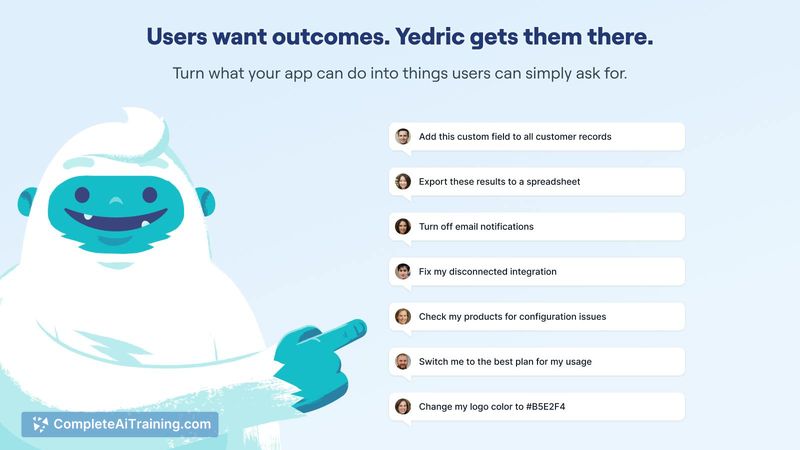
Yedric.ai is an embeddable AI agent that lets users accomplish tasks in your app by simply asking. It connects to your product knowledge, user context, and APIs to handle requests like changing settings or fixing issues. This tool is for product t...
About Yedric.ai
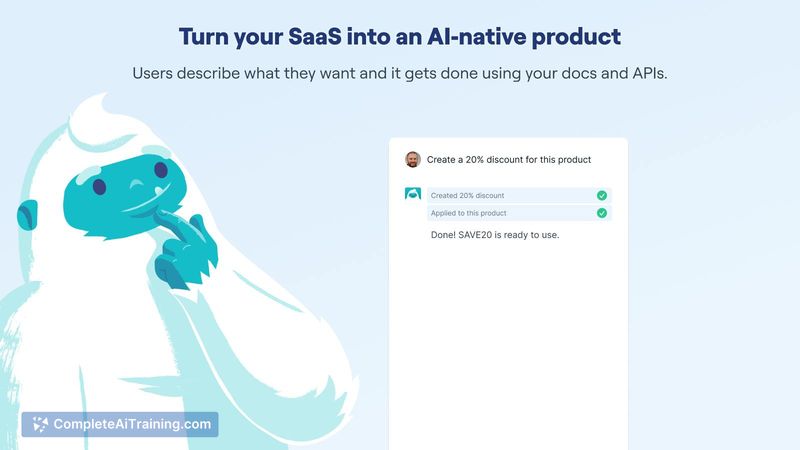
Yedric.ai is an embeddable AI agent that integrates into existing SaaS products. It converts natural-language requests from users into actions the product's APIs and systems can execute. The tool was originally built for the creators' own Shopify apps before being released as a standalone product for other development teams.
Review
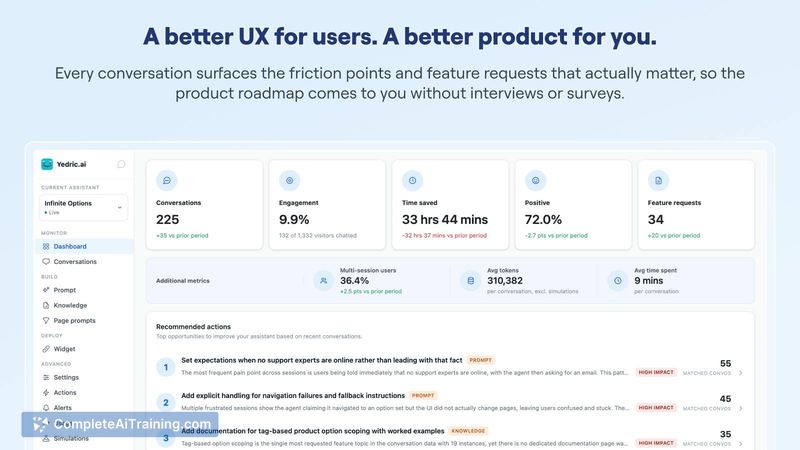
Yedric.ai tackles a specific friction point in software: the gap between what a user wants to accomplish and their ability to locate the right feature. Rather than building a custom conversational layer from scratch, developers embed Yedric's agent and connect it to their existing API endpoints and documentation. The setup, according to the team, can be completed in under 30 minutes.
Key Features
- Embeddable agent that accepts plain-language instructions and triggers corresponding actions within the host application.
- Conversation dashboard that surfaces what users are asking for, including requests the product can't yet fulfill-one app reportedly surfaced over 80 distinct feature requests in a month.
- Knowledge integration that lets developers connect existing documentation so the agent can reference product-specific information when responding.
- Model flexibility: ships with OpenAI's models included in every plan, and teams can switch to Claude by Anthropic without altering their configuration.
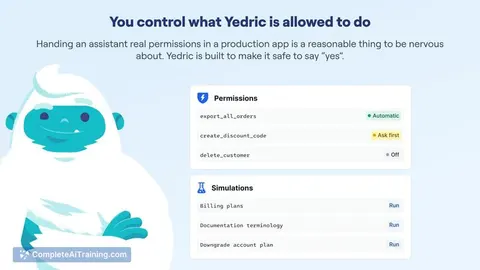
- Incremental action exposure, meaning developers don't need to wire up every endpoint at launch. They can start with read-only operations and expand based on actual user queries.
Pricing and Value
Yedric.ai is free to use, with users supplying their own LLM API key. The launch materials do not describe any paid tiers, usage limits, or future pricing changes. Pricing beyond the bring-your-own-key model is not yet defined.
Pros
- Setup time is measured in minutes, not weeks, since the agent plugs into existing APIs without requiring a separate vector database.
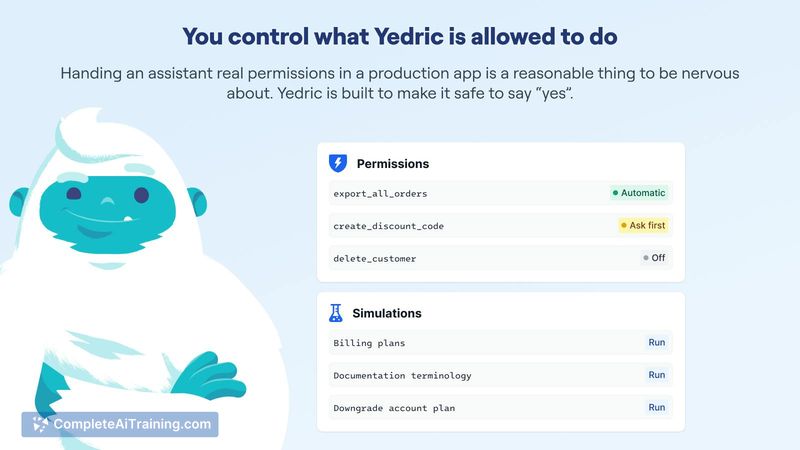
- Destructive actions remain under the developer's control-teams decide which endpoints to expose, which avoids accidental data loss from unprompted agent behavior.
- The conversation dashboard logs user intent directly, turning support interactions into a structured feedback channel for product decisions.
- Works with multiple LLM providers, so teams aren't locked into a single model's pricing or performance characteristics.
Cons
- The agent's reliability depends heavily on the quality and clarity of the APIs it's connected to; poorly documented or inconsistently designed endpoints will produce unreliable results.
- No mention of on-premise deployment or self-hosted options, which may rule out teams with strict data residency requirements.
- Yedric.ai is not well suited for products where the primary user interaction is visual design work, such as graphics editors or 3D modeling tools, since natural-language commands don't map cleanly to spatial or aesthetic tasks.
Yedric.ai fits teams that already have a functional API and want to add a conversational layer without diverting engineering time to build one from scratch. It makes the most sense for SaaS products with deep feature sets where users frequently struggle to locate specific settings or actions. Teams evaluating it should budget time for curating which endpoints get exposed and monitoring the conversation logs to catch edge cases the agent mishandles.
Jobs Yedric.ai suits
We checked Yedric.ai against 500+ jobs; these get the most out of it.