
Blog ·
11 Essential AI Courses for Heads of Operations in 2026
Master AI to streamline operations, cut costs, and lead your team into the future. Discover the top 11 courses for 2026, covering automation, data strategy, and ethical implementation.
 Jeroen Erne
The operational landscape is shifting beneath our feet. Artificial intelligence is no longer a distant concept discussed at tech conferences - it's actively reshaping how operations teams function, make decisions, and deliver results. For Heads of Operations professionals, this presents both a challenge and an opportunity. The title you hold today may not exist in its current form within five years, and the question is whether you'll be the one adapting or the one being replaced.
Businesses are scrambling to integrate AI into their operational workflows, and those who understand the technology are the ones being tapped for leadership roles. According to recent surveys, 69% of businesses already use AI in some capacity, and that number climbs higher every quarter. The reality is simple: AI literacy is fast becoming as essential to operational leadership as budgets, staffing, and process optimization. The professionals who invest in AI education now will have a significant advantage over those who wait.
That's where this article comes in. We're going to look at five AI courses specifically designed for Heads of Operations professionals - programs that teach you how to apply AI in ways that genuinely matter for your daily responsibilities. From process automation to quality control to workflow design, these courses cover applications that will help you lead with confidence in an AI-enhanced environment.
Why AI matters for Heads of Operations today
Consider what your typical day looks like. You're juggling multiple workstreams, coordinating across departments, managing resources, and solving problems that arise in real time. AI tools can handle much of this heavy lifting - freeing you to focus on strategy and decision-making rather than firefighting and repetitive tasks. That's not just a productivity gain; it's a fundamental shift in how operations leadership works.
Operations functions are data-heavy by nature. You deal with supply chains, budgets, timelines, quality metrics, and performance indicators. AI systems excel at parsing and recognizing patterns in data that would take a human hours or days to identify. More sharply, modern AI platforms can use predictive analytics on your operational data to identify bottlenecks before they become critical incidents. This transforms your role from reactive to strategic.
For younger leaders entering operations, this matters even more. The classic career path - start in an analyst role, develop institutional knowledge, and climb the ladder through first-hand exposure - is getting compressed by AI-driven tools. The critical skills now are knowing how to direct AI systems to get the insights you need, knowing what questions to ask, and having the judgment to filter good results from bad ones.
The purpose of this article is straightforward: to help you identify the best AI courses for your specific operational leadership needs. We'll compare five AI training options, including CompleteAI Training for Heads of Operations - a program that gives you access to ALL courses and ALL certifications on the platform rather than limiting you to a single course, which makes it a particularly flexible option for leaders who want breadth alongside depth.
The Growing Role of AI in Heads of Operations
So what does AI actually look like in operational leadership day-to-day? Here are some concrete applications:
- Process automation: Using AI to handle routine approvals, status updates, and data entry tasks that previously required manual attention.
- Decision support: AI-powered analytics that sift through historical performance data to forecast outcomes and identify the best course of action.
- Resource allocation: Recent AI models can project workload patterns and recommend where to deploy staff and budget for maximum impact.
- Personalization: For operations leaders in any sector, AI can customize experiences based on behavioral data - whether that's customer service responses or internal knowledge sharing.
- Predictive maintenance: Using sensor data and machine learning to spot equipment failures before they happen, saving cost and downtime.
- Quality assurance: Automated systems that continuously monitor output quality and alert you to deviations that human teams might miss.
What this means for Heads of Operations is that tasks like report generation, performance tracking, and even vendor communication are now handled by AI systems. In turn, that changes your daily tasks - what used to be just crunching number is now supervised by machine intelligence. The most effective practitioners in this space aren't necessarily the ones who deeply understand the algorithms but who ask the right questions and direct AI outcomes in closer alignment to operational goals.
Benefits of becoming an AI expert in Heads of Operations
When you understand AI and how to apply it in your operational context, you position yourself for several key advantages:
You become more strategic. Rather than getting caught up in day-to-day managing that AI can handle, you're freed to focus on the bigger picture - designing systems that are efficient, resilient, and aligned with business objectives. That's exactly the kind of leadership that gets noticed by C-suite and trim management.
You gain a seat at the decision table. Companies are investing heavily in AI, and they need leaders who can not only speak about the budget but guide implementation strategy. Those with AI literacy are an increasingly critical voice in shaping how these tools get deployed across the organization.
You future-proof your career. The risk of being sidelined is real. When budget cuts come, the people who are perceived as replaceable tend to be the ones who didn't adapt. Understanding AI at a systems level signals that you're investing in growth - and it's harder to brush aside someone who brings that kind of value.
This article will compare five distinct AI courses with the needs of Heads of Operations professionals in mind. We'll break down what each course includes, how deep the technical content goes, and what practical value you'll get in your role. It's not about chaseing certifications for their own sake but choosing the training that actually equips you to do your job better - starting right now.
Comparison: All AI Courses for Heads of Operations (Updated 2026)
| Course Name | Provider | Price | Key Topics | Pros | Cons | Best For |
|---|---|---|---|---|---|---|
| CompleteAI Training | CompleteAI | Premium (subscription-based) | Comprehensive AI curriculum for Heads of Operations. One flat subscription covers ALL video courses AND ALL certifications on the platform - not a single course or fixed bundle. Includes material for every job role, hands-on projects, daily AI tool updates, and curated industry news. New content added continuously at no extra cost. | Most comprehensive option; one price unlocks everything (hundreds of courses + all certifications); ideal for cross-functional work or career moves; expert instructors; hands-on projects; daily updates on AI tools and news | Premium pricing; subscription model; ongoing learning required as AI evolves | Heads of Operations wanting complete, all-access training rather than a single course |
| AI for Heads of Operations (Subscription) | Complete AI Training | $8.25/month (billed annually) or $29/month | Subscription includes ALL video courses and ALL certifications on the platform - not a single course. One flat price unlocks hundreds of courses across every job role, with new content added continuously. Relevant for Heads of Operations whose work spans multiple functions or who want to move roles. | Full access to all video courses and certifications; new content included automatically; access to every other job role's material; one flat subscription price versus paying per course elsewhere; daily AI tool updates and curated industry news | Subscription-based; continuous learning required as AI develops | General learners and operations professionals wanting broad, cross-functional access |
| AI in Operations Management: Transforming Business Operations | Udemy | Subscription (Udemy Personal Plan) or individual purchase (varies) | AI for process streamlining, decision-making enhancement, practical business success applications | Comprehensive coverage of AI for process streamlining; focuses on decision-making; practical business applications | Beginner-level may not challenge advanced ops leaders; rating not verifiable | General learners |
| AI Wise for Operations Managers | AI Wise Training | $297 (track only) or $397 (Core + track bundle) | Operations, production, and logistics management; On the Job Prompting; regulatory compliance; data governance; certification exam | Role-specific for operations/production/logistics managers; includes On the Job Prompting; covers regulatory compliance and data governance; certification exam included | Requires AI Wise Core for full context; relatively short duration | General learners |
| AI for Operations Leaders | TESS Group | Not specified (contact provider) | AI-driven automation, data intelligence, change management for digital transformation | Focuses on AI-driven automation and data intelligence; includes change management for digital transformation; delivered live across England | UK-focused delivery; price not publicly listed | General learners |
| Certified AI Operations Manager (CAIOM) | The Case HQ | Not specified | Operational, technical, and strategic AI management; practical AI system management skills | Certification designed for real business environments; covers operational, technical, and strategic AI management; validates practical AI system management skills | Price and duration not publicly listed; advanced level may require prior experience | General learners |
| AI Applications for Human-AI Teaming in Operations | Emory University Goizueta Business School | Not specified | Redesigning operational workflows for human-AI collaboration; hands-on simulation; design sprint | Executive education from a top business school; hands-on simulation and design sprint; focuses on human-AI collaboration across operational workflows | Short duration; price not publicly listed | General learners |
| Claude for Customer Experience, Operations & Quality | Udemy | Subscription (Udemy Personal Plan) or individual purchase (varies) | Practical application of Claude AI to operations, quality, and customer experience; quality assurance | Practical focus on Claude AI for operations and quality; relevant for COOs and Heads of Operations; covers customer experience and quality assurance | Narrow focus on Claude specifically; shorter duration | General learners |
| Certified AI for Operations and Process Improvement Professional (CAIOPI) | Tonex Training | Not specified | Bottleneck identification, workflow improvement, intelligent automation, root cause analysis | Validates practical AI knowledge for operational excellence; covers bottleneck identification, workflow improvement, and intelligent automation; includes root cause analysis | Price and duration not listed; advanced certification may be intensive | General learners |
| AI Automation Bootcamp for Operations Leaders | Maven (Linda Mutricy) | Not specified | Building AI-powered tools and autonomous AI agents; real-world case studies for data-intensive operations | Hands-on, learn-by-doing approach; build AI-powered tools and autonomous AI agents; real-world case studies for data-intensive operations | Price not listed; cohort-based with limited availability | General learners |
| AI for Operations | MHCAI | Not specified | AI for analysis and automation; no-code automation with Make, Zapier, Power Automate; SOP creation; knowledge management | Covers AI as analysis tool and automation platform; includes no-code automation with Make, Zapier, Power Automate; focuses on SOP creation and knowledge management | Price not listed; facilitated workshop format may require scheduling | General learners |
| AI for Operations and Supply Chain | Cursuri AI | $49 (discounted) or $199 (regular) (€49 / €199) | Demand forecasting, inventory, procurement, logistics, warehouse automation, predictive maintenance, RPA+AI, S&OP, integrated business planning, cost optimization | Comprehensive end-to-end coverage of operations and supply chain AI; includes demand forecasting, inventory, procurement, logistics, and more; content kept up to date | Provider less well-known; platform may have limited reviews | General learners |
Understanding AI Training for Heads of Operations Professionals
Operations leaders are under constant pressure to streamline processes, cut costs, and improve efficiency. AI tools have become central to hitting those targets, but the training market is crowded and confusing. You've got everything from quick Udemy courses to executive education from top business schools, and the price tags range from pocket change to four figures. This comparison breaks down the main options available for Heads of Operations who want to get serious about AI, whether that's for automation, data analysis, or strategic planning.
What you choose depends on your starting point and your goals. Some people need a structured certification to bolster their CV. Others want hands-on experience building AI tools. And some just need a broad understanding of how AI can fit into their existing workflows. The courses below cover all of these scenarios, but they vary wildly in depth, cost, and practical applicability. I've tried to give you a clear picture of each one so you can make a decision that fits your actual needs, not just whatever looks good on a landing page.
One thing to keep in mind before we get into the details: the AI training space is moving fast, and some of the biggest names in the game are shifting away from single courses toward subscription models. That's a significant shift because it changes the economics of learning. If you're someone who needs to stay current over the long haul, paying for a single course that becomes outdated in six months might not be the best use of your budget. But if you just need a specific skill, a one-off course could be the right call. Let's look at what's out there.
Course 1: CompleteAI Training
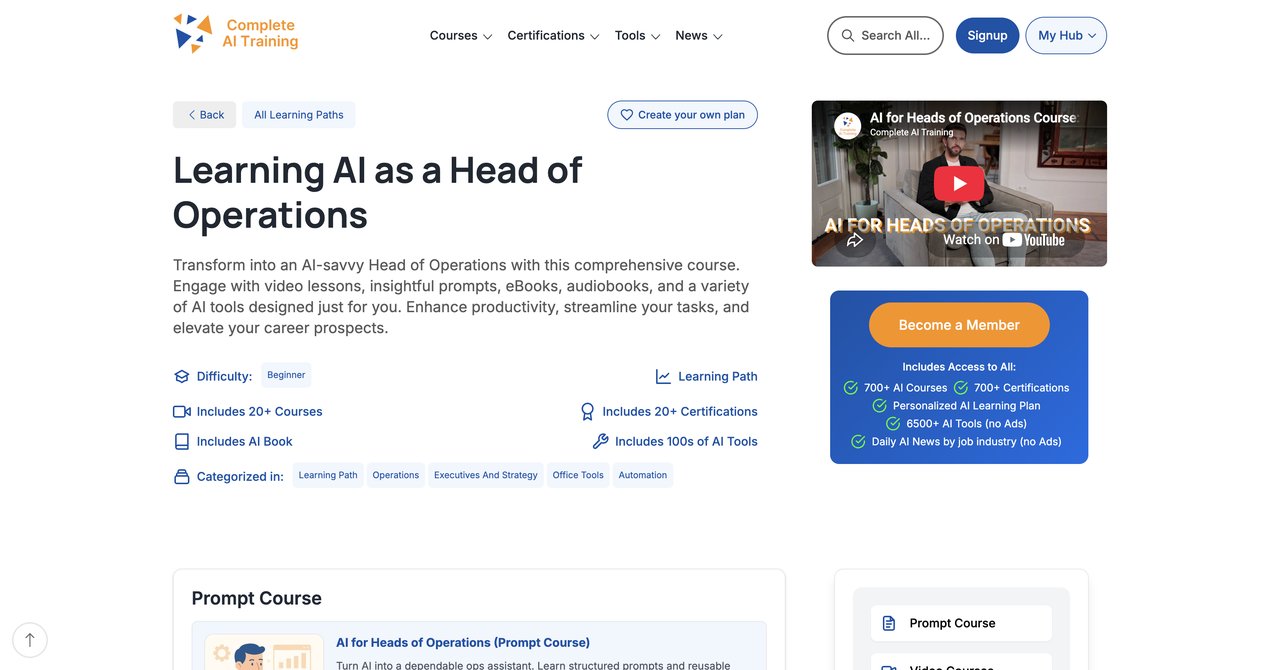
CompleteAI Training is not a single course. It's a subscription that unlocks every single video course and every single certification on the entire platform-hundreds of them, across every job role, not just this one for Heads of Operations. That's the fundamental difference between this and every other option on this list. You're not buying one thing; you're buying access to everything, and it's all included for one flat price.
So what does that actually mean in practice? For a Head of Operations, it means you're not boxed into one narrow track. Operations work touches on supply chain, customer experience, HR, finance, and a dozen other functions. If you need to understand AI in any of those areas, it's already included in your subscription. If you're eyeing a move to a COO role or a different industry, you've got access to all the training for those paths too, without paying extra. New courses and certifications are added continuously, and they're included automatically. There's no upsell, no "premium tier" for the good stuff. One flat subscription price covers all of it.
This matters because the alternative is paying per course elsewhere. You buy one course for $200, then another for $300, then a certification exam costs you another $150. Before you know it, you've spent $1,000 on a handful of courses when you could have had a subscription for a fraction of that. The platform also sends daily updates on the latest AI tools and curated industry news, which is genuinely useful for someone who doesn't have time to track every announcement from OpenAI, Anthropic, and Google.
The subscription is priced at $8.25 per month if you pay annually, or $29 month-to-month. That's a remarkably low bar for the amount of content you get access to. The catch-and it's a mild one-is that it's a subscription, so you're committing to continuous learning. AI is developing so quickly that this is arguably a feature rather than a bug. You'll want to keep coming back to stay current, and the subscription model encourages that.
There's a dedicated course specifically for Heads of Operations, but honestly, the biggest selling point isn't that single course. It's the breadth of the whole platform. If you want to compare this to the other options below, the value proposition is simple: everything they offer individually, you get as part of one subscription here.
Key topics covered:
- AI fundamentals and tool-specific training (ChatGPT, Claude, Gemini, and more)
- Operations-specific AI applications and process improvement
- Cross-functional AI use cases across every business role
- Certification preparation for multiple AI credentials
- Daily AI news and tool updates
Target audience and skill level:
This is suitable for everyone from beginners to advanced practitioners. Because the platform covers so many roles and skill levels, you can start where you are and progress at your own pace. It's particularly well-suited to Heads of Operations who need to understand AI across multiple business functions-not just the narrow scope of a single operations course.
Pros:
- Full access to ALL video courses on the platform, not a single course or a fixed bundle
- Full access to ALL certifications on the platform, included at no extra cost
- New courses and certifications are added continuously and included automatically
- Access to every other job role's material too-valuable for cross-functional work or career advancement
- One flat subscription price covers everything, versus paying per course elsewhere
- Daily updates on the latest AI tools and curated AI industry news
Cons:
- Subscription-based, so you need to stay engaged to get full value
- Continuous learning is required as AI develops continually
Who would benefit most:
Anyone who wants comprehensive, ongoing access to AI training without worrying about individual course costs. If you're the kind of person who likes to explore, learn across disciplines, and keep your skills current, this is the most cost-effective option available. It's also ideal for organizations that want to provide AI training for multiple team members without a complex procurement process.
Visit CompleteAI Training for Heads of Operations
Course 2: AI in Operations Management , Transforming Business Operations (Udemy)
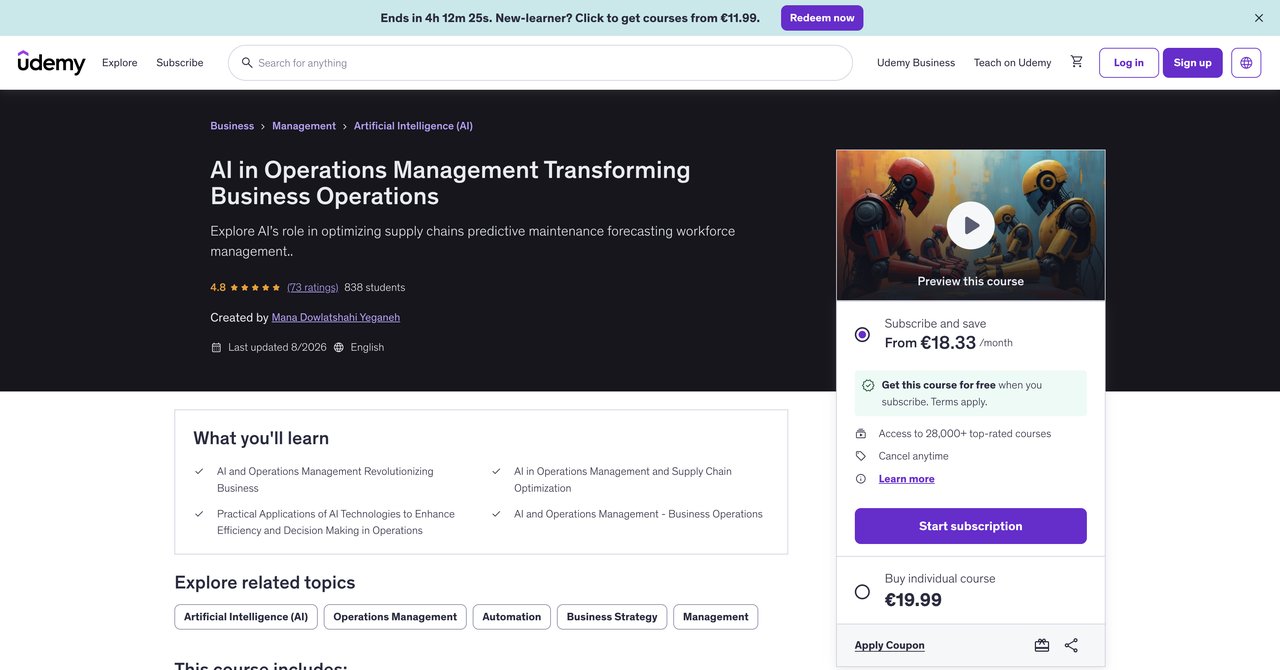
Udemy's offering in this space is a beginner-level course that covers the basics of how AI can streamline operational processes, improve decision-making, and drive business results. It's a broad overview rather than a deep dive, which makes it a reasonable starting point if you're new to AI and just want to understand the landscape before committing to something more substantial.
The course walks through practical applications of AI in operations, with a focus on process streamlining and decision support. It's the kind of content that gives you a solid foundation without overwhelming you with technical jargon. If you've been managing operations for years but haven't paid much attention to AI until now, this will bring you up to speed on the basics.
That said, the beginner-level framing means it's not going to challenge someone who's already implemented AI solutions. The content is fairly generic in places, and the "business success applications" section tends to stay at a high level rather than getting into the weeds of specific tools or workflows. It's a starting point, not a destination.
One thing to note: Udemy courses are sold individually or through the Udemy Personal Plan subscription. The pricing varies, and you'll often see discounts on Udemy courses, so the effective cost can be quite low. But you get what you pay for in terms of depth and support.
Key topics covered:
- AI fundamentals for operations
- Process streamlining with AI
- Decision-making enhancement
- Practical business applications
Target audience and skill level:
Beginners who need a foundational understanding of AI in operations. If you have no prior AI knowledge and want a low-cost introduction, this fits the bill.
Pros:
- Comprehensive coverage of AI for process streamlining
- Focuses on decision-making enhancement
- Practical business success applications
- Low cost, especially if you catch a Udemy sale
Cons:
- Beginner-level content may not challenge experienced ops leaders
- Rating not verifiable-Udemy reviews can be inconsistent
- No certification included in the base price
Who would benefit most:
Newcomers to AI who need a cheap, low-commitment introduction. If you're still figuring out whether AI is relevant to your operations role, this is a low-risk way to find out. If you already know you need serious training, you'll outgrow this quickly.
Visit AI in Operations Management on Udemy
Course 3: AI Wise for Operations Managers (AI Wise Training)
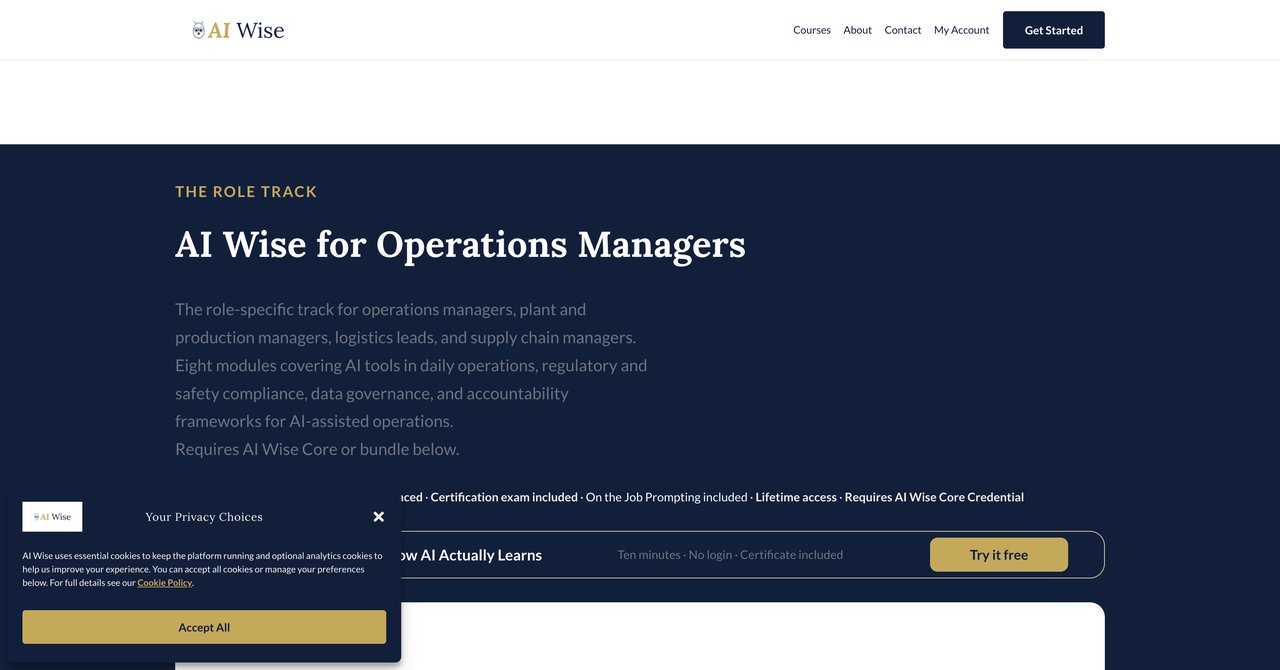
AI Wise Training offers a course specifically designed for operations, production, and logistics managers. It sits at an intermediate level, so it's not for complete beginners, but it also doesn't assume you've been building AI systems for years. The course includes "On the Job Prompting," which is a practical approach to using AI in your day-to-day work, plus coverage of regulatory compliance and data governance.
The regulatory and governance angle is a differentiator here. Most operations courses gloss over compliance issues, but AI Wise takes them seriously. If you work in a heavily regulated industry-healthcare, finance, manufacturing-this could be the most relevant course on the list for you. Understanding how AI fits within compliance frameworks is increasingly important, and few courses address it head-on.
The course also includes a certification exam, which is a nice addition if you need something to show your employer or put on your CV. However, there's a catch: the course requires AI Wise Core for full context. That means you're looking at a bundle purchase to get the complete experience, which pushes the cost up to $397 for the Core + track bundle. The track-only option is $297, but you'll be missing context that the course assumes you have.
The course is relatively short, which is both a pro and a con. It's efficient, but it doesn't go as deep as some of the more comprehensive options. If you need a focused, role-specific certification and you're already familiar with AI basics, this could be a good fit. If you're starting from zero, you'll need to factor in the Core course as well.
Key topics covered:
- On the Job Prompting for operations
- Regulatory compliance in AI
- Data governance
- Operations, production, and logistics applications
- Certification exam
Target audience and skill level:
Intermediate-level operations, production, and logistics managers who need a role-specific course with a certification. Prior AI knowledge is helpful, and the Core course is recommended for full context.
Pros:
- Role-specific for operations/production/logistics managers
- Includes On the Job Prompting
- Covers regulatory compliance and data governance
- Certification exam included
Cons:
- Requires AI Wise Core for full context-an additional cost
- Relatively short duration, so depth is limited
Who would benefit most:
Operations managers in regulated industries who need to understand AI compliance and governance. The certification is a tangible credential, and the role-specific focus means you're not wading through irrelevant content.
Visit AI Wise for Operations Managers
Course 4: AI for Operations Leaders (TESS Group)
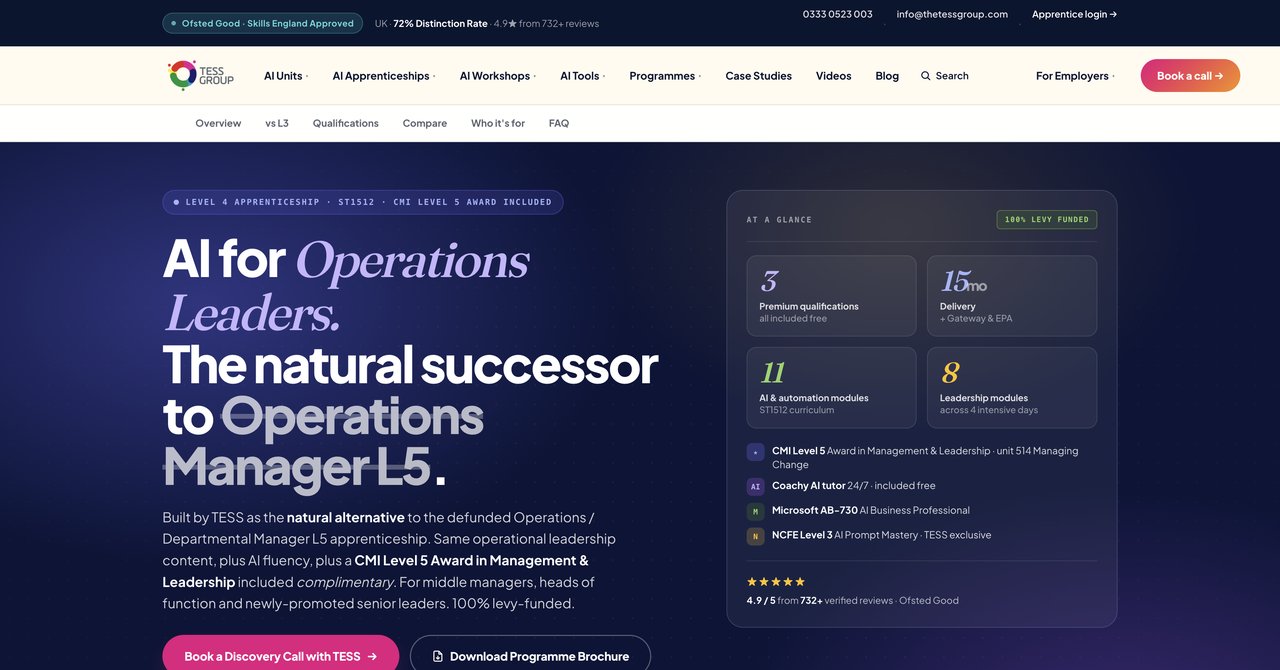
TESS Group runs a live online cohort-based program called AI for Operations Leaders. It's a Level 4 program that focuses on AI-driven automation and data intelligence, with a significant component on change management for digital transformation. The cohort format means you're learning alongside other operations leaders, which can be valuable for networking and peer learning.
The change management angle is worth calling out. AI implementation isn't just a technical challenge; it's a people challenge. Getting your team to adopt new tools and workflows is often harder than the technical work itself. TESS Group clearly understands this, and the program dedicates real time to managing that transition.
The program is delivered live across England, which is both a strength and a limitation. If you're in the UK, having a live instructor and cohort can be a fantastic experience. If you're elsewhere, you're out of luck. The price isn't publicly listed, so you'll need to contact the provider for a quote. That's typical for corporate-style training programs, but it makes it harder to compare costs with other options.
This is a solid choice for UK-based operations leaders who want a structured, interactive learning experience with a focus on organizational change. Just be prepared to reach out for pricing and to commit to a fixed schedule.
Key topics covered:
- AI-driven automation
- Data intelligence
- Change management for digital transformation
- Operations leadership applications
Target audience and skill level:
Operations leaders in the UK who want a live, cohort-based learning experience. The Level 4 designation suggests a professional standard, so some prior experience with AI or operations management is assumed.
Pros:
- Focuses on AI-driven automation and data intelligence
- Includes change management for digital transformation
- Delivered live across England-interactive and engaging
- Cohort format for peer learning
Cons:
- UK-focused delivery-not accessible internationally
- Price not publicly listed-requires contacting the provider
Who would benefit most:
UK-based operations leaders who value live instruction and peer interaction. If change management is a bigger challenge for you than the technical side of AI, this program addresses that gap directly.
Visit AI for Operations Leaders by TESS Group
Course 5: Certified AI Operations Manager (CAIOM) by The Case HQ
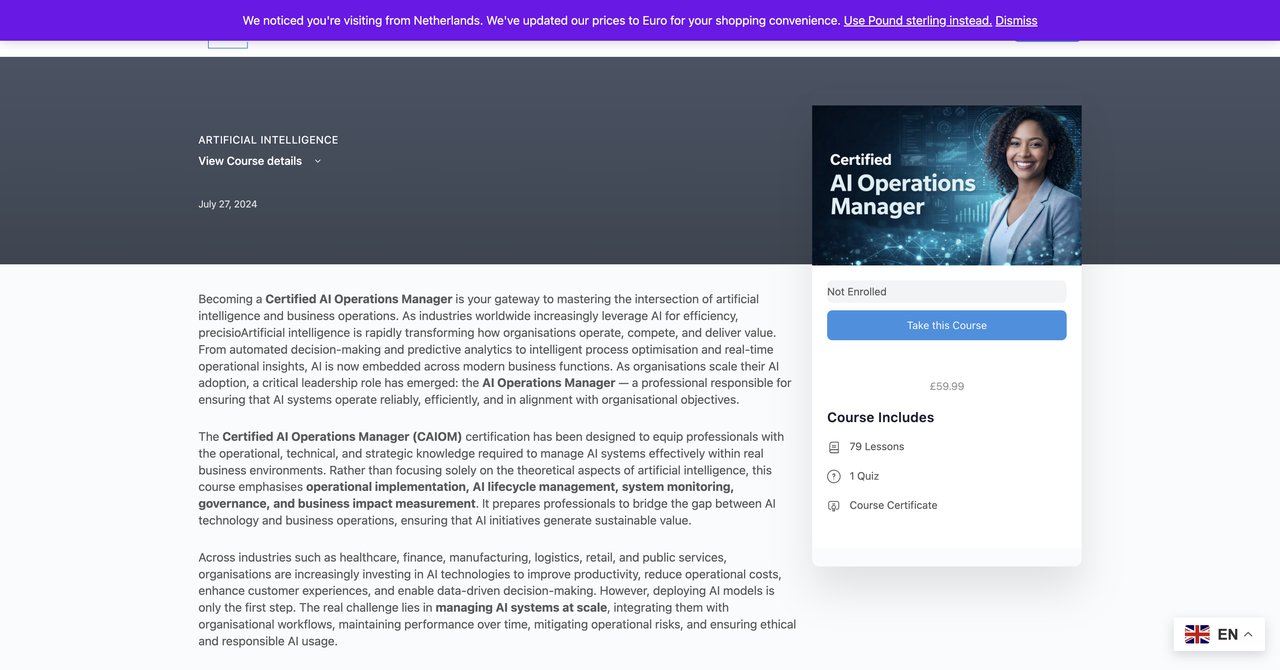
The Case HQ offers an advanced-level certification called the Certified AI Operations Manager (CAIOM). This one is designed for real business environments, which is a nice change from the more academic or theoretical courses on the market. It covers operational, technical, and strategic AI management, and it validates your ability to manage AI systems in practice.
The certification is structured around practical skills. You're not just learning concepts; you're demonstrating that you can apply them in real-world scenarios. That's a significant advantage if you're looking for a credential that carries weight with employers. The CAIOM designation could be a differentiator when you're competing for senior roles.
The downside is that the price and duration aren't publicly listed. You'll need to contact The Case HQ for details, which is a friction point if you're comparing options quickly. The advanced level also means it's not suitable for beginners. If you don't have prior AI experience or a strong operations background, you might struggle with the material.
For experienced operations leaders who want a serious certification and are willing to invest the time and money, CAIOM is worth considering. Just be prepared to go through a sales process to get the details.
Key topics covered:
- Operational AI management
- Technical AI management
- Strategic AI management
- Practical AI system management
- Certification validation
Target audience and skill level:
Advanced operations professionals who already have some AI experience and want a formal certification. Prior knowledge is definitely required.
Pros:
- Certification designed for real business environments
- Covers operational, technical, and strategic AI management
- Validates practical AI system management skills
- Strong credential for career advancement
Cons:
- Price and duration not publicly listed
- Advanced level may require prior experience
Who would benefit most:
Senior operations professionals who need a recognized certification to validate their AI skills. If you're eyeing a COO role or a move to a more strategic position, CAIOM could be the credential that sets you apart.
Visit Certified AI Operations Manager by The Case HQ
Course 6: AI Applications for Human-AI Teaming in Operations (Emory University Goizueta Business School)
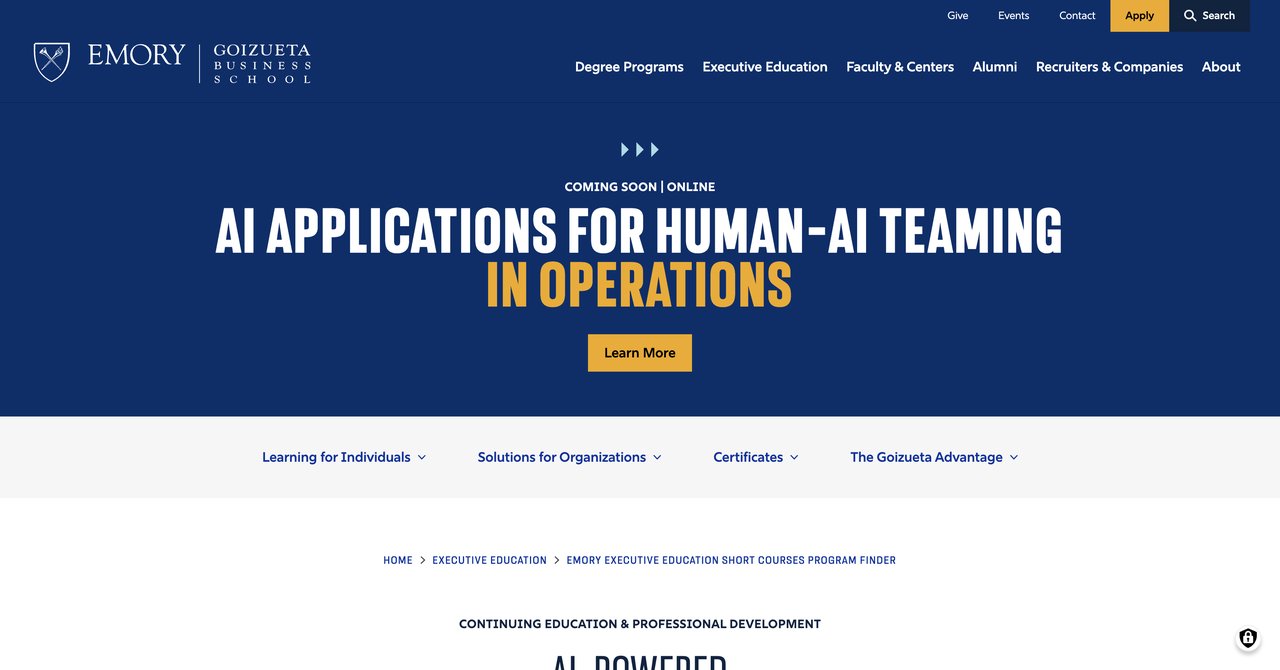
Emory University's Goizueta Business School offers an executive education course focused on redesigning operational workflows for effective human-AI collaboration. This is a different angle from most of the other courses on this list. Instead of just teaching you how to use AI tools, it explores how to structure work so that humans and AI systems work together effectively.
The course includes hands-on simulation and a design sprint, which means you're not just sitting through lectures. You're actively working through scenarios and designing solutions. That practical element is valuable, especially for operations leaders who need to think about workflow design rather than just tool adoption.
Being an executive education program from a top business school, the quality is high. The faculty bring academic rigor and real-world consulting experience to the table. The networking opportunities with other executives are also a plus-you're learning alongside people who face similar challenges.
The downsides are the short duration and the unlisted price. Executive education programs at top schools don't come cheap, so you should expect a significant investment. The short format means you're getting a concentrated experience rather than deep, ongoing training. It's more of a catalyst than a comprehensive education.
Key topics covered:
- Human-AI collaboration
- Operational workflow redesign
- Hands-on simulation
- Design sprint methodology
Target audience and skill level:
Executives and senior operations leaders who want a high-quality, intensive learning experience. Some AI knowledge is helpful but not strictly required, given the focus on workflow design rather than technical implementation.
Pros:
- Executive education from a top business school
- Hands-on simulation and design sprint
- Focuses on human-AI collaboration across operational workflows
- Networking opportunities with other executives
Cons:
- Short duration-concentrated but not comprehensive
- Price not publicly listed-likely expensive
Who would benefit most:
Senior leaders who are more concerned with organizational design than technical implementation. If your challenge is figuring out how to integrate AI into your team's workflow, this course gives you a structured framework for doing that.
Visit AI Applications for Human-AI Teaming at Emory Goizueta
Course 7: Claude for Customer Experience, Operations & Quality (Udemy)
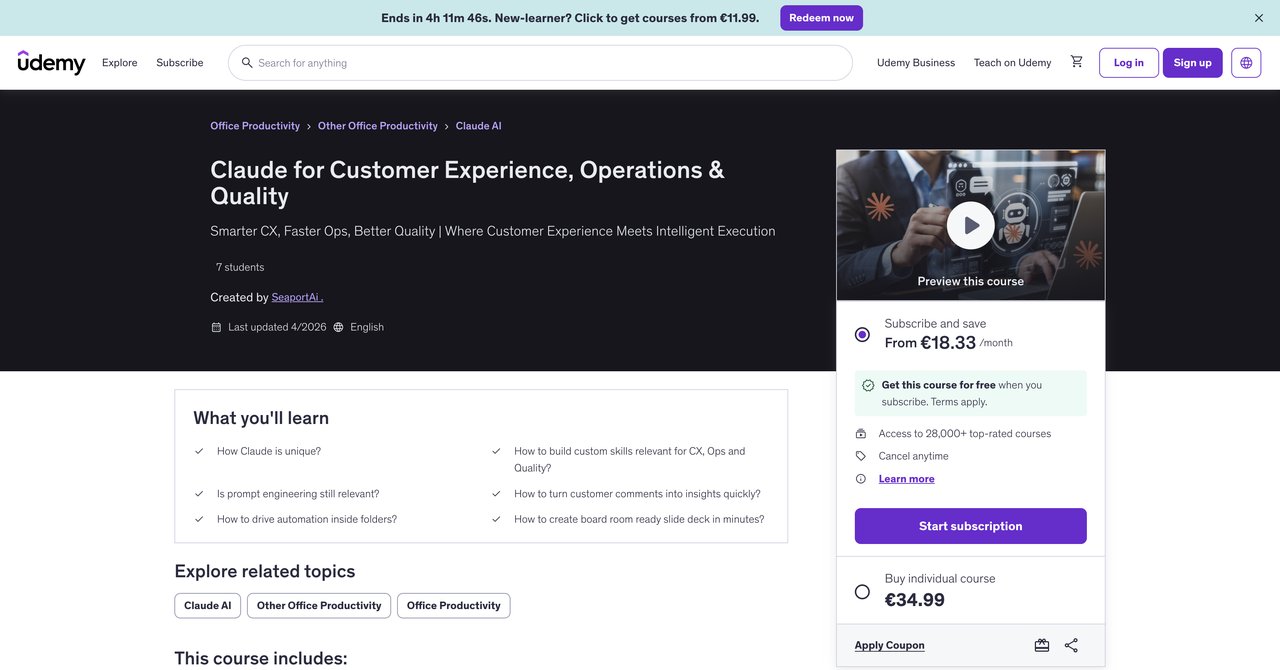
This Udemy course focuses specifically on using Claude AI-Anthropic's large language model-for operations, quality, and customer experience. It's an intermediate-level course that's particularly relevant for COOs and Heads of Operations who want practical, tool-specific training.
The focus on Claude specifically is both a strength and a limitation. On one hand, you get deep, practical training on a specific tool. You'll learn how to use Claude for quality assurance, customer experience management, and operational tasks. On the other hand, you're not learning transferable AI skills that apply across different platforms. If your organization uses ChatGPT, Gemini, or another tool, you'll need additional training.
The course is practical and hands-on, which is good for someone who wants to start using Claude immediately. The instructor focuses on real-world applications rather than theory. That said, the course is relatively short, so you're not getting an exhaustive treatment of Claude's capabilities or operations management in general.
Like other Udemy courses, this is available through the Udemy Personal Plan subscription or as an individual purchase. The pricing varies, but it's generally affordable compared to more comprehensive options.
Key topics covered:
- Claude AI for operations
- Quality assurance applications
- Customer experience management
- Practical tool usage
Target audience and skill level:
Intermediate-level operations professionals who want to master a specific tool. If your organization is already using Claude or planning to, this course is directly relevant.
Pros:
- Practical focus on Claude AI for operations and quality
- Relevant for COOs and Heads of Operations
- Covers customer experience and quality assurance
- Hands-on, tool-specific training
Cons:
- Narrow focus on Claude specifically-not transferable to other AI tools
- Shorter duration, so depth is limited
Who would benefit most:
Operations professionals who have already chosen Claude as their AI tool and need to get up to speed quickly. If you're still evaluating different AI platforms, this is premature.
Visit Claude for Customer Experience, Operations & Quality on Udemy
Course 8: Certified AI for Operations and Process Improvement Professional (CAIOPI) by Tonex Training
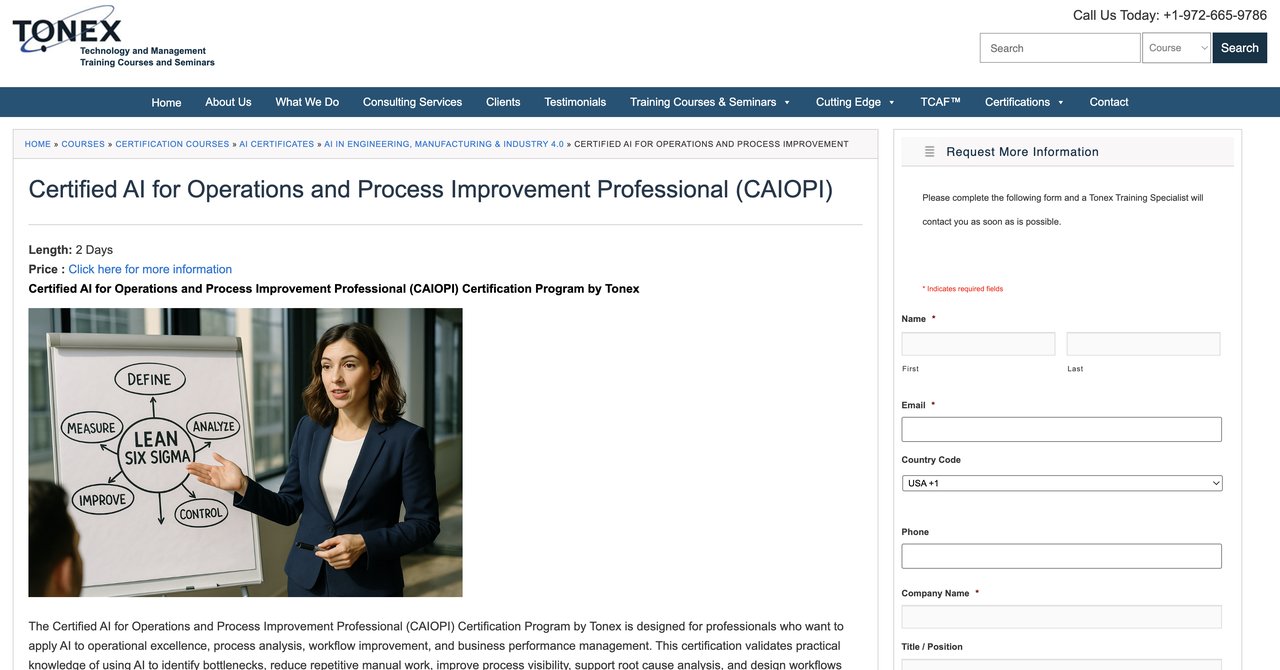
Tonex Training offers an advanced certification called the Certified AI for Operations and Process Improvement Professional (CAIOPI). This one validates practical AI knowledge specifically for operational excellence. It covers bottleneck identification, workflow improvement, intelligent automation, and root cause analysis.
The focus on process improvement is a strong differentiator. This isn't a general AI course; it's specifically about using AI to improve operational processes. If your primary goal is to identify inefficiencies and fix them, this certification is directly relevant. The root cause analysis component is particularly useful for operations leaders who need to dig into why processes fail.
The certification is advanced, which means it's not for beginners. You'll need a solid understanding of both operations management and AI fundamentals to get the most out of it. The price and duration aren't listed publicly, so you'll need to contact Tonex for details.
This is a good option for experienced operations professionals who want a certification that specifically validates their process improvement skills. It's a niche credential, but it's a valuable one if you work in continuous improvement or operational excellence roles.
Key topics covered:
- Bottleneck identification
- Workflow improvement
- Intelligent automation
- Root cause analysis
- Operational excellence
Target audience and skill level:
Advanced operations professionals who focus on process improvement and want a formal certification. Prior AI knowledge is required.
Pros:
- Validates practical AI knowledge for operational excellence
- Covers bottleneck identification, workflow improvement, and intelligent automation
- Includes root cause analysis
- Niche, relevant certification for process improvement roles
Cons:
- Price and duration not listed-requires contacting provider
- Advanced certification may be intensive
Who would benefit most:
Operations professionals in continuous improvement, Lean, Six Sigma, or operational excellence roles who want to add AI to their toolkit. The certification is a strong credential for these specific functions.
Visit CAIOPI by Tonex Training
Course 9: AI Automation Bootcamp for Operations Leaders (Maven / Linda Mutricy)
Linda Mutricy runs a hands-on, two-week bootcamp through Maven called AI Automation Bootcamp for Operations Leaders. This is a learn-by-doing experience where participants build AI-powered tools and autonomous AI agents. It's not about theory; it's about creating things that work.
The bootcamp format is intense but effective. Over two weeks, you'll go from understanding AI concepts to building actual tools that you can use in your operations role. The real-world case studies focus on data-intensive operations, which is where AI can have the most immediate impact.
The hands-on approach is the biggest selling point here. You're not just watching videos or reading case studies; you're building. That's a fundamentally different learning experience, and for many people, it's the most effective way to learn. The skills you develop in the bootcamp are directly applicable to your job the moment you finish.
The downsides are the price (not listed publicly) and the cohort-based format. Maven bootcamps typically run on a schedule, so you'll need to plan around the start dates. The limited availability means you might have to wait for the next cohort.
Key topics covered:
- Building AI-powered tools
- Creating autonomous AI agents
- Real-world case studies for data-intensive operations
- Hands-on implementation
Target audience and skill level:
Operations leaders who want to actually build AI tools, not just learn about them. Some technical comfort is helpful, but the bootcamp is designed for operators, not programmers.
Pros:
- Hands-on, learn-by-doing approach
- Build AI-powered tools and autonomous AI agents
- Real-world case studies for data-intensive operations
- Intensive, focused format
Cons:
- Price not listed-requires contacting Maven
- Cohort-based with limited availability-you may have to wait
Who would benefit most:
Operations leaders who learn best by doing and want to leave with tangible AI tools they've built themselves. If you're tired of theoretical courses and want to get your hands dirty, this is the one.
Visit AI Automation Bootcamp by Maven
Course 10: AI for Operations (MHCAI)
MHCAI offers an 8-hour workshop called AI for Operations. It covers AI as both an analysis tool and an automation platform, with a strong emphasis on no-code automation using tools like Make, Zapier, and Power Automate. There's also coverage of SOP creation and knowledge management.
The no-code automation focus is a practical differentiator. Most operations leaders aren't programmers, and they don't need to be. This workshop shows you how to use accessible tools to automate workflows without writing a line of code. That's immediately useful for streamlining operations.
The workshop also covers SOP creation and knowledge management, which are often overlooked in AI training. If you're responsible for documenting processes and ensuring your team has access to the right information, this is directly relevant.
The 8-hour format is efficient-you can complete it in a day or spread it over a couple of sessions. However, the workshop format means you'll need to schedule around the facilitator's availability. The price isn't listed publicly, so you'll need to contact MHCAI for details.
Key topics covered:
- AI as an analysis tool
- AI as an automation platform
- No-code automation with Make, Zapier, Power Automate
- SOP creation
- Knowledge management
Target audience and skill level:
Operations professionals who want practical, no-code automation skills. Suitable for beginners to intermediate users.
Pros:
- Covers AI as analysis tool and automation platform
- Includes no-code automation with Make, Zapier, Power Automate
- Focuses on SOP creation and knowledge management
- Efficient 8-hour format
Cons:
- Price not listed-requires contacting provider
- Facilitated workshop format may require scheduling
Who would benefit most:
Operations managers who want to start automating workflows without learning to code. If you're drowning in manual processes and need practical solutions fast, this workshop delivers.
Visit AI for Operations by MHCAI
Course 11: AI for Operations and Supply Chain (Cursuri AI)
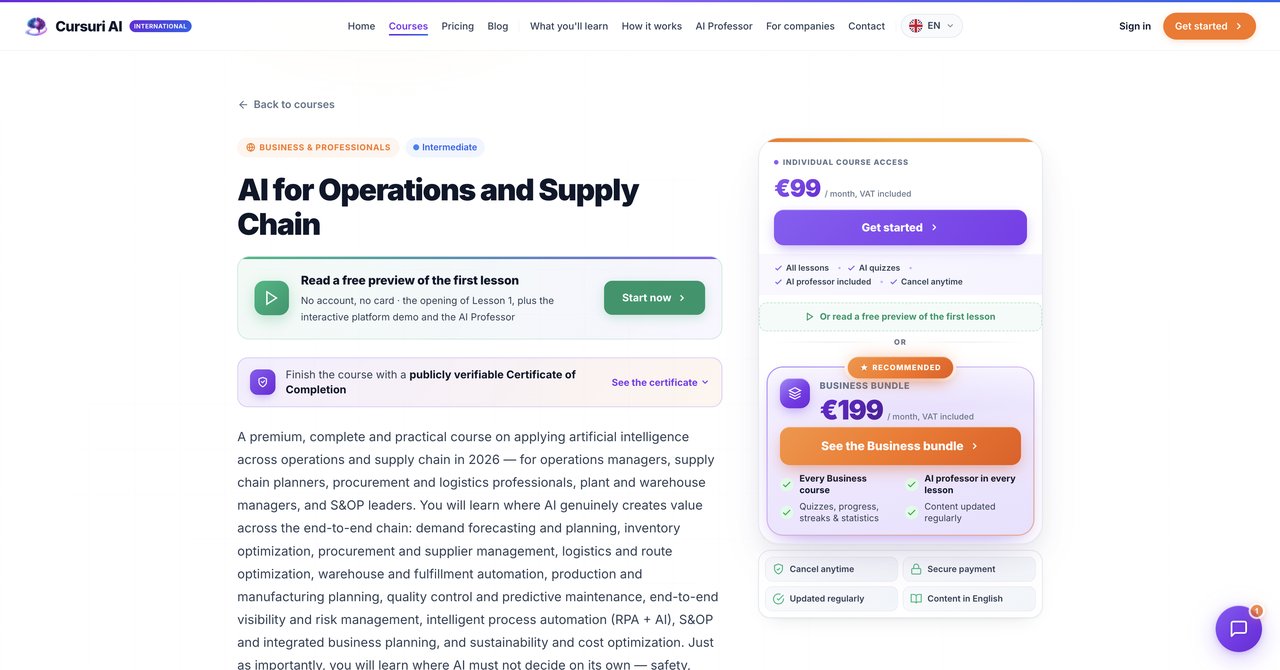
Cursuri AI offers a comprehensive end-to-end course covering AI for operations and supply chain. This one is broad in scope-it covers demand forecasting, inventory management, procurement, logistics, warehouse automation, predictive maintenance, RPA+AI, S&OP, integrated business planning, and cost optimization. If you want the full picture, this is it.
The course is particularly strong on the supply chain side. Demand forecasting and inventory management are covered in real depth, which is rare in general AI courses. If your operations role involves supply chain responsibilities, this course gives you the AI-specific knowledge you need to improve those processes.
The pricing is transparent, which is refreshing. It's $49 at the discounted rate or $199 at the regular price. That's a reasonable cost for the breadth of content covered. The provider also keeps the content up to date, which is important in this fast-moving field.
The main downside is that the provider is less well-known than some of the big names in AI training. You'll find limited reviews, and the platform may not have the polish of a Udemy or a university program. But if you're willing to look past that, the content quality is solid.
Key topics covered:
- Demand forecasting
- Inventory management
- Procurement
- Logistics
- Warehouse automation
- Predictive maintenance
- RPA+AI
- S&OP and integrated business planning
- Cost optimization
Target audience and skill level:
Operations and supply chain professionals at any level who want comprehensive AI training. The content is accessible to beginners but has enough depth for intermediate users.
Pros:
- Comprehensive end-to-end coverage of operations and supply chain AI
- Includes demand forecasting, inventory, procurement, logistics, and more
- Content kept up to date
- Transparent pricing
Cons:
- Provider less well-known-limited reviews
- Platform may have fewer features than larger competitors
Who would benefit most:
Operations professionals with supply chain responsibilities who want a comprehensive, affordable course. If you need to understand AI across the entire supply chain, this is the most complete option on the list.
Visit AI for Operations and Supply Chain by Cursuri AI
Overall Recommendations
So which course should you choose? The answer depends on your specific situation, but here are some clear recommendations based on different needs.
For comprehensive, ongoing access: CompleteAI Training is the standout option. The subscription model gives you access to hundreds of courses and certifications across every job role, not just operations. At $8.25 per month billed annually, it's the most cost-effective way to get broad AI training and stay current as the field evolves. If you want to learn across multiple functions or you're planning to move into a broader leadership role, this is the one. You're not limited to a single course or a fixed bundle-everything on the platform is included.
For a quick, cheap introduction: The Udemy course on AI in Operations Management is fine if you're a complete beginner and want to test the waters. It's low-cost and covers the basics without overwhelming you. Just be aware that you'll likely need more advanced training once you've got the fundamentals down. The Claude-specific Udemy course is also worth considering if you've already committed to that tool.
For a formal certification: The CAIOM from The Case HQ and the CAIOPI from Tonex Training are both solid credentials, but they're advanced and the pricing isn't transparent. The AI Wise certification is more affordable and includes compliance and governance content, which is valuable in regulated industries. If you need a recognized credential to advance your career, any of these will work, but be prepared to contact the providers for pricing details.
For hands-on builders: The Maven bootcamp with Linda Mutricy is the best option if you want to actually build AI tools and agents. It's intensive, practical, and you'll leave with working solutions. The MHCAI workshop is also good for no-code automation, particularly if you want to use Make, Zapier, or Power Automate.
For supply chain specialists: The Cursuri AI course is the most comprehensive option for supply chain and operations. It covers everything from demand forecasting to warehouse automation at a very reasonable price. The provider is less well-known, but the content is strong.
For UK-based leaders: TESS Group's live program is a solid choice if you're in the UK and want a cohort-based experience with a change management focus. The live instruction and peer learning are valuable, but the price is opaque and the delivery is geographically limited.
For executive-level strategic thinking: The Emory Goizueta program is the prestige option. It's from a top business school, and the focus on human-AI collaboration is unique. It's expensive and short, but the networking and academic rigor are hard to beat.
Ultimately, the best choice comes down to your goals, budget, and preferred learning style. If you want the most value for your money and the flexibility to learn across multiple areas, CompleteAI Training is hard to beat. If you need a specific certification or want to master a particular tool, one of the more specialized options might be a better fit. Take a look at what each course offers, think about where you want to be in a year, and choose accordingly.