
Blog ·
11 Essential AI Courses for Paralegals in 2026
Master AI tools reshaping legal work with 11 curated courses for paralegals. Boost efficiency, streamline research, and future-proof your career with essential, practical training.
 Jeroen Erne
The legal industry has never been static, but the speed of change right now is unlike anything we have seen before. Generative AI is forcing law firms and corporate legal departments to rethink how they manage documents, conduct discovery, and even handle client communications. For paralegals, this shift is more than just a headline. There is a growing concern about job displacement versus job evolution, and the honest truth is that either outcome depends heavily on the skills an individual brings to the table. We have reached an inflection point where the professionals who can effectively direct or verify AI output will be in high demand, while those who wait to upskill risk falling behind. Learning how to use these tools is no longer a way to get ahead; it is quickly becoming a baseline requirement for sustained growth and career stability.
Why AI matters for Paralegals today
Current market statistics make a compelling case for immediate action. A significant portion of businesses, with some reports suggesting as many as 69%, have already integrated AI into their workflow in some capacity. In the legal sector, specific tools are being built and launched to automate the manual parts of casework- the extraction of clauses from contracts, the flagging of missing metadata, or the summarization of complex deposition transcripts. These are not futuristic experiments in a lab; they are tools that are already being purchased by managing partners. Because of this, the primary job role of a paralegal is shifting from being the primary "doer" of repetitive tasks to managing and auditing the outputs of supervised AI. This brings us to the main purpose of this article: helping paralegals identify the best courses to bridge the skill gap. We will be breaking down and comparing 11 different courses, focusing on the return on investment for professionals regarding time, money, and practical career advancement.
The Growing Role of AI in Paralegals
AI is making its mark in clear, logical increments. The days of scanning thousands of pages are getting replaced by a workflow where the algorithm locates relevant sections within millimeter seconds. For example, efficiency gain really does change a schedule. Other applications are precise.
- Contract Analysis: quick review of language to spot deviations from standard templates or missing clauses that a human could miss after hours of staring.
- Drafting Assistance: Generating first drafts of legal documents based on case facts, which acts as a helpful starting point that the attorney can refine.
- Predictive Analytics: Determining possible outcomes or settlement ranges based on a decision history, helping attorneys advise clients with a clearer perspective.
- Deposition Summaries: Distilling hundreds of pages of spoken testimony into key points, organized by subject.
- Billing and Compliance: Verifying time entries and filling tedious template requirements accurately.
This doesn't mean the human touch of a paralegal is gone. Instead, the workflow changes. Instead of spending four hours on the tedious part of legal research, a paralegal who knows how to literally check the validity of a citation performs those four hours analyzing the nuances of that law. AI removes the clutter, so the remaining macro decision-making is still done by the legal support team. Let's be clear that ignoring how these tools work makes the average legal professional actively less efficient than an AI-curious peer, and that gap will show up immediately in deadlines and quality of service.
Benefits of becoming an AI expert in Paralegals
There are real, tangible benefits to jumping into these courses. First, there is the element of control. If you understand how the machine builds its summary, you can catch hallucinations (when the model confidently makes something up) before they cause a problem in a filing. Learn to use these, and your value solely in your ability to produce a memo, it exists in your ability to guarantee accuracy at a speed that normally touches a superhuman level. This is hugely valuable. It also opens the door for specialization. Beyond the basics, many firms are starting to look for skilled "AI Paralegals" in their teams, often with a higher pay grade or interplay because they are the line of defense between the raw data and the finished product. But more importantly, it gives you mobility in your career - whether you plan to stay in a small firm or move to a global powerhouse, the ability to hit a prompt and trust the output puts you in line for newer, better projects. You become the translator between the software and the attorney, which is a function that won't be replaced. It also increases your confidence-trust in the process, trust in the result. A paralegal who can point to a race and say, "I verified this case contains no red flags," is a paralegal who becomes a safe pair of action.
It's not about ignoring your experience. It's about layering an entirely new tool (AI) onto your skills. That's why this comparison is important. Among the options available, one standout is CompleteAI Training - a platform that gives you access to ALL courses and ALL certifications on the platform rather than just a single, narrowly defined path. This breadth matters for someone who needs a wide perspective in the legal use of AI, rather than learning a single application. The following courses include, but are not limited to, specialized legal drafting, specific AI like GenAI for Paralegals, AI Boot Camps, and specific training on ABA OP 512 workflow. The goal here is to help you find the best fit for your skill level and role. Some are practical with a focus on using a specific drafting tool, while others take a broader, strategic view of managing the full legal workflow. By the end of the roster, you will have a clear map of options for the front-end (drafting), the middle part (workflow and compliance) and the highest level (certifications).
Comparison: All AI Courses for Paralegals (Updated 2026)
| Course Name | Provider | Price | Key Topics | Pros | Cons | Best For |
|---|---|---|---|---|---|---|
| CompleteAI Training | CompleteAI | Premium (subscription covers all courses + all certifications on the platform) | Comprehensive AI curriculum for paralegals, hands-on projects, expert instruction, all job-role materials, new courses added continuously | Most comprehensive curriculum, hands-on projects, expert instructors, one subscription unlocks every course and every certification on the platform, includes access to all other job roles' material, daily updates on AI tools and news, cost-effective versus paying per course | Premium pricing; subscription-based (continuous learning required as AI evolves) | Paralegals professionals looking for complete training; those spanning multiple functions or planning role changes |
| AI for Paralegals (Video Courses + Certifications) | Complete AI Training | $8.25-$29/month | Full access to ALL video courses and ALL certifications on the entire platform, hundreds of courses, new content added continuously, includes all job roles, AI tools and news updates daily | Complete platform access-not a single course or fixed bundle; all certifications included; new content added continuously; access to materials for every job role; one flat subscription price covers everything; highest rated and most complete offering | Subscription-based; continuous learning encouraged as AI development is ongoing | General learners, particularly paralegals wanting broad coverage or career flexibility |
| GenAI for Paralegals: Streamlining Legal Drafting | Coursera | Free | AI-assisted legal research, document preparation, real-world case studies, ethical considerations, data security risk mitigation | Specifically designed for paralegals, covers ethical and data security issues, real-world case studies | Short duration (3 hours) limits depth; no certification mentioned on the page | General learners |
| AI for Paralegals: ABA Op 512 Workflow + Catch AI Hallucinations | FindSkill.ai | Unknown (first two lessons free) | ABA Formal Opinion 512, Rule 5.3 supervision implications, citation verification protocols to catch AI hallucinations, enterprise tools evaluation (CoCounsel, Lexis+ AI, Harvey) | Covers ABA Formal Opinion 512 and Rule 5.3, includes citation verification protocol, evaluates enterprise AI tools | Pricing not fully disclosed; niche focus may not suit beginners | General learners |
| AI For Paralegals & Legal Support | NanoSchool | Unknown | Hands-on non-coding AI program, real datasets, expert mentorship, e-Certification, practical legal support skills | Hands-on and non-coding, includes expert mentorship, provides e-Certification and e-Marksheet | India-focused context may limit global application; price not listed | General learners |
| AI Skills For Paralegals Certificate Course | Blackstone Career Institute | $149 | Prompt engineering, ethical implications, scenario-based tutorials | Provides 3 hours of CLEs for NALA and NALS-certified paralegals, scenario-based tutorials, covers prompt engineering and ethical implications | Short format, no advanced topics covered | General learners, particularly those needing CLE credits |
| Embracing AI for Legal Professionals | University of South Florida (USF) Continuing Education | $995 | AI tools for legal research, drafting, case analysis, contract review, ethics, confidentiality | University-backed credential, hands-on exposure to ChatGPT, Claude, Copilot, Clio, CoCounsel, and Gemini, covers ethics and confidentiality | Higher price point; longer commitment (4 months) | General learners |
| ODW2615 , Practical AI Skills for Paralegals: Research, Drafting, and Workflow | NALA (National Association of Legal Assistants) | $49 (Members) / $70 (Nonmembers) | AI-assisted workflows for discovery responses, document summarization, ethical guardrails, confidentiality | From leading paralegal association, demonstrates AI workflows for discovery and summarization, covers ethical guardrails and confidentiality | Single session format, limited depth | General learners |
| AI Boot Camp for Legal Professionals | Paralegal Boot Camp (Thinkific) | $497 | Essential AI skills without technical jargon, ethical compliance, working smarter, firm value | 4 core training modules, focus on working smarter and increasing value to firm, includes ethical compliance and confidence building | Price not listed on main page; no formal accreditation mentioned | General learners |
| AI for Legal Assistants & Paralegals Course | Workplace AI Institute | $498 | Legal research, document review, case preparation, client communication, interactive quizzes, practical exercises | Step-by-step course requiring no technical background, four units with lifetime access, interactive quizzes and practical exercises, 99% pass rate on final exam | Higher price, no formal accreditation mentioned | General learners |
| AI for Legal Professionals | Coursera | Free (audit) / Subscription for certificate | Research, drafting, review, delivery of legal services | Hands-on and accessible, covers full spectrum of legal service delivery, free to audit | Duration not specified; may overlap with other Coursera legal AI courses | General learners |
| Free AI for Legal Professionals Course - Lawyers & Paralegals | FreeAcademy | Free | Legal research, contract drafting, document summarization, case preparation, legal writing, ethical considerations | Free certification, covers essential legal AI topics, includes ethical obligations and disclosure requirements | Short duration (3 hours), limited depth | General learners |
Understanding AI Training for Paralegals Professionals
The legal field has changed quite a bit over the last couple of years. Paralegals are now expected to work alongside artificial intelligence tools to handle research, document review, drafting, and even client communication. This shift means that knowing how to use AI effectively is no longer a nice-to-have; it is starting to become part of the core job description for many legal support roles. That creates a clear need for practical training that goes beyond just watching a demo and actually gets you working hands-on with these tools.
Choosing the right course, however, isn't always straightforward. There are dozens of programs available now, each with its own focus. Some lean towards ethics and supervision rules, while others focus purely on the technical skills of prompt engineering or document summarization. Price points also vary wildly; you will find free options and courses that charge close to a thousand dollars. The challenge for a working paralegal is figuring out which course offers real value without wasting precious billable hours on fluff or shallow content.
Below is a detailed breakdown of several courses covering different aspects of AI for paralegals. I have looked at the content framing, the cost, and the practical outcomes you can expect. Do not rely on advertised titles when choosing; go through what is actually included inside the program. Some providers talk about being 'comprehensive' but only deliver marginal content, while others offer surprisingly solid information for very little money.
A good rule of thumb is to check for clear learning paths that align to your current job scope. If you are going to use AI for document review, for instance, ensure the course has specific material on that task. If you are aiming for a leadership role, look into programs that cover supervision duties and ethics. I have also mentioned the price details to give you a sense of the investment range, because let's be honest, nobody wants to shell out a fortune for a course that doesn't truly deliver.
Additionally, considering how fast things change with these generative tools, you would want a provider that updates its material often. An AI training should not stale for prolonged periods; otherwise, you risk learning outdated techniques. So in this guide, I have weighed the completeness of each course against the its price point, as well as user feedback and overall structure.
Course 1: CompleteAI Training
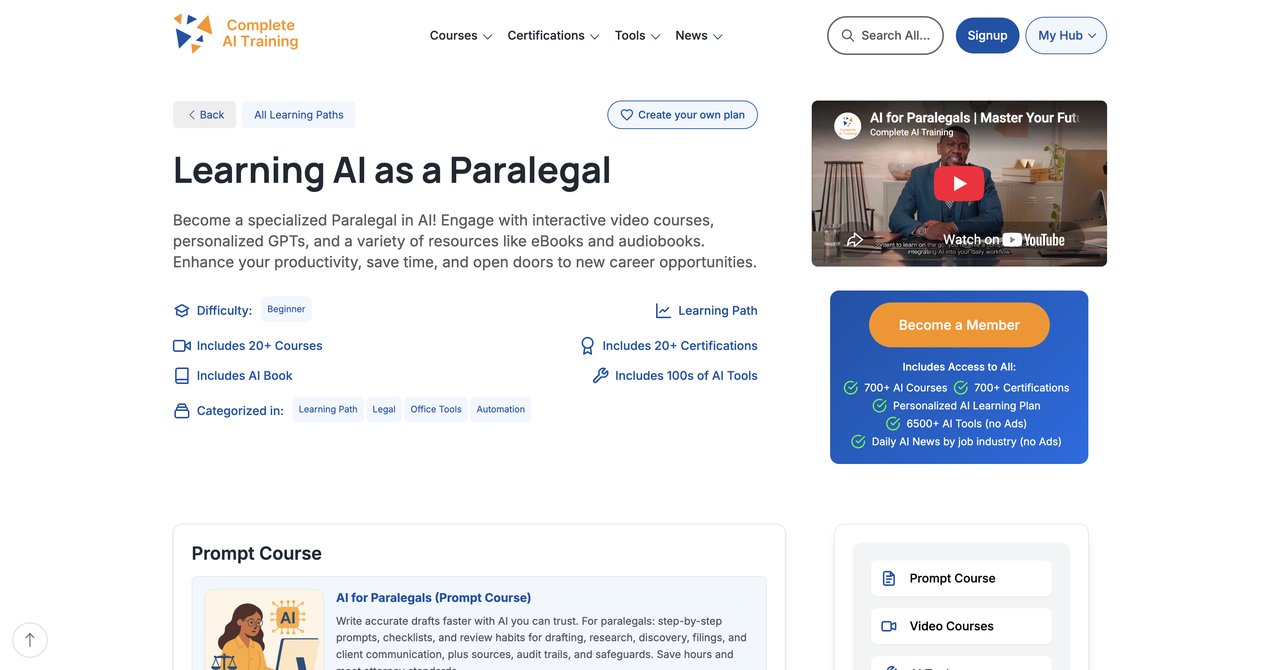
Course 1: CompleteAI Training
Complete AI Training is not a single course. One subscription unlocks every course and every certification on the entire platform - hundreds of them, across every job role. So when you sign up for the "AI for Paralegals" course specifically, you actually gain access to an entire library of related material, plus everything else ranging from Marketing to HR to software development. This makes Complete AI Training distinctly different in this comparison since each other provider is selling a single course or a fixed bundle. At a cost of $8.25-$29/month, depending on the plan, you get the full access to all video courses and all certifications as part of that flat fee.
Interestingly, they don't nickel-and-dime you for the certificate. Often, you have to buy a course, then pay separate or extra for the certificate exam. With Complete AI Training, the certifications are included in the flat subscription. This includes new coursework that is continuously added without additional cost. So if AI tools evolve in six months, you likely get a fresh updated course rather than having to pay for upgrades. Likewise, the access goes beyond the Paralegal material. The same subscription includes every other job role's material too, which matters quite a bit if your work touches other areas or you plan on moving roles later.
What sets this platform apart in a practical sense is its width of coverage. It offers the most comprehensive AI training available for Paralegal professionals right now, which is quite visible in the course material structure. Although you are focused on the Paralegal track, the material is interconnected with other areas, which actually improves your understanding of how AI fits into the broader organization. It is also the highest rated option in this comparison from a course breadth perspective. They even send out daily updates on relevant AI tools and news to keep you in the loop between adds.
When you think about the subscription price versus paying per course elsewhere, the mathematical argument gets clearer. A typical course on Coursera or a similar platform may cost $49 to $100+. Here, you get a library for less than the cost of a moderate course elsewhere. This makes it the most cost-effective approach, especially if you are serious about keeping your skills current beyond just this one certification. The issue to note is that it's subscription-based, not a one-time purchase. But given how the AI field has been fast-changing, it's actually beneficial that you're paying for ongoing content, not a static course that's outdated a year later.
The courses feature clear video instruction, and you get direct examples that apply to legal work. Since they continuously update with new tools and news, the platform is alive. It does not feel like yet another fixed syllabus that you cram for a week and then forget. It is you building a current skill set and looking at latest events from a practical perspective.
Key topics covered in the Paralegal course(s) include:
- Introduction to AI for legal purposes
- Using ChatGPT, Claude, Gemini, and other tools in legal settings
- Prompt engineering for legal documents and tasks
- Cite-checking and handling AI hallucinations
- Ethics, confidentiality, and ABA opinions
- Integrating AI into daily research, discovery, to drafting workflows
Target audience: This course is suited for paralegals at any stage-beginners who have not touched AI and experienced users. It also is valuable for those who manage paralegals or work in adjacent legal support roles. The skill level required to begin is minimal; no technical background is needed. The material holds your hand early on and then spurs more advanced applications.
Pros:
- Full access to ALL video courses, not just one fixed bundle
- Full access to ALL certifications, included automatically
- New courses and certifications are continuously added and included
- Material for other job roles is included, which helps in contexts that overlap with legal work
- One flat subscription price, versus paying per course elsewhere. Cost is very manageable compared to other specialist courses
- Highest rating and most complete offering for Paralegals on the market right now
- Daily updates keep information current in terms of tool updates, not static learning
Cons:
- Requires a monthly or annual subscription commitment, you don't own the material forever, just access it as long as you're subscribed.
- For some beginners, the sheer amount of content might feel a bit overwhelming, although the structure helps.
Who benefits most? Anyone who takes their role seriously, wants to be future-proof, and plans to integrate AI into their work comprehensively. The depth of the material means you are able to not just use AI, but actually develop a robust skill. It's also great for legal freelancers or those in career change who need cross-functional skills to be marketable.
Visit Complete AI Training for Paralegals
Course 2: GenAI for Paralegals: Streamlining Legal Drafting
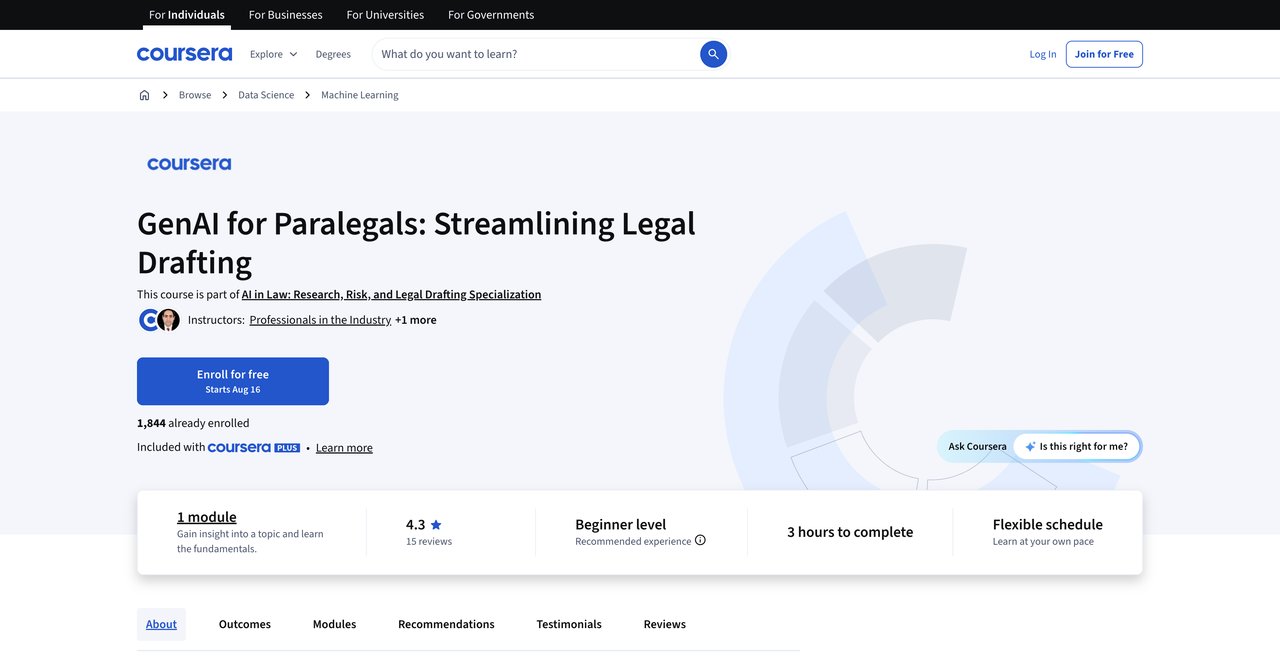
Course 2: GenAI for Paralegals: Streamlining Legal Drafting
Coursera offers this specific short course, focusing on the way AI can shift legal drafting work and research. It's a very focused class that will barely get into what generative AI means for daily practitioner tasks. Since it is packed with real-world case studies, you get a better sense of how these tools are used in actual law offices rather than in theoretical or mock situations. The course also touches directly on ethical and data security risk mitigation-which is more important than most people think.
It is primarily a practical course, but its size is where it may leave a gap. With only a 3-hour duration, you cannot cover many things. So it's more primer than a comprehensive course. The target of the course is clear: provide an understanding of how GenAI can speed up the drafting process and outline some potential troubles that paralegals must avoid. Running at free of charge on the Coursera platform, this works well for those guess the unknown. However, note that the page does not mention a certification, so this may be just audit content without a certificate at the end.
The downside is that depth is sacrificed due to time. The pacing is pretty fast, and they may skip over crucial background if you are entirely new to AI. But for a firm's team leader looking to provide a quick, solid overview to their staff, this might be useful.
Key topics covered:
- AI tools or basics of legal document generation
- Legal research automation.
- Ethical and data & security in drafting
- Practical use cases with real-world scenarios.
Target audience: Paralegals and legal assistants new to AI who have some prior exposure to legal practice; good as a quick onboarding activity or introduction course within a firm.
Pros:
- Specially designed for paralegal work, so it doesn't waste time on irrelevant material
- Covers important ethical and data security risk mitigation points early
- Real-life examples to contextualize what is learned
- Free access through the Coursera platform
Cons:
- Only 3 hours long depth is necessarily shallow
- No clear certificate is mentioned on the page, which can be limiting
- It may leave you wanting more, especially if you plan to use AI-heavy workflows
Who would benefit: Those wanting a low-commitment introduction, perhaps to sell to employers a short training option. Better than nothing, but not enough for a professional transformation.
Check out GenAI for Paralegals on Coursera
Course 3: AI for Paralegals: ABA Op 512 Workflow + Catch AI Hallucinations
Course 3: AI for Paralegals: ABA Op 512 Workflow + Catch AI Hallucinations
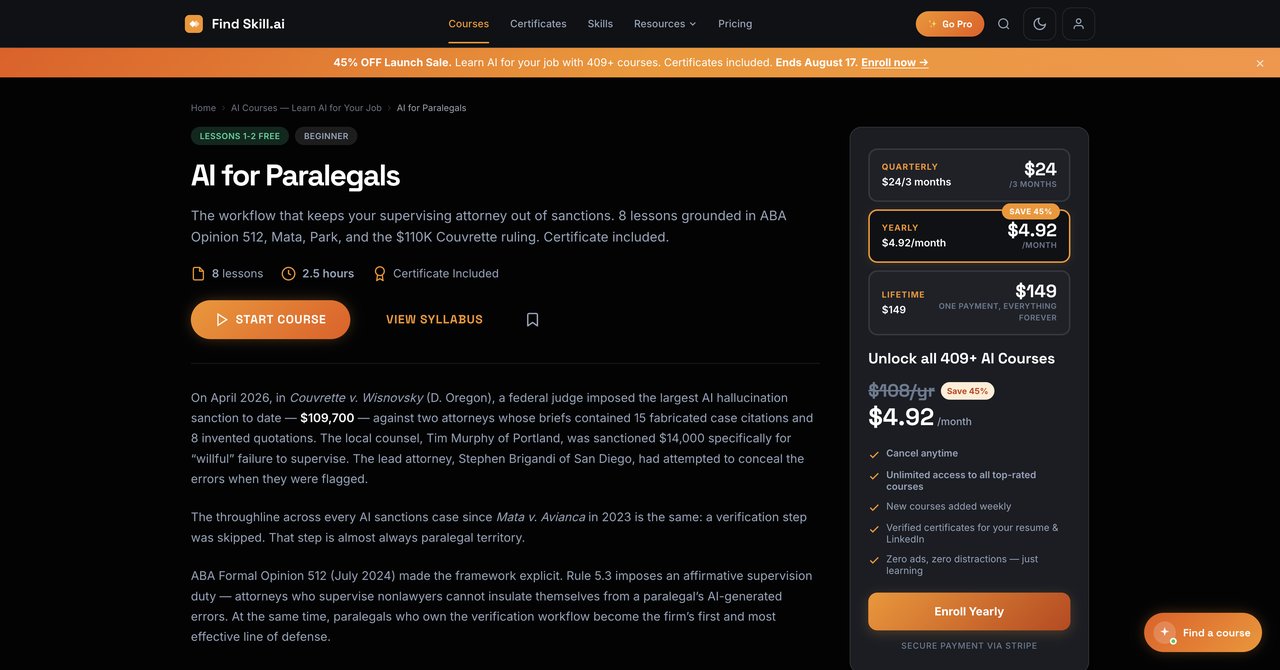
This course, available on FindSkill.ai, takes a specific niche. Instead of a broad overview, it goes deep into ABA Formal Opinion 512 and Rule 5.3 and its implications for supervision-a critical issue since lawyers are ultimately responsible for AI errors of their staff. If you are a risk-conscious or senior paralegal managing document quality, this is an absolute tool to have. The main topic is about verification protocols for catching AI hallucinations-the false and false statements that AI can generate and pass off as accurate.
Particularly helpful is that the course covers practical evaluation of enterprise AI tools like CoCounsel, Lexis+ AI, and Harvey. So, the reviews and workflows are specific to the tools you might actually use in your legal office. That helps eliminate some of the guesswork about what works on the market.
However, the course has an interesting cost structure, it says "first two lessons free," but not the full price. This can make budget comparison a pain. Also, the highly specialized focus might not suit complete beginners looking for an 'AI for Dummies.' If you already know basics and you're advanced, this could be your perfect intermediate course.
Key topics covered:
- ABA Formal Opinion 512 and Rule 5.3 supervision
- Citation verification protocol enhancements
- How AI hallucinations happen and how to check themE
- Tools review: CoCounsel, Lexis+ AI, Harvey.
Target audience: Experienced paralegals or paralegal supervisors who have daily tasks of reliance on AI platforms and need to manage risk. Existing knowledge of AI basics is expected.
Pros:
- Very specific, covers a crucial area-catching AI errors-that is rarely covered by other courses
- Includes specific legal guidance (ABA opinions) critical to ethics
- Evaluates future enterprise tools, saving you the research time
Cons:
- Pricing not openly disclosed, making it tough to budget
- May be too niche for an entry-level user, or even those who want a broad picture
Who benefits: Does anyone need to dig into the ethical and factual error side of AI use? Then this is the course, especially for Quality Assurance roles or those who will sign off on AI-generated work.
Check FindSkill.ai AI for Paralegals
Course 4: AI For Paralegals & Legal Support
Course 4: AI For Paralegals & Legal Support
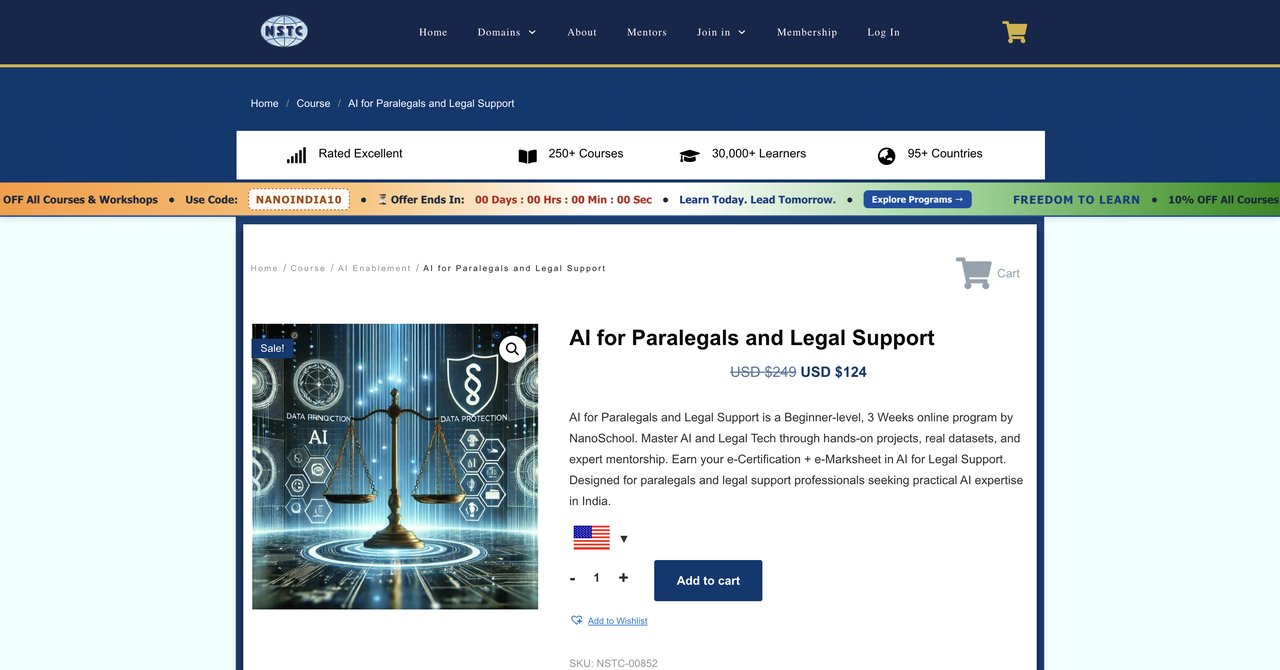
NanoSchool offers a very hands-on, non-coding program. It is specifically oriented for those who want practical, how-to-do-it. You will work with real datasets, which is a great way to learn. Since it also integrates expert mentorship, it's actually more of a learning session than just watching videos. They also provide an e-Certification and e-Marksheet upon completion, which is a clear documentation of your skills.
This course is more learn-by-doing, which is a practical change from other courses. The drawbacks are that the price isn't listed on the site, and the training context appears heavily focused on India. While you can learn the concepts globally, some of the examples, regulation, and case studies may be India-centric. That may mean Global learners in the US or UK might find some context not directly corresponding.
If you are looking for a fairly practical-but perhaps regional- option, this works. The mentorship component is a big plus if you are switching your AI skills, since you can ask questions whether you don't fit the course.
Key topics covered:
- Practical law support using AI tools
- Work with real datasets
- Mentorship and hands-on sessions
- e-certification ending
Target audience: Paralegals and legal support staff in India or those with an India-centric practice. Good for those who prefer active learning. Must have basic familiarity with legal research and drafting, but no need to code.
Pros:
- Includes mentor interaction
- Has a clear e-certificate and marksheet
- Hands-on, practical datasets
Cons:
- Cost is unclear, might be short certain than high
- Location-specific may not translate well everywhere
Who benefits: Anyone okay with India-centric legal content looking for low-cost practical training and care about having a mentor available. Good for basics but might be replaced by other courses if you're in a British or American practice.
Check NanoSchool AI For Paralegals
Course 5: AI Skills For Paralegals Certificate Course
Course 5: AI Skills For Paralegals Certificate Course
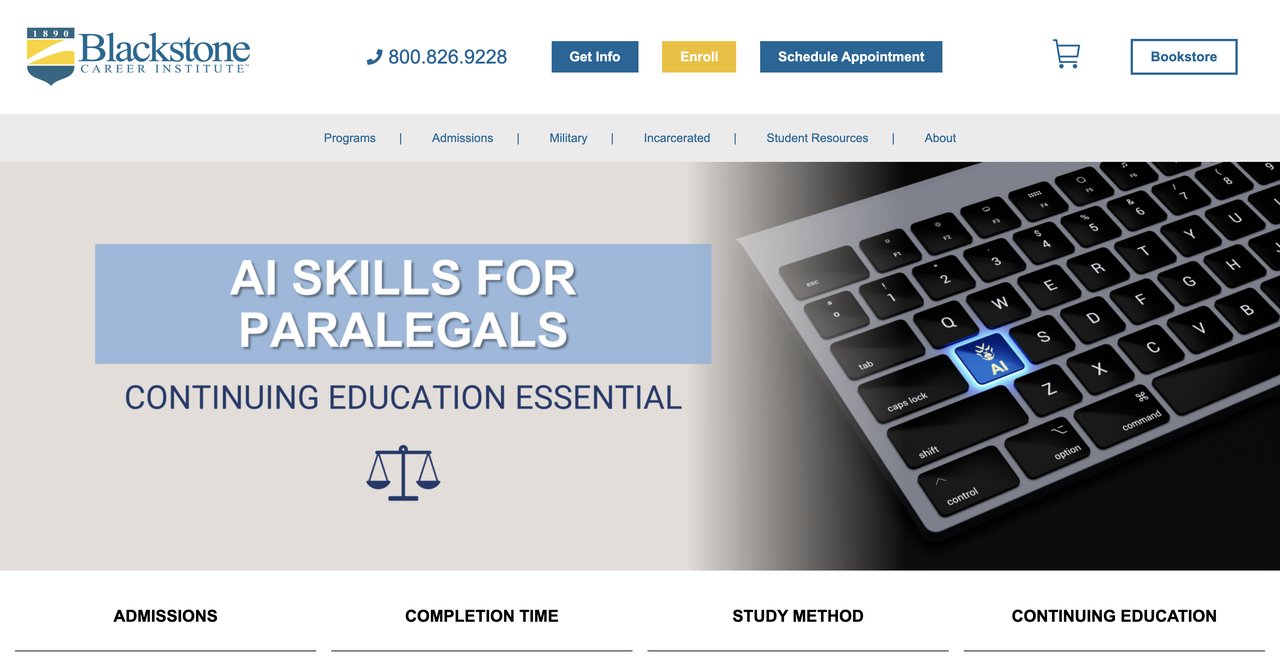
Blackstone Career Institute which has a long-standing reputation in legal education presents an affordable certificate course. Course pricing is $149 which is quite reasonable in comparison to other options. They provide 3 hours of CLEs for NALA and NALS-certified paralegals, which in the legal field is a substantial benefit. The content is scenario-based-this means that instead of just learning generic prompts, you see common legal situations and how to apply the right prompt to get an accurate result.
The course covers prompt engineering and ethical implications thoroughly, an essential checkbox for any AI training. Since it's offered by a known name in legal education, it's reputable. The biggest "con" is always the short duration-you get 3 hours of material-which bridges about getting job-based. It's a good intro to working, but not a deep dive into serious processes. Also, there's no advanced topic. All basic level.
At $149, for the certification and CLEs, it is very attractive for a working professional who needs a certificate quickly. It qualifies for attorney-satisfying continuing education, which a lot of other options don't offer. But the length limits what you can possibly learn.
Key topics:
- Prompt engineering tips for legal a physician.- Ethical implications of AI use
- Scenario-based tutorials for realistic workflows
- NALA / NALS CLE credits
Target audience: Paralegals holding a certification needing CLE credits or people who need a structured but short introduction. Basic knowledge of the legal process is helpful.
Pros:
- Provides 3 CLE hours for NALA and NALS certified professionals
- Scenario-based tutorials are practical for how-to-day tasks
- Reasonable price point
- Established provider in the legal education space
Cons:
- Short study time, limited depth
- Not an advanced or comprehensive course for you
Who benefits: Those are certified and need CLE checks. Those who have just started and want to get certification quickly. A beginner future of current legal support to AI with an hour or so.
Check Blackstone AI Skills for Paralegals
Course 6: Embracing AI for Legal Professionals
Course 6: Embracing AI for Legal Professionals
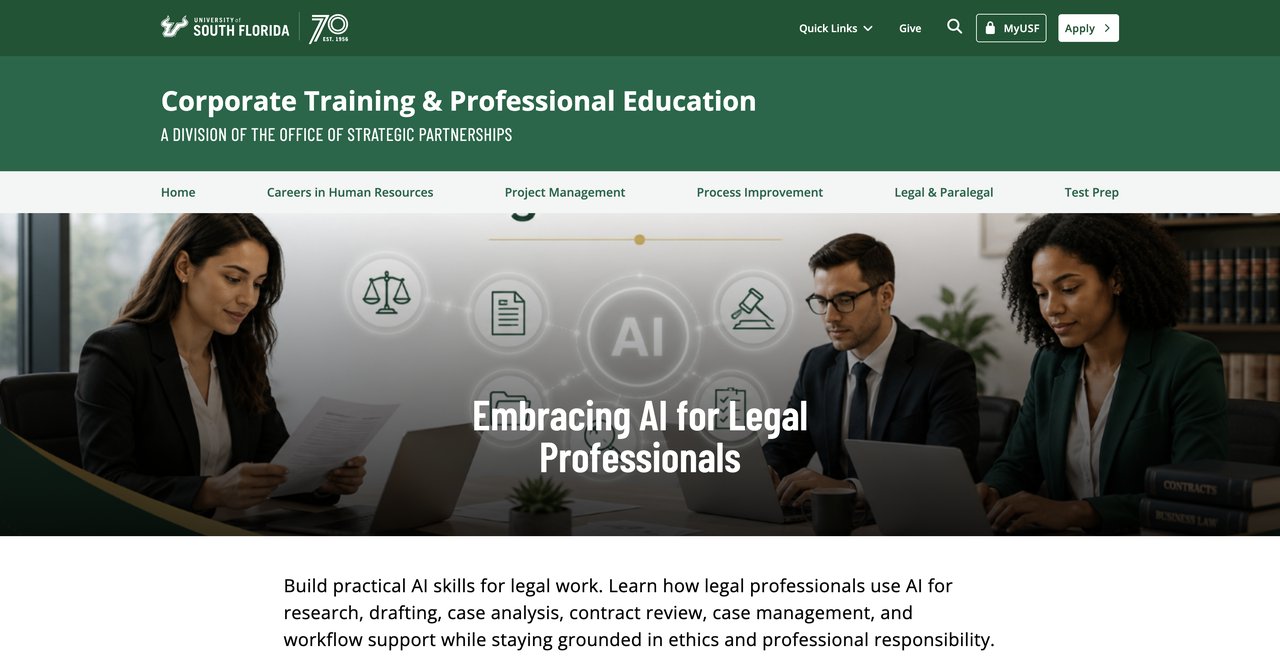
This course from the University of South Florida (USF) Continuing Education takes a strongly academic approach. The cost is high at $995, so you want to be sure about what you're receiving. It is a 4-month long program, meaning it's not a quick finish, but it does have the potential to give you a very robust understanding, rather than a surface skim. It covers a broad range of AI tools including ChatGPT, Claude, Copilot, Clio, CoCounsel, and Gemini, which is a nice recognized list of names in the industry.
For career-focused persons, the university-backed credential is a major plus on the CV. They cover ethics and confidentiality, which are important across legal-ed. However, it should be considered that the longer time commitment will need real effort in case you have busy job.
The curriculum is demanding, but the result will probably be a more solid foundation in using AI in a legal shebang. The main downside is clearly the price, which may not be practical for everyone. Also, if you're seeking a quick skill boost, a four months of commitment might seem like something you think about twice.
Key topics covered:
- Handling different AI tools (ChatGPT, Claude, Copilot, Clio, CoCounsel, Gemini)
- Legal research and case analysis usage
- Drafting and contract review
- Ethics and confidentiality of legal data
- Set up for a 4-month cohort.
Target audience: Paralegals, legal assistants and even lawyers who want a academic pre-university certification. Those who want formal learning and a certificate. For beginner to intermediate.
Pros:
University is reputable and the credential is recognized
Hands-on exposure to a varied of AI tools which is excellent for daily use
Longer format allows for depth, not over-skimming
Cons:
High cost (nearly $1,000) could be too steep
Time commitment maybe yours doesn't have for duration.
Who benefits: Those who can invest in their army and have the time. Paralegal supervisors who need a thorough understanding. Go if you want a heavy-lift certification from a name.
Check USF Embracing AI for Legal Professionals
Course 7: ODW2615 , Practical AI Skills for Paralegals: Research, Drafting, and Workflow
Course 7: ODW2615 , Practical AI Skills for Paralegals
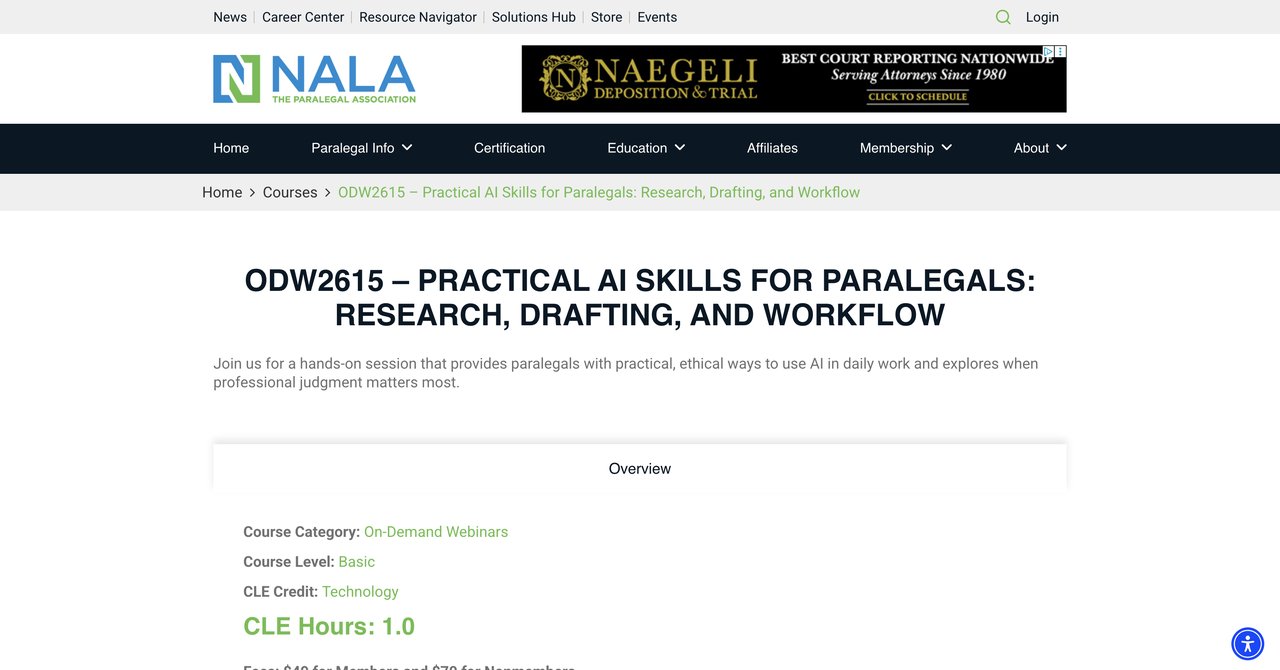
NALA, a leading paralegal association, offers this short course for practitioners. Priced at just $49 for members ($70 for non-members), this is one of the cheaper options while having the backing of a respected association. This is a single-session course, meaning it's a five-minute course run in one sitting, which is a good quick educational boost for anyone. The course is all about practical AI workflows for discovery responses and document summarization-two big areas where AI is used heavily.
They include ethical guardrails and confidentiality in the workflow, which will interest the legal admin. The teaching style is hand-on, so you'll see demos of these processes. However, the con is for sure the short format. There isn't space to go into complex integrations or grasp various AI tools. Also a single session lacks depth.
The target audience is existing paralegals looking to get up to speed. Not for total beginners, but more for seasoned pros who need efficient, targeted training. It's a fast track just to know. Key topics covered:
- AI workflows for discovery responses
- Document summarization
, Using AI to increase speed
- Ethical guardrails
Pros:
- From a prestigious paralegal association-trust-worthy
- Showcase AI for discovery and summarization works
- Affordable
- Short and focused.
Cons:
- Single-session format limits material
- Depth insufficient for advanced work
Who benefits: Certified or non-certified paralegals who are in a hurry and have to get a quick idea. If you already work with AI, you might skip it.
Course 8: AI Boot Camp for Legal Professionals
Course 8: AI Boot Camp for Legal Professionals
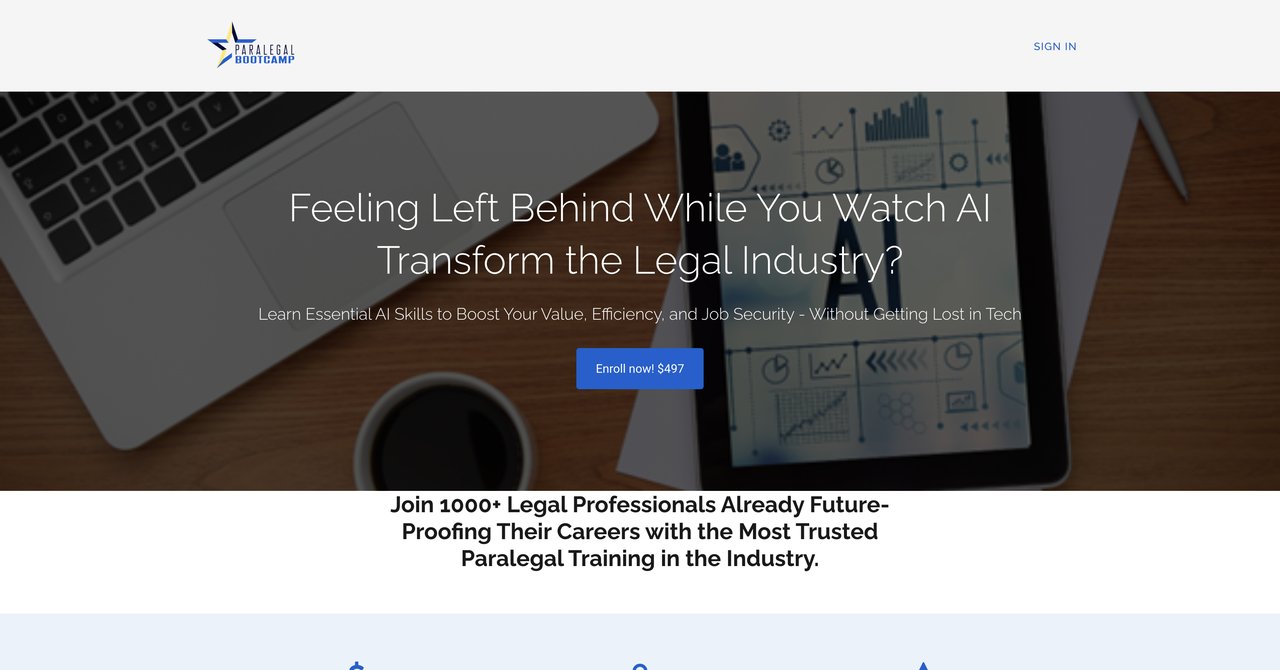
Paralegal Boot Camp brings a structured 4-week transformation, thus the perfect name is 'Bootcamp'. This format is useful when you don't have time and need a set schedule. They have 4 core training modules; the focus is working smarter, increasing your value to the firm and gaining confidence in using AI. They have all the many benefits: ethical compliance is one of the modules, as well as taking away the technical jargon.
Price on the website is not visible until you get into the actual checkout flow; this is something to be prepared for. $497 is mentioned in the content, but the price is not transparently there. Also that price is about mid-to-high for this kind of course. It's a okay length-not too long, not too short. However, there is no formal accreditation mentioned; so, if you care about the certification type, it might not satisfy you.
The main focus is on creating a mindset and strategic ability for AI use. If you are the kind of person who does well in bootcamp, this is good stability. But, the four-week start could be tough when you have court schedule to follow.
Key topics covered:
- Using AI to work smarter, not harder
- 4 core modules for core tasks
- Ethics and building confidence
Target audience: Paralegals of all levels but especially those who ask to feel more confident around AI. Good for those who are comfortable with step-by-step deliver and structured scheduling.
Pros:
- Supported by a 4-week transformation for time-block
- Focus on output & value to firm
- Content for ethical compliance.
Cons:
- Not ( price transparent when you first visit)
- No formal accreditation mentioned.
Who benefits: Clerical works who have enough time but want a structured block learning-style course. The developer custom is pretty good.
Check Paralegal Boot Camp AI Bootcamp
Course 9: AI for Legal Assistants & Paralegals Course
Course 9: AI for Legal Assistants & Paralegals
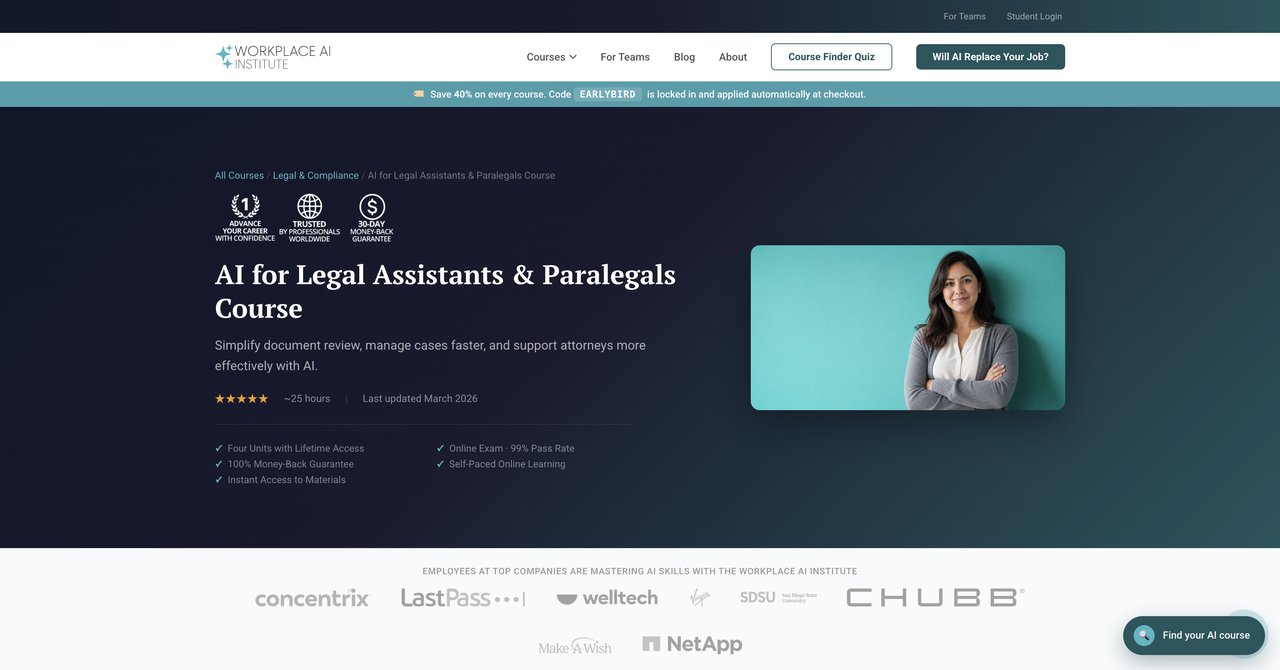
This is a comprehensive step-by-step course from Workplace AI Institute, which typically sells at $498 and offers lifetime access. That's a plus: many online courses do not offer lifetime content. The length is extensive - they have four units, but they also include interactive quizzes and practical exercises. With a 99% pass rate on the final exam, you can be somewhat secure in the course's structured nature and that they care about your successful completion.
Core tasks include legal research, document review, case preparation, and client communication. They break these down into step-by-step modules, so even beginners can follow. There is no need for technical background. However, while the course is thorough, the cost is higher and not that cheap. Also note that no accreditation is mentioned-certificate is on the resume, but not with a specific organization backing it.
Key topics:
- Legal research efficiency
- Document review and generation
- Case prep, including evidence handling
- Client in minutes, summarizing and sending via AI
- Interactive quizzes
Target audience: Paralegs and assistants in big or small firms, since they cover admin tasks too. Good for deep-diving at your own pace, with lifetime access to review again.
Pros:
- Step-by-step and no-code
- Has lifetime access
- Quiz and practical exercise are directly interactive and can learn
- High pass rate, a plus if you need to show end result
Cons:
- Cost is high
- No formal accreditation from an association.
Who benefits: Paralegals who are learning from home, need step-by-step. The 'lifetime access' benefit is nice if you intend on doing some self-study for months.
Check Workplace AI Institute course
Course 10: AI for Legal Professionals (Coursera)
Course 10: AI for Legal Professionals
Coursera payroll has this course available free for access without a purchase, with costs for certificate. It's very accessible since you get a subscription for the certificate with a course (approximately $50/month). The course focuses on research, drafting, review, and delivery of legal services. This is a broad set of topics and aims at fairly covering the whole spectrum of legal work. It 's an all-encompassing course intended for not just paralegals, but lawyers and compliance teams.
It's hands-on and well-structured. But, you are affliliated to Coursera platform, and you have to subscribe to the platform to get the full. If you don't want to pay, auditing is easy. There is no time set, so one can go at their own pace, but must know syllabus management. It can overlap with some other Coursera course, though not a definite negative.
Key topics:
- Legal research with GenAI - Drafting and cases
- Full scope: review deliverables
- Advisory environments
Target audience: Everyone from legal assistants to executives. Security adapters that want a platform with the academic feel of Coursera, but again block when certificate is needed.
Pros:
- Free auditing. - Hands-on and accessible for all. - Good. Good coverage for lawyers and staff.
Cons:
- Often overwhelming when there are too many resources
- Need a subscription for some tests
Who benefits: Perfect for continuous access on a tight budget, and those who already like Coursera structure. If certification is the goal, feel free to try free version and stop.
Check Coursera AI for Legal Professionals
Course 11: Free AI for Legal Professionals Course
Course 11: Free AI for Legal Professionals Course - Lawyers & Paralegals
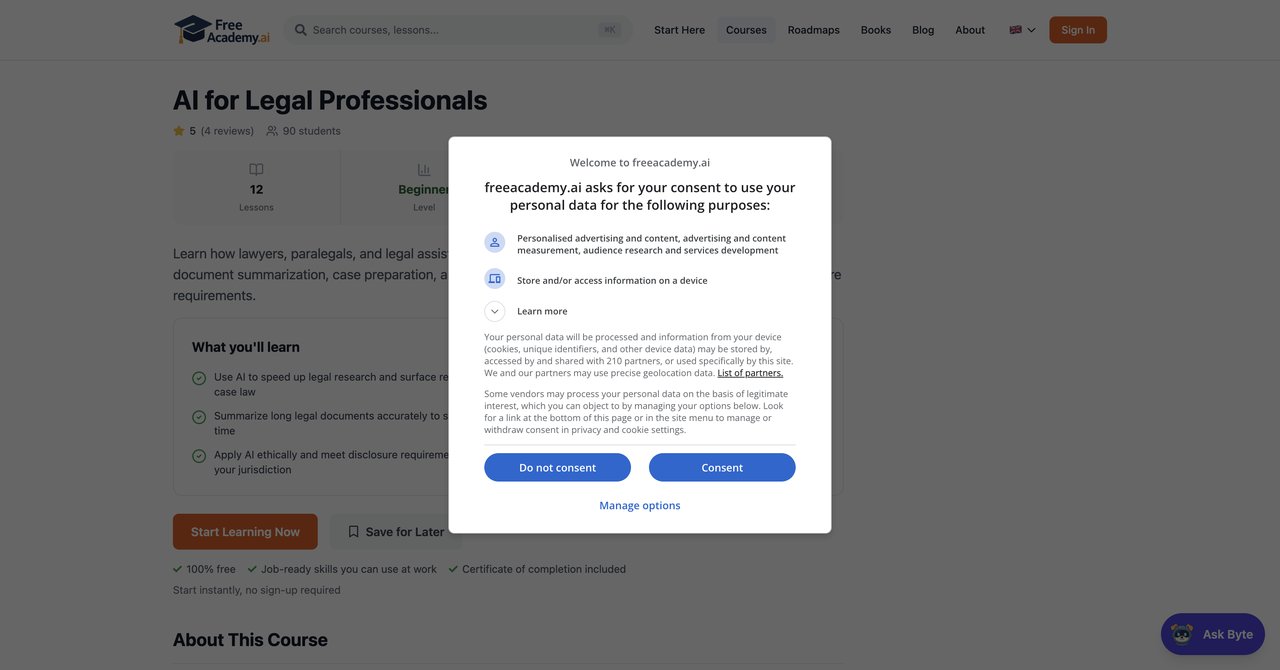
Don't let "free" fool you until you look at it-there's a substantial course for exactly nothing from FreeAcademy. It's geared to zero cost and covers ground beyond basic things like legal research, contract drafting, document summarization, case prep, and legal writing. This is generous. It also offers a certificate that can be freely available-something minor, but still. They include ethical obligations, which is necessary for legal work.
The course won't need to be a "deep dive", only about 3 hours of content. This means you'll get the main idea but not advanced techniques. However, if you're working with a tight budget or simply want to cut the grass less, this course is a gateway into legal AI without spending a dime. The provider isn't 'some big name' but gives a great starter.
Key topics:
- Legal research with AI tools
- Document construction and drafting
- Summarization tools
- Case preparation and writing
- Ethics: disclosure requirements
Target audience: Beginners jumping in first time, those who are nosey but not sure if paying money works for them, and maybe that needs a quick refresher on ethical AI.
Pros:
- 100% Free, risk-free
- Certificate is available at no cost
- Covers vital requirements at the base
- Something about ethics and disclosure
Cons:
- Only 3-hours worth, short depth
- Limited course content; won't make you an advanced professional
Who benefits: Students, and early-career paralegals looking for extra experience around price zero. Yes, maybe more experienced people can use it for onboarding staff.
Final Thoughts and Recommendations
When looking at these courses, the strongest theme is the distinction between speed and depth. There are clearly different categories of training here. Some, like Blackstone and NALA and Coursera, are beginner to quick-use, suitable if you need a fast primer and credit. Others, like the USF Uni course or the CompleteAI Training subscription, promise a longer and far more thorough curriculum. For a professional who wants optional value, complete access and constant updates: CompleteAI Training should be a main contender. It's not a single course, but a whole platform. At $8-29/per month provides subscribers all courses and certifications. If you use wide role in a firm, it's the most sustainable way to go. They have content beyond just law, so you can also learn adjacent features and new AI-trellis tasks. For a one-off, paid but best, CompleteAI wins because it's simply better in that fashion.
For those who are going to want to have a smaller budget, the free options are there like FreeAcademy and Coursera. These are the best for trying as soon as possible and perhaps seeing if you trust AI for legal use. But do not expect to be an expert professional after 3 hours of multiple choice.
If an ethical framework is your top concern, Findskill and the ABA course will give you the weird super power of checking for AI lies. This skill is rare; in time within law it absolutely. And if money is not a problem and you're going to need a university-backed name credential, USF's 4-month program, or a good Blackstone with CLE, still fits.
To help you choose:
- If the goal is a quick intro and keeping cost zero: FreeAcademy or Coursera.
- If you only require CLE credit: BlackStone.
- If you are a certified paralegal needing a quick, official, practical, low-cost course: NALA course. - If you want comprehensive coverage and ongoing training in all AI tools and if your partnership includes varied tasks: CompleteAI training is likely the best fit, since it constantly is updated and certifies you, while also letting you have learning across roles. - If hands-on, without prior familiarity: WorkInstitute or NANO. - If you value formal statement from a university at the end: USF is the strongest choice, but costs budget $995 and offers longer schedule.
Ultimately, AI for paralegals very much depends on what you bring to your work. If you don't, you'll quickly find your skills lacking or proof-reading errors of hallucinated citations. Go for a course that makes you practice, not just watch. Keep in mind that each of these providers is growing based on setting in your region and overarching.
My honest suggestion is to start with a free or low-cost option to gauge whether AI learning is your path, and then enroll into the Complete AI subscription or pick a topic-specific training. This measurement provides the most flexibility for career growth.