
Blog ·
8 Recommended AI Courses for QA Managers in 2026
Master AI-powered testing in 2026 with eight targeted courses. Boost your QA leadership, implement smarter automation, and drive true quality innovation. Discover the top training picks now.
 Jeroen Erne
Artificial intelligence has moved from being a theoretical concept to a practical tool that's reshaping how software is built, tested, and delivered. For Quality Assurance (QA) Managers, this shift is not just a trend - it's a direct challenge to the skills and methodologies you've spent years refining. The global AI in software testing market is projected to exceed $2.8 billion by 2027, and companies are already shifting budgets toward intelligent automation and predictive analytics. That means the professionals who understand how to manage AI-driven testing processes will be the ones who set the standard. Those who don't risk becoming sidelined as their organizations prioritize digital transformation initiatives.
For QA Managers, the need to upskill isn't about learning to write code in Python or building machine learning models from scratch. It's about figuring out how to integrate AI into testing strategies, how to lead teams using new tools, and how to shift your approach from manual quality checks to overseeing predictive, automated systems. A recent report from IBM found that 69% of businesses are actively using or piloting AI in some form, and a growing portion of that is focused on software quality. That's a clear signal-if you want to stay relevant, effective, and career-resilient, you need to consider formal AI training designed specifically for your role.
Why AI matters for QA Managers today
QA Managers have always been responsible for ensuring that software meets certain standards. But the nature of that responsibility is changing. AI is not just a new tool to be added to your toolbox. It changes the fundamental way that testing happens. For example:
- Automation: AI can generate test cases automatically, spot regression patterns that humans miss, and speed up execution times dramatically.
- Predictive analytics: You can now foresee where defects are most likely to occur based on past data, which allows you to direct how you allocate limited resources.
- Heterogeneous data handling: AI helps QA teams make sense of unstructured data-logs, screenshots, user behavior-so you can catch issues that manual testing simply misses.
- Continuous evolution: AI models can learn from production feedback, meaning that QA loops are becoming more dynamic-you are no longer stuck with a test plan that gets stale after six months.
But adopting these capabilities isn't automatic. The tools are only as good as the people managing them. That's where your role changes. You're not just enforcing quality gates anymore. You're designing them around artificial intelligence, understanding how to fail, how those systems make choices, and which data is feeding your conclusions. That's why this article exists-to help you, a QA Manager professional, sort through the growing pile of AI course options and identify which training actually delivers what you need.
The Growing Role of AI in QA Managers
AI is not just assisting; it's increasingly taking over tasks that, until a few years ago, were considered your core responsibilities. Let me walk you through a few practical examples:
- Automated bug detection: AI frameworks can scan thousands of lines of code and flag potential problem areas before a full test cycle even begins.
- Intelligent test data management: Instead of relying on static test sets, AI can generate synthetic data on the fly, that adapts to what you are testing-and protects personal information in the process.
- Personalized user acceptance testing: Understanding user behavior used to be a manual task. Now, AI can simulation how different personas will use your software, giving you real insight into the functional correctness, not just the technical one.
- Self-healing tests: One of the biggest headaches in QA is maintenance when the UI changes. AI can detect those changes and automatically update your test scripts, saving you hours of tedious work.
All of this means the job no longer revolves around manual test planning and execution. It is moving toward monitoring AI systems, making decisions about their confidence scores, and leading a team that supervises intelligent agents. Understanding how to be an effective manager in this shifted context is essential. And it starts with specialized learning, not just on general AI, but on AI for QA specifically.
Benefits of becoming an AI expert in QA Managers
Becoming skilled in AI doesn't just keep you afloat; it gives you a real advantage. For QA Managers, that translates to:
- Career growth: Companies are willing to pay more for QA leaders who can integrate AI productively. You move from routine management to strategic influence.
- Process optimization: You will be able to cut overall testing time drastically, and achieve wider coverage-which means faster releases without compromises on quality.
- Better agility: Your team will respond fast to change; you will build more flexibility in the testing cycles you lead, and you'll gain better visibility into risk.
- Decision-making skill: When you know data models and how they are tested, you can make much more informed decisions about production readiness than managers who only know manual QA. You become the person saying "this is not good enough" with actual evidence, not just coaxed.
In short, investing in an AI course is not a vanity line on a resumé. It's a direct route to being the kind of QA Manager who solves hard problems, enables higher quality, and ultimately gets better results from a team.
This article compares 41 of the best AI courses for QA Managers professional, covering their core content, pros, cons, and who they are best suited for. One course included in this comparison is CompleteAI Training, and it stands out because instead of selling a single course, it gives you access to ALL courses and ALL certifications available on the platform. That's a different approach - you are not locking yourself into one curriculum, but get a broad library for your entire continuous learning.
So if you are ready to give your career a heads up, let's go into the detail of all the different options-and what they actually will deliver for you.
Comparison: All AI Courses for QA Managers (Updated 2026)
| Course Name | Provider | Price | Key Topics | Pros | Cons | Best For |
|---|---|---|---|---|---|---|
| CompleteAI Training for QA Managers (All Courses + Certifications) | CompleteAI Training | $29/month or $8.25/month billed annually - one subscription covers ALL courses and ALL certifications on the platform, not just one course | AI for QA Managers, complete AI curriculum, hands-on projects, daily AI tool updates, access to every job role's material, all certifications included | Full-platform access to all video courses, not just one course or bundle; all certifications included at no extra cost; new courses added continuously; access to all other job role materials; one flat subscription covers everything; very affordable with annual billing | Subscription-based, requires ongoing learning to keep pace with AI changes | QA Managers professionals looking for complete training with full platform access |
| CompleteAI Training (Short link: ai-for-qa-managers) | CompleteAI Training | Premium (single course pricing, higher than subscription) | Comprehensive AI training curriculum specifically for QA Managers, hands-on projects, expert-led instruction | Comprehensive curriculum, hands-on projects, expert instructors | Premium pricing compared to the subscription option | QA Managers professionals wanting complete training without subscribing to the full platform |
| AI for QA Leaders and Managers | Sii Poland | Unknown (custom quote) | AI adoption strategy, team performance, decision-making for QA Leads, Test Managers, Heads of QA; no programming required | Designed specifically for QA Leaders, covers adoption strategy and team performance, no coding needed | Price not public, limited to 8-12 participants per session, regional provider (Poland-based, likely in-person/remote EU time zones) | General learners, particularly QA managers needing strategic AI adoption without technical hands-on work |
| Certified Tester - Testing with Generative AI (CT-GenAI) | QA (qa.com) | From $2,575 | GenAI fundamentals, prompt engineering, risk management, organizational integration, hands-on exercises | Official certification credential, covers fundamentals and organizational aspects, includes practical exercises | High price, requires travel or virtual attendance on fixed dates | General learners seeking an official certification for GenAI in testing contexts |
| GenAI for QA - Masterclass in Testing & Automation | Coursera (Packt) | Subscription (Coursera Plus) or single purchase not specified | Integration of ChatGPT, Claude, Google Bard, and TestRigor into QA workflows; practical tool application | Covers multiple GenAI tools, shows directly which tools teams can adopt, structured for hands-on learning | Not tailored to management/leadership decisions specifically, assumes existing QA tool familiarity | General learners, especially QA managers evaluating tool adoption for their teams |
| Master AI Prompt Engineering for Software Testing & QA | Udemy | ~$49.99 (often discounted) | Prompt engineering specifically for testers, suitable for non-programmers | Short and focused, teaches prompt engineering for testing use cases, accessible to non-coders | Very short duration, limited depth for strategic or managerial concerns | General learners seeking a quick primer on prompt engineering in QA contexts |
| Gen AI for QA: Test Automation with Claude & GitHub Copilot | Udemy | ~$59.99 (often discounted) | Hands-on with Claude and GitHub Copilot for test automation, concrete automation capabilities | Practical examples, high learner satisfaction (4.7/5), shows actual automation capabilities | Focused on automation engineers, not management strategy; assumes some automation background | General learners, QA managers evaluating tools for budget and tooling decisions |
| ISTQB Artificial Intelligence Testing | Udemy | ~$49.99 (often discounted) | Aligned with ISTQB AI Tester Certification, testing AI-based systems, comprehensive syllabus coverage | Aligned with ISTQB certification, comprehensive coverage, structured and exam-focused | Focuses on testing AI systems, not on using AI to manage QA teams; heavy theory may not suit all managers | General learners interested in understanding how to test AI-based products |
| AI for Software Testers: GenAI, AI Agents, MCP & Agentic AI | Udemy | ~$54.99 (often discounted) | AI agents, MCP Server, agentic AI, real-world projects for automation testers and SDETs | Covers emerging topics (AI agents, MCP, agentic AI), includes real-world projects, suitable for technical testers | Not management-focused, requires some automation background (Selenium/Playwright/Cypress) | General learners, specifically automation testers and SDETs looking to expand into agentic AI |
| AI for Software Testing (General Course) | Not specified | Not specified | General AI concepts for software testing, some foundational knowledge | Good introduction for beginners in AI for testing | Not comprehensive, lacks depth, no certification | Absolute beginners |
Understanding AI Training for QA Managers Professionals
If you manage a QA team, you've probably noticed that artificial intelligence is no longer a distant concept. It's showing up in test automation tools, in bug prediction models, and in the way your team talks about their daily workflows. The tricky part is figuring out what you actually need to learn, and which course is worth your time and budget. There's a surprisingly wide range of options out there, from inexpensive Udemy courses to official certification programs that cost thousands of dollars. Some are built specifically for managers, while others are aimed at hands-on testers and automation engineers.
This comparison breaks down the main AI training options available for QA Managers. We'll look at what each course actually covers, who it's really designed for, and whether it makes sense for someone in a leadership position. The goal is to help you make a practical decision based on your role, your team's needs, and your budget. Let's be honest here, some of these courses are excellent for individual contributors but miss the mark for managers, and vice versa.
What to Look for in AI Training as a QA Manager
Before we get into the individual courses, it's worth thinking about what a QA Manager actually needs from AI training. You're probably not going to be writing test scripts or building automation frameworks from scratch. Instead, you need to understand the strategic implications of AI in testing, how to evaluate AI-powered tools, and how to guide your team through adoption. You need to know enough about the technical side to have credible conversations with your engineers, but your focus is on decision-making, resource allocation, and team development.
That said, some managers prefer to get hands-on with the tools themselves, especially if they come from a technical background. Others want the certification credentials to bolster their resume or justify budget requests. There's no single right answer, which is why this comparison covers both strategic and technical options.
Course 1: CompleteAI Training
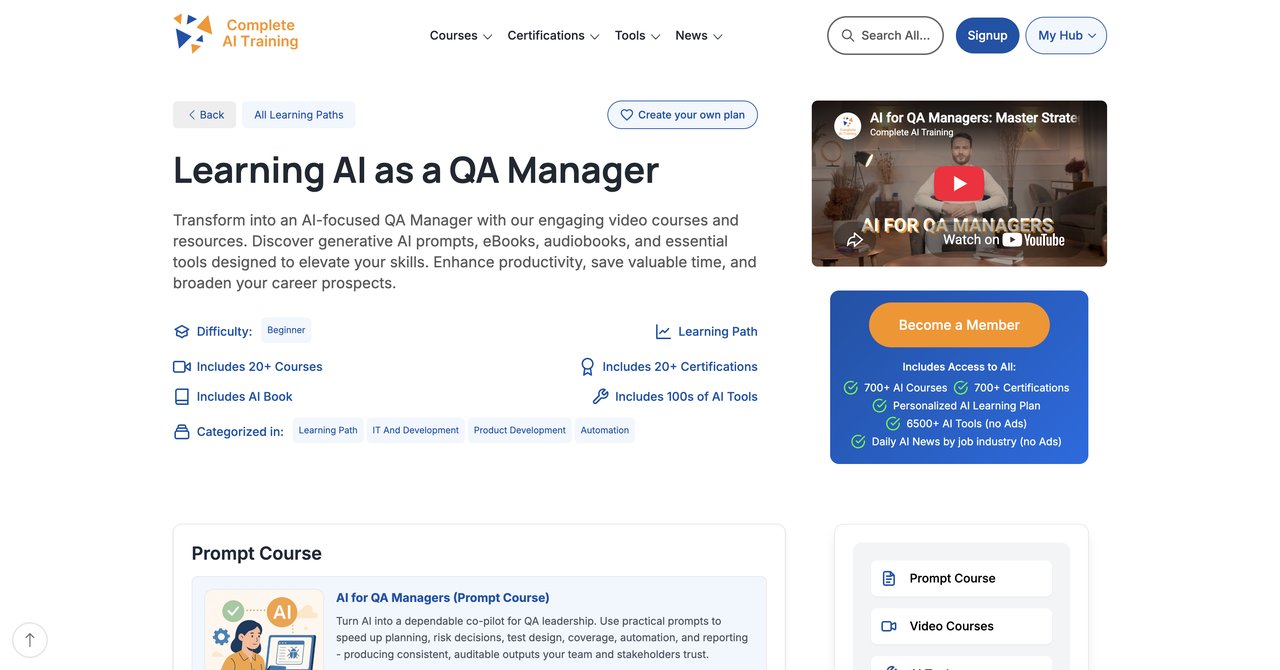
CompleteAI Training is not a single course. One subscription unlocks every course and every certification on the whole platform, hundreds of them, across every job role, not just this one. That's the key thing to understand from the start. When you subscribe, you're getting access to the entire catalog, not a fixed bundle or a single program. This includes the AI for QA Managers content, but it also includes material for developers, data scientists, product managers, marketers, and every other function you can think of.
The subscription model is straightforward: $29 per month, or $8.25 per month if you pay annually. For that price, you get full access to all video courses on the platform, not just one course or a fixed bundle. You also get full access to all certifications, and those are included at no extra cost. That's a significant difference from most other providers, where you pay separately for the course and then pay again for the exam or certificate. New courses and certifications are added continuously, and they're included automatically, so your subscription doesn't go stale.
One of the standout features is that you get access to every other job role's material too. For a QA Manager, that's genuinely useful. Your work spans development, operations, product, and sometimes customer success. Being able to dip into those other role-specific courses without paying extra is valuable, especially if you're preparing for a move into a broader leadership position. The platform updates its content daily, which is necessary in the AI space where tools and best practices change quickly.
The main drawback is that it's a subscription, so you need to keep paying to maintain access. If you're someone who prefers to buy a course once and own it forever, this might not be your preferred model. However, given how fast AI is changing, the subscription model arguably makes more sense, you're not stuck with outdated material.
Key Topics Covered
The CompleteAI Training platform covers an enormous range of AI topics. For QA Managers specifically, the content includes AI fundamentals, practical applications of AI in testing, test automation with AI tools, prompt engineering, AI strategy for QA teams, and much more. Because you have access to the entire catalog, you can also explore related areas like machine learning basics, AI ethics, and data analysis if those are relevant to your role.
Target Audience and Skill Level
This is suitable for QA Managers at any level, from those who are completely new to AI to those who have already implemented some AI tools and want to deepen their understanding. The platform includes beginner-friendly content as well as advanced material, so you can start where you are and progress at your own pace. The fact that you also have access to content for other roles means you can bring your team along with you if you want to share learning resources.
Pros
- Full-platform access to all video courses, not just one course or bundle
- All certifications included at no extra cost
- New courses and certifications added continuously and included automatically
- Access to every other job role's material, ideal for cross-functional work or career moves
- One flat subscription price covers all of the above, versus paying per course elsewhere
- Very affordable pricing, especially with annual billing
- Daily updates on AI tools and news keep the content current
Cons
- Subscription-based, requires continuous learning to keep up with AI developments
- You don't own the content outright, so access ends if you cancel
Who Would Benefit Most
QA Managers who want comprehensive, ongoing access to AI training without breaking the bank. This is particularly good for managers who are responsible for upskilling their entire team, because the subscription covers everyone's learning needs across different roles. It's also ideal for those who value certifications and want to collect multiple credentials without paying per-certification fees. If you're planning to move into a broader leadership role, the access to other job roles' content is a real advantage.
Visit CompleteAI Training for QA Managers
Course 2: AI for QA Leaders and Managers by Sii Poland
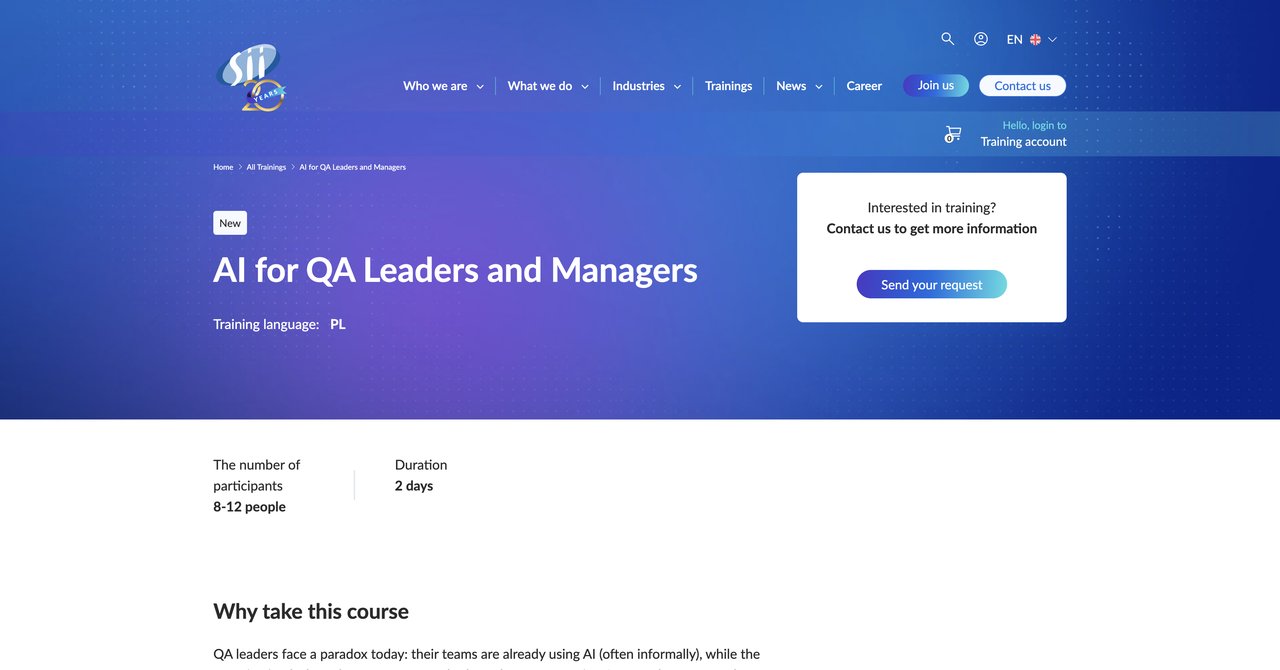
Sii Poland offers a two-day instructor-led course that is specifically designed for QA Leads, Test Managers, and Heads of QA. This is a live training experience, which means you get real-time interaction with an instructor and the ability to ask questions and discuss scenarios with other participants. The course focuses on AI adoption strategy, team performance, and decision-making, and it explicitly does not require programming skills.
The strength of this course is its focus on the managerial side of AI adoption. It's not about teaching you how to use specific tools; it's about helping you think through the strategic questions. How do you introduce AI to a team that's resistant to change? How do you measure the impact of AI on your testing processes? How do you make decisions about which AI tools to invest in? These are the kinds of topics covered.
The main limitation is that the price is not public. You need to contact Sii Poland for a custom quote, which makes it harder to compare with other options. Additionally, the course is limited to 8-12 participants per session, which keeps the quality high but means availability might be limited. The provider is based in Poland, so sessions are likely to run in European time zones, which could be challenging for participants in other regions.
Key Topics Covered
The curriculum covers AI adoption strategy, team performance management in the context of AI, decision-making frameworks for AI tool selection, and practical considerations for integrating AI into QA processes. There's also discussion of how to build a business case for AI investment and how to manage stakeholder expectations.
Target Audience and Skill Level
This is aimed squarely at QA Leads, Test Managers, and Heads of QA. No programming background is required. The course assumes you have management experience and are looking to add AI strategy to your skill set. It's less suitable for individual contributors or those who want hands-on technical training.
Pros
- Designed specifically for QA Leaders and Managers
- Covers AI adoption strategy, team performance, and decision-making
- No programming required
- Small class size allows for interaction and discussion
- Instructor-led with real-time feedback
Cons
- Price not public, requires contacting the provider for a quote
- Limited to 8-12 participants per session
- Regional provider, likely in-person or remote in EU time zones
- No certification credential mentioned
Who Would Benefit Most
Experienced QA managers who prefer a live, instructor-led format and want to focus specifically on the strategic and leadership aspects of AI adoption. If you're based in Europe or can work with European time zones, and if you have the budget for a premium training experience, this could be a strong option. The small class size suggests a high level of interaction and personalized attention.
Visit AI for QA Leaders and Managers by Sii Poland
Course 3: Certified Tester - Testing with Generative AI (CT-GenAI) by QA
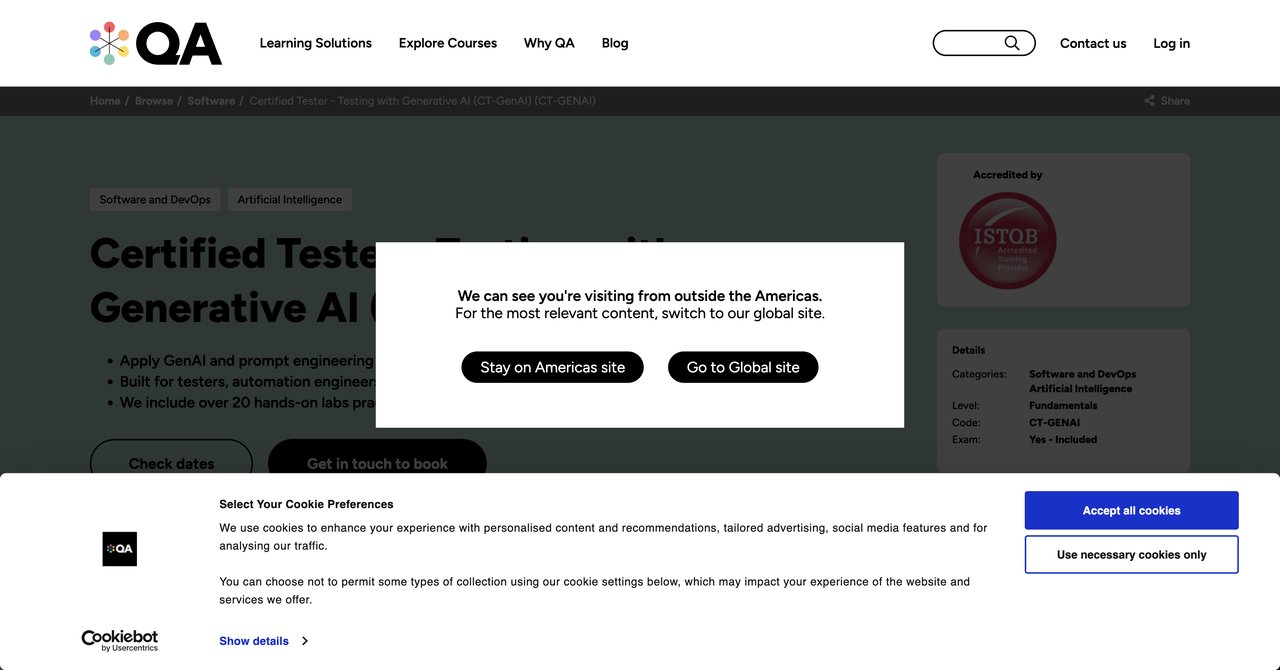
The CT-GenAI certification from QA (qa.com) is an official credential that covers Generative AI fundamentals, prompt engineering, risk management, and organizational integration. It's a structured program with hands-on exercises, and it's marketed as suitable for managers and consultants as well as testers. The certification itself carries weight in the industry, which can be valuable if you need to demonstrate your AI knowledge to stakeholders or clients.
The course content is comprehensive. It starts with the fundamentals of Generative AI, then moves into practical applications for testing. Prompt engineering is covered in depth, which is useful because that's a skill that transfers across many different AI tools. Risk management is another key component, and that's particularly relevant for QA managers who need to understand the potential downsides of AI adoption. The organizational integration section helps you think about how to roll out AI across a testing team or department.
The biggest drawback is the cost. At $2,575 and up, this is a significant investment. It's also delivered on fixed dates, so you need to plan your schedule around the available sessions. Depending on where you're located, you may need to travel or attend virtually at specific times. For many QA managers, the cost and scheduling constraints will be prohibitive, especially if you're paying out of your own pocket rather than having an employer cover it.
Key Topics Covered
Generative AI fundamentals, prompt engineering, risk management, organizational integration, hands-on exercises with GenAI tools, and practical applications for software testing. The certification also covers ethical considerations and limitations of AI in testing contexts.
Target Audience and Skill Level
This is suitable for QA managers, testers, and consultants who want an official certification credential. Some familiarity with testing concepts is assumed, but you don't need to be a programmer. The course is designed to be accessible to non-technical participants while still providing depth.
Pros
- Official certification credential recognized in the industry
- Covers GenAI fundamentals, prompt engineering, risk management, and organizational integration
- Hands-on exercises provide practical experience
- Suitable for managers and consultants
- Structured curriculum with clear learning objectives
Cons
- High price point at $2,575 and up
- Requires travel or virtual attendance on fixed dates
- Limited scheduling flexibility
- Certification may need renewal or continuing education
Who Would Benefit Most
QA managers who need a recognized certification to advance their career or meet employer requirements. If your organization values formal credentials, this is a solid choice. It's also good for consultants who need to demonstrate their AI expertise to clients. The cost is justified if you or your employer sees certification as a strategic investment.
Visit CT-GenAI Certification by QA
Course 4: GenAI for QA - Masterclass in Testing & Automation by Coursera (Packt)
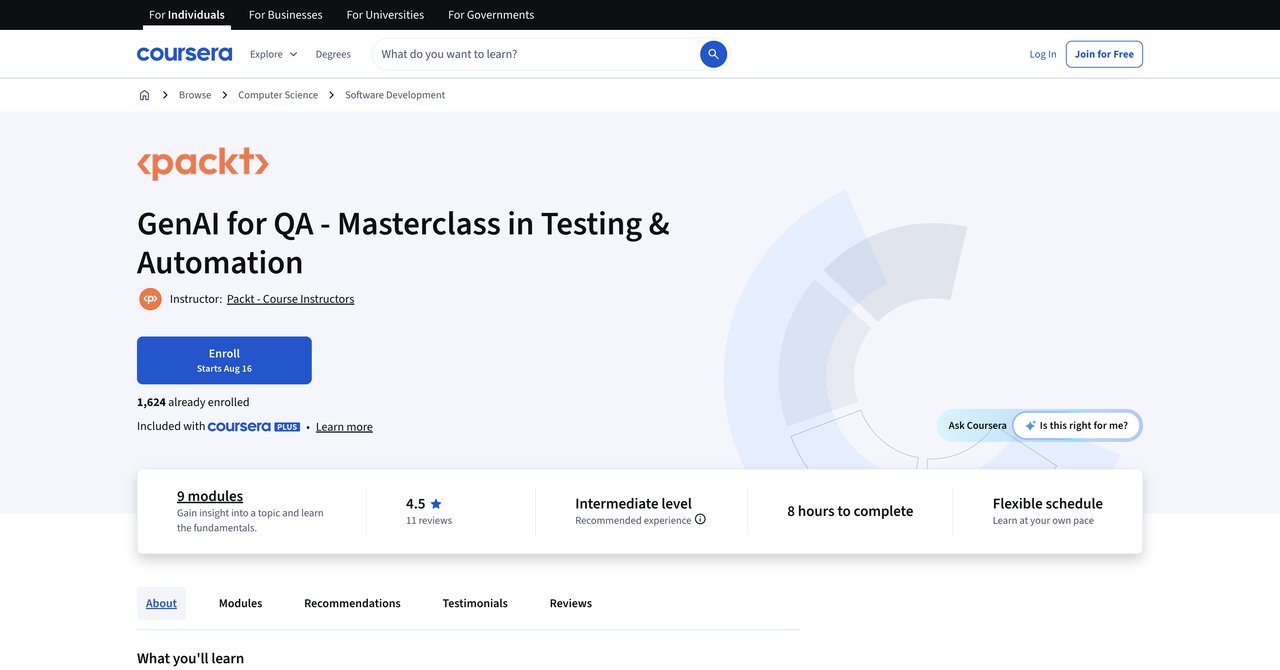
This Coursera course, published by Packt, is a structured program that covers the integration of ChatGPT, Claude, Google Bard, and TestRigor into QA workflows. It's a practical course that shows you exactly which GenAI tools your team might adopt and how they can be applied to real testing scenarios. The course is part of the Coursera Plus subscription, which means you might already have access if you subscribe to that platform.
The content is hands-on and tool-focused. You'll learn how to use specific AI tools for test case generation, test data creation, and even some aspects of test execution. The inclusion of TestRigor is notable because it's a specialized tool for AI-powered testing, so you get exposure to tools that are actually being used in the industry rather than just theoretical concepts.
The main limitation is that it's not specifically tailored to management or leadership decisions. It's more of a practitioner's course, focused on how to use the tools rather than how to strategically implement them across a team. If you're a QA manager who wants to understand what your team would actually do with these tools, this is useful. If you're looking for strategic guidance on adoption and team management, this isn't the right fit.
Key Topics Covered
Integration of ChatGPT, Claude, Google Bard, and TestRigor into QA workflows, practical AI tool application for test case generation and execution, and hands-on exercises with these tools. The course also covers automation considerations and how to evaluate AI-generated test results.
Target Audience and Skill Level
This is best suited for QA professionals who have some existing familiarity with testing tools and concepts. It's not a beginner course, and it's not specifically designed for managers. If you have hands-on testing experience and want to add AI tools to your skill set, this is a good option. QA managers might find it useful for understanding what their team would actually do with these tools.
Pros
- Covers integration of ChatGPT, Claude, Google Bard, and TestRigor
- Practical AI tool application for QA workflows
- Structured for hands-on learning
- Available through Coursera Plus subscription, which may already be available to you
- Published by Packt, a known technical publisher
Cons
- Not specifically tailored to management or leadership decisions
- Requires existing QA tool familiarity
- Single course, not a comprehensive program
- No certification credential mentioned
Who Would Benefit Most
QA professionals who want practical, hands-on experience with specific GenAI tools. If you're a manager who likes to understand the tools your team uses, this is a good way to get that understanding. It's also suitable for QA engineers who want to add AI skills to their toolkit. The Coursera Plus subscription model makes it relatively affordable if you already use that platform.
Visit GenAI for QA Masterclass on Coursera
Course 5: Master AI Prompt Engineering for Software Testing & QA by Udemy
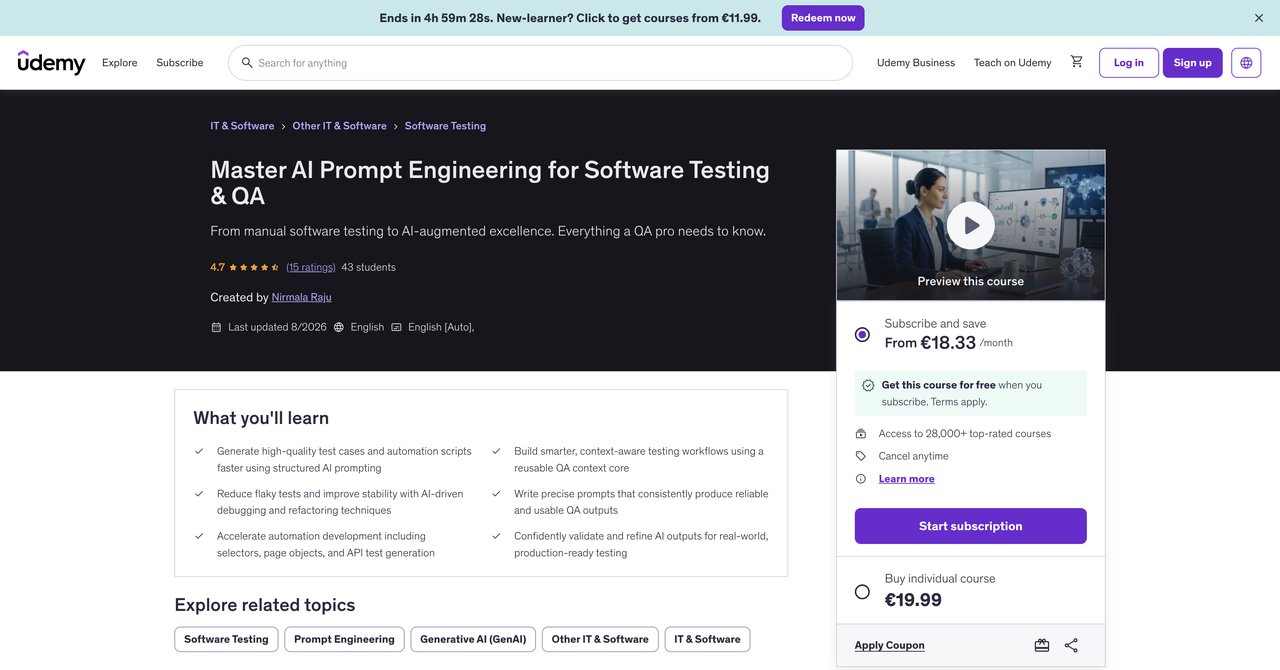
This Udemy course is a short, focused program that teaches prompt engineering specifically for testers. It's designed to be accessible to non-programmers, which makes it a low-barrier option for QA managers who want to understand how prompt engineering works without getting deep into technical details. The course helps you evaluate whether your team is using AI effectively by showing you what good prompts look like and how they affect the quality of AI-generated test outputs.
The price is attractive, typically around $49.99 but often discounted to much less during Udemy sales. For that price, you get a focused introduction to prompt engineering in the context of software testing. It's a good starting point if you're new to AI and want to build foundational knowledge without a significant time or financial commitment.
The obvious limitation is the short duration. This is not a comprehensive course, and it won't give you deep strategic or managerial insights. It's more of a primer. For QA managers who already have a good understanding of AI concepts, this might feel too basic. But for those who are just getting started, it's a useful and affordable entry point.
Key Topics Covered
Prompt engineering fundamentals, how to write effective prompts for testing scenarios, evaluating AI-generated test outputs, and practical examples of prompts for different testing contexts. The course also touches on how to identify poorly constructed prompts and improve them.
Target Audience and Skill Level
This is suitable for non-programmers and beginners who want to understand prompt engineering. QA managers can benefit from the foundational knowledge, and it's also useful for testers who want to improve their AI tool usage. No prior AI experience is required.
Pros
- Short and focused, easy to complete
- Teaches prompt engineering specifically for testers
- Suitable for non-programmers
- Very affordable, especially during Udemy sales
- Helps QA managers evaluate if their teams use AI effectively
Cons
- Very short duration, limited depth
- Limited strategic or managerial content
- No certification credential
- Not comprehensive enough for advanced users
Who Would Benefit Most
QA managers who are new to AI and want a quick, affordable introduction to prompt engineering. It's also good for testers who want to improve their practical AI skills. If you're looking for a low-commitment way to start learning about AI in testing, this is a reasonable first step.
Visit Master AI Prompt Engineering on Udemy
Course 6: Gen AI for QA: Test Automation with Claude & GitHub Copilot by Udemy
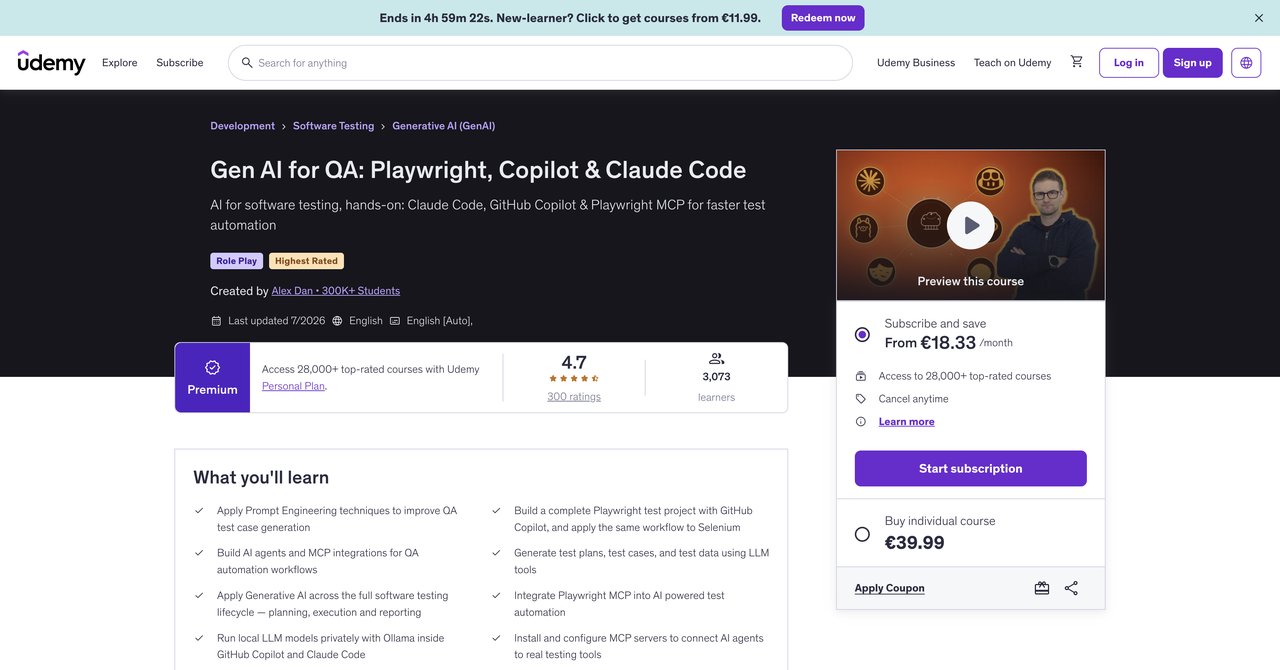
This hands-on Udemy course focuses on using Claude and GitHub Copilot for test automation, with practical examples throughout. It has a high learner satisfaction rating of 4.7 out of 5, which suggests that the content is well-received by students. For QA managers, this course offers a concrete view of what AI-powered automation looks like in practice, which can inform tooling and budget decisions.
The course is practical rather than theoretical. You'll see real examples of how Claude and GitHub Copilot can be used to generate test code, identify test scenarios, and automate repetitive tasks. This is valuable for managers who need to understand the capabilities and limitations of these tools before making investment decisions. It also helps you have more informed conversations with your automation engineers about what's possible.
The main limitation is that it's focused on automation engineers rather than management strategy. If you don't have some automation background, you might struggle with parts of the course. It assumes familiarity with automation concepts and probably some coding experience. For a non-technical QA manager, this could be a steep learning curve.
Key Topics Covered
Using Claude and GitHub Copilot for test automation, generating test code with AI, practical automation examples, integrating AI tools into existing automation frameworks, and evaluating the quality of AI-generated test code.
Target Audience and Skill Level
This is best suited for QA professionals with some automation background. If you're a manager who has previously worked as an automation engineer, you'll find this accessible. If you're purely managerial with no technical background, you might find it challenging. The course is also suitable for SDETs and automation testers who want to incorporate AI tools into their workflow.
Pros
- Hands-on with Claude and GitHub Copilot
- Practical automation examples
- High learner satisfaction at 4.7/5
- Informs tooling and budget decisions for managers
- Reasonable price, often discounted
Cons
- Focused on automation engineers, not management strategy
- Assumes some automation background
- Not suitable for complete beginners
- No certification credential
Who Would Benefit Most
QA managers with a technical background who want to understand AI automation tools at a practical level. It's also excellent for automation engineers and SDETs who want to add AI skills. If you're responsible for choosing automation tools for your team, this course gives you the context you need to make informed decisions.
Visit Gen AI for QA Test Automation on Udemy
Course 7: ISTQB Artificial Intelligence Testing by Udemy
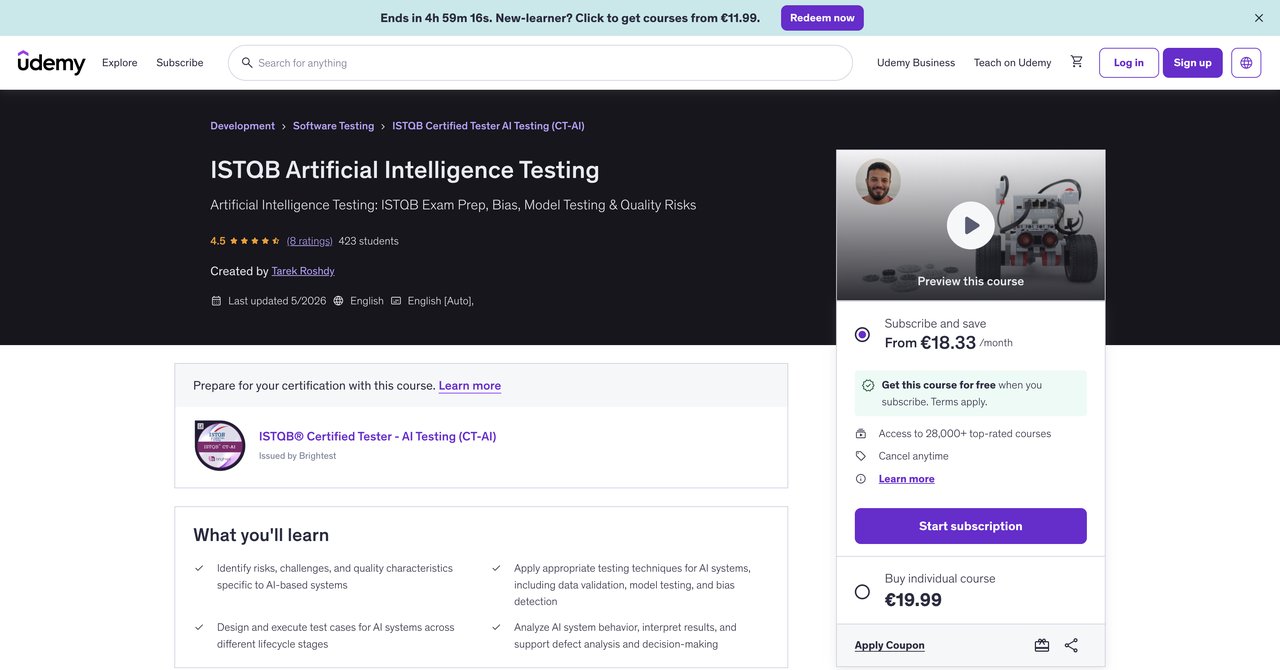
This Udemy course is aligned with the ISTQB AI Tester Certification syllabus, which makes it a structured and exam-focused option. The content covers testing AI-based systems comprehensively, which is different from most other courses that focus on using AI to test software. This is an important distinction. The course teaches you how to test AI systems themselves, including machine learning models, rather than how to use AI tools in your testing processes.
For QA managers, this is relevant if your organization is building AI-powered products. Understanding how to test AI systems is becoming increasingly important as more companies incorporate machine learning into their software. The course is structured around the ISTQB syllabus, so it's comprehensive and well-organized. If you're planning to take the ISTQB AI Tester certification exam, this course is designed to prepare you for it.
The downside is that it focuses on testing AI systems, not on using AI to manage QA teams. If you're looking for practical guidance on how to implement AI tools in your testing processes, this isn't the right course. It's also heavy on theory, which might not suit all managers who prefer practical, hands-on learning.
Key Topics Covered
Testing AI-based systems, machine learning model validation, data quality considerations, AI system risk assessment, and the ISTQB AI Tester certification syllabus. The course also covers ethical considerations and limitations of AI testing.
Target Audience and Skill Level
This is suitable for QA professionals who need to test AI systems as part of their work. It's also relevant for managers who oversee teams that test AI products. Some testing background is assumed, and a basic understanding of machine learning concepts would be helpful. It's not designed for those who want to learn how to use AI tools in their testing workflow.
Pros
- Aligned with ISTQB AI Tester Certification syllabus
- Comprehensive coverage of testing AI-based systems
- Structured and exam-focused
- Relevant for organizations building AI products
- Affordable price point
Cons
- Focuses on testing AI systems, not using AI to manage QA teams
- Heavy theory may not suit all managers
- Requires some testing background
- Not practical for day-to-day AI tool usage
Who Would Benefit Most
QA managers whose organizations are building AI-powered products and who need to understand how to test those systems. It's also good for those planning to take the ISTQB AI Tester certification. If you're looking for practical guidance on using AI tools in your QA processes, look elsewhere.
Visit ISTQB Artificial Intelligence Testing on Udemy
Course 8: AI for Software Testers: GenAI, AI Agents, MCP & Agentic AI by Udemy
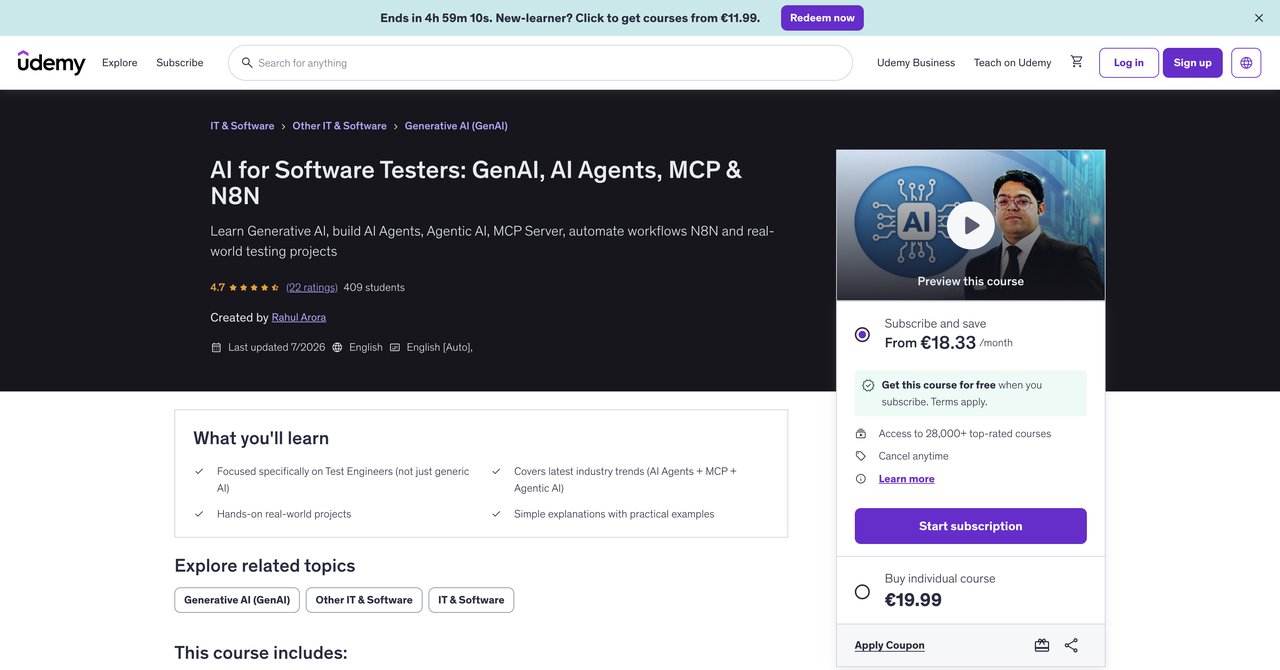
This Udemy course covers cutting-edge topics like AI agents, MCP Server, and agentic AI, with real-world projects for automation testers and SDETs. It's one of the more advanced options on this list, focused on the latest developments in AI as they apply to software testing. For QA managers who want to stay ahead of the curve, this course provides insight into where AI testing is heading.
The content is practical and project-based. You'll work through real-world scenarios that show how AI agents can be used in testing contexts. The inclusion of MCP Server and agentic AI is notable because these are emerging areas that most courses don't cover yet. If you want to understand the future of AI in testing, this course gives you a preview.
The main limitation is that it's not management-focused. It's designed for automation testers and SDETs, and it requires some automation background, specifically with tools like Selenium, Playwright, or Cypress. For a non-technical QA manager, this would be difficult to follow. But for a manager with a technical background, it offers valuable insights into advanced AI applications.
Key Topics Covered
AI agents in testing, MCP Server configuration and use, agentic AI concepts, real-world projects for automation testers, and advanced AI applications in QA workflows. The course also covers how to integrate these advanced AI concepts into existing automation frameworks.
Target Audience and Skill Level
This is aimed at automation testers and SDETs with existing automation experience. QA managers with a technical background can benefit, but those without automation skills will struggle. The course assumes familiarity with Selenium, Playwright, or Cypress.
Pros
- Covers cutting-edge topics: AI agents, MCP Server, and agentic AI
- Real-world projects provide practical experience
- Suitable for automation testers and SDETs
- Insight into future directions of AI in testing
- Reasonable price, often discounted
Cons
- Not management-focused
- Requires some automation background
- Advanced content may be overwhelming for beginners
- No certification credential
Who Would Benefit Most
QA managers with a strong technical background who want to understand the cutting edge of AI in testing. It's also excellent for automation engineers and SDETs who want to stay current with AI developments. If you're responsible for evaluating advanced AI testing tools, this course provides useful context.
Visit AI for Software Testers on Udemy
Final Recommendations and Summary
So, which course should you choose? That depends on your specific situation, and honestly, there's no universal answer. Let's break it down by different scenarios.
If you want the most comprehensive coverage for the lowest cost, CompleteAI Training is hard to beat. The subscription model gives you access to hundreds of courses and certifications across every job role, not just QA. For $8.25 to $29 per month, you get continuous updates and the ability to learn across multiple disciplines. This is particularly strong if you're responsible for upskilling a team or if you're planning to move into a broader leadership role. The all-courses-and-all-certifications approach means you never have to worry about buying a single course and then finding out you need another one. It's a genuinely different model from everything else on this list.
If you prefer a live, instructor-led experience and you're based in Europe or can work with European time zones, the Sii Poland course for QA Leaders and Managers is worth investigating. It's specifically designed for managers, which is rare in this space. The small class size suggests a high-quality experience. The main issue is the unknown price, so you'll need to contact them for a quote and decide if it fits your budget.
If you need an official certification credential, the CT-GenAI from QA is the most recognized option on this list. It's expensive at $2,575 and up, and the fixed scheduling might be inconvenient, but the certification carries weight. If your employer is willing to pay and you need the credential for career advancement or client credibility, this is the one to go for.
If you're a hands-on manager who wants to understand the specific tools your team would use, the Coursera course on GenAI for QA (covering ChatGPT, Claude, Google Bard, and TestRigor) is a practical choice. It's not management-focused, but it gives you direct exposure to the tools. Similarly, the Udemy course on Claude and GitHub Copilot is useful if you have some automation background and want to understand AI-powered test automation specifically.
If you're completely new to AI and want a low-cost starting point, the Udemy prompt engineering course is a reasonable first step. It's short, affordable, and accessible to non-programmers. It won't make you an expert, but it builds foundational knowledge.
If your organization is building AI-powered products and you need to understand how to test those systems, the ISTQB AI Testing course is the relevant choice. It's different from the others in that it focuses on testing AI rather than using AI to test. That's an important distinction that shouldn't be overlooked.
And if you're a technically strong manager who wants to stay ahead of the curve, the Udemy course on AI agents and agentic AI offers a glimpse into the future. It's advanced and assumes automation experience, but it covers topics that few other courses address.
Ultimately, the best choice depends on your budget, your technical background, your career goals, and whether you need a certification. For most QA managers, the subscription model of CompleteAI Training offers the best value and the most flexibility, especially because it includes certifications and covers other job roles. But if you have specific needs around live instruction, formal certification, or deep technical training, one of the other options might be a better fit. Take your time, consider your situation honestly, and choose accordingly.