AI app for education · no coding needed
Vocational scenario simulator
Industry-specific situations evaluated against observable vocational competencies.
Made for: Vocational training providers
What it does for you
The problem
Learners cannot safely practice every difficult workplace situation.
What it gives you
Scenario transcripts and competency feedback
What you give it
Trainer-authored scenarioscompetency rubrics
How it works, step by step
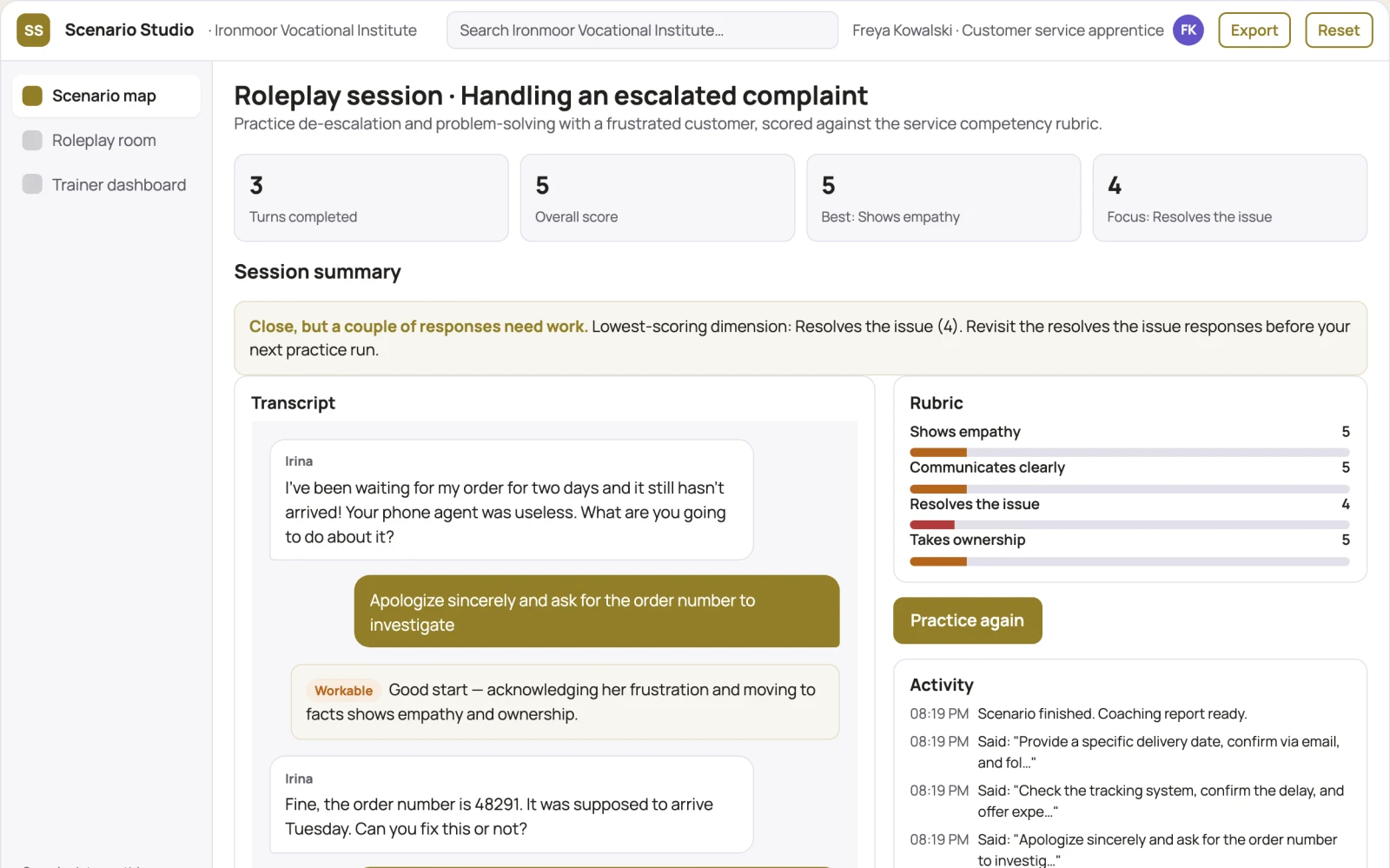
- Simulate customer interactions
- Vary constraints
- Branch consequences
- Capture decisions
- Score against rubrics
- Support trainer debriefs
What you see on screen
- Scenario map
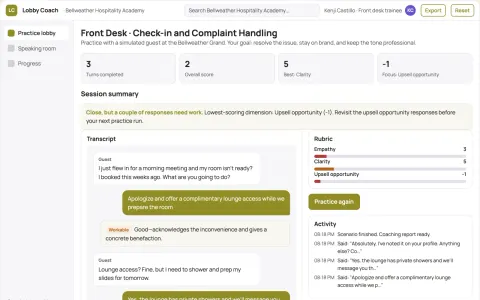
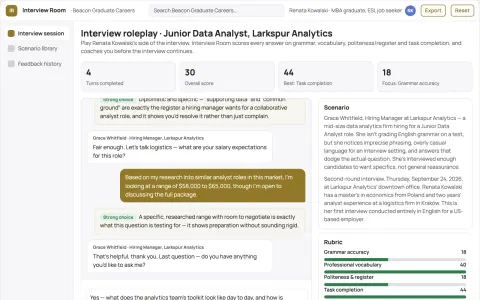
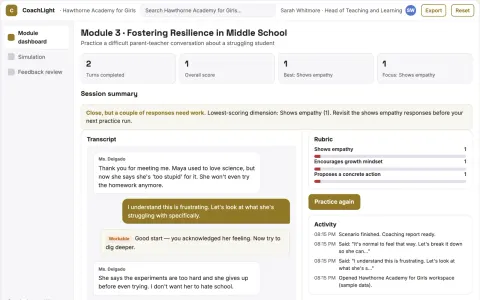
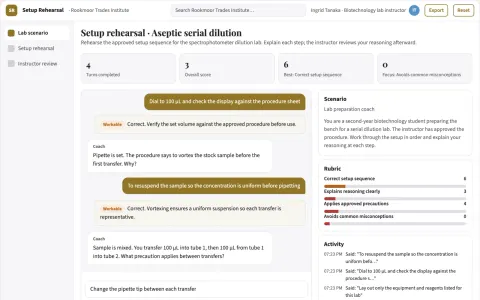
- roleplay room
- trainer dashboard
Jobs this app suits
Our AI checked this app against 500 jobs; these get the most out of it. Each job links to its learning path.
Build it yourself with your AI system
Build this app yourself, no coding needed
Start with a quick version you can try in a few minutes. Like it? Then build the full app by copying and pasting our step-by-step instructions: everything is prepared for you.
Sign in to see how to build it yourself
Build a quick version to try, or get the full app pack for Vocational scenario simulator with the step-by-step building instructions. You don't need any technical skills: you copy, paste and answer a few questions. Both are included in the membership.
4 Have it built for you days to a few weeks
Rather not do it yourself, or want it fully tailored to your data, your way of working and your brand? Nexibeo builds Vocational scenario simulator with you.
What's in the app pack
Included in the Complete AI Training membership.
- The building instructions your AI follows, step by step
- The questions your AI will ask you about your business before it starts
- A clickable demo you can open in your browser, to see how it should work
- A detailed blueprint of the screens, the information it keeps and the checks it runs
Become a member to get the app packAlready a member? Sign in
The files, for the technically curious
- START-HERE.mdHow to build it with your own AI (read first)3 KB
- README.mdOverview and links1 KB
- questions.mdQuestions to answer before you build2 KB
- prompt-cloudflare.mdThe full build prompt, hosted on Cloudflare23 KB
- prompt-vps.mdThe same build on your own server (Docker)23 KB
- spec.jsonData model, API, AI pipeline, acceptance criteria13 KB
- demo/index.htmlThe working demo on sample data198 KB
Questions
Do I need to know how to code?
No. You copy and paste the prompts on this page into ChatGPT or Claude, and the AI does the building. When it asks you something, you answer in your own words.
What does it cost?
The quick version, the app pack and the step-by-step instructions are for members: you pay the membership price, not a price per app (see the plans). Building the full app uses your own ChatGPT or Claude subscription. Putting it online is often cheap or no cost at the start, and your AI tells you before anything costs money.
How long does it take?
The quick version: about two minutes. The real app: an afternoon for a first version you can use, longer if you want every feature.
Can I change it to fit my business?
Yes. Tell your AI what to change in plain words, like “add a column for the price” or “use our logo and colours”. Or have Nexibeo build and customise it for you.
More detailsHow the AI works, safeguards and what to build first
For vocational training providers, turn trainer-authored scenarios and competency rubrics into scenario transcripts and competency feedback. Address the recurring problem: learners cannot safely practice every difficult workplace situation. The pilot measures trainer-rated competence and repeated error reduction against the buyer's current method, before the larger build.
Set the participant’s goal, choose or customize a scenario, conduct an interactive session, record choices or dialogue, review evidence-based feedback with a facilitator when needed, and repeat selected parts with changed constraints. Start with trainer-authored scenarios and competency rubrics and finish with scenario transcripts and competency feedback.
How the AI works
Generate responsive dialogue, alternative situations and structured reflection prompts. Ground feedback in agreed goals or rubrics. Treat creative choices and facilitator judgment as authoritative. Evaluate specific actions rather than infer personality or hidden traits.
Safeguards
Use educator-reviewed content and answer keys. Apply appropriate access and consent for learner records and distinguish completion from demonstrated learning. Validate source access and reviewer availability during the pilot. Maintain customer-level access, data deletion controls and a record of final approvals.
What to build first
Begin with vocational training providers and one recurring use case. Build the first two modules: simulate customer interactions; vary constraints. Provide operator assistance for the third module: branch consequences. Deliver scenario transcripts and competency feedback through a manual review queue. Perform other necessary full-scope functions manually during the pilot. Include all applicable access, accuracy and professional-review controls from the start.
What it can connect to
Learning resources, course portals and educator review processes. Learning portals, calendar scheduling and authorized session exports. Make recording, sharing and retention controls explicit in the product. These are candidate integration categories, not verified supported connectors.
The screens in detail
Use a scenario catalog with clear goals and difficulty settings. The main session area supports text, optional voice and visible context. Follow it with a replay or decision map, annotated feedback and a next-practice plan. Facilitators can author scenarios and review participant-selected sessions. In this product, the first view is scenario map, followed by roleplay room and trainer dashboard.