AI app for it and development · no coding needed
Remote AI agent approval coordination portal
Keep agents moving while a named human stays in control of risky actions.
Made for: Engineering teams running AI coding agents on shared hosts
What it does for you
The problem
AI coding agents block on permission prompts and questions that only a human at the keyboard can answer, so work stalls when nobody is at the terminal.
What it gives you
Routed, policy-checked approval decisions
What you give it
Agent configurationshost inventorypolicy rulesrouting targets
Build your own version of Pushary, CodeMote and more
One app with what these 3 AI tools do, yours to keep and change: Pushary, CodeMote, Preloop.
Everything these tools do, in one app
- Remote approval of agent actions Lets a human approve or deny what an AI agent wants to do from a phone or another channel instead of being at the keyboard.Found in Pushary, CodeMote, Preloop
- Lock screen notifications Pushes an alert to the phone's lock screen when the agent needs attention or input.Found in Pushary, CodeMote
- Enforced gating before execution Holds a risky command or action until the human responds, so it cannot proceed unanswered.Found in Pushary, Preloop
- Works with multiple agents Supports several different AI coding agents or CLI tools rather than being tied to one vendor.Found in Pushary, CodeMote
- Per-tool approval policies Lets you set rules for each tool, including path-level granularity, to control which actions need approval.Found in Pushary
- Auto-approve safe operations Automatically approves low-risk actions such as reads under a specified path.Found in Pushary
- Deny dangerous operations Blocks specified dangerous operations outright instead of sending them for approval.Found in Pushary
- Rule specificity and overrides Matches rules by specificity, with explicit rules overriding defaults.Found in Pushary
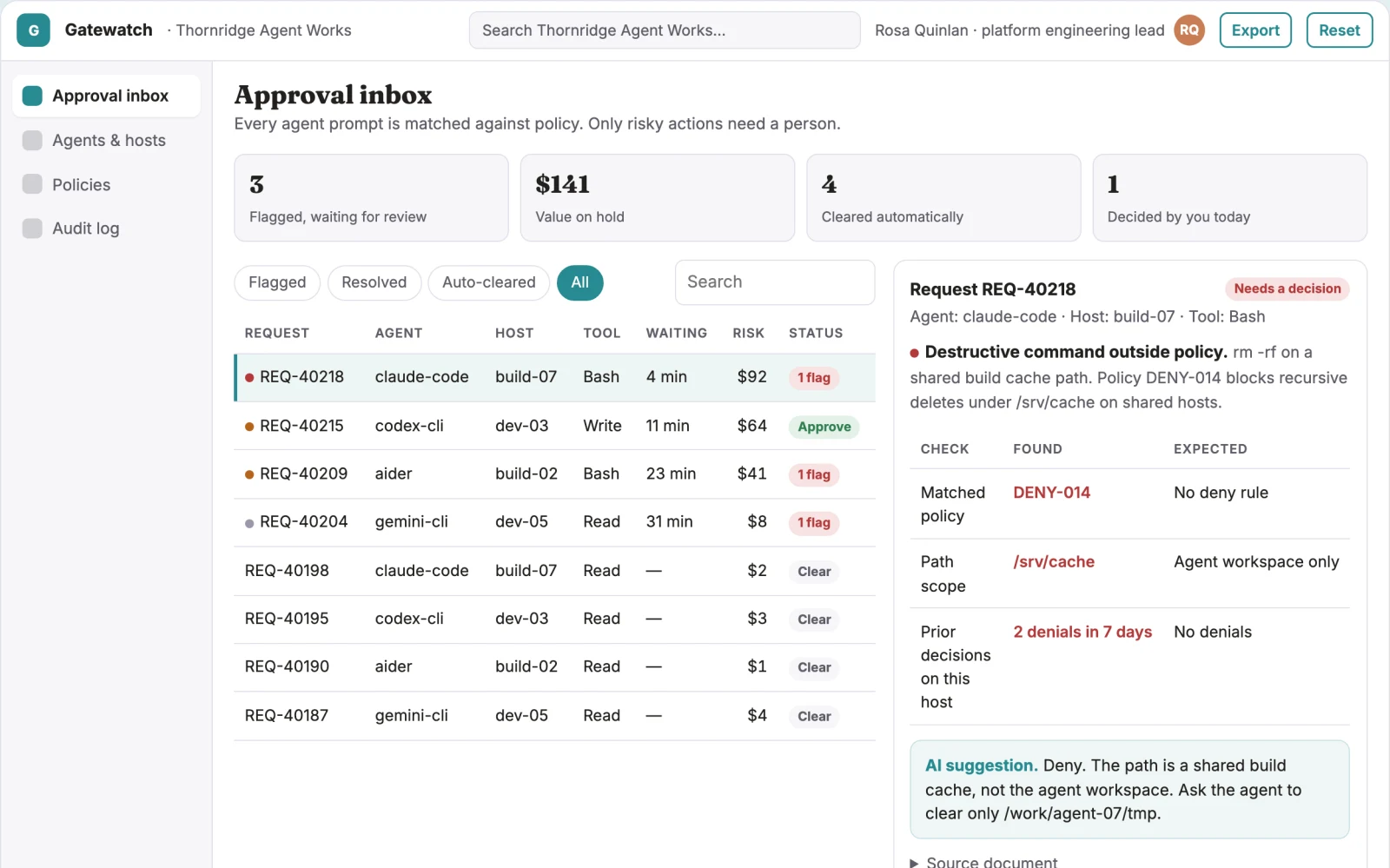
- Unified approval inbox Collects approval requests from all agents and machines into a single queue.Found in Pushary
- Approval via Slack or Teams Routes approval requests to Slack or Teams so they can be answered there.Found in Pushary, Preloop
- Exportable audit trail Records every question and answer, including the policy target that matched, and lets you export it.Found in Pushary
- Fallback channels on timeout If the phone is unreachable, approvals can time out and fall back to the terminal, web dashboard, or Slack.Found in Pushary
- QR-code pairing Pairs the phone with a terminal by scanning a QR code instead of copying API keys.Found in Pushary
- Native mobile apps Provides native iPhone and Android apps rather than relying on web push.Found in Pushary
- Fail-closed behavior Missing or clearing a notification denies or waits, never auto-approves.Found in Pushary
- Live terminal session mirror Streams the terminal output in real time so you can watch the agent work from the phone.Found in CodeMote
- Git diff viewer Shows git diffs on the phone so you can review changes.Found in CodeMote
- File editor Lets you edit files from the phone.Found in CodeMote
- Speech-to-text input Lets you dictate text instead of typing on the phone keyboard.Found in CodeMote
- Direct encrypted connection Connects over an encrypted tunnel with no relay server, so code never touches the developer's infrastructure.Found in CodeMote
- Multiple concurrent sessions Runs several terminals at once, each with its own Live Activity and independent push notifications.Found in CodeMote
- Command shortcuts Stores common commands as shortcuts for quick reuse.Found in CodeMote
- Session persistence across network drops Keeps the agent running on the host and restores the full terminal state when you reconnect.Found in CodeMote
- MCP proxy architecture Intercepts tool calls by acting as an MCP proxy, working with existing MCP clients and servers with minimal configuration changes.Found in Preloop
- Flexible operation modes Lets teams choose automation only, approval gates only, or both combined.Found in Preloop
- Audit logs and payload capture Keeps detailed logs and captured request payloads for compliance and forensic review.Found in Preloop
- Approval routing to people or teams Routes approval requests to individuals, teams, or channels to avoid single-person bottlenecks.Found in Preloop
- Model-assisted risk scoring Planned option to use a model to score risk and reduce manual approval volume.Found in Preloop
How it works, step by step
- Route agent permission prompts and questions to a phone or another channel
- Push lock-screen notifications when an agent needs attention or input
- Hold risky commands until a human responds
- Support multiple AI coding agents and CLI tools
- Apply per-tool approval policies with path-level granularity
- Auto-approve low-risk operations such as reads under a specified path
- Deny specified dangerous operations outright
- Match rules by specificity with explicit rules overriding defaults
- Collect requests from all agents and machines into one inbox
- Route approvals to Slack or Teams
- Record every question and answer with the matched policy target and export it
- Fall back to terminal, web dashboard or Slack on timeout
- Pair a phone with a terminal by QR code
- Provide native iPhone and Android apps
- Fail closed when a notification is missing or cleared
- Mirror the live terminal session
- Show git diffs on the phone
- Edit files from the phone
- Accept speech-to-text input
- Connect over an encrypted tunnel with no relay server
- Run multiple concurrent sessions with independent notifications
- Store common commands as shortcuts
- Persist sessions across network drops and restore terminal state
- Intercept tool calls as an MCP proxy
- Let teams choose automation only, approval gates only, or both
- Keep detailed logs and captured request payloads
- Route requests to individuals, teams or channels
- Score request risk with a model to reduce manual approval volume
Jobs this app suits
Our AI checked this app against 500 jobs; these get the most out of it. Each job links to its learning path.
Build it yourself with your AI system
Build this app yourself, no coding needed
Start with a quick version you can try in a few minutes. Like it? Then build the full app by copying and pasting our step-by-step instructions: everything is prepared for you.
Sign in to see how to build it yourself
Build a quick version to try, or get the full app pack for Remote AI agent approval coordination portal with the step-by-step building instructions. You don't need any technical skills: you copy, paste and answer a few questions. Both are included in the membership.
4 Have it built for you days to a few weeks
Rather not do it yourself, or want it fully tailored to your data, your way of working and your brand? Nexibeo builds Remote AI agent approval coordination portal with you.
What's in the app pack
Included in the Complete AI Training membership.
- The building instructions your AI follows, step by step
- The questions your AI will ask you about your business before it starts
- A clickable demo you can open in your browser, to see how it should work
- A detailed blueprint of the screens, the information it keeps and the checks it runs
Become a member to get the app packAlready a member? Sign in
The files, for the technically curious
- START-HERE.mdHow to build it with your own AI (read first)3 KB
- README.mdOverview and links5 KB
- questions.mdQuestions to answer before you build2 KB
- prompt-cloudflare.mdThe full build prompt, hosted on Cloudflare26 KB
- prompt-vps.mdThe same build on your own server (Docker)26 KB
- spec.jsonData model, API, AI pipeline, acceptance criteria12 KB
- demo/index.htmlThe working demo on sample data196 KB
Questions
Do I need to know how to code?
No. You copy and paste the prompts on this page into ChatGPT or Claude, and the AI does the building. When it asks you something, you answer in your own words.
What does it cost?
The quick version, the app pack and the step-by-step instructions are for members: you pay the membership price, not a price per app (see the plans). Building the full app uses your own ChatGPT or Claude subscription. Putting it online is often cheap or no cost at the start, and your AI tells you before anything costs money.
How long does it take?
The quick version: about two minutes. The real app: an afternoon for a first version you can use, longer if you want every feature.
Can I change it to fit my business?
Yes. Tell your AI what to change in plain words, like “add a column for the price” or “use our logo and colours”. Or have Nexibeo build and customise it for you.
More detailsHow the AI works, safeguards and what to build first
Keep agents moving while a named human stays in control of risky actions. For engineering teams running AI coding agents on shared hosts, convert agent permission prompts, tool calls and questions into routed, policy-checked approval requests that a human can answer from a phone, Slack or Teams. The benefit is a testable hypothesis, measured through approval latency, unanswered-prompt rate and reviewer correction time; do not assume that AI output alone produces business value.
Confirm the buyer's problem and scope, collect agent configurations, host inventory, policy rules and routing targets, then follow this sequence: 1. Route agent permission prompts and questions to a phone or another channel. 2. Push lock-screen notifications when an agent needs attention or input. 3. Hold risky commands until a human responds. Resolve uncertain cases with qualified reviewers, approve routed, policy-checked approval decisions, and measure approval latency, unanswered-prompt rate and reviewer correction time against a documented baseline.
How the AI works
Use AI to interpret permitted inputs, suggest structured mappings and generate candidate outputs for the three stated task modules. Use deterministic code for policy matching, gating, schema validation, hard constraints and reproducible tests. Review source-linked explanations and uncertainty before accepting results. Model-assisted risk scoring is a planned option; final approval and denial remain human. A model suggestion is never a verified fact, professional decision or authorization to act.
Safeguards
Preserve agent permissions, source attribution, command accuracy and usage permissions. Named humans approve substantive actions and execution scope. One agent type, one host group and one routing channel; final approval and denial remain human. Keep all consequential actions under authorized human control and do not fabricate missing inputs, permissions, professional judgments or market evidence.
What to build first
Pilot scope: One agent type, one host group and one routing channel; final approval and denial remain human. Implement one approved input format, a bounded representative case set and the first two task modules: route agent permission prompts and questions to a phone or another channel; push lock-screen notifications when an agent needs attention or input. Support the third module with operator review: hold risky commands until a human responds. Include source references, corrections, basic organization access, approval states, export and value measurement. Use managed operator assistance for unresolved exceptions. The cost estimate covers this narrow prototype, not unrestricted multi-tenant scale, complex production integrations, specialist certification or physical operations.
What it can connect to
Agent-owned configurations, authorized host access and permitted notification channels. Cloud secret storage, Slack and Teams, git providers and MCP clients and servers. Start with file exchange and validate destination specifications before promising direct publishing. Start with authorized file exchange. Validate current provider access, usage rights and schema behavior before promising a connector.
The screens in detail
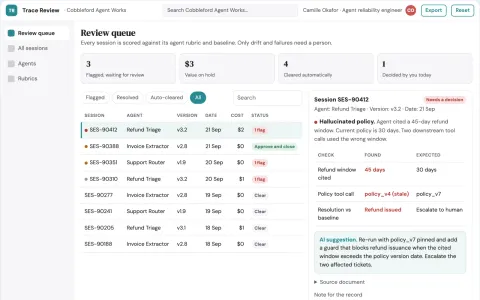
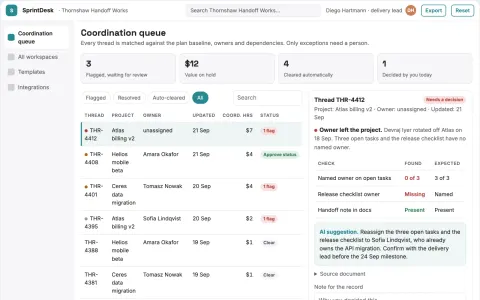
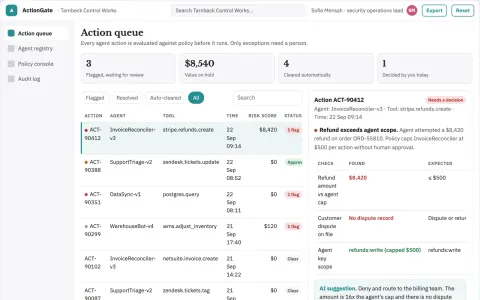
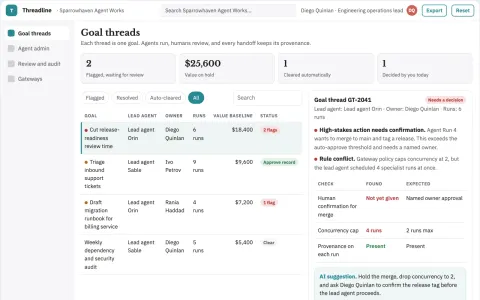
Primary screens: Agent and host registry, Policy and routing rules, Approval inbox, Audit and export. Use a queue list for pending requests, a detail pane showing the command, path, agent, host and matched policy, and a right-hand panel for decision, comment and fallback channel. Let users compare a request against its policy target and prior decisions. Display pending, approved, denied, timed-out and fallback states. Provide a phone lock-screen action and a Slack or Teams message with the same decision controls. Make the task-specific outcome routed, policy-checked approval decisions visible beside its evidence, review state and value baseline.