AI app for science and research · no coding needed
Instrument log analyst
Equipment-specific context with evidence for investigation rather than automatic diagnosis.
Made for: Laboratory equipment managers
What it does for you
The problem
Maintenance signals are buried in unstructured instrument records.
What it gives you
Instrument investigation brief
What you give it
Authorized equipment logsmaintenance history
How it works, step by step
- Parse log events
- Align timestamps
- Identify unusual patterns
- Compare maintenance periods
- Flag investigation candidates
- Record technician conclusions
What you see on screen
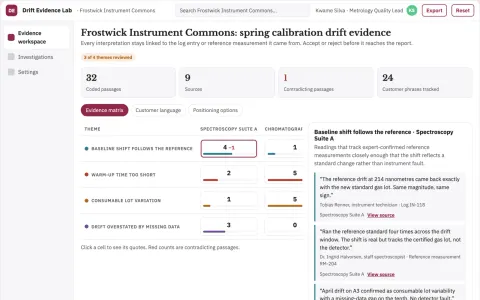
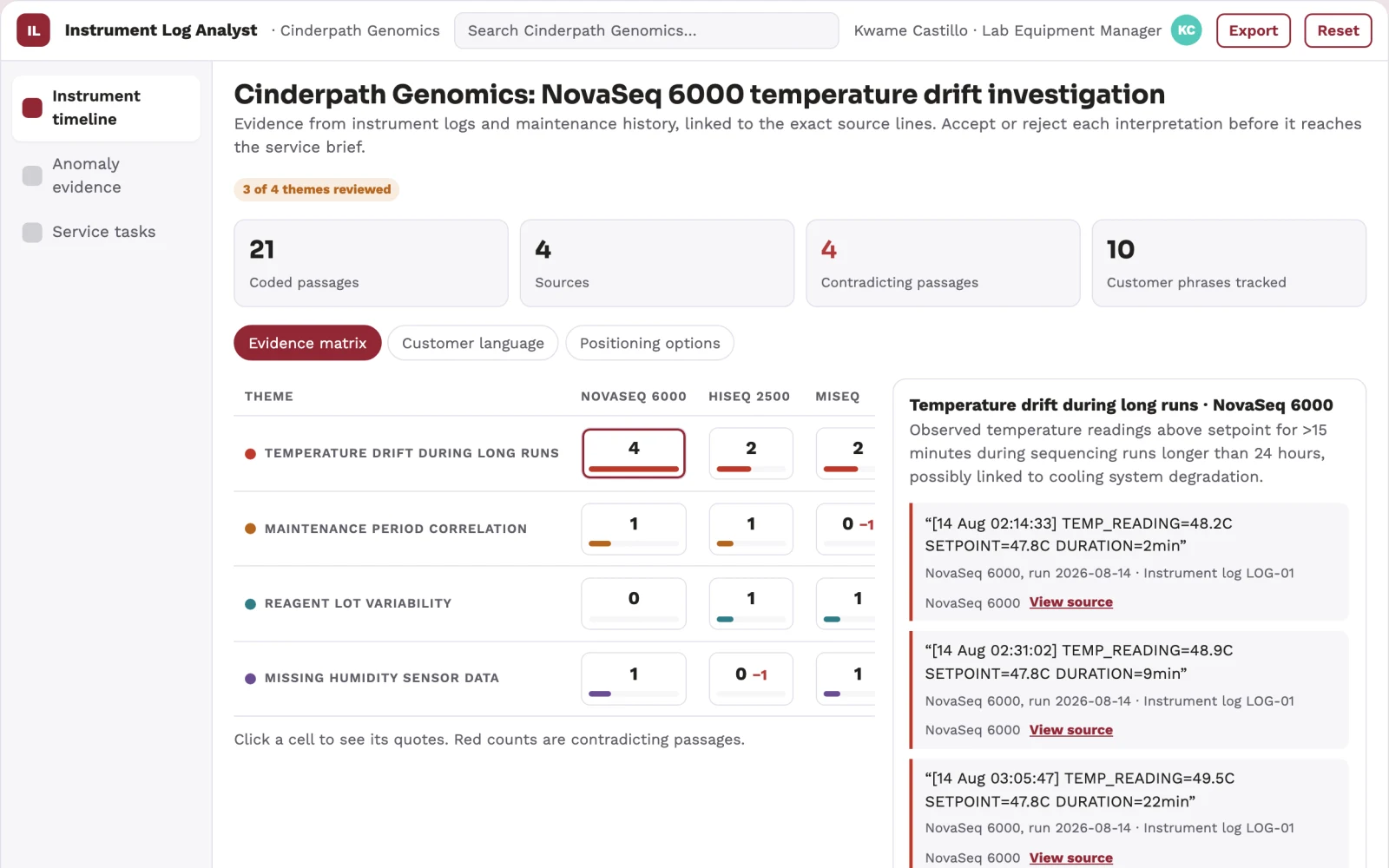
- Instrument timeline
- anomaly evidence
- service tasks
Jobs this app suits
Our AI checked this app against 500 jobs; these get the most out of it. Each job links to its learning path.
Build it yourself with your AI system
Build this app yourself, no coding needed
Start with a quick version you can try in a few minutes. Like it? Then build the full app by copying and pasting our step-by-step instructions: everything is prepared for you.
Sign in to see how to build it yourself
Build a quick version to try, or get the full app pack for Instrument log analyst with the step-by-step building instructions. You don't need any technical skills: you copy, paste and answer a few questions. Both are included in the membership.
4 Have it built for you days to a few weeks
Rather not do it yourself, or want it fully tailored to your data, your way of working and your brand? Nexibeo builds Instrument log analyst with you.
What's in the app pack
Included in the Complete AI Training membership.
- The building instructions your AI follows, step by step
- The questions your AI will ask you about your business before it starts
- A clickable demo you can open in your browser, to see how it should work
- A detailed blueprint of the screens, the information it keeps and the checks it runs
Become a member to get the app packAlready a member? Sign in
The files, for the technically curious
- START-HERE.mdHow to build it with your own AI (read first)3 KB
- README.mdOverview and links1 KB
- questions.mdQuestions to answer before you build3 KB
- prompt-cloudflare.mdThe full build prompt, hosted on Cloudflare23 KB
- prompt-vps.mdThe same build on your own server (Docker)23 KB
- spec.jsonData model, API, AI pipeline, acceptance criteria13 KB
- demo/index.htmlThe working demo on sample data196 KB
Questions
Do I need to know how to code?
No. You copy and paste the prompts on this page into ChatGPT or Claude, and the AI does the building. When it asks you something, you answer in your own words.
What does it cost?
The quick version, the app pack and the step-by-step instructions are for members: you pay the membership price, not a price per app (see the plans). Building the full app uses your own ChatGPT or Claude subscription. Putting it online is often cheap or no cost at the start, and your AI tells you before anything costs money.
How long does it take?
The quick version: about two minutes. The real app: an afternoon for a first version you can use, longer if you want every feature.
Can I change it to fit my business?
Yes. Tell your AI what to change in plain words, like “add a column for the price” or “use our logo and colours”. Or have Nexibeo build and customise it for you.
More detailsHow the AI works, safeguards and what to build first
For laboratory equipment managers, turn authorized equipment logs and maintenance history into instrument investigation brief. Address the recurring problem: maintenance signals are buried in unstructured instrument records. The pilot measures confirmed useful alerts and false alarms against the buyer's current method, before the larger build.
Agree definitions, import authorized data, validate coverage and identifiers, compute transparent measures, group relevant evidence, review findings, assign investigations or improvements, and repeat on a comparable period. Start with authorized equipment logs and maintenance history and finish with instrument investigation brief.
How the AI works
Classify text, summarize evidence and propose explanations to investigate. Compute financial or operational measures with deterministic code. Separate observed patterns from causal claims and preserve examples that contradict the summary.
Safeguards
Preserve original data, methods, citations and research limitations. Use researcher review and document every substantive transformation. Validate source access and reviewer availability during the pilot. Maintain customer-level access, data deletion controls and a record of final approvals.
What to build first
Begin with laboratory equipment managers and one recurring use case. Build the first two modules: parse log events; align timestamps. Provide operator assistance for the third module: identify unusual patterns. Deliver instrument investigation brief through a manual review queue. Perform other necessary full-scope functions manually during the pilot. Include all applicable access, accuracy and professional-review controls from the start.
What it can connect to
Authorized datasets, papers, protocols, code and research records. Read-only business data exports, reporting databases and task trackers. Reconcile source totals before scheduling recurring data refreshes. These are candidate integration categories, not verified supported connectors.
The screens in detail
Open with a compact overview and filters for the relevant period or segment. Let users drill from each theme or metric into underlying records. Keep source definitions and missing-data notes near the result. Use an action panel to assign investigations and record what was learned. In this product, the first view is instrument timeline, followed by anomaly evidence and service tasks.