AI app for science and research · no coding needed
Evidence-backed visual research synthesis workspace
Reduce manual synthesis effort while keeping every claim traceable to its source.
Made for: Research teams, analysts and educators who turn documents, web pages and media into visual maps and study material
What it does for you
The problem
Insights and source material are scattered across papers, PDFs, videos and notes, so building cited visual maps and study outputs takes repeated manual work.
What it gives you
Reviewer-approved visual maps, diagrams and study outputs linked to source citations
What you give it
Permitted documentsPDFsweb pagesmedia transcriptsknowledge-source queriespasted notes
Build your own version of Minduck, ResearchFlow and more
One app with what these 9 AI tools do, yours to keep and change: Minduck, ResearchFlow, Heuristica, Infira, AI Mindmap Extension, Grimo AI, Jumprun, Map This, Clevr.
Everything these tools do, in one app
- AI content suggestions Provides AI-generated ideas and suggestions to inspire creativity and assist with writing.Found in Minduck
- Grammar and style corrections Offers real-time corrections for grammar and writing style.Found in Minduck
- Customizable templates Provides templates that can be customized for different writing formats.Found in Minduck
- Team collaboration Enables multiple users to work together on projects in real time.Found in Minduck, Heuristica
- Word processor integration Integrates with popular word processing software for a smoother workflow.Found in Minduck
- AI-powered analysis Uses AI to analyze information from sources and extract reliable, citeable insights.Found in ResearchFlow
- Visual mind mapping Generates interactive mind maps to visualize complex topics and relationships between ideas.Found in ResearchFlow, Heuristica, AI Mindmap Extension and 1 more
- Chart and graph breakdown Simplifies complex charts and graphs by highlighting key trends without requiring advanced data expertise.Found in ResearchFlow
- Automated research workflow Automates data collection and analysis to save time and streamline the research process.Found in ResearchFlow
- Simplified interaction Allows users to interact with AI by pressing buttons instead of writing complex prompts.Found in Heuristica
- Study material generation Transforms concept maps into study outputs such as flashcards, quizzes, study notes, essays, and lesson plans.Found in Heuristica
- Integrated knowledge sources Gathers information from multiple platforms like Wikipedia, arXiv, PubMed, Semantic Scholar, and YouTube in one place.Found in Heuristica
- Personalized learning Adapts the learning experience to the individual user.Found in Heuristica
- Content outline and summary generation Generates outlines or summaries based on the user's explorations.Found in Heuristica
- Instant flowchart generation Creates flowcharts instantly from text or outlines.Found in Infira
- Auto-building timelines Automatically arranges events and milestones into timelines.Found in Infira
- Interactive 3D concept maps Displays concept maps in 3D that reveal connections between ideas interactively.Found in Infira
- History view Allows users to revisit prior versions of their visuals.Found in Infira
- One-click conversion Converts web pages, PDFs, YouTube videos, and AI chats into mind maps with a single click.Found in AI Mindmap Extension
- AI-powered insights Uses AI to uncover patterns and generate ideas from content.Found in AI Mindmap Extension, Jumprun
- Integration with AI workspace Integrates with a larger AI-powered workspace for expanded brainstorming and exploration.Found in AI Mindmap Extension
- Information aggregation Collects data from diverse sources into one centralized platform.Found in Grimo AI
- Organization and distillation Organizes and refines data to capture the essence of notes and research.Found in Grimo AI
- Collaborative insights Allows users to fork (copy and customize) insights contributed by others for collaborative learning.Found in Grimo AI
- Query-over-search Uses a query-based approach to quickly extract relevant information without traditional search clutter.Found in Grimo AI
- Interactive canvases Provides dynamic canvases to visualize and engage with data interactively.Found in Jumprun
- Multi-source integration Aggregates information from various online platforms such as websites, YouTube, and social media.Found in Jumprun
- Continuously updated content Keeps visual data current by regularly updating content.Found in Jumprun
- PDF to mind map conversion Automatically converts PDF documents into structured mind maps.Found in Map This
- Multiple input options Allows users to generate maps from pasted notes or AI prompts in addition to PDFs.Found in Map This
- Downloadable output Saves generated mind maps as PNG or SVG files for easy sharing and future reference.Found in Map This
- User-friendly workflow Provides a streamlined process (e.g., upload, generate, save/share) for efficiency.Found in Map This
- Voice-based explanations Explains concepts through voice narration while visually illustrating ideas on a canvas.Found in Clevr
- Diagram generation Generates various diagrams such as flowcharts, timelines, and sequence diagrams.Found in Clevr
- Interactive conversation Allows users to ask follow-up questions or request clarifications during explanations.Found in Clevr
- Multi-language support Supports multiple languages for spoken interaction.Found in Clevr
- Canvas reset Provides an option to clear the canvas and restart explanations quickly.Found in Clevr
How it works, step by step
- Ingest documents, PDFs, web pages, media transcripts and pasted notes
- Extract citeable claims with source links
- Generate interactive mind maps and concept maps
- Build flowcharts, timelines and sequence diagrams from text or outlines
- Display 3D concept maps with interactive connections
- Break down charts and graphs into key trends
- Suggest content ideas and outlines from explored material
- Apply grammar and style corrections to generated text
- Offer customizable templates for maps, reports and study formats
- Generate flashcards, quizzes, study notes, essays and lesson plans from maps
- Support button-based interaction instead of complex prompts
- Aggregate knowledge sources such as Wikipedia, arXiv, PubMed, Semantic Scholar and YouTube
- Keep visual data current through scheduled source refresh
- Support real-time team collaboration and forking of shared insights
- Export maps as PNG or SVG and reports with citations
- Keep a history view of prior visual versions
Jobs this app suits
Our AI checked this app against 500 jobs; these get the most out of it. Each job links to its learning path.
Build it yourself with your AI system
Build this app yourself, no coding needed
Start with a quick version you can try in a few minutes. Like it? Then build the full app by copying and pasting our step-by-step instructions: everything is prepared for you.
Sign in to see how to build it yourself
Build a quick version to try, or get the full app pack for Evidence-backed visual research synthesis workspace with the step-by-step building instructions. You don't need any technical skills: you copy, paste and answer a few questions. Both are included in the membership.
4 Have it built for you days to a few weeks
Rather not do it yourself, or want it fully tailored to your data, your way of working and your brand? Nexibeo builds Evidence-backed visual research synthesis workspace with you.
What's in the app pack
Included in the Complete AI Training membership.
- The building instructions your AI follows, step by step
- The questions your AI will ask you about your business before it starts
- A clickable demo you can open in your browser, to see how it should work
- A detailed blueprint of the screens, the information it keeps and the checks it runs
Become a member to get the app packAlready a member? Sign in
The files, for the technically curious
- START-HERE.mdHow to build it with your own AI (read first)3 KB
- README.mdOverview and links7 KB
- questions.mdQuestions to answer before you build2 KB
- prompt-cloudflare.mdThe full build prompt, hosted on Cloudflare25 KB
- prompt-vps.mdThe same build on your own server (Docker)25 KB
- spec.jsonData model, API, AI pipeline, acceptance criteria12 KB
- demo/index.htmlThe working demo on sample data200 KB
Questions
Do I need to know how to code?
No. You copy and paste the prompts on this page into ChatGPT or Claude, and the AI does the building. When it asks you something, you answer in your own words.
What does it cost?
The quick version, the app pack and the step-by-step instructions are for members: you pay the membership price, not a price per app (see the plans). Building the full app uses your own ChatGPT or Claude subscription. Putting it online is often cheap or no cost at the start, and your AI tells you before anything costs money.
How long does it take?
The quick version: about two minutes. The real app: an afternoon for a first version you can use, longer if you want every feature.
Can I change it to fit my business?
Yes. Tell your AI what to change in plain words, like “add a column for the price” or “use our logo and colours”. Or have Nexibeo build and customise it for you.
More detailsHow the AI works, safeguards and what to build first
Reduce manual synthesis effort while keeping every claim traceable to its source. For research teams, analysts and educators who turn documents, web pages and media into visual maps and study material, convert permitted documents, web pages, media transcripts and notes into reviewer-approved visual maps, diagrams and study outputs linked to source citations. The benefit is a testable hypothesis, measured through accepted visual maps per synthesis hour and corrections after review; do not assume that AI output alone produces business value.
Confirm the buyer's problem and scope, collect permitted documents, web pages, media transcripts and notes, then follow this sequence: 1. Ingest documents, PDFs, web pages, media transcripts and pasted notes. 2. Extract citeable claims with source links. 3. Generate interactive mind maps and concept maps. Resolve uncertain cases with qualified reviewers, approve reviewer-approved visual maps, diagrams and study outputs linked to source citations, and measure accepted visual maps per synthesis hour and corrections after review against a documented baseline.
How the AI works
Use AI to interpret permitted inputs, suggest structured mappings and generate candidate outputs for the stated task modules. Use deterministic code for arithmetic, schema validation, citation checks and reproducible tests. Review source-linked explanations and uncertainty before accepting results. Source access permissions, citation accuracy and final interpretation remain human responsibilities. A model suggestion is never a verified fact, professional decision or authorization to act.
Safeguards
Preserve source attribution, quotation accuracy and usage permissions. Named reviewers approve substantive interpretations and publication scope. One source set and one output family; citation accuracy and final interpretation remain human responsibilities. Keep all consequential actions under authorized human control and do not fabricate missing inputs, permissions, professional judgments or market evidence.
What to build first
Pilot scope: One source set and one output family; citation accuracy and final interpretation remain human responsibilities. Implement one approved input format, a bounded representative case set and the first two task modules: ingest documents, PDFs, web pages, media transcripts and pasted notes; extract citeable claims with source links. Support the third module with operator review: generate interactive mind maps and concept maps. Include source references, corrections, basic organization access, approval states, export and value measurement. Use managed operator assistance for unresolved exceptions. The cost estimate covers this narrow prototype, not unrestricted multi-tenant scale, complex production integrations, specialist certification or physical operations.
What it can connect to
Author-owned documents, permitted web pages and licensed knowledge sources. Cloud storage, reference managers, word processors and export destinations. Start with file exchange and validate destination specifications before promising direct publishing. Start with authorized file exchange. Validate current provider access, usage rights and schema behavior before promising a connector.
The screens in detail
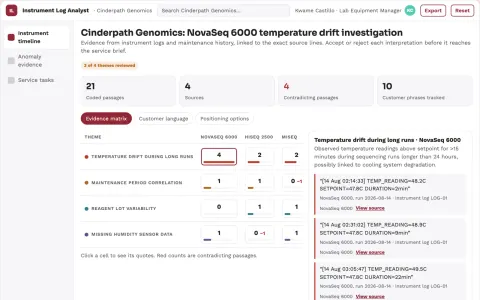
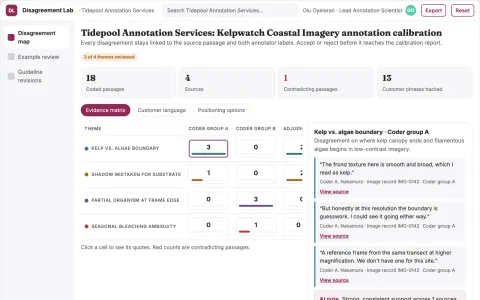
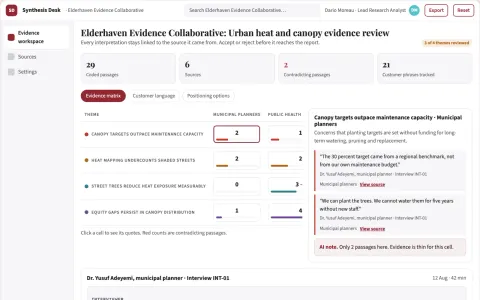
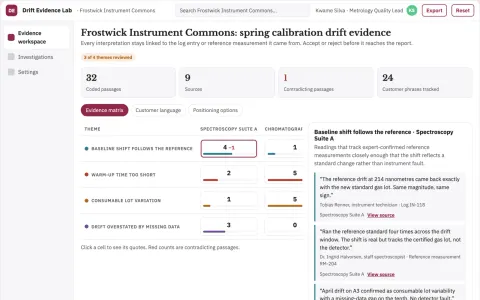
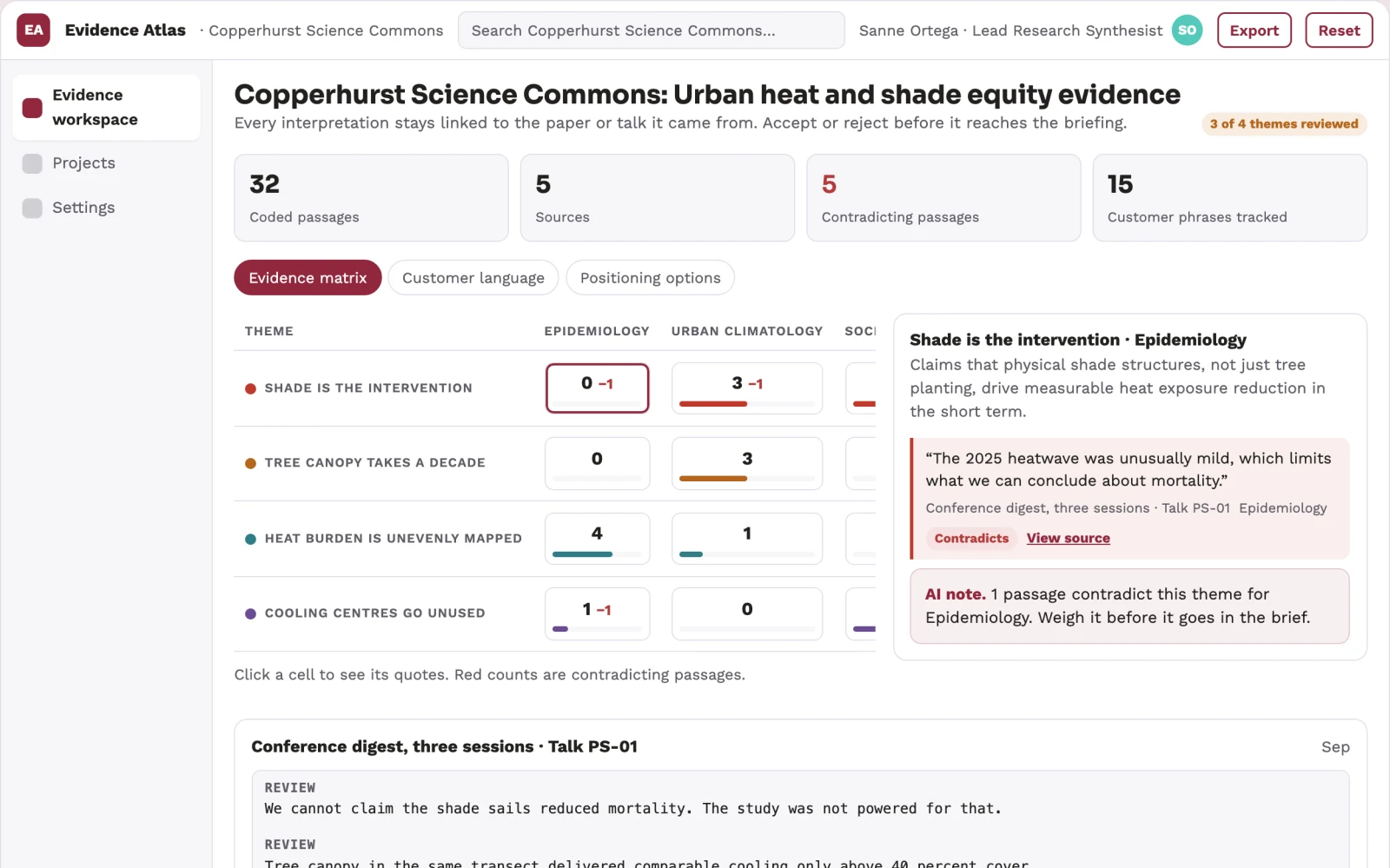
Primary screens: Source intake and permissions, Editable synthesis canvas, Review and export. Use a thumbnail gallery for projects, a large central canvas for maps, diagrams and timelines, and a right-hand panel for sources, citations, constraints and comments. Let users compare versions side by side. Display draft, changes requested and approved states. Provide a client preview link with comments anchored to the relevant node. Make the task-specific outcome reviewer-approved visual maps, diagrams and study outputs linked to source citations visible beside its evidence, review state and value baseline.