AI-Driven Decision-Making for the C-Suite: Executive Strategy (Video Course)
Executives are making smarter decisions with AI,and this course shows you how. You'll get practical frameworks, real case studies, and a clear path to lead AI transformation in your organization. Built for business leaders, not coders.
Related Certification: Certification in Leading AI-Driven Executive Decision-Making
Also includes Access to All:
What You Will Learn
- Map your organization on the executive AI layer and lead AI transformation
- Distinguish predictive vs. generative AI and apply each strategically
- Prioritize AI investments using ROI, time-to-value, data readiness, and scalability
- Establish AI governance: privacy, ethics, transparency, human oversight, and compliance
- Automate executive reporting with AI cowork tools and reusable instructions files
Study Guide
# AI-Driven Decision-Making for the C-Suite: A Complete Learning Guide ## Introduction The boardroom is changing. Not slowly, not subtly, but fundamentally. The way executives make decisions today looks almost nothing like it did a decade ago, and the pace of change is only accelerating. This course is designed for one specific purpose: to give you, as a business leader, a complete and practical understanding of how artificial intelligence is reshaping strategic decision-making at the highest levels of organizations. You're not going to get a technical deep dive into neural networks or algorithm math here. That's not what you need. What you need is a working framework for understanding what AI can do for your organization, how to distinguish between different types of AI, when to invest, how to measure success, and how to implement AI-powered systems that actually deliver results. Here's what we'll cover throughout this guide. We'll start by tracing the evolution of executive decision-making, from pure intuition to the emerging world of autonomous business intelligence. We'll then draw a clear line between predictive AI and generative AI, because these two categories serve fundamentally different purposes and understanding the distinction is critical. We'll explore how AI is being applied across every business function, from finance to HR to supply chain. From there, we'll move into frameworks. You'll learn how to evaluate AI initiatives, prioritize investments, and measure success using the same KPIs you already track. We'll spend significant time on governance, because responsible AI adoption isn't optional anymore, it's a board-level imperative. Finally, we'll walk through a real-world case study that shows exactly how AI cowork tools can automate executive reporting, transforming what used to take days into what now takes under an hour. This isn't theoretical. This is happening right now in organizations like yours. By the end of this guide, you'll have everything you need to lead AI transformation in your organization, not just support it from the sidelines. You'll understand the landscape, you'll have practical tools, and you'll know exactly where to start. Let's dig in. --- ## Section 1: From Digital Transformation to AI Transformation There's been a lot of talk over the past several years about digital transformation. Organizations invested heavily in cloud infrastructure, data warehouses, customer relationship management systems, and business intelligence tools. The goal was to digitize processes and make data accessible. That phase is largely complete for most enterprises. But here's the thing: digital transformation was never the destination. It was the foundation. The real shift happening now is something more profound, the move from digital transformation to AI transformation. What's the difference? Digital transformation made data available. AI transformation makes data intelligent. Digital transformation gave you dashboards. AI transformation gives you decisions. Digital transformation told you what happened. AI transformation tells you what will happen, what to do about it, and how to communicate it. This distinction matters because it changes the executive agenda. When AI was just another technology layer, it could be delegated to the IT department. But AI transformation is a leadership issue. Every C-suite leader needs to develop working AI literacy, the capacity to assess opportunities, evaluate risks, and make informed investment decisions. Consider the shift this represents. In the traditional model, executives relied on reports that looked backward. The CFO reviewed last quarter's financials. The CMO analyzed last month's campaign performance. The COO examined last week's operational metrics. All of this information was historical, descriptive, and inherently reactive. AI transformation flips this paradigm. Instead of asking "what happened?" you can now ask "what's going to happen?" and "what should we do about it?" This is the difference between driving while looking in the rearview mirror and driving with a GPS that can see around corners. The organizations that understand this distinction are already pulling ahead. They're not treating AI as a cost center or a compliance requirement. They're treating it as a competitive weapon, a way to make better decisions faster than their competitors. Here's what AI transformation looks like in practice. A retail company uses predictive AI to forecast demand across thousands of SKUs, optimizing inventory before the season even begins. A financial services firm uses generative AI to draft personalized client communications based on individual portfolio data. A healthcare organization uses AI to identify patients at risk of readmission and automatically generates intervention plans. A manufacturer uses predictive maintenance to identify equipment failures before they happen, reducing downtime by significant margins. In each case, the common thread isn't the technology itself. It's the decision-making capability that the technology enables. These organizations aren't deploying AI because it's trendy. They're deploying it because it makes them better at the fundamental job of running a business. The executive AI layer is how we conceptualize this capability stack. Think of it as a series of increasingly sophisticated capabilities that build on each other: At the base, you have enterprise data. This is the raw infrastructure, all the structured and unstructured information your organization generates and collects. Without solid data foundations, nothing above it works. Next comes business intelligence. This layer transforms raw data into reports, dashboards, and visualizations. It answers the question "what happened?" Most organizations have this capability today, and it's table stakes. Above that sits predictive analytics. This layer uses machine learning to forecast future outcomes. It answers the question "what will happen?" This is where organizations start gaining real competitive advantage. Then comes generative AI. This layer creates new content, recommendations, and scenarios. It answers the question "what should we do?" and "how should we communicate it?" This is where we see the explosion of capability that's dominating headlines. Above that are AI agents. These are autonomous systems that execute tasks on behalf of users. They read files, perform analysis, generate reports, and take actions without requiring step-by-step human direction. And at the top, you have executive dashboards. These are the interfaces that bring everything together, giving decision-makers access to AI-powered insights in a format they can actually use. Understanding this stack is essential because it gives you a roadmap. You can assess where your organization is today, where you need to go, and what investments are required to get there. --- ## Section 2: The Evolution of Executive Decision-Making To understand where AI-driven decision-making fits, it helps to see the full arc of how executives have made decisions over time. This evolution isn't just academic history. Each stage built on the previous one, and organizations today sit at different points along this continuum. **Stage One: Traditional Decision-Making** In the earliest phase, executives relied on intuition, experience, and precedent. Decisions were made based on judgment developed over years of practice. This approach had real strengths. Experienced leaders developed pattern recognition that served them well. But it also had significant limitations. It was slow, inconsistent, and heavily dependent on individual capability. Two executives looking at the same situation could reach completely different conclusions, and there was no systematic way to determine who was right. **Stage Two: Data-Driven Decision-Making** The next phase introduced systematic data analysis. Organizations began collecting historical data and using business intelligence tools to understand what had happened. This was genuinely revolutionary. For the first time, executives could base decisions on facts rather than gut feelings. Dashboards showed sales trends, customer behavior, operational metrics. The limitation was that this data was inherently backward-looking. You knew what happened last quarter, but you were still guessing about next quarter. **Stage Three: Predictive Analytics** The third phase added forward-looking capability. Machine learning algorithms could analyze historical patterns and forecast future outcomes. Revenue forecasting became more accurate. Customer churn could be predicted before it happened. Demand forecasting allowed organizations to optimize inventory. This was a significant leap forward. But predictive analytics still had a limitation: it could tell you what was likely to happen, but it couldn't tell you what to do about it. **Stage Four: AI-Augmented Decisions** The fourth phase brought AI directly into the decision process. AI systems didn't just predict outcomes, they provided recommendations. An executive could ask "what should we do?" and receive AI-generated suggestions based on data analysis. The human remained the final decision-maker, but the AI served as a powerful analytical partner. This is where most organizations are today, and it's where the real value is starting to emerge. **Stage Five: Autonomous Business Intelligence** The fifth and most advanced stage involves machines directly generating comprehensive responses from data. An executive can ask a question, and the AI system will analyze relevant data, generate insights, create reports, and even produce presentation-ready deliverables without human intervention at every step. This is the frontier. It's not about AI making decisions independently, it's about AI handling the entire analytical and communication workflow, freeing humans to focus on judgment, strategy, and stakeholder management. Here's a concrete example of how this evolution plays out in practice. Imagine a CFO trying to understand why revenue declined in a particular region. In the traditional model, the CFO would rely on experience and perhaps anecdotal reports from regional managers. In the data-driven model, the CFO would review dashboards showing revenue trends by region, product, and customer segment. In the predictive analytics model, the CFO would see forecasts suggesting the decline would continue without intervention. In the AI-augmented model, the CFO would receive recommendations like "pricing optimization in Region A could recover 60% of the decline based on elasticity analysis." And in the autonomous model, the CFO could simply ask "what happened in Region A and what should we do about it?" and receive a complete analysis with recommendations, supporting data, and even a draft board presentation. Each stage adds capability, but it also changes the nature of executive work. The skills that made someone successful at stage one are not the same skills required at stage five. This is why AI literacy is now a core leadership competency. --- ## Section 3: Predictive AI vs. Generative AI If there's one concept that matters most for executives trying to make sense of the AI landscape, it's the distinction between predictive AI and generative AI. These two categories serve fundamentally different purposes, and understanding the difference will help you evaluate opportunities, allocate resources, and set realistic expectations. **Predictive AI: What Is Likely to Happen?** Predictive AI is designed to identify patterns and forecast future outcomes. It uses historical data and real-time signals to estimate what's going to happen next. The output is always a prediction, a probability, a forecast, or a classification. Think about the business applications. Revenue and sales forecasting uses predictive AI to estimate future performance based on historical trends, market conditions, and pipeline data. Customer churn prediction identifies which customers are most likely to leave, allowing proactive retention efforts. Demand forecasting helps retailers and manufacturers optimize inventory levels. Fraud detection uses predictive models to flag suspicious transactions in real-time. Predictive maintenance anticipates equipment failures before they occur. Supply chain optimization forecasts disruptions and adjusts plans accordingly. The common thread is that predictive AI answers the question "what is likely to happen?" It's fundamentally about anticipation. **Generative AI: What Should We Do About It?** Generative AI is designed to create new content and recommendations. Rather than predicting an outcome, it produces something that didn't exist before: a strategic recommendation, an executive summary, a presentation, a marketing campaign, a business proposal, a scenario analysis. The business applications are equally diverse. Strategic recommendations use generative AI to propose courses of action based on analysis of available data. Executive summaries and board reports are drafted by AI systems that synthesize complex information into digestible formats. Business proposals and presentations are generated from raw materials. Marketing and communications content is created at scale. Innovation and idea generation benefit from AI's ability to explore combinations that humans might not consider. The common thread is that generative AI answers the question "what should we do next?" and "how should we communicate it?" It's fundamentally about action. **How They Work Together** Here's the key insight: predictive and generative AI are not competitors. They're complementary capabilities that work together to create a complete decision framework. Imagine you're a retail executive trying to plan for the holiday season. Predictive AI analyzes historical sales data, current inventory levels, and market trends to forecast demand for each product category. That's the "what is likely to happen" answer. Generative AI then takes those predictions and develops a comprehensive action plan: which products to promote, how to allocate marketing budget, what inventory levels to target, and how to communicate the strategy to stakeholders. That's the "what should we do" answer. Or consider a financial services scenario. Predictive AI identifies which loan applicants are most likely to default based on historical data. Generative AI then drafts personalized communication for each applicant, explaining the decision and offering alternative options where appropriate. The most sophisticated organizations are building systems that combine both capabilities. Predictive models identify the risks and opportunities. Generative AI translates those insights into action. The result is a decision-making capability that's both analytical and creative, both rigorous and communicative. --- ## Section 4: AI Applications Across Business Domains AI isn't a single-department tool. It's an enterprise-wide capability that touches every function. Understanding how AI applies across the organization helps you identify opportunities in your own area of responsibility and coordinate efforts across departments. **Finance** The finance function has been an early adopter of AI. Financial forecasting uses predictive models to project revenue, expenses, and cash flow with greater accuracy than traditional methods. Budgeting processes benefit from AI's ability to analyze historical patterns and identify opportunities for optimization. Fraud detection has been transformed by AI systems that can identify suspicious transactions in real-time, flagging anomalies that would escape human attention. **Sales** Sales organizations use AI for revenue prediction, forecasting which deals are likely to close and what the pipeline looks like in aggregate. Lead scoring uses predictive models to identify which prospects are most likely to convert, allowing sales teams to focus their efforts where they'll have the most impact. AI can also analyze sales conversations and customer interactions to identify what's working and what's not. **Marketing** Marketing has been transformed by AI. Customer segmentation has become more sophisticated, with AI identifying micro-segments based on behavior, preferences, and predictive propensity. Personalized campaigns are generated at scale, with AI creating variations of messaging tailored to individual customers. Marketing attribution has improved, helping organizations understand which channels and touchpoints actually drive results. **Operations** Operations leaders use AI for process optimization, identifying inefficiencies and recommending improvements. Demand forecasting helps align production with expected demand. Quality control has been enhanced by AI systems that can identify defects more reliably than human inspectors. Resource allocation is optimized based on predictive models of workload and capacity. **Human Resources** HR is an increasingly important AI application area. Workforce planning uses predictive models to anticipate talent needs based on business forecasts and attrition patterns. Talent analytics identify which characteristics correlate with high performance, informing hiring and development decisions. Employee engagement analysis uses AI to identify patterns in survey data, exit interviews, and communication channels. **Supply Chain** Supply chain optimization is one of the highest-value AI applications. Inventory optimization uses predictive models to maintain optimal stock levels, reducing carrying costs while minimizing stockouts. Logistics planning optimizes routes, carrier selection, and delivery schedules. Risk management identifies potential disruptions before they occur, allowing proactive mitigation. **Customer Service** Customer service has been transformed by AI. AI assistants handle routine inquiries, freeing human agents for complex issues. Sentiment analysis monitors customer feedback across channels, identifying emerging issues before they escalate. Personalization improves the customer experience by tailoring responses and recommendations to individual preferences. The key takeaway: AI is not a niche technology. It's a general-purpose capability that can enhance every aspect of business operations. The question isn't whether AI applies to your function. It's which applications will deliver the most value in your specific context. --- ## Section 5: The Executive AI Layer To understand how AI transforms decision-making, it helps to think in terms of layers. The executive AI layer is a framework that shows how raw data flows through increasingly sophisticated capabilities to ultimately support strategic decisions. **Layer One: Enterprise Data** This is the foundation. Your organization generates and collects data from countless sources: transaction systems, customer interactions, operational sensors, employee feedback, financial records, market data. The quality and accessibility of this data determines everything that happens above it. Organizations with fragmented, siloed, or low-quality data will struggle to extract value from AI, regardless of how sophisticated their tools are. **Layer Two: Business Intelligence** The next layer transforms raw data into insight. Business intelligence tools create reports, dashboards, and visualizations that help executives understand what's happening in the business. This is table stakes today. If your organization can't answer basic questions about performance, you need to fix that before investing in more advanced capabilities. **Layer Three: Predictive Analytics** This layer adds forward-looking capability. Machine learning models analyze historical patterns and current conditions to forecast future outcomes. This is where competitive advantage starts to emerge. Organizations that can anticipate demand, identify risks, and predict customer behavior have a significant edge over those that can only react. **Layer Four: Generative AI** This layer adds creative capability. Generative AI creates new content, recommendations, and scenarios based on available data. It transforms insights into action plans, analysis into communication, and predictions into strategy. This is the layer that's generating the most excitement and the most disruption. **Layer Five: AI Agents** This layer adds autonomous capability. AI agents execute tasks on behalf of users without requiring step-by-step direction. They read files, perform analysis, generate deliverables, and take actions. This is where the real productivity gains emerge, as AI handles the mechanical work that previously consumed human time and attention. **Layer Six: Executive Dashboards** At the top, you have the interface layer. Executive dashboards bring everything together, giving decision-makers access to AI-powered insights in a format they can actually use. The best dashboards are interactive, allowing executives to explore data, test scenarios, and drill into details. Here's how this works in practice. Imagine your organization is considering entering a new market. The enterprise data layer contains all relevant information about your current operations, the target market, competitors, and customer needs. The business intelligence layer presents this data in accessible formats, showing current performance and market conditions. The predictive analytics layer forecasts demand, competitive response, and financial outcomes under various scenarios. The generative AI layer develops strategic alternatives, draft plans, and communication materials. AI agents assemble all of this into comprehensive briefings and presentations. And the executive dashboard lets you explore the analysis interactively, testing assumptions and refining your approach. The power of this framework is that it gives you a roadmap. You can assess where your organization is today, identify gaps, and prioritize investments accordingly. --- ## Section 6: An Executive Decision Framework with AI Now let's get practical. How do you actually use AI to make better decisions? The following framework provides a structured approach that can be applied across any business challenge. **Step One: Collect Business Data** Every decision starts with data. Assemble all relevant information from internal systems, external sources, and operational processes. This might include financial data, customer information, operational metrics, market intelligence, and any other relevant inputs. The key is to be comprehensive. Decisions made on incomplete data are decisions made in the dark. **Step Two: Prepare and Augment Data** Raw data is rarely ready for analysis. It needs to be cleaned, standardized, and validated. Duplicate records need to be removed. Missing values need to be addressed. Inconsistent formats need to be reconciled. This step is critical, because the quality of your analysis depends entirely on the quality of your data. As the saying goes: garbage in, garbage out. **Step Three: Generate Insights** Once your data is ready, apply analytical techniques to extract meaningful patterns and understanding. This is where business intelligence tools come into play. What happened? What's the current state? What patterns are visible in the data? This step answers descriptive questions and establishes the factual foundation for everything that follows. **Step Four: Derive Predictive Outcomes** Now apply machine learning and predictive AI to forecast future scenarios. What's likely to happen if current trends continue? What are the risks and opportunities on the horizon? This step answers predictive questions and gives you visibility into the future. **Step Five: Generate Strategic Alternatives** This is where generative AI adds unique value. Based on your insights and predictions, generate multiple potential courses of action. The key word here is multiple. Too often, executives settle on a single approach without adequately exploring alternatives. Generative AI can create diverse options, each with its own logic and trade-offs. **Step Six: Evaluate Business Impact** For each strategic alternative, assess the potential consequences. What are the financial implications? What's the operational impact? How will customers, employees, and other stakeholders be affected? What are the risks? This step combines quantitative analysis with qualitative judgment. **Step Seven: Make Executive Decisions** Now you have what you need to decide. Review the analysis, apply your judgment, and select the optimal strategy. AI has done the heavy lifting of data analysis and option generation. The final decision remains yours. **Step Eight: Monitor and Optimize Continuously** The decision isn't the end. It's the beginning. Track performance against expectations, gather new data, and refine your approach based on real-world results. The best decisions are iterative, not one-time events. This framework is powerful because it makes explicit what was previously implicit. It ensures that every decision is grounded in data, informed by prediction, and supported by structured analysis. And it shows exactly where AI adds value: in data preparation, insight generation, prediction, option creation, and evaluation. --- ## Section 7: Prioritizing AI Investments Not all AI initiatives deserve equal investment. Resources are finite, and the landscape is crowded with opportunities. The organizations that succeed are those that prioritize effectively, focusing on initiatives that deliver the most value with the least risk. **Key Evaluation Questions** Before investing in any AI initiative, ask these six questions: First, business impact. Does this solve a critical business problem? The best AI initiatives address pain points that are already well understood. If you can't articulate the problem clearly, you probably shouldn't invest in the solution. Second, ROI potential. Will this generate measurable value? The value might come from revenue growth, cost reduction, productivity improvement, or risk mitigation. But it needs to be quantifiable. If you can't define how you'll measure success, you won't know if you've achieved it. Third, time to value. How quickly will benefits become visible? Some initiatives deliver value in weeks. Others take years. Quick wins build momentum and demonstrate value. Long-term investments require patience and sustained commitment. Fourth, data readiness. Is reliable data available? AI systems are only as good as their training data. If your data is fragmented, incomplete, or low-quality, you'll need to invest in data infrastructure before AI can deliver value. Fifth, risk. What are the implementation risks? This includes technical risk, operational risk, and reputational risk. Some AI applications, like customer-facing chatbots, carry more risk than others. Sixth, scalability. Can this solution be expanded across the enterprise? The best investments are those that create capabilities you can apply broadly, not just solve a single problem. **The Prioritization Matrix** Once you've answered these questions, use a prioritization matrix to categorize initiatives: | Implementation Complexity | High Value | Low Value | |---------------------------|-----------|-----------| | **Easy** | Quick Wins | Opportunities | | **Complex** | Strategic Investments | Reassess or Defer | Quick wins are initiatives that are easy to implement and deliver high business value. These should be prioritized first. They build momentum, demonstrate value, and create organizational buy-in. Examples include AI-powered executive reporting, customer support chatbots, and document automation. Strategic investments are complex initiatives that offer substantial long-term value. These require dedicated resources and sustained commitment. Examples include enterprise AI platforms, predictive analytics systems, and AI-powered decision intelligence. These are the initiatives that can transform your organization, but they require patience and investment. Opportunities are easy to implement but offer limited value. These are worth pursuing if you have excess capacity, but they shouldn't be priorities. They can provide incremental improvements at low cost. Reassess or defer are initiatives that are both complex and low-value. These should be avoided unless circumstances change. The complexity isn't worth the limited payoff. **Building the Business Case** When you've identified a priority initiative, build a comprehensive business case. Start with a clear problem statement: what specific challenge are you addressing? Then explain the AI opportunity: how does this technology address the challenge? Quantify the expected benefits: revenue growth, cost reduction, productivity gains, risk mitigation. Detail the investment required: technology, data, talent, change management. And establish success metrics: ROI, productivity, customer satisfaction, time savings. The business case isn't just a formality. It's the tool you'll use to secure resources, align stakeholders, and measure success. --- ## Section 8: Measuring AI Success with Executive KPIs Here's a trap that many organizations fall into: they measure AI success by technology adoption rather than business outcomes. They track the number of models deployed, the volume of data processed, the count of AI applications in production. These metrics are seductive because they're easy to measure. But they don't tell you whether AI is actually creating value. The right approach is to measure AI success through the same KPIs you already use to run the business. AI should improve financial performance, operational efficiency, customer satisfaction, and innovation capability. If it doesn't, it's not working, regardless of how many models you've deployed. **Financial KPIs** Revenue growth is the most fundamental measure. Is AI helping you sell more, retain more, or expand into new markets? Cost reduction matters too. Is AI lowering your cost of operations, reducing waste, or improving efficiency? Profit margin captures the combined effect. And return on investment tells you whether the AI investment itself is paying off. **Operational KPIs** Productivity improvement measures how much more your team can accomplish with AI support. Decision speed captures how quickly you can move from question to answer. Forecasting accuracy tells you whether your predictive models are actually predicting. Process efficiency measures whether AI is streamlining operations. **Customer KPIs** Customer satisfaction scores capture the experience. Retention rates tell you whether AI is helping you keep customers. Net Promoter Score measures loyalty and advocacy. **Innovation KPIs** AI adoption rate measures how quickly your organization is embracing AI capabilities. Time to market captures whether AI is accelerating product development. New product launches measure whether AI is enabling innovation. **Role-Specific Applications** Different executives should focus on different KPIs: The CEO should focus on growth, market expansion, and competitive intelligence. How is AI helping you grow the business and outmaneuver competitors? The CFO should focus on financial forecasting, budgeting, and risk management. How is AI improving financial decision-making and reducing risk? The COO should focus on operational efficiency and supply chain optimization. How is AI streamlining operations and improving reliability? The CMO should focus on customer insights and campaign optimization. How is AI improving targeting, personalization, and marketing ROI? The CHRO should focus on talent planning and workforce analytics. How is AI helping you hire better, develop people, and retain top talent? The CIO/CTO should focus on enterprise AI strategy, governance, and cybersecurity. How is AI being deployed across the organization, and is it being done responsibly? The key principle: AI success is business success. If AI isn't improving the metrics that matter, it isn't working. --- ## Section 9: AI Governance and Responsible Adoption AI adoption brings enormous opportunity, but it also brings risk. Organizations that ignore these risks do so at their peril. Governance isn't a barrier to innovation. It's the foundation for sustainable, trustworthy AI deployment. **Core Governance Pillars** Data privacy and security sit at the foundation. AI systems process vast amounts of sensitive information. This data must be protected throughout the AI lifecycle, from collection to processing to storage. Breaches and misuse aren't just operational failures. They're existential risks. Ethical AI practices ensure that AI systems are fair, transparent, and non-discriminatory. AI models can perpetuate and amplify biases present in training data. Organizations must actively work to identify and mitigate these biases. Regulatory compliance is increasingly complex. Different jurisdictions have different requirements for AI systems, data protection, and automated decision-making. Organizations must stay current on evolving regulations and ensure compliance across their operations. Human oversight maintains appropriate control over AI decisions. AI should augment human judgment, not replace it. Especially for high-stakes decisions, humans must remain in the loop. Model transparency requires documenting how AI systems make decisions. This isn't just about technical documentation. It's about being able to explain AI decisions to stakeholders, regulators, and affected parties. Risk management involves identifying and mitigating potential harms. This includes technical risks like model failure, operational risks like process disruption, and reputational risks like public backlash. Accountability assigns clear responsibility for AI outcomes. Someone needs to own the results, both good and bad. **Executive Responsibilities** As an executive, you have specific governance responsibilities: First, establish AI governance policies. This means creating the framework within which AI is deployed, including approval processes, review requirements, and accountability structures. Second, ensure regulatory compliance. This means staying current on requirements and building compliance into your AI processes from the start. Third, promote responsible and ethical AI adoption. This means creating a culture where ethical considerations are part of every AI decision. Fourth, continuously monitor AI performance and risks. This means ongoing review of AI systems, not just at deployment but throughout their lifecycle. **Practical Governance in Action** Here's what governance looks like in practice. When your organization deploys an AI system, you should have: A clear owner who is accountable for the system's performance and risks. A documented description of what the system does, how it works, and what data it uses. A risk assessment that identifies potential harms and mitigation strategies. An approval process that ensures appropriate review before deployment. Monitoring mechanisms that track performance and flag issues. And a process for addressing problems when they arise. This might sound bureaucratic, but it's essential. The organizations that get governance right are the ones that can scale AI safely and sustainably. --- ## Section 10: Case Study - Automated Executive Reporting with AI Cowork Tools Now let's get to the most practical part of this guide. We're going to walk through a real-world example of how AI cowork tools can transform executive reporting, turning what used to take days into what takes under an hour. **The Scenario** Imagine a leadership training organization that runs programs for emerging managers. The organization has just completed a quarter with 75 learners across three cohorts, taught by two different trainers. The program generated extensive data: Post-training surveys with ratings across seven dimensions plus open-ended comments. Reflection journals where learners captured their key takeaways. Manager feedback collected 30 days after training, reporting on whether learners were applying their new skills. Mid-training pulse checks that captured engagement in real-time. Trainer observations assessing each cohort's participation. Facilitator self-assessments evaluating their own performance. Attendance and demographic data profiling the learners. The L&D team needs to produce a comprehensive executive report for senior leadership, including the C-suite and the head of L&D. This report needs to cover satisfaction metrics, learning outcomes, trainer performance, behavior change, and recommendations for improvement. In the traditional approach, this would be a substantial manual effort. An analyst would need to compile data from all sources, calculate metrics like average ratings and NPS, extract themes from qualitative feedback, cross-reference trainer performance, analyze demographic patterns, and then design and build a polished presentation. This would easily consume a full day or more of focused work. **The AI Cowork Solution** AI cowork tools like Claude Cowork from Anthropic, Microsoft Copilot, and ChatGPT Work automate this entire workflow. Here's how it works: **Step One: Create an Instructions File** The foundation is a detailed instructions file, typically in markdown format. This file captures the complete workflow that an analyst would follow. It specifies: The scope and context: program name, reporting period, number of cohorts, trainer names, target audience. The data inventory: a listing of all files and what each contains. This ensures the AI doesn't miss anything. Analysis requirements: "Do not skip any file. Cross-reference information across files. Calculate average ratings, NPS, attendance rates, completion rates, and assessment score improvements. Extract recurring themes from qualitative data. Identify the top five 'what worked' themes and top five 'needs improvement' themes. Include key quotes." Cross-file analysis requirements: "Compare trainer performance between Trainer A and Trainer B. Evaluate learner feedback against learning objectives. Slice data by demographics and experience levels. Correlate manager-reported behavior change with learner-reported confidence." Trend analysis requirements: "Identify declining satisfaction across cohorts and explain the causes." Design rules: company-specific colors, fonts, chart types, data callouts, quote boxes, and slide density of five bullets maximum. Writing style: executive tone, honest, data-driven, active voice, no placeholder text. Success criteria: "The CXO can understand the program's performance in under five minutes. Each slide has a single clear message. Recommendations are specific and actionable." **Step Two: Configure the Environment** The user selects the workspace folder containing all data files. They choose the AI model based on task complexity. For complex strategic analysis, they'd use a top-tier model. For routine tasks, a mid-tier model. For simple tasks, a lightweight model. They also configure approval settings. For sensitive files where deletion or modification would be problematic, they'd choose manual approval for each action. For routine tasks, they might allow auto-pause for unsafe actions. For low-risk tasks, they might enable full autonomy. **Step Three: Execute the Task** The user provides a simple prompt: "Follow the instructions.md file and do the needful." The AI cowork tool then goes to work. It reads all data files. It performs quantitative analysis, calculating averages, NPS, completion rates, and score improvements. It conducts qualitative analysis, extracting themes and selecting representative quotes. It cross-references information across files, comparing trainer performance and correlating different data sources. And it generates the deliverables specified in the instructions file. **Step Four: Review and Refine** The AI produces multiple outputs. A 15-slide PowerPoint presentation with executive summary, data visualizations, and recommendations. A one-page PDF summary with key metrics at a glance. An interactive HTML dashboard allowing executives to filter data dynamically. The human analyst reviews these outputs and can request changes conversationally: "Change the pie chart on slide 5 to a bar chart." "Update the color scheme on the dashboard." "Add a slide on demographic breakdown." The AI makes the changes, and the final deliverables are ready. **The Deliverables** A typical executive report generated through this process includes: Slide one: Title slide with program name, subtitle with key numbers, and date. Slide two: Executive summary with four to five headline bullets readable in 30 seconds. Slide three: Program overview covering objectives, audience, duration, and schedule. Slide four: Participation snapshot showing learner demographics and engagement. Slide five: Overall satisfaction metrics across all dimensions. Slide six: Batch-wise performance comparison across cohorts. Slide seven: NPS and recommendation scores. Slide eight: What learners loved, the top positive themes. Slide nine: What needs improvement, the top concerns. Slide ten: Trainer performance comparison. Slide eleven: Behavior change metrics showing on-the-job application. Slide twelve: Demographic insights, feedback sliced by experience and department. Slide thirteen: Learning objectives versus actual outcomes. Slide fourteen: Recommendations and action plan. Slide fifteen: Next steps and closing commitments. **The Measured Savings** Here's the remarkable part. What would take a human analyst seven to eight hours, or a full day, can be completed in 45 to 60 minutes using AI cowork tools, including human review time. That's a cost reduction of 80 to 90 percent for a recurring reporting task. But the savings go beyond time. The AI doesn't get tired. It doesn't miss files. It doesn't make calculation errors. It applies consistent standards across all analysis. And it can be scheduled to run recurring reports automatically, on a daily, weekly, or monthly basis. **The Human Role** Here's the crucial point: AI doesn't eliminate human review. It transforms it. The human's job shifts from manual construction to specification, review, and refinement. Instead of spending hours compiling data and building slides, the human spends time defining what's needed, reviewing what's produced, and refining the output. This is a far more strategic use of expertise. The analyst becomes an editor and quality controller rather than a data processor. Their judgment is applied where it matters most, not on mechanical tasks. --- ## Section 11: The Art of the Instructions File If there's a secret to getting great results from AI cowork tools, it's the instructions file. This is the difference between generic output and executive-grade deliverables. The quality of what you get out is directly proportional to the quality of what you put in. **What Makes a Great Instructions File** First, be explicit about everything. Don't assume the AI knows anything about your organization, your program, or your standards. Spell out the scope, the context, the data, and the requirements. Second, specify the exact analysis to perform. Don't say "analyze the data." Say "calculate average ratings across all seven dimensions, compute NPS as promoter percentage minus detractor percentage, calculate attendance and completion rates, and measure pre/post assessment score improvements." Third, define the output structure slide by slide. Don't say "create a presentation." Say "create a 15-slide PowerPoint with this specific structure: title slide, executive summary, program overview, participation snapshot, and so on." Fourth, provide design requirements. Specify colors, fonts, chart types, and layout preferences. The AI can follow your brand standards if you tell it what they are. Fifth, state tone and style guidelines. Do you want formal or conversational? Data-driven or narrative? Direct or nuanced? The AI will match your stated preferences. Sixth, include success criteria. How will you know if the output is good? "The CXO can understand the program's performance in under five minutes." "Each slide has a single clear message." "Recommendations are specific and actionable." Seventh, prohibit data fabrication. Explicitly instruct the AI not to make up data. "Every claim must be backed by a number or a fact from the source files." "Do not include placeholder text." Eighth, require cross-referencing across files. "Do not skip any file. Cross-reference information across files to ensure consistency and completeness." **A Sample Instructions File Structure** Here's what a well-structured instructions file might look like: Program name: Leadership Essentials for First-Time Managers Reporting period: Q1 Total learners: 75 across three cohorts Trainers: Trainer A and Trainer B Audience: Senior leadership, CXOs, and L&D head Analysis to perform: 1. Quantitative analysis: Calculate average ratings, NPS, attendance rates, assessment score improvements 2. Qualitative analysis: Extract themes, cluster feedback, identify top themes 3. Cross-file analysis: Compare trainer performance, map feedback to objectives, correlate data 4. Trend analysis: Identify declining satisfaction trends and explain causes Output requirements: - 15-slide PowerPoint with specified structure - Executive tone, data-driven, honest - Maximum 5 bullet points per slide - All charts must contain actual data - Directly presentable, no placeholders **Why This Matters** The instructions file is the knowledge transfer mechanism. It captures the expertise of your best analysts and makes it reproducible. Once you've created a great instructions file for one report, you can use it for every subsequent report. You can adapt it for different programs, different data sets, different audiences. This is the real competitive advantage. It's not the AI itself. It's the combination of human expertise captured in structured instructions and AI capability that executes them at scale. --- ## Section 12: Key Takeaways and Action Items We've covered a lot of ground. Let's distill the key insights and translate them into action. **The Core Insights** Predictive and generative AI are complementary. Predictive AI informs judgment by answering "what is likely to happen." Generative AI informs content and recommendations by answering "what should we do about it." Used together, they form a complete decision framework. Executive decision-making is progressing toward autonomous AI. The leaders who redesign their workflows now will build an irreversible advantage. Those who wait will find themselves competing against organizations that move faster, decide better, and execute more efficiently. Clear and highly structured instruction files are the real secret. The quality of AI output depends on the quality of the input. Organizations that invest in capturing expert workflows in structured instructions will get dramatically better results than those that rely on ad-hoc prompting. AI does not eliminate human review. It transforms it. The human role shifts from manual construction to specification, review, and refinement. This makes human judgment more valuable, not less. Approach AI prioritization using a matrix of easy versus complex and value. Look for quick wins first. Reinvest in strategic opportunities. Avoid the trap of pursuing complex, low-value initiatives. Measure success by outcome-based KPIs. Financial, operational, customer, and innovation metrics. Not by the number of models deployed. If AI isn't improving the metrics that matter, it isn't working. Responsible AI is non-negotiable. Governance, data privacy, model transparency, human oversight, and risk management must be planned from the start. You can't retrofit responsibility after a failure. Recurring reporting processes should be automated. Turn them into recurring, scheduled AI agents. The savings compound over time. **Action Items for C-Suite Executives** First, establish a C-suite AI literacy program. This isn't optional. Every executive needs to understand what AI can do, how to evaluate opportunities, and how to lead AI transformation. Second, create a feedback loop to review AI investments through existing executive KPIs. AI shouldn't be evaluated in isolation. It should be evaluated by its contribution to business outcomes. Third, demand a prioritization matrix to govern the AI portfolio. Quick wins versus strategic investments. This ensures resources are allocated where they'll have the most impact. Fourth, enforce governance principles across the AI portfolio. You can't delegate responsibility for responsible AI. **Action Items for L&D, Reporting, and Analytics Teams** First, convert report generation workflows into instruction brief files. Make them repeatable and scalable. Second, pilot AI cowork reports with a defined dataset before scaling to sensitive data. Learn the process, refine the instructions, and validate the output. Third, define expected metrics in advance. Include quantitative KPIs like NPS, ratings, and attainment. Include qualitative metrics like theme counts and verbatim pull quotes.
Author, Links & Resources
Unlock this content to view the author bio and resources by Logging in or Signing up.
Unlock this content to view the author bio and resources by Logging in or Signing up.
Certification
About the Certification
Become certified in AI-driven executive decision-making. You'll evaluate AI opportunities, lead transformation, and turn data into strategy using proven frameworks,no coding required. Show employers you can drive smarter outcomes.
Official Certification
Upon successful completion of the "Certification in Leading AI-Driven Executive Decision-Making", you will receive a verifiable digital certificate. This certificate demonstrates your expertise in the subject matter covered in this course.
Benefits of Certification
- Enhance your professional credibility and stand out in the job market.
- Validate your skills and knowledge in cutting-edge AI technologies.
- Unlock new career opportunities in the rapidly growing AI field.
- Share your achievement on your resume, LinkedIn, and other professional platforms.
How to complete your certification successfully?
To earn your certification, you’ll need to complete all video lessons, study the guide carefully, and review the FAQ. After that, you’ll be prepared to pass the certification requirements.
Other AI Video Courses
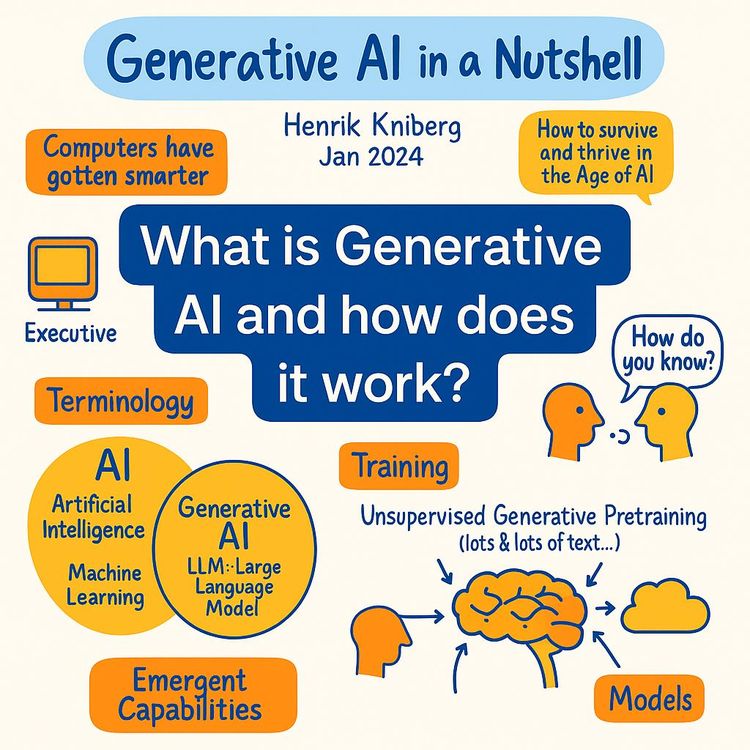
Video Course: What is Generative AI and how does it work?

Video Course: How to Use ChatGPT from Beginner to Professional

Video Course: How to Use Google Gemini for Google Workspace to Boost Productivity

Video Course: How to Use Claude 3.7 AI - Tips for Beginners!

Video Course: ChatGPT for Data Analytics: Full Course - from Beginners to Professional

Video Course: Generating Images and photos With ChatGPT?

Video Course: Generating Images & Photo's with MidJourney
Video Course: Generating Design's with Microsoft Designer and AI

Video Course: Generating Design's with Canva.com and AI
Join 20,000+ Professionals, Using AI to transform their Careers
Join professionals who didn’t just adapt, they thrived. You can too, with AI training designed for your job.