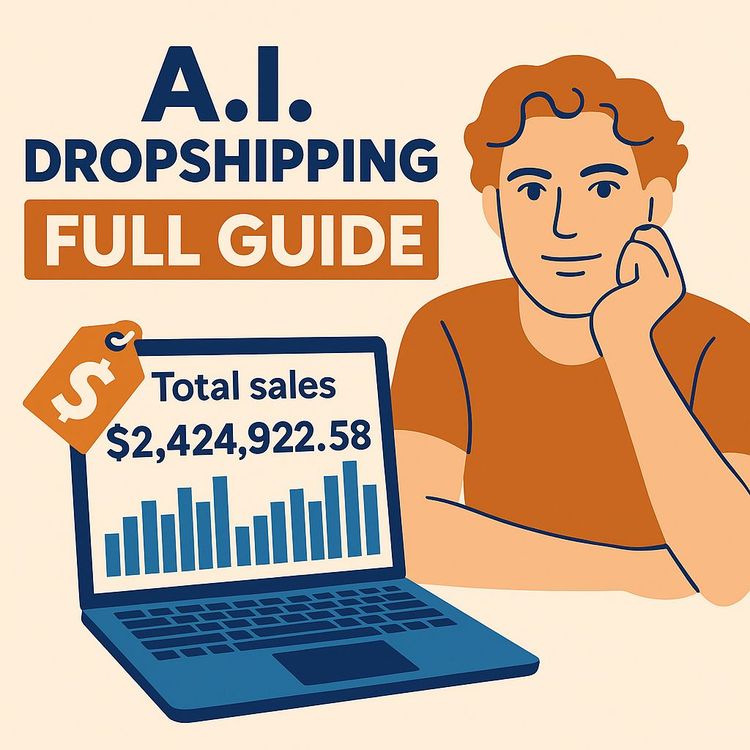
AI Dropshipping for Beginners: Complete Shopify & Meta Ads Course (Video Course)
Build a real store without guesswork. This course lays out a beginner-friendly, step-by-step system: AI-built Shopify site, angle-led Meta ad tests, automated daily fulfillment, and email flows that quietly drive revenue. Learn fast, scale smart.
Related Certification: Certification in Launching and Scaling AI Dropshipping on Shopify with Meta Ads
Also includes Access to All:
What You Will Learn
- Launch a conversion-ready Shopify store with an AI store builder
- Pick winning products using the four-criteria and craft multiple marketing angles
- Produce AI-generated image ads and run a Meta ad angle-testing framework
- Automate supplier integration and daily fulfillment for hands-off orders
- Set up email automations (welcome, abandoned cart, post-purchase) to boost revenue
- Install the Meta Pixel, track key metrics, and optimize landing pages
Study Guide
The Best A.I. Dropshipping Guide (Beginner Friendly Full Course)
You don't need to be a coder, a designer, or a marketing savant to build a real e-commerce business anymore. You need a simple system, a handful of AI tools, and the discipline to test until you find what works. This course gives you exactly that: an end-to-end blueprint for launching and scaling a dropshipping store with AI doing most of the heavy lifting. We'll start from a blank slate and move all the way to ads, automated fulfillment, and email systems that print revenue in the background.
Here's what you'll walk away with: a conversion-ready Shopify store built with an AI store builder, a method for choosing products with multiple marketing angles, a predictable Meta ad testing framework, a supplier that fulfills orders for you daily, and an email marketing engine that can drive a sizable portion of your revenue. We'll also talk about the mindset no one likes to hear about: consistency, patience, and data-driven decisions. That's the difference between dabbling and building something that lasts.
Course Roadmap & Why This Works
Most people overcomplicate e-commerce. They chase a perfect product, waste money on random ads, and quit when the first week isn't profitable. This guide strips the friction out of the process and stacks the odds in your favor. AI lowers startup costs and shortens the feedback loop, so you can test faster and improve faster. You'll use AI to build, AI to create ads, and automation to fulfill orders while you sleep. Your energy goes to strategy, not repetitive tasks.
Promise of the system:
Launch a clean, simple store quickly, use AI-generated image ads to test several marketing angles, identify the winner, and then scale with an automated fulfillment flow and email automations capturing extra revenue you'd otherwise miss.
Section 1: What Dropshipping Is (And Why AI Changes Everything)
Dropshipping is an online retail model where you sell a product without holding inventory. When someone buys from your store, the order details are sent to a third-party supplier who ships the item to your customer. You focus on marketing and customer experience; the supplier handles warehousing and logistics. AI compresses setup time and reduces the cost of creative production, which is usually where new entrepreneurs get stuck.
Example:
You use an AI store builder to launch a Shopify store in a single afternoon. It imports a premium theme, loads 10 pre-vetted products, and connects to a supplier app. Your store goes from idea to live with minimal manual work.
Another example:
Instead of hiring a photographer, you use an AI image generator to create polished lifestyle images for your product. You edit those in Canva, export, and you're ready for ads the same day.
Key terms you'll use: niche (the market segment you choose), conversion rate (the percentage of visitors who buy), marketing angle (the hook you use to sell the product), ad creative (the image or video you run in ads), Meta Pixel (the tracking code for Meta ads), and automation flow (pre-built email sequences triggered by events like sign-ups or cart abandonment).
Section 2: Your AI-Powered Store,Build It Fast, Build It Right
The goal in the beginning: a simple, high-converting store that doesn't distract you from testing. An AI store builder makes this painless.
The build process (step-by-step):
1) Choose an AI store builder that integrates with Shopify. It should include a premium theme, import pre-vetted products, and handle supplier linking.
2) Select an initial niche like clothing, tech, or home goods. Don't overthink this. You'll refine the product focus later.
3) Enter your basic info (name, email). The builder links this to your Shopify account.
4) Customize colors and a banner image. Keep it clean. You can update later.
5) Create your Shopify account. Shopify often offers an extended trial with a very low intro price for the first few months.
6) Link your Shopify store by pasting your store URL (e.g., your-store-name.myshopify.com) into the builder.
7) Install the supplier app (e.g., Zenrop) from the Shopify App Store to sync products and fulfillment.
8) Let the AI builder upload your theme, products, and configurations.
9) Remove your storefront password inside Online Store > Preferences so customers can access your site.
Example:
In a single session, you select "Home Goods," pick neutral brand colors, connect your Shopify URL, and install Zenrop. The store is live with 10 curated products and a clean, premium theme.
Another example:
You start in "Tech," but later realize your winning product is a posture device. Because the store uses a flexible theme, you quickly switch homepage assets and layout to spotlight that product without rebuilding your entire site.
Best practice for design: keep it simple. A minimal layout, a clean product page, clear pricing, and obvious buttons convert better than clutter. Fancy bells and whistles are fun for you, not for your customer.
Section 3: Navigating the Shopify Dashboard Without Getting Lost
Shopify is your command center. It's straightforward once you know which tabs matter.
Home: fast overview of sales, sessions, conversion. Check daily to gauge performance at a glance.
Orders: where every order lands. Update addresses, check fulfillment status, and handle refunds here.
Products: edit images, descriptions, pricing, and variants. Keep titles clear and benefits-focused.
Customers: see who bought what, segment by behavior, and export for marketing.
Analytics: track conversion rate, average order value (AOV), traffic sources, and sales by product.
Marketing: basic campaign tools live here. You'll still use Meta's native platform for ads, but this view is useful for email campaigns and promotions.
Discounts: create codes for promos or cart recovery incentives.
Online Store: change theme settings, edit pages, and build your landing pages. "Themes" > "Customize" is where you adjust images, fonts, and layouts.
Example:
You notice most sales come from mobile. You simplify your product page to fit critical info above the fold on phones,headline, benefits, price, and a clear Buy button.
Another example:
Analytics show a product with high add-to-carts but low purchases. You test a small price drop and add a trust badge near the Buy button. Conversions rise the next day.
Section 4: Product and Niche Strategy,Stop Hunting for Perfect, Start Validating Demand
Picking products is about probability. If you choose something with multiple ways to sell it and proof people want it, you reduce risk. Use these four criteria every time.
The four criteria (in order):
1) Passion or knowledge: If you like the niche, your marketing will feel more authentic and you'll stick with it longer.
2) Problem-solving: Products that cure a pain point sell faster. You're meeting demand, not creating it from scratch.
3) Multiple marketing angles: You want at least 5-10 hooks to test. Different hooks resonate with different people.
4) Proven demand: Use real data to validate. No demand, no sales.
Examples of the criteria in action:
Example 1 (Problem-solving + angles): A compact, ultrasonic device originally sold as a jewelry cleaner is repositioned for cleaning dental retainers and dentures. Same device, new angle, new audience, fresh demand.
Example 2 (Passion + demand): You're into strength training and choose a lifting accessory that prevents wrist pain. It solves a clear problem and your knowledge helps craft believable marketing.
Example 3 (Angles): A waterproof backpack can be sold as a commuter lifesaver, a travel essential, a hiking must-have, a camera gear protector, or a student bag that survives storms. That's five angles in one minute.
Research toolkit:
TikTok Creative Center: find trending products, keywords, and viral ads to see what people actually engage with.
Meta Ad Library: search your niche and competitors to analyze creatives, angles, and how long ads have been running (longevity often implies profitability).
Google Trends: plug in a product keyword and check search interest over time. You want steady demand or upward momentum, not a flatline.
Example: Research workflow
1) Find a product on TikTok Creative Center with strong ad engagement. 2) Validate competitor creatives in the Meta Ad Library. 3) Confirm interest with Google Trends before adding it to your store.
Another example:
You like pet products. You find a pet hair remover tool. You check the Ad Library,plenty of ads, some running for months. Trends shows consistent interest. You list it and prepare angles: couch cleanup, car detailer, clothes saver, and allergy-friendly home.
Section 5: Offer, Positioning, and Value,Make the Sale Obvious
People don't buy products; they buy outcomes. Your job is to present the outcome clearly and reduce friction. You do that with a strong angle, simple messaging, and an offer that feels like a no-brainer.
Offer checklist:
Clear headline tied to a benefit. Supporting bullets that name the problem and promise the outcome. Risk reversal (easy returns or warranty). Social proof (reviews). A time-bound incentive (limited-time discount or bundle).
Example:
Angle: "No more morning back pain." Offer: posture corrector + free stretching guide PDF + 30-day money-back guarantee + "Today only" 15% off.
Another example:
Angle: "Protect your camera gear from rain." Offer: waterproof backpack + rain cover + lifetime warranty + "Buy 2 save 20%" bundle for photographers with multiple bags.
Best practice: simplicity converts. If your product page reads like a science paper, you'll lose people. Short, punchy, outcome-driven copy wins.
Section 6: Supplier & Fulfillment Automation,Set It and Stop Babysitting Orders
Fulfillment makes or breaks customer experience. Use an integrated supplier (e.g., Zenrop) so you never manually forward orders again.
Core features you need:
Direct Shopify integration,products and orders sync automatically.
Automatic order syncing,every order flows to the supplier without your involvement.
Automated daily fulfillment,turn on a setting to have the supplier process and ship orders daily. Tracking data pushes back to Shopify and emails your customer automatically.
Product sourcing,browse the catalog for new products, or submit requests for items not yet offered.
Custom branding options,some suppliers offer branded inserts, packaging, or product modifications as you scale.
Example:
You get five orders overnight. By morning, they're already being packed with tracking numbers attached to each order. You didn't touch a thing.
Another example:
You find a trending gadget your supplier doesn't carry. You submit a sourcing request with a link and estimated demand. A week later, it's in their catalog and synced to your store.
Risk mitigation tips: communicate realistic shipping times on product pages, keep a backup supplier in mind for top sellers, and monitor tracking escalation (stalled shipments) daily. Reliability builds trust,and repeat revenue.
Section 7: AI Creative Production,Image Ads That Actually Sell
AI-generated image ads are a gift for new store owners. They're fast, cheap, and good enough to compete with big brands. While video tech is advancing, image ads are stable, scalable, and perfect for testing angles at speed.
Workflow for image ads:
1) Use a language model (e.g., ChatGPT) to produce highly detailed prompts. Provide the product image and describe your scene, aesthetic, lighting, colors, and composition.
2) Paste the prompt into an AI image generator (e.g., Artlist's "Nano Banana," Midjourney, etc.). Use image-to-image with your product photo if available.
3) Finalize in Canva or Photoshop. Add your logo, benefit-driven headline, brand colors, and a subtle CTA.
Example prompt structure:
"Create a 1080x1080 lifestyle ad for a blue golf polo. The shirt hangs from a tree branch on a Hawaiian beach at golden hour. Emphasize the light blue hue with the dark blue collar as an accent. The brand logo is visible on the back. Clean, premium aesthetic. Room at the top for a short headline."
Another example prompt:
"Product: waterproof backpack. Scene: rainy urban commute with light reflections on the street. Focus on droplets beading on the fabric. Cool tones with a neon city accent. Include space for headline and logo bottom-right."
Best practices for images: show the product in use, highlight one clear benefit per image, maintain consistent brand colors, and avoid clutter. Make the first glance do the selling.
Example ad variations to test:
Version A: big benefit headline ("Stop leaks. Travel stress-free.") + product alone on a clean background.
Version B: lifestyle shot with a human using the product + a short testimonial.
Version C: comparison ("Old vs New") split image to highlight the improvement.
Advanced tips:
Create 10-20 image variations quickly by swapping headlines and backgrounds in Canva. Use different crops for feed (1:1) and stories (9:16). Keep your file sizes light for faster load times.
Section 8: Meta Ads Testing Framework,Angles Over Guesswork
Here's the most important mindset in your marketing: you're not testing random creatives; you're testing angles. The hook. The promise. The way you frame the problem and solution. Once a winning angle shows up, you double down on it everywhere.
Recommended Meta campaign setup:
Objective: Sales.
Budgeting: use Ad Set Budget (ABO), so each ad set gets its own daily spend. This keeps tests fair.
Ad sets: each ad set = one marketing angle. Start with 3-5 angles.
Targeting: leave it broad (e.g., one country, wide age range). Let the algorithm find buyers.
Creatives per ad set: 2-3 images, each aligned to that angle.
Destination: send traffic to your product landing page, not the homepage.
CTA: Shop Now. Keep it simple.
Example angles for a skincare device:
Angle 1: Redness relief. Angle 2: Acne support. Angle 3: Post-shave irritation. Each angle gets its own ad set, with tailored imagery and copy.
Another example for a posture device:
Angle 1: Office neck pain relief. Angle 2: Better lifting form in the gym. Angle 3: Long-distance driving comfort. Three angles, three sub-audiences, one product.
Budget and timing:
Set around $25/day per ad set to start. Let the test run for 3-7 days unless a clear winner emerges early. Don't panic-pause on day one. Ads need data to optimize.
How to analyze:
Look at cost per add-to-cart, cost per purchase, ROAS, and the number of purchases. If one angle is producing sales and the others aren't, pause the losers and move budget to the winner. Then create more variations of that angle's creatives.
Example analysis:
Angle 2 (Acne) produces 4 sales at a profitable cost per purchase. Angles 1 and 3 get clicks but no sales. You pause 1 and 3, duplicate angle 2's ad set, and test three new images and two headlines under the same angle.
Landing page alignment:
Once an angle wins, change your product page to reflect that angle. Update the headline, hero image, and bullet points. Remove anything that distracts from the winning promise.
Scaling:
Horizontal scaling: duplicate winning ad sets into new geos or placements, or test new creatives under the same angle.
Vertical scaling: slowly raise budgets on winning ad sets while watching performance closely. Small, steady increases beat big jumps.
Remember: testing angles is the main event. Creatives support the angle; they don't replace it.
Section 9: Tracking, Pixel Setup, and Measurement That Keeps You Profitable
Set up your tracking right before you spend. The Meta Pixel helps optimize your ads and powers retargeting.
Setup checklist:
Install the Meta Pixel via Shopify's native integration or through the sales channel. Turn on purchase, add-to-cart, and view content events. Confirm with the Pixel Helper tool. Connect your domain and verify it. If available, enable server-side tracking to improve data reliability.
Example:
You run a small test budget for three days. Pixel shows add-to-carts are healthy but purchases lagging. You compress your product page copy, add a trust badge near the Buy button, and shorten the checkout flow. Purchases start coming in.
Another example:
Your retargeting performance is weak. You realize the Pixel wasn't capturing view content events. You fix it and retarget visitors from the last 7 days. CPA drops on retargeting ad sets.
Metrics that matter: conversion rate, average order value, cost per purchase, ROAS, and MER (total revenue divided by total ad spend across all channels). Always pair ad performance with site performance; ads can't fix a leaky store.
Section 10: Email Marketing That Prints Money (On Autopilot)
Email should become a major revenue channel. Think of it as a second sales machine that turns one-time clicks into repeat buyers. Platforms like Omnisend plug into Shopify and come with pre-built flows designed for e-commerce.
Essential flows to enable:
Welcome Series: greets new subscribers, tells your story, and offers a first-time discount.
Abandoned Cart: sends reminders when someone leaves items in their cart. This is often the highest revenue flow.
Post-Purchase: confirms the order, sets delivery expectations, asks for a review, and offers a complementary product.
Example Welcome Series:
Email 1: "Welcome + 10% off." Email 2: your brand story + core benefits. Email 3: bestsellers with social proof. Simple, clean, effective.
Another example Abandoned Cart flow:
Email 1 (1-3 hours later): friendly reminder with the product image. Email 2 (24 hours later): answer common objections (shipping, fit, warranty). Email 3 (48-72 hours later): small incentive to complete the purchase.
Pro tips:
Use Omnisend's optimized send times. Layer SMS for time-sensitive nudges. Keep messages short and benefits-first. Make sure every email has one goal and one primary CTA.
Aim for email to contribute a meaningful portion of revenue over time. That means capturing emails on-site with a tasteful pop-up, running automations from day one, and sending a weekly campaign that offers value or a clear promotion.
Section 11: Advanced Angle Crafting,The Real Growth Lever
If you get good at crafting angles, you'll never run out of ways to sell. Each angle reframes the same product for a different segment or motivation. This is how you multiply your odds without changing inventory.
Angle brainstorm method:
List 10 pains your product removes. List 10 desires it satisfies. List 5 different lifestyles or use cases. Combine one from each list to generate fresh hooks.
Examples for a waterproof backpack:
Pain-based: "No more soaked textbooks or laptops." Desire-based: "Travel light, worry less." Lifestyle: "Designed for photographers who shoot in the rain."
Combine into angles: (1) Student angle: "Campus-proof protection." (2) Photographer angle: "Keep gear dry, keep shooting." (3) Traveler angle: "Rain won't ruin your trip."
Examples for a pet hair remover:
Pain-based: "Hair on car seats." Desire-based: "Clean home, fewer allergies." Lifestyle: "Busy parents with shedding pets."
Angles: (1) Car detailer's choice. (2) Allergy-friendly home tool. (3) Quick clean for busy pet parents.
Section 12: Landing Page Optimization,Make The Angle Obvious
Once you find a winning angle in ads, your product page should reflect it perfectly. Remove mixed messages. Align image, headline, bullets, and social proof with that single promise.
Quick optimization steps:
Update hero image to match ad visuals. Change the headline to the angle's strongest promise. Add 3-5 bullets that address the top objections. Move reviews higher on the page. Add a simple FAQ that handles shipping, returns, and product-specific concerns.
Example:
Winning angle: "Acne support." Your page headline becomes "Clearer skin without the harsh routine." Your top bullet points speak to gentle daily use, sensitive skin, and visible improvements. Images show real skin, real people.
Another example:
Winning angle: "Protect camera gear." Your headline becomes "Keep your kit dry in any storm." You add an image of droplets beading off the bag and include a quick blurb about fabric technology, warranty, and a customer photo in the rain.
Small changes win: tighter copy, fewer distractions, and one unified message.
Section 13: Organic Traffic Options (Optional But Useful)
Paid traffic is the fastest way to validate, but you can layer in organic methods to lower your blended costs.
Two simple organic plays:
Short-form video: post quick demos, before/afters, or myth-busting content on TikTok and Instagram Reels.
SEO basics: write a short blog post that answers a real question your buyer is asking, like "How to keep camera gear dry in storms." Internal link to your product page.
Example:
Three 15-second videos showing your posture device at a desk, in a car, and at the gym. Each one uses a different headline from your angle tests.
Another example:
A customer-generated photo contest with a small store credit reward. You collect UGC and future ad material while building community.
Section 14: Operations, Cash Flow, and Metrics You Can't Ignore
A profitable store is boring on purpose. It runs on numbers and simple systems.
Metrics to track weekly:
Conversion rate (site-wide and per product), average order value, cost per purchase, ROAS, MER, email revenue share, and refund rate.
Cash flow basics:
Know your cost per unit (including shipping), ad spend, and payment processing fees. Understand your break-even ROAS. If you're close to break-even, that's still data. Plenty of stores run at break-even for weeks before turning profitable once optimizations kick in.
Example:
Your backpack costs $20 landed. You sell at $59. Your break-even ROAS is roughly 1.6-1.8 after fees. You see 1.5 at first. You add a small bundle and a post-purchase upsell. AOV climbs, and your effective ROAS crosses break-even.
Another example:
Your CPA is stuck too high. You swap in the winning angle on the landing page, refresh your ad images, and simplify the checkout. CPA drops by 20% over three days.
Section 15: Customer Experience and Retention,Where Profit Compounds
Acquiring a customer is expensive. Keeping them is where margins grow. This is where your email platform shines, alongside thoughtful post-purchase touches.
Retention playbook:
Post-purchase education: send a short guide on how to get the most from the product.
Cross-sell: recommend accessories or related items in the post-purchase flow.
Community: invite to a private group or newsletter where you share tips related to your niche.
Example:
After buying a posture device, customers get a short routine they can do in 5 minutes daily. You follow up with a link to a bundle: device + resistance band at a discounted price.
Another example:
After purchasing the waterproof backpack, customers receive a packing checklist for weekend trips and a link to a rainproof camera insert add-on.
Omnisend's pre-built flows, send-time optimization, and multi-channel tools (email, SMS, push) make all of this easy to set up once and run forever.
Section 16: Fulfillment Caveats, Quality Control, and Contingencies
Automation doesn't mean abdication. Keep an eye on the supply chain and customer feedback.
Quality control tips:
Order your own product to evaluate packaging, shipping times, and product quality.
Monitor tracking anomalies daily. If a shipment stalls, proactively notify the customer and offer a solution.
Keep a backup supplier in mind for your top seller.
Example:
You spot a pattern: shipments to a certain region are delayed. You update your shipping estimate for that region and add a small incentive to offset frustration.
Another example:
A batch arrives with packaging scuffs. You message customers in that batch, apologize, and offer a partial refund or future discount. Reviews stay positive because you addressed the issue before they asked.
Section 17: Practical SOPs and Checklists You Can Reuse
Systems free your brain for higher-value work. Document a handful of simple processes so you can hand them off later.
Daily:
Check ad performance at the same time each day, monitor order statuses, scan for customer service tickets that need attention.
Weekly:
Review metrics, test one new angle or creative batch, update landing pages to match what's working, and send one email campaign.
Monthly:
Audit product pages, trim underperformers, refresh top ad creatives, and evaluate new products to test via your research toolkit.
Example SOP snippet (Ad testing):
1) Choose 3 angles. 2) Build one ad set per angle. 3) Add 2-3 image creatives each. 4) Budget ~$25/day per ad set. 5) Let run for 3-7 days. 6) Pause losers, duplicate the winner, and iterate.
Another example SOP (Cart recovery):
1) Enable abandoned cart flow (3-4 emails). 2) Insert product image, objection-handling copy, and a small incentive on the final email. 3) Monitor recovery rate weekly and tweak subject lines.
Section 18: Case Studies and Scenarios,Angles in the Wild
Case Study 1: The "Dental Pod" reposition
An ultrasonic cleaner originally sold for jewelry was reframed as a cleaning pod for dental retainers and dentures. Same hardware, new problem solved, new audience. Ads focused on hygiene, convenience, and daily routines. Angle outperformed the original use-case because the pain point felt more urgent.
Case Study 2: Posture device across lifestyles
Angle 1 (Office): "No more afternoon neck pain." Angle 2 (Gym): "Lift with better form." Angle 3 (Driving): "Comfort on long rides." Broad targeting, ABO budget. The office angle won. The product page switched to office imagery and desk ergonomics tips. CPA dropped, and conversions rose.
Case Study 3: Pet hair remover as a car detailer's tool
Angle 1: "Cleaner couch in minutes." Angle 2: "Detail your car like a pro." Angle 3: "Allergy-friendly home." The car detailer angle produced the strongest ROAS. The landing page featured car seat imagery and testimonials from detailers. Email campaigns highlighted "Weekend car cleanup" checklists.
Section 19: Common Mistakes (And What To Do Instead)
Mistake: hunting for a never-seen-before product. Instead: find products with demand and multiple angles.
Mistake: creative-first testing. Instead: angle-first testing with 2-3 images per angle.
Mistake: complicated websites. Instead: simple design with one clear CTA and frictionless checkout.
Mistake: ignoring email. Instead: set up welcome, abandoned cart, and post-purchase on day one.
Mistake: micromanaging fulfillment daily. Instead: set automated daily fulfillment and audit exceptions.
Example pivot:
Your initial ad set focuses on a "trendy" angle that flatlines. You shift to a pain-based angle ("Stop neck pain at your desk") and see add-to-cart rates double the next day.
Another example:
Your store has low conversion on mobile. You remove an autoplay video, move reviews above the fold, and enlarge the Buy button. Mobile conversion increases immediately.
Section 20: Putting It All Together,A 14-Step Action Plan
1) Choose an AI store builder integrated with Shopify.
2) Pick a starting niche (you can adjust later).
3) Create your Shopify account and link your store URL to the builder.
4) Install the supplier app (e.g., Zenrop) to sync products and fulfillment.
5) Launch with a premium theme and 10 pre-vetted products.
6) Remove your storefront password to go live.
7) Do initial research via TikTok Creative Center, Meta Ad Library, and Google Trends.
8) Pick 1-2 products that meet the four criteria (passion, problem-solving, multiple angles, proven demand).
9) Generate AI image ads using prompts crafted with a language model, produce images in an AI image generator, finalize in Canva.
10) Install the Meta Pixel and confirm event tracking.
11) Build a Meta Sales campaign using ABO, one ad set per angle, 2-3 creatives each, broad targeting.
12) Run for 3-7 days at around $25/day per ad set. Analyze based on purchases, CPA, and ROAS.
13) Double down on the winning angle: update your landing page, create more creatives for that angle, and scale carefully.
14) Enable email automations (welcome, abandoned cart, post-purchase) with Omnisend and send one weekly campaign.
Example first week:
Day 1-2: store live, supplier connected, Pixel installed, emails enabled. Day 3: ad creatives made with AI. Day 4: ads running on three angles. Day 7: first optimization based on results.
Another example first month:
Week 1: validate angles. Week 2: align landing page with winner. Week 3: scale ads modestly, add new creative under the winning angle. Week 4: introduce a complementary product and a cross-sell in the post-purchase flow.
Section 21: For Entrepreneurs vs Existing Stores,Tailored Moves
If you're starting from zero:
Follow the 14-step plan. Keep your store simple, test angles quickly, and let email handle the follow-up. Expect a few weeks of testing and iteration before real consistency shows up.
If you already run a store:
Use AI to speed up creative production. Increase your testing velocity with angle-led experiments. Audit and upgrade your email flows,especially abandoned cart and post-purchase. Consolidate your best angles into your homepage and product pages for coherence.
Example for a new store:
You run three angles for a single hero product, find a winner, and pivot your entire store to feature that product and angle prominently.
Another example for an existing store:
You replace your generic product photos with AI-enhanced images that match your best-performing ad angle. Click-through rates jump without a full reshoot.
Section 22: Frequently Asked Questions (Real Answers)
Do I need video ads?
Not to start. AI image ads are easier to generate, cheaper to test, and perform well. Add video later if you want to expand.
Broad targeting? Doesn't that waste money?
Broad works because the algorithm learns fast if your angle and creative are strong. Narrow targeting can box you into higher costs and slower learning.
How many products should I launch with?
Start with a handful, but focus your ad spend on 1-2 products with the most angle potential. Win with one, then expand.
What if my test loses money?
That's normal at first. Run a tight test, kill losers quickly, and iterate. Profit often shows up after a few cycles of learning.
Section 23: Practical Templates You Can Copy
Angle-first ad copy (short):
Headline: "Stop morning neck pain." Primary text: "Daily relief in minutes. No meds. No hassle. Try it risk-free." Button: Shop Now.
Angle-first ad copy (benefit + proof):
Headline: "Keep your camera gear dry." Primary text: "Storm-ready fabric, tested in heavy rain. Pack light, shoot more. Warranty included." Button: Shop Now.
Abandoned cart email 1:
Subject: "You left something behind." Body: product image + "Still thinking it over? Here's what customers love…" + one-click return to cart.
Welcome email 1:
Subject: "Welcome,here's a little something." Body: brand story in 2-3 lines + first-time code + bestseller highlight.
Section 24: The Mindset That Keeps You In The Game
The difference between people who make this work and the ones who don't is simple: the winners keep testing, simplify relentlessly, and let the data decide. Expect stretches where you break even. Expect to pivot angles. Expect to get better. This is a skill, not a lottery ticket.
Guiding principles:
Simplicity beats cleverness in design.
Angles beat random creative swaps.
Email compounds over time,set it early.
Automation frees you to think and iterate.
Example:
Someone spends months searching for a perfect product. You pick a solid product with five angles and run tests this week. In a month, you're optimizing a real business while they're still window-shopping.
Another example:
Your first product flops. You keep the same store, plug in a new product that meets the four criteria, and reuse your testing framework. The second try hits.
Conclusion: Your Next Steps
You now have a complete, modern system for building and scaling a dropshipping store with AI. Start with an AI-powered Shopify setup. Choose products using the four criteria: something you care about, that solves a problem, with multiple angles and real demand. Use AI to produce polished image ads fast. Test angles with a clean Meta ABO structure. Let broad targeting and the algorithm do its job. Align your landing page to the winning angle. Turn on automated fulfillment so orders ship without you. And don't sleep on email,welcome, abandoned cart, and post-purchase flows can become a big slice of your revenue.
Most importantly: apply this. Build the store. Run the tests. Iterate. Keep it simple and keep going. Consistency turns guesses into data and data into profit.
Final takeaway:
Use AI to automate the busywork, trust a structured testing process, and let your angles do the selling. That's how you turn a small start into a durable e-commerce business.
Frequently Asked Questions
This FAQ distills the most asked questions about AI-powered dropshipping into clear, actionable answers. It covers setup, niche selection, ad testing, creative workflows, fulfillment, email automation, scaling, legal basics, and day-to-day operations. Use it to get unstuck fast, avoid common mistakes, and make better decisions with less guesswork.
How to use this:
Skim the sections, click the questions that match your current step, apply the answer, then move to the next bottleneck.
Section 1: Store Setup and Foundation
What is the first step in creating an AI-powered dropshipping store?
Use an AI store builder that integrates with Shopify. You'll choose a niche, connect your email, and let the tool assemble a fully themed store with pre-loaded products and a connected supplier app. This compresses days of work into minutes and gives you a starting point you can refine.
Key points:
AI builds your theme, homepage sections, and starter product catalog; it also links a fulfillment app so orders route automatically.
Example:
Select "pets," provide your details, connect Shopify, and the builder imports a clean theme, pet products, and a supplier like Zenrop so you can start editing copy and images immediately.
What are the initial costs associated with setting up this type of store?
Your primary fixed cost is a Shopify plan after the trial. Promotional pricing is often available, and you'll need an active plan to publish your theme and accept payments. Variable costs include ads (Meta, TikTok, Google), optional apps (email, reviews, upsells), and potential product samples.
Budget frame:
Plan for your first few weeks of ad testing, plus small tool subscriptions.
Tip:
Start lean: Shopify plan + supplier app + email tool is enough to launch. Add more apps only when a clear revenue use case exists (e.g., post-purchase upsells).
Why is it necessary to subscribe to a Shopify plan to complete the store setup?
An active plan unlocks core features. Without it, you can't transfer/activate your custom theme, remove the storefront password, or process payments. That means no real traffic, no checkouts, and no data.
Key features unlocked:
Theme activation, password removal, payment gateways, checkout, and live store access.
Outcome:
Turning the plan on moves you from "sandbox" to "open for business," which is where learning and optimization actually happen.
How do I customize the appearance of my AI-generated Shopify store?
Go to Online Store → Themes → Customize. Edit sections (hero banners, collections, testimonials) and adjust colors, fonts, and logos under Theme settings. Keep the design simple and conversion-first: clear headline, benefit bullets, social proof, and a visible "Add to cart."
Practical flow:
Swap banner images, tighten product copy, add comparison blocks, and highlight guarantees.
Example:
Model your layout from successful competitors in your niche, but keep your copy, images, and brand tone original.
What is Zenrop and how does it integrate with the store?
Zenrop is a Shopify-integrated supplier and fulfillment app. It sources products, syncs listings to your store, and automates order routing and tracking. Many AI builders auto-install Zenrop and import a starter set of "winning" products.
Core functions:
Product sourcing, one-click imports, daily auto-fulfillment, and tracking updates pushed back to Shopify.
Costs:
Often free for small catalogs with tiered pricing as you scale. Start small, validate sales, then expand SKUs.
Why must I remove the password from my new Shopify store?
New stores are locked by default. If you don't remove the password, customers hit a gate and can't browse or buy, and your ads will waste budget sending traffic to a dead end.
Action steps:
Online Store → Preferences → Disable password. Test your live site in an incognito window.
Result:
Your store becomes accessible to the public, your pixel tracks properly, and conversions can happen.
Section 2: Niche and Product Selection
What are the key criteria for selecting a successful product or niche?
Pick a space you can sustain effort in, sell something that solves a clear problem, ensure multiple marketing angles, and validate existing demand. You don't need "never-seen-before"; you need proven interest and a better angle, offer, or experience.
Snapshot criteria:
Interest fit, problem-solution clarity, 5-10 angles, and demand validation.
Example:
A posture corrector can target office workers, gamers, or parents,each with unique messaging and creatives.
What is a "marketing angle" and why is it important?
An angle is the hook + audience + use case you lead with. The same product can be reframed for different buyers. Angles let you test positioning without changing the product.
Example:
An ultrasonic cleaner sold as a jewelry tool was reframed for dental retainers, unlocking a new audience with the same hardware.
Why it matters:
More angles mean more shots on goal, better learning, and higher odds of profitable ads.
What free tools can I use for product research and competitor analysis?
Use TikTok Creative Center to spot trending creatives, Meta Ad Library to analyze competitors' active ads, and Google Trends to gauge interest over time. Filter by keywords, industries, and geos to find patterns.
Workflow:
Trends for demand → Ad Library for angles and creatives → Note which ads run longest (often a profit signal).
Tip:
Save top ads to a swipe file and re-create the structure with your brand and product specifics.
How do I validate that a product has sufficient demand?
Check search interest in Google Trends, look for consistent or rising demand, then confirm with active ads in Meta Ad Library and organic traction on social platforms. Pair this with competitor site traffic estimates and review volumes.
Signals to seek:
Stable or rising search interest, multiple advertisers, long-running ads, and recent positive reviews.
Next step:
Run small-budget ad tests across 3-5 angles to validate with real conversions.
Section 3: Marketing and Advertising
What are the main ways to drive traffic to a new dropshipping store?
Two paths: organic and paid. Organic means short-form content (TikTok, Reels, Shorts) showcasing the product,cheap but inconsistent. Paid means Meta, TikTok, or Google ads,predictable and scalable. Most brands blend both.
Rule of thumb:
Use paid to learn fast and scale; use organic to lower blended CAC and boost trust.
Example:
Daily 3-5 product demos organically + Meta sales campaign for controlled testing.
How can I use AI to create image ads for my products?
Draft a detailed prompt with a chatbot, generate images with an AI image tool, then finalize in Canva or Photoshop. Use your product as a reference image to maintain brand consistency. Produce multiple variations quickly to test hooks and aesthetics.
Workflow:
Prompt → Generate → Brand polish → Export sizes for placements.
Example:
"Blue polo on a Hawaiian beach at golden hour" becomes 8-12 variants with different headlines and color grades.
Is AI effective for creating video ads?
AI video is improving but still inconsistent for realistic product ads. Artifacts and odd motion can hurt trust. For most beginners, AI images often produce lower costs and stronger ROAS than early AI video attempts.
Practical approach:
Start with image ads and simple slideshow videos. Layer in UGC or edited clips later.
Tip:
Use AI for scripts, hooks, and storyboards even if you shoot or edit the final video manually.
What is a recommended structure for a Facebook ad testing campaign?
Create a Sales campaign. Use ad set budgets so each angle gets a fair spend. Target broad (large geo, wide age), and group 3-5 creatives per angle. Run 3-7 days, then cut losers and scale winners.
Setup snapshot:
Sales objective → Ad set budgets → Broad targeting → Angle-based ad sets → 3-5 creatives per angle.
Post-test:
Double down on the winning angle and align the product page to that message.
Section 4: Scaling and Best Practices
Why is email marketing so important for an e-commerce business?
Email drives retention and profitability. You've already paid for traffic,email brings people back at a low cost. With core automations, it can consistently produce a meaningful slice of revenue.
Key benefits:
Recover carts, increase repeat orders, and build brand trust with helpful content and offers.
Reality:
Paid ads find buyers; email turns one-time purchasers into returning customers.
How can I automate email marketing for my store?
Use a Shopify-integrated ESP like Omnisend. Turn on pre-built flows, then customize copy and branding. Start with a Welcome, Abandoned Cart, and Post-Purchase sequence. Add segments later (e.g., first-time vs. repeat customers).
Quick start:
Enable templates, add your logo/colors, write concise benefit-driven copy, and set smart send windows.
Tip:
Include plain-text variants,often higher deliverability and solid conversion.
What is a realistic mindset for starting a dropshipping business?
Treat it like a skill stack: product selection, offers, creatives, analytics, and customer experience. Expect tests to fail before they work. You're buying data to learn what converts, then scaling the winners.
Operating principles:
Consistency, data-driven decisions, and patience.
Reality check:
Many profitable stores tested multiple angles and products before hitting momentum. Keep iterating.
Section 5: Additional FAQs for Practical Execution
How do I connect and verify the Meta Pixel on Shopify?
In Shopify, go to Sales Channels → Facebook & Instagram and connect your Meta account, ad account, and pixel. Ensure your pixel fires on page view, add to cart, initiate checkout, and purchase. Use Meta's Event Manager and the Pixel Helper browser tool to verify events.
Key steps:
Connect accounts → Assign pixel → Enable conversions API → Test events.
Tip:
Send traffic to a test product page and complete a test checkout to confirm "Purchase" is received.
Certification
About the Certification
Get certified in AI Dropshipping with Shopify & Meta Ads. Prove you can launch an AI-built Shopify store, run angle-led Meta ad tests, automate fulfillment, and set revenue-driving email flows,so you can scale fast and profitably.
Official Certification
Upon successful completion of the "Certification in Launching and Scaling AI Dropshipping on Shopify with Meta Ads", you will receive a verifiable digital certificate. This certificate demonstrates your expertise in the subject matter covered in this course.
Benefits of Certification
- Enhance your professional credibility and stand out in the job market.
- Validate your skills and knowledge in cutting-edge AI technologies.
- Unlock new career opportunities in the rapidly growing AI field.
- Share your achievement on your resume, LinkedIn, and other professional platforms.
How to complete your certification successfully?
To earn your certification, you’ll need to complete all video lessons, study the guide carefully, and review the FAQ. After that, you’ll be prepared to pass the certification requirements.
Other AI Video Courses
Video Course: What is Generative AI and how does it work?

Video Course: How to Use ChatGPT from Beginner to Professional
Video Course: How to Use Google Gemini for Google Workspace to Boost Productivity
Video Course: How to Use Claude 3.7 AI - Tips for Beginners!

Video Course: ChatGPT for Data Analytics: Full Course - from Beginners to Professional

Video Course: Generating Images and photos With ChatGPT?

Video Course: Generating Images & Photo's with MidJourney
Video Course: Generating Design's with Microsoft Designer and AI

Video Course: Generating Design's with Canva.com and AI
Join 20,000+ Professionals, Using AI to transform their Careers
Join professionals who didn’t just adapt, they thrived. You can too, with AI training designed for your job.