AI for Learning and Development: Smarter Training That Scales (Video Course)
Create training content in minutes, not days. This course shows you exactly how AI accelerates every step,from needs analysis to content creation to measuring impact. Practical tools, proven prompts, real results.
Related Certification: Certification in Designing AI-Powered Training That Scales
Also includes Access to All:
What You Will Learn
- Conduct AI-powered training needs analysis from performance, exit, and survey data
- Generate facilitator guides, slide decks, workbooks, quizzes, and SOP-based assessments with AI
- Design personalized learning paths and 30-day onboarding roadmaps for distinct roles
- Build AI chatbots and self-service knowledge bases to answer routine HR and training queries
- Analyze feedback and measure impact using pre/post assessments and AI-driven analytics
- Implement AI responsibly: pilot projects, tool selection, data anonymization, and stakeholder buy-in
Study Guide
Introduction: Why This Course Exists
Every L&D professional knows the feeling. You sit down to create a training program, and there it is,the blank page. You need a facilitator guide, a slide deck, a participant workbook, a quiz, and somehow it all needs to be ready by Monday. Your budget is tight, your team is lean, and the workforce you're training spans four generations with completely different learning preferences.
This course is about one thing: how artificial intelligence changes that entire picture. Not in some distant future, but right now, with tools you can access today. AI won't replace your judgment, your strategy, or your human touch. What it does is remove the friction between thinking and doing. It accelerates execution. It finds patterns in data you'd never spot manually. It builds the first draft so you can focus on making it great.
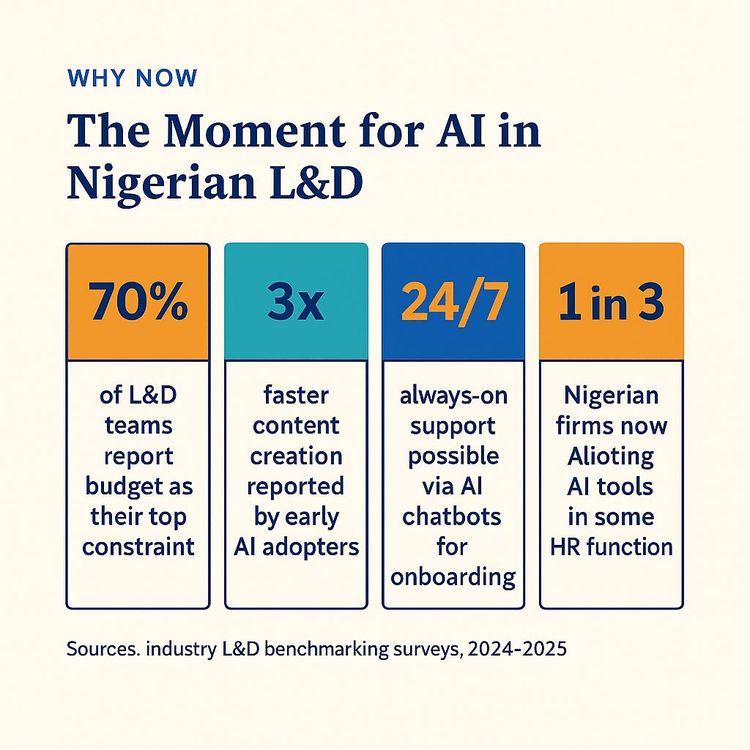
Here's the reality. Organizations that embrace AI in learning and development are pulling ahead. They create content three times faster. They support employees around the clock with intelligent systems. They make decisions based on evidence rather than guesswork. And they do it all with the same budgets and headcounts they had before.
The gap between AI-enabled organizations and everyone else is widening. This course ensures you're on the right side of that gap.
The Real State of L&D Today
Before we talk solutions, let's be honest about the problems. The learning and development function has been struggling with the same issues for years, and AI speaks directly to each one.
Budget constraints are the first wall you hit.
Management often treats training budgets as discretionary. When money gets tight, L&D is among the first to feel the knife. There's a persistent belief that meaningful training requires significant financial investment,expensive consultants, fancy platforms, off-site workshops. AI challenges that assumption directly. You can produce high-quality content with free or low-cost tools that would have required a professional agency a few years ago.
Time pressure is the second wall. The modern workplace demands speed. Tasks that once took days,building a PowerPoint presentation, drafting an employee handbook, creating training materials,can now be completed in minutes with AI assistance. That shift changes expectations. Leaders want faster turnaround, and professionals who leverage AI are meeting those expectations while those who don't fall behind.
Then there's the lean team problem. Many HR departments run with one manager or a tiny group responsible for L&D across multiple locations. A single HR manager might be driving training initiatives in Lagos, Abuja, and Port Harcourt simultaneously, each with distinct needs and logistical headaches. AI tools bridge that gap. They automate routine tasks, enable self-service solutions, and provide analytical support that would otherwise require additional headcount.
Generational diversity adds another layer of complexity. Your workforce includes Baby Boomers who prefer structured classroom learning, Gen Xers who want practical takeaways, Millennials who crave digital and collaborative experiences, and Gen Z employees who expect microlearning and instant feedback. Creating content in multiple formats for all these preferences used to mean multiplying your workload. AI lets you generate the same core content in text, visual, audio, and interactive formats without starting from scratch each time.
Finally, there's the physical versus virtual delivery challenge. In-person training gives you immediate feedback through body language. You can read the room, adjust your pace, and see when people are lost. Virtual training strips that away. Facilitators must actively engage participants through chat prompts, reactions, and interactive elements. AI supports this by generating engagement strategies, interactive activities, and assessment mechanisms specifically designed for online environments.
The AI in L&D Framework
Let's map out where AI actually fits in the learning and development lifecycle. It's not one tool doing one job. AI operates across five key domains, and understanding this framework helps you see the full picture.
Domain one: Training Needs Analysis.
This is the foundation. AI aggregates performance reviews, exit interviews, survey data, and recruitment insights to identify skill gaps. Instead of manually reading through hundreds of documents, you upload them to an AI tool and ask it to find patterns.
Domain two: Content Creation.
This is where most people start. AI generates facilitator guides, participant workbooks, slide decks, quizzes, case studies, and roleplay scenarios. The blank page problem disappears.
Domain three: Personalization.
AI tailors learning pathways to individual roles, departments, and experience levels. A new hire doesn't get the same training as a senior executive. A finance analyst doesn't follow the same path as a sales manager.
Domain four: Employee Support.
AI-powered chatbots and self-service knowledge banks give employees access to learning resources around the clock. They don't have to wait for HR to answer a policy question or find a training document.
Domain five: Analytics and Measurement.
AI analyzes training feedback, tracks assessment scores, and measures intervention impact. You get clear evidence of what worked, what didn't, and what to do next.
These five domains form a complete system. You identify needs, create content, personalize delivery, support learners, and measure results. AI strengthens every link in that chain.
AI-Powered Training Needs Analysis
Most training fails because it's not grounded in actual needs. Someone at the top decides the team needs leadership training, so you build a leadership program. But nobody asked whether leadership was actually the problem. Maybe the real issue is unclear processes, poor communication tools, or a toxic culture that no amount of training can fix.
Training needs analysis (TNA) exists to prevent this waste. And AI makes TNA dramatically more effective.
The first step is gathering data from the right sources. Performance review summaries are the obvious starting point,quarterly, bi-annual, or annual evaluations that document employee strengths, areas for improvement, and development needs. But don't stop there.
Exit interview notes are gold. Departing employees often share honest feedback about organizational gaps, workload issues, and skill deficiencies that current employees won't voice. Recruitment data reveals skill shortages in the external talent market that mirror internal gaps. If you're struggling to hire data analysts, chances are your existing team has data skills gaps too. Employee engagement surveys capture feedback on workplace challenges, training satisfaction, and development opportunities. And operational feedback from managers surfaces performance issues, compliance failures, and process inefficiencies that formal documents might miss.
Here's the practical workflow. Compile all these documents into a master file. Remove any personally identifiable information,names, email addresses, employee IDs. Upload the consolidated data to an AI tool like ChatGPT or Claude. Then ask the AI to act as an L&D analyst and identify recurring skill gaps, group them by department, distinguish quick wins from long-term needs, and present findings in a clear table format.
An example prompt looks like this.
"Act as an L&D analyst. I'm providing performance review summaries, exit interview notes, and engagement survey results for our organization. Identify the top five recurring skill gaps, group them by department, and suggest which ones are quick wins versus long-term training needs. Present your findings as a table."
What you get back is a structured analysis that would have taken days to produce manually. But here's the critical part: validate with managers. AI suggestions should always be confirmed with line managers and department heads before designing programs. The AI identifies patterns; humans confirm the context behind those patterns.
When it comes to prompting, remember the four pillars. Assign a role,"act as an L&D analyst." Provide context,include relevant data, organizational background, and industry specifics. Specify the output format,"present as a table," "list five priorities," "group by department." Include constraints,timeframes, audience characteristics, compliance requirements. The more structured your prompt, the more useful your output.
AI-Driven Content Creation
This is where AI delivers its most visible wins. Content that took days now takes minutes. Let me walk you through each type of learning content and how AI handles it.
Facilitator guides are the backbone of instructor-led training.
AI can generate a complete facilitator guide with session timings, structure, talking points, key messages, group activities, interactive exercises, and discussion prompts. You give it the topic, audience, and duration, and it builds the entire session blueprint.
Example prompt: "Create a 60-minute facilitator guide on effective delegation for mid-level managers with timings, talking points, and two group activities."
The output gives you a session that flows from opening to closing, with activities placed strategically to reinforce learning. You can then refine it with your own examples and organizational context.
Participant workbooks transform that facilitator guide into learner-facing materials. AI creates reflection questions, practical exercises, assessment tools, and action planning templates. The same session content becomes a workbook that participants can write in, think through, and take back to their jobs.
Assessments and quizzes serve two critical purposes. Pre-training assessments establish baseline knowledge and identify specific gaps before the session begins. Post-training assessments measure knowledge gain and intervention effectiveness. The difference between the two scores is your proof of impact.
Example prompt: "Write a 10-question multiple-choice quiz testing understanding of delegation principles with an answer key."
This is especially valuable when you're training on technical topics outside your own expertise. The AI generates questions that test real understanding, and the answer key ensures you can grade them accurately.
Slide decks and visual content have their own set of AI tools. Gamma.ai generates complete slide decks with visual design built in. Claude produces structured, professional presentation content. Canva AI enhances and customizes generated content with design elements. Lovable AI creates polished presentation materials. Manus AI offers advanced presentation generation capabilities. Arena.ai provides agent-mode presentation creation. Each tool has its strengths, and most have free tiers you can test before committing.
Employee handbooks and policy documents are another area where AI dramatically accelerates production. Generate a complete employee handbook from your organizational information. Summarize complex policies into one-page learning guides that employees will actually read. Convert standard operating procedures into accessible quiz formats to test understanding. Create compliance refresher materials that keep critical policies top-of-mind.
One practical approach: use AI to mine public resources, such as benchmarking against published handbooks from other organizations, then customize the output for your context while checking legal and ethical integrity.
Personalization and Audience Segmentation
Treating all employees as one homogeneous group is a common mistake in L&D. A new hire doesn't need the same training as a senior executive. A mid-level manager faces different challenges than a technical specialist. Personalization isn't a luxury,it's a necessity for effective learning.
Let's break down the audience segments. New hires need onboarding that covers organizational policies, culture, compliance, and role-specific fundamentals. Mid-level managers require training in leadership, delegation, communication, and project management. Senior executives benefit most from strategy, change management, and organizational leadership. Technical staff need role-specific skills, industry regulations, and professional development in their domain.
AI enables personalization at scale. You design role-specific learning paths that reflect each segment's needs. You generate microlearning content based on employee handbooks or policies,short, focused lessons that fit into busy schedules. You create onboarding roadmaps like a 30-day learning plan for a new finance analyst, with specific milestones and resources for each week.
The coaching and mentorship model takes this further. AI helps HR shift from transactional training delivery to strategic coaching. You assign coaches and mentors based on identified needs from performance data. You use AI-generated feedback frameworks to structure performance conversations. You create development plans that extend beyond formal training events, giving employees a continuous growth trajectory rather than isolated workshops.
Example prompt for this domain.
"Develop a 30-day onboarding learning roadmap for a new finance analyst, including weekly goals, recommended courses, and checkpoints with their manager."
The result is a structured plan that turns a new hire's first month into a deliberate ramp-up rather than a vague orientation period.
AI Chatbots and Employee Self-Service
How many routine questions does your HR team answer every week? What's the policy on annual leave? How do I access the training portal? Who do I contact about my benefits? These questions consume hours of HR time, and they're almost always the same questions repeated by different people.
AI chatbots solve this. You build an internal knowledge system that answers frequently asked questions about policies and procedures, provides on-demand access to training materials, guides employees through compliance requirements, and reduces HR workload by handling routine inquiries automatically.
Here's the implementation approach. First, compile a master document containing your frequently asked questions, policies, procedures, and organizational information. Second, upload it to an AI platform,ChatGPT with custom instructions or project features works well. Third, write a system prompt that tells the AI to act as a self-service bot based on the uploaded document. Fourth, test internally with random employee questions to validate response quality. Fifth, share the generated link through your organizational communication channels. Then iterate and improve based on user feedback and emerging questions.
The quality of your chatbot depends entirely on the quality of your source document.
If the information is outdated or incomplete, the responses will be too. Update the document regularly as policies change. Review the bot's answers periodically to catch inaccuracies.
One business owner used this approach to automate Instagram customer inquiries. They compiled a master document with price lists, opening hours, and service descriptions, uploaded it to a paid ChatGPT project, and generated a link that customers could use to get instant answers. This same model applies internally for HR and L&D.
Be cautious about what you upload. Use sanitized documents without sensitive employee information. Test the bot thoroughly before external launch. And always include a human escalation path for questions the bot can't handle.
Analytics and Impact Measurement
Here's a scenario that plays out in organizations everywhere. A three-day training program concludes with overwhelmingly positive feedback. Participants smile, thank the facilitators, and head back to their desks. The organizers declare success. But is that actually true?
In one real case, a three-day training with approximately 100 participants received strong feedback. The organizers were satisfied. But when they downloaded the survey data and ran it through AI analysis, a more nuanced picture emerged. Only 61% rated the training as "excellent." Another 22% said "very good," and 17% said "good." That's positive, but it's not perfect. And the AI identified specific improvement areas: more practical sessions, better time management, reduced operational interruptions, and improved audio equipment.
This is the power of AI-driven feedback analysis. It transforms raw data into actionable insights. It surfaces patterns that manual review would miss. It tells you not just whether people were happy, but what specifically needs to change.
The workflow is simple. Export your feedback data to Excel or CSV. Upload it to an AI tool. Ask for overall satisfaction percentages, strengths of the training, areas for improvement, and recommendations for future topics. The AI processes hundreds of responses in seconds and gives you a structured analysis.
Measuring training return on investment requires more than satisfaction surveys. You need pre-training assessments to establish baselines. You need post-training assessments to measure knowledge gain. You need department-level analysis to identify specific areas of underperformance. And you need longitudinal tracking to assess retention and application over time.
The pre-training and post-training assessment model is your most powerful measurement tool.
Before the training, administer a baseline assessment,a 10-question quiz on the topic. This reveals existing knowledge levels and helps you refine the content. After the training, administer a similar or identical assessment. Compare the scores. If the average moved from 40% to 75%, you have objective evidence of learning impact. Add incentives,recognition, certificates, small bonuses,to increase engagement and completion rates.
This approach also helps you identify which departments or teams aren't benefiting from training. If the sales team improved dramatically but the operations team stayed flat, you know where to focus follow-up support.
The Practical AI Prompt Library
You don't need to be a prompt engineer to get value from AI. You need a library of proven prompts that work for common L&D tasks. Here are ten that you can adapt immediately.
One: Training program design.
"Create a one-day training program on customer service for bank employees, including objectives, modules, activities, and materials."
Two: Pre-training assessment.
"Generate a pre-training assessment on Excel skills with 10 questions and an answer key."
Three: Policy summarization.
"Summarize this HR policy into a one-page learning guide with clear headings."
Four: SOP conversion.
"Turn this standard operating procedure into a 10-question quiz with answers."
Five: Role-play scenarios.
"Create five role-play scenarios for conflict resolution in a corporate setting."
Six: Feedback analysis.
"Analyze this employee feedback spreadsheet and identify recurring themes. Suggest areas for improvement."
Seven: Post-training action planning.
"Create a post-training action plan for participants to apply their new skills in their daily work."
Eight: Onboarding roadmap.
"Develop a 30-day onboarding learning roadmap for a new marketing coordinator."
Nine: Microlearning topics.
"Suggest microlearning topics from this employee handbook, focusing on compliance and code of conduct."
Ten: Executive coaching support.
"Act as an executive coach and provide feedback from a performance conversation with a manager who struggles with delegation."
These prompts work because they include a role, a task, an audience, and a format. The more specific you are, the better the output. Save your best prompts. Build a library. Share it with your team. You'll be amazed at how much time this saves.
Tool Selection: Free vs. Paid Solutions
One of the biggest misconceptions about AI is that you need to spend money to get value. That's simply not true. Some of the most powerful AI tools have free tiers that handle most L&D tasks effectively.
On the free side, you have ChatGPT's free tier for general-purpose AI assistance. Claude's free tier offers high-quality content generation with usage limits. Canva provides design and presentation tools with AI features built in. Gamma.ai generates presentations without cost. Arena.ai offers multi-purpose AI assistance.
On the paid side, ChatGPT Plus or Pro unlocks advanced features including custom GPTs and project organization. Claude Pro extends your usage limits and adds premium capabilities. Custom chatbots built on paid platforms give you organization-specific AI solutions for employee self-service.
Here's the strategic approach: explore free tools first.
Validate the value before committing financial resources. Build confidence and skills with free versions. Then upgrade when you hit the limits,whether that's usage caps, the need for custom chatbots, or the requirement for more sophisticated analysis.
Be aware of free tool limitations. Usage caps can interrupt your workflow. Hallucination issues occasionally produce incorrect information. Reduced functionality means some features are locked behind paywalls. Evaluate these constraints against your actual needs before deciding whether paid versions are justified.
Implementation Strategy and Change Management
Introducing AI into L&D is not just a technical change. It's an organizational transformation. And transformation requires strategy.
Start by identifying pain points. Document the specific inefficiencies and challenges in your current L&D processes. Where do you waste the most time? What tasks are slow, repetitive, or poorly executed? This documentation becomes your business case.
Then pitch AI as a solution to those specific problems. Don't talk about AI in the abstract. Show how it addresses the pain points you've identified. For example, if manual survey analysis takes two days, demonstrate how AI does it in five minutes. If slide deck creation takes four hours, show how AI produces a draft in sixty seconds.
Demonstrate before-and-after results. Run a pilot on one task, document the time savings and quality improvements, and present the evidence to leadership. Numbers speak louder than promises.
Involve skeptics early. The most resistant leaders can become your best allies if they're part of the process from the beginning. Invite them to test the tools. Ask for their input. Address their concerns directly.
Communicate the "why." Help stakeholders understand that AI is not about replacing people. It's about enabling them to work better, faster, and more creatively. The strategic rationale matters.
For the rollout itself, follow a phased approach. Start small with one painful, time-consuming task. Build momentum by demonstrating quick wins. Protect employee data by anonymizing sensitive information before uploading. Explore free tools first to validate value. Then scale gradually as organizational confidence grows.
Common pitfalls to avoid.
Uploading sensitive or personally identifiable data to unsecured tools. Relying on AI outputs without human review and validation. Focusing on tools rather than the underlying learning problems. Undertaking too much change at once. Ignoring the need for performance support, coaching, and follow-up after training.
Winning over stakeholders requires deliberate effort. Engage skeptics early. Communicate the "why" clearly. Achieve leadership buy-in,senior sponsorship is critical for budget approval, cross-departmental cooperation, and long-term sustainability. Celebrate wins publicly. Share success stories and measurable improvements to maintain momentum. And provide training and support so employees have time to become comfortable with AI tools.
Data Privacy and Ethical Considerations
The power of AI comes with significant responsibility. L&D professionals handle sensitive employee data, and using AI tools introduces new risks.
Anonymize employee data before uploading to AI platforms. Remove names, email addresses, ID numbers, and any other identifying information. This is non-negotiable. Review your organizational policies to ensure compliance with data protection regulations. Recognize that information shared with AI tools may be accessible externally,treat it accordingly. Edit sensitive content from documents before AI processing. And test AI responses with internal audiences before any external deployment.
Data protection principles to follow.
Anonymize personal data. Minimize data collection,share only what's needed to complete the task. Use secure platforms, preferably enterprise-grade AI tools with strong data protections. Obtain consent from employees about how their feedback and performance data will be used. Follow regulations like GDPR or other local data protection laws.
Human oversight is essential. AI is a starting point, not a final authority. All AI-generated outputs must be reviewed and refined by subject matter experts. Decisions about people should never be made solely by algorithms. Be aware of AI limitations,hallucination, bias in training data, and context blindness. Document your processes so there's a clear record of how AI is used in decision-making.
Building trust requires transparency. Tell employees how AI is used in L&D. Emphasize that AI amplifies human competence rather than diminishing it. Maintain a "human in the loop" for all consequential decisions. When people understand that AI is a tool serving human goals, resistance fades.
Learning Management Systems and the Technology Stack
AI doesn't exist in isolation. It works alongside your existing technology stack, including your Learning Management System.
LMS platforms centralize content hosting, giving employees access to training videos, documents, and assessments in one place. They support self-paced learning through on-demand access to recorded sessions and materials. They track progress by monitoring completion rates and assessment scores. And they enable knowledge management by organizing and retrieving learning resources.
Examples of LMS platforms include Trainer Central, designed for hosting and managing training content. SellAR, which offers options for uploading videos and creating learning accounts for employees. Coursera and Alison, which provide external courses that can be assigned to employees as development opportunities.
When selecting an LMS, consider scalability, ease of use, integration with existing HR systems, and support for different content formats including video, quizzes, and assessments.
AI tools and LMS platforms complement each other. AI generates the content; the LMS delivers and tracks it. AI analyzes the data; the LMS stores it. Together they form a complete learning ecosystem.
Implications for Different Stakeholders
The impact of AI in L&D extends beyond the HR department. Let's look at who benefits and how.
For HR practitioners, the efficiency gains are transformative. Content development time drops from days to minutes. Decisions become data-driven rather than intuitive. A single HR team of two people can successfully manage L&D across three locations with AI support. And HR professionals reposition from administrative training coordination to strategic talent development,a more valuable and satisfying role.
For organizations, AI-enabled L&D creates competitive advantage. High-performance teams outperform competitors. Training budgets shrink while quality improves or stays constant. Meaningful development opportunities increase employee engagement and reduce turnover. And compliance assurance improves through AI-generated assessments and refreshers that ensure policy understanding.
For educational institutions, AI accelerates curriculum development and assessment creation. Personalized learning becomes possible for diverse student populations. AI-generated materials free educators to focus on mentorship and facilitation rather than content production.
For policymakers, AI-enabled training addresses skills gaps at scale. Promoting AI adoption in L&D supports broader digital transformation goals. And AI tools help organizations maintain training documentation and compliance records more reliably.
Key Insights and Takeaways
Let me leave you with the insights that matter most.
AI removes the blank page, not professional judgment.
AI accelerates execution, but strategic thinking, contextual understanding, and human oversight remain essential. You are still the boss.
Start with one painful task. Identify the most time-consuming, frustrating L&D activity in your workflow and apply AI there first. The quick win will build confidence and momentum.
Data is the foundation. Performance reviews, exit interviews, recruitment insights, and engagement surveys are valuable data sources for AI-powered needs analysis. Start collecting them systematically if you haven't already.
Assessment before and after. Measuring knowledge gain through pre- and post-training assessments provides objective evidence of intervention effectiveness. This is how you prove ROI.
Personalization matters. Different employee segments require different learning approaches. AI enables tailored content at scale, so there's no excuse for one-size-fits-all training.
Free tools provide significant value. Explore them before investing in premium solutions. Most organizations can accomplish a great deal with free tiers alone.
Protect employee data. Anonymization and careful content review are non-negotiable when using AI platforms. One breach of trust can undo years of progress.
Leadership buy-in is critical. Involve skeptics early, demonstrate results, and communicate the strategic rationale. Without senior sponsorship, AI initiatives stall.
AI is a business partner, not a replacement. Human thought, depth, and competence remain essential. AI enhances efficiency in applying that competence.
L&D extends beyond formal training. Coaching, mentorship, self-service resources, and continuous learning systems create sustainable development cultures. AI supports all of these.
Action Items for L&D Professionals
You now have the framework, the prompts, and the strategies. Here's what to do next.
Conduct an AI readiness assessment. Identify your current L&D processes, pain points, and opportunities for AI integration. Write them down. Be specific.
Start with a pilot project. Select one time-consuming task,training needs analysis, slide deck creation, or feedback analysis,and apply AI tools. Measure the before-and-after difference.
Build a data repository. Systematically collect performance reviews, exit interviews, and survey data for AI analysis. The quality of your AI insights depends on the quality of your data.
Develop a prompt library. Create and document effective prompts for common L&D tasks. Share them with your team. Refine them over time.
Explore free AI tools. Test ChatGPT, Claude, Canva, Gamma, and Arena.ai before committing to paid solutions. Build confidence first.
Establish data privacy protocols. Create guidelines for anonymizing employee data before AI processing. Make them mandatory.
Create a training calendar. Use AI to develop a structured annual L&D calendar aligned with organizational goals and compliance requirements.
Implement pre- and post-training assessments. Measure knowledge gain for all major training interventions. This is your evidence of impact.
Build an employee self-service knowledge base. Develop AI-powered chatbots for routine HR and training inquiries. Start with the most common questions.
Secure leadership buy-in. Present pilot results, demonstrate ROI, and involve key stakeholders early. Make them part of the journey, not spectators to it.
For Organizations and Individuals Transitioning to L&D
Organizations should invest in AI tool access for L&D teams where free versions prove insufficient. Develop AI literacy programs that train HR and L&D staff on effective prompting and integration. Create an AI governance framework that establishes policies for data privacy, tool selection, and ethical AI use. Integrate AI into the HR technology stack, connecting AI tools with existing HRIS, LMS, and performance management systems. And measure and report L&D impact using AI analytics, tracking training effectiveness and communicating results to leadership.
For individuals transitioning into L&D, the path is clear. Build an HR generalist foundation first,understand recruitment, performance management, and HR strategy before specializing in learning and development. Develop presentation and facilitation skills, mastering slide creation, public speaking, and group facilitation. Learn AI prompting by practicing with the prompt library in this course. Understand knowledge management,organizing, storing, and retrieving learning resources. And cultivate coaching capabilities, learning to provide feedback, guide development, and support employee growth.
The organizations that thrive will be those that embrace AI as a business partner in workforce development. The path forward is clear: start with specific pain points, demonstrate value through measurable results, protect employee data, and build momentum through incremental adoption.
Conclusion
Artificial intelligence represents a transformative opportunity for learning and development professionals. By automating routine tasks, accelerating content creation, enabling data-driven decision-making, and supporting personalized learning experiences, AI empowers HR teams to deliver more effective training with fewer resources.
The technology does not replace professional judgment. It amplifies it. It lets you focus on strategic thinking, coaching, and human connection instead of administrative grind.
Here's the message that matters most. The tools are available right now. The methods are proven. The only question is whether you'll act. Those who integrate AI into their practice will enhance their own effectiveness and position their organizations for sustained success. Those who wait will watch the gap widen.
Start small. Pick one task. Run one pilot. Show one result. Then build from there.
Your judgment, your strategy, and your human touch remain irreplaceable. AI simply removes the friction between thinking and doing. And in a world where speed determines competitive advantage, that friction removal changes everything.
Frequently Asked Questions
This FAQ exists to give Learning and Development professionals, HR teams, and business leaders clear, practical answers about using Artificial Intelligence in training. It moves from basics through advanced applications, addressing real implementation questions, risks, and day-to-day use cases. You can use it as a reference: skim the fundamentals, then jump into prompts, tools, ethics, rollout plans, and career questions as your needs get more specific.
PART 1: FOUNDATIONS OF AI IN L&D
What is Artificial Intelligence in the context of Learning and Development?
Simple definition:
In L&D, Artificial Intelligence refers to software that can read, write, summarize, analyze, and make suggestions based on data and instructions you give it. Think of it as a very fast assistant that can create drafts, spot patterns, and personalize learning at scale.
How it shows up in L&D:
AI tools help you design programs, write facilitator guides, generate quizzes, analyze survey results, and build chatbots that answer learner questions. Instead of starting from a blank page, you start from a strong draft and use your expertise to refine it.
Real example:
An L&D manager uploads performance review summaries into an AI tool, asks it to "act as an L&D analyst," and gets a list of skill gaps grouped by department. That output becomes the basis for the annual training plan, saving days of manual work and guesswork.
What role does Artificial Intelligence play in Learning and Development?
Core role:
AI acts as an accelerator and support system, not a replacement for L&D professionals. It handles repetitive, structured tasks so you can focus on strategy, stakeholder relationships, and quality of learning experiences.
Where it helps most:
It speeds up content creation, converts policies into learning assets, builds assessments, analyzes surveys, and personalizes recommendations for different roles and levels. AI removes the "blank page" problem and turns scattered information into structured programs.
Practical example:
Instead of spending three days building a slide deck and workbook, an HR specialist uses an AI tool to generate a full draft in an hour, then spends their effort refining examples, stories, and activities so the session fits the company's culture and goals.
Why is AI adoption becoming essential for L&D teams now and in the future?
Competitive reality:
If your team creates training manually while competitors use AI to produce the same work in a fraction of the time, you fall behind on speed, variety, and responsiveness. AI allows L&D teams to meet growing demands without growing headcount at the same pace.
Pressure on L&D:
Budgets are tight, expectations are high, and workforces are diverse. AI lets you handle more requests, personalize learning, and prove impact with data, instead of relying on generic workshops and "smiley-sheet" feedback only.
Cultural effect:
As employees learn to use AI in training and daily work, they raise the bar for productivity everywhere they go. Organizations that build this capability early become reference points; others are forced to catch up or accept lower performance as the norm.
Will AI replace L&D professionals?
Short answer:
AI will replace repetitive tasks, not thoughtful professionals. The people at risk are those who keep doing manual, template work and refuse to learn how to work with AI as a partner.
What AI can't do well:
It doesn't understand your politics, culture, power dynamics, or subtle human emotions. It can't build trust with skeptical executives, coach a struggling manager in a nuanced conversation, or design learning that fits your unique context without your guidance.
Smart approach:
Use AI for drafting content, analyzing data, and generating options. Then use your judgment to choose, adapt, and implement. The L&D professional who can think critically, communicate clearly, and work fluently with AI becomes significantly more valuable, not less.
What benefits does AI in L&D offer business leaders and the wider organization?
For executives:
AI-supported L&D gives clearer visibility into skills, training impact, and readiness for strategic goals. Leaders get dashboards instead of long, vague reports. They see which departments improved after specific interventions and where risk remains.
For managers:
They receive targeted programs for their teams, faster. Instead of waiting months for a generic course, they can get role-specific sessions, microlearning, and action plans generated and refined in weeks or days.
For the organization:
AI lowers the cost per learner, increases consistency across locations, and keeps training relevant as roles change. Over time, this builds a culture where learning is continuous, data-backed, and clearly connected to performance, rather than a box-ticking exercise.
What skills do L&D professionals need to work effectively with AI?
Core skill set:
You need strong critical thinking, clear writing, a basic grasp of learning science, and solid stakeholder management. AI amplifies these; it does not replace them.
AI-specific skills:
Prompt writing (giving clear instructions), evaluating AI outputs, combining multiple tools (e.g., ChatGPT + Canva), and translating business problems into L&D solutions. You don't need to code, but you do need to be curious and willing to experiment.
Practical development path:
Pick a few recurring tasks,needs analysis, slide creation, survey analysis,and commit to doing them with AI every week. Document what works, refine your prompts, and share wins internally. Over time, you build a personal "playbook" that makes you visibly better and faster at your role.
PART 2: THE L&D LIFECYCLE AND AI APPLICATIONS
What are the key stages of the L&D lifecycle where AI creates value?
Core stages:
The L&D lifecycle includes needs analysis, content creation, personalization, delivery support, and measurement/analytics. AI can plug into each stage and compress the time it takes to move from one to the next.
Practical examples:
- Needs analysis: AI reads performance reviews and exit interviews and surfaces recurring skill gaps.
- Content creation: It drafts facilitator guides, participant workbooks, slides, quizzes, and case studies.
- Personalization: It adapts content for different roles, levels, and learning preferences.
- Delivery support: Chatbots answer questions and act as digital co-facilitators.
- Measurement: AI analyzes assessments and survey data to reveal what worked and what didn't.
Result:
You spend less time assembling raw materials and more time on stakeholder conversations, facilitation quality, and continuous improvement.
How should organizations approach Training Needs Analysis (TNA) with AI?
First step: centralize data.
Gather performance review summaries, recruitment notes, exit interview highlights, engagement survey comments, and relevant metrics into one anonymized document. This becomes your "master file."
Use AI as an analyst:
Upload the file and give a clear instruction such as: "Act as an L&D analyst. Identify recurring skill gaps by department, distinguish quick wins from long-term needs, and present results in a table format." AI will produce patterns humans often miss when scanning hundreds of entries.
Critical step: validate:
Share the AI output with line managers and leaders. Ask, "Does this reflect reality? What's missing? What should we prioritize?" This combination of machine-scale analysis and human context gives you a grounded, defensible TNA.
What constitutes a performance review summary, and why is it valuable for AI analysis?
What it includes:
A performance review summary typically contains overall rating, key achievements, strengths, development areas, and agreed development plans. Example: "Victor consistently meets expectations, shows strong stakeholder management, and needs improvement in time management."
Why AI loves it:
These summaries are structured, repeatable, and written across many employees and departments. When you combine them and remove personal identifiers, AI can quickly spot patterns: recurring issues with financial reporting, communication, leadership, or technical skills.
How L&D uses it:
Feed the summaries into an AI tool with a prompt asking for cross-department skill gaps and recommended interventions. You'll get a prioritized list of training topics for specific populations rather than guessing what to offer.
How does AI enhance the effectiveness of pre-training and post-training assessments?
Before training:
AI can generate baseline assessments in minutes, even for topics outside your expertise. For example: "Create a 20-question multiple-choice assessment on intermediate Excel for finance staff, with an answer key." This reveals current competence and informs your design.
After training:
Use the same or a slightly modified assessment. Comparing pre- and post-scores turns "people liked the session" into evidence: "average scores moved from 42% to 78%." That speaks directly to leaders who care about measurable change.
Extra value:
AI can also help you interpret the results by department or role, and suggest follow-up interventions for groups that did not improve enough.
How do I run a Training Needs Analysis step-by-step using AI?
Step 1 - Collect inputs:
Pull together performance reviews, exit interviews, survey comments, and any customer or quality metrics that point to skill issues. Remove names and identifiers.
Step 2 - Consolidate:
Combine them into one or a few documents or spreadsheets. The more consistent the format, the better AI can work with it.
Step 3 - Analyze with AI:
Upload to an AI tool and ask it to group recurring gaps by department, role, and impact on business outcomes. Request a summary and a table of "quick wins vs. long-term development."
Step 4 - Validate and refine:
Discuss the findings with managers. Adjust based on their context, then translate agreed priorities into a training calendar, coaching programs, and on-the-job supports.
How can AI support personalization and learner segmentation in practice?
Start with segments, not individuals:
Group learners by role, level, and key challenges (e.g., new hires, first-time managers, seasoned leaders, frontline staff). Then ask AI to adapt core content to each segment's context and examples.
Tactical approach:
Use one "master" facilitator guide and have AI generate variations: "Now rewrite this module for frontline retail staff," or "Simplify this for new graduates in their first job." You can also ask AI to create different formats,videos scripts, short articles, quizzes,from the same source material.
Outcome:
Learners feel the content speaks to their reality without you building every version from scratch. This is personalization at scale, grounded in thoughtful segmentation rather than trying to be unique for every single employee.
Certification
About the Certification
Become certified in AI-Powered Learning & Development. Prove you can create training content in minutes, run AI-driven needs analysis, and measure learning impact,skills that let you build scalable programs employers actually need.
Official Certification
Upon successful completion of the "Certification in Designing AI-Powered Training That Scales", you will receive a verifiable digital certificate. This certificate demonstrates your expertise in the subject matter covered in this course.
Benefits of Certification
- Enhance your professional credibility and stand out in the job market.
- Validate your skills and knowledge in cutting-edge AI technologies.
- Unlock new career opportunities in the rapidly growing AI field.
- Share your achievement on your resume, LinkedIn, and other professional platforms.
How to complete your certification successfully?
To earn your certification, you’ll need to complete all video lessons, study the guide carefully, and review the FAQ. After that, you’ll be prepared to pass the certification requirements.
Other AI Video Courses
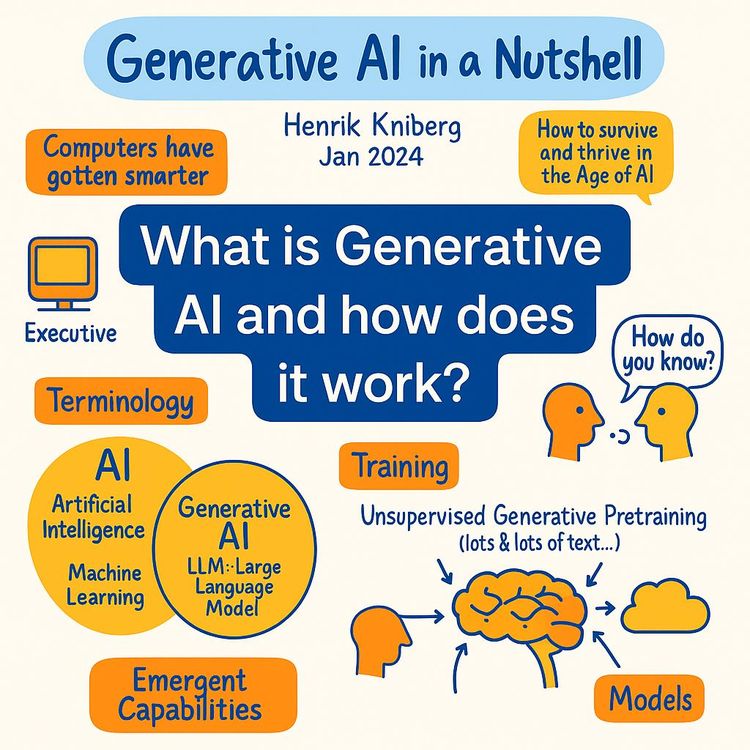
Video Course: What is Generative AI and how does it work?

Video Course: How to Use ChatGPT from Beginner to Professional
Video Course: How to Use Google Gemini for Google Workspace to Boost Productivity

Video Course: How to Use Claude 3.7 AI - Tips for Beginners!
Video Course: ChatGPT for Data Analytics: Full Course - from Beginners to Professional
Video Course: Generating Images and photos With ChatGPT?

Video Course: Generating Images & Photo's with MidJourney
Video Course: Generating Design's with Microsoft Designer and AI
Video Course: Generating Design's with Canva.com and AI
Join 20,000+ Professionals, Using AI to transform their Careers
Join professionals who didn’t just adapt, they thrived. You can too, with AI training designed for your job.