AI Fundamentals from Google Experts | Professional Certificate (Video Course)
Learn to use AI as a smart coworker, not a magic trick. Google experts show core concepts, a simple prompting playbook (Persona, Task, Context, Format), and the ACT check for safe use,so you forecast, stress-test, and ship better work, faster. No fluff.
Related Certification: Certification in Applying AI Fundamentals to Solve Real-World Problems
Also includes Access to All:
What You Will Learn
- Describe core AI concepts (models, LLMs, generative, multimodal, agents)
- Apply the PTFC prompting blueprint (Persona, Task, Context, Format)
- Iterate prompts and tune temperature for creativity versus predictability
- Use the ACT framework (Ask, Check, Tell) to verify and disclose AI outputs
- Prototype end-to-end workflows with Gemini, AI Studio, and NotebookLM
Study Guide
Learn AI Basics from Google Experts | Google AI Professional Certificate
Let's be honest. The conversation about AI usually swings between hype and hesitation. You either hear "it will do everything for you" or "it can't be trusted." The truth lives in the middle,and that's where the real advantage is. This course teaches you how to use AI as a strategic collaborator. You'll learn the core concepts,what AI is, how it works, and where it thrives,and then we'll get practical: how to prompt, how to iterate, how to keep a human in the loop, and how to apply AI responsibly in your day-to-day work.
By the end, you'll know how to set up AI to help you forecast growth, pressure-test assumptions, generate options you hadn't considered, and streamline the admin that steals your mornings. You'll also know what not to trust it with and how to verify everything you put your name on. This isn't about becoming a data scientist; it's about becoming the kind of professional who can wield a powerful tool with precision. As one guiding principle puts it, "The real benefit isn't just in solving one-off tasks. It's in collaborating to help you solve a problem, navigating across various steps, and enlisting its help to set you up for making better decisions."
Section 1: What AI Is,and Why It's Now a Business Skill
Artificial Intelligence (AI) in plain terms
AI is the practice of building systems that perform tasks we usually reserve for human intelligence: reasoning, learning, making recommendations, summarizing, classifying, and generating content. These systems learn from data, find patterns, and use those patterns to make predictions or produce new outputs.
AI as collaborator, not just automation
Yes, AI can draft emails and clean your calendar. But its deeper value comes from partnering on complex work. Treat it as a colleague you can brief,one that's fast, tireless, and creative, but still needs your judgment. That mindset unlocks real leverage.
Examples:
* You ask for a market expansion forecast with three scenarios. AI returns models based on your historical sales, seasonality, and assumptions you provide,plus it highlights hidden risks you didn't see.
* You lead a strategy offsite. AI generates facilitation prompts, 90-minute workshop flow options, icebreakers tuned to your culture, and a wrap-up memo shaped for executives.
What this course emphasizes
We'll start from basics, move to modern capabilities (LLMs, generative, multimodal, agents), then practice an actionable prompting framework used by professionals. Finally, we'll lock in responsible use with a simple ACT framework: Ask, Check, Tell. There's no fluff here,only what you can apply immediately.
Section 2: Core AI Concepts (The Foundations You'll Use Daily)
AI Models: What they are and how they work
An AI model is a trained computer program. During training, it ingests massive amounts of data and learns statistical patterns. After training, it can apply those learned patterns to new inputs: predict the next word, spot a trend in your spreadsheet, or suggest a design direction.
Examples:
* A spam filter trained on billions of emails learns patterns that separate spam from legitimate messages, then flags new spam instantly.
* A recommendation system on a shopping site learns customer behavior and suggests relevant products to a new visitor.
Training Data: Why data quality and diversity matter
The model can only learn from what it sees. Narrow, unbalanced, or poor-quality training data limits its performance and can introduce bias. If the data is incomplete, the model's outputs will be too.
Examples:
* An image model trained mostly on pictures of red apples may misclassify green apples. Add variety and the model gets better at real-world detection.
* A language model trained heavily on one region's news may underperform on topics prevalent in other regions. Expanding sources improves fairness and relevance.
Large Language Models (LLMs)
LLMs are advanced models trained on enormous text and code datasets. They're fluent in language: they can answer questions, draft documents, translate, summarize, reason over instructions, and generate fresh content.
Examples:
* You paste a messy meeting transcript; the LLM turns it into a crisp executive summary, an action list, and a follow-up email draft.
* You describe a bug in your product. The LLM proposes likely root causes, testing steps, and a templated incident report.
Generative AI (GenAI)
Generative AI creates new content,text, images, code, audio,based on patterns it learned. This is different from searching. It composes something new in the style and constraints you provide.
Examples:
* You give a brand voice guide; GenAI drafts a month of social posts aligned to that tone, each with alternate captions and call-to-action variants.
* You supply a rough outline for a client proposal; GenAI expands it into a polished draft with clear sections, a case study, and a pricing rationale.
Multimodal AI
Multimodal systems handle multiple input types (text, images, audio, video) in one place and output across those types. The benefit: you can point at reality,screenshots, photos, audio notes,and ask the model to reason over them.
Examples:
* You upload a photo of a complex dashboard and ask for the three most important insights, each with an action recommendation.
* You share a voice note recap of a customer call; the AI produces issue themes, suggested experiments, and a prioritized backlog.
AI Agents
Agents pair an intelligent model with tools (calendar, browser, email, spreadsheets) and the ability to break down a goal into steps. You define the destination; the agent plans and executes under your supervision.
Examples:
* "Organize a kickoff meeting." The agent checks calendars, books a room, creates an agenda, drafts invites, and schedules reminders,all for your approval before sending.
* "Compile a competitor brief." The agent browses approved sources, extracts key points to a doc, flags claims that need human verification, and suggests follow-up interviews.
Model vs. App (Car Analogy)
Think of the model as the engine,it creates the power. The app is the car surrounding it,steering wheel, dashboard, safety systems, user interface. Multiple apps can use the same model, just like many cars can use similar engines. Choosing the right "car" (app) affects usability, governance, and integrations; the "engine" (model) affects capability, quality, and style of output.
Examples:
* The same LLM inside a note-taking app can summarize meetings, while inside a data tool it can write SQL. Same engine, different vehicles.
* A finance app using a general LLM adds controls and templates for regulatory reporting,your experience differs because the app wraps the model with domain workflows.
Temperature (Creativity and Predictability)
Temperature is a setting that tunes creativity. Low temperature = more deterministic and consistent. High temperature = more diverse and creative, but less predictable.
Examples:
* Low temperature for compliance emails: you want precise, boring, and consistent phrasing every time.
* High temperature for brainstorming brand names: you want a wide range of inventive options, even a few weird ones to spark direction.
Section 3: The Mindset Shift,From Task Executor to Collaborative Partner
Most people underuse AI because they treat it like a vending machine: insert prompt, receive answer. Power users treat it like a colleague. They set the role, share context, define the target, and iterate. When you elevate the conversation, the output levels up with it.
Simple vs. collaborative prompting
A simple request is fine for quick tasks. But for work that matters,forecasts, proposals, plans,use the collaborative approach.
Examples:
* Simple: "Draft a note to the team about the new project."
* Collaborative: "Act as a senior business strategist. Our goal is to grow revenue by 15% by year-end. Build a forecast with three scenarios, list core assumptions, pressure-test them, and propose the top five risks with mitigations."
Examples:
* Simple: "Give me five ad headlines."
* Collaborative: "You're a performance marketer. For a DTC skincare brand targeting first-time buyers, propose three headline sets tuned to awareness, consideration, and conversion. Include angle, promise, and a compliant disclaimer."
Section 4: Prompting Fundamentals (Persona, Task, Context, Format)
Prompting is a core professional skill now. The output you get depends on the clarity and specificity of your input. Use a four-part blueprint. Order is flexible; coverage is not.
1) Persona
Assign a role to the AI. You're telling the model which subset of its knowledge to prioritize, how to communicate, and what lens to use.
Examples:
* "You are a seasoned team leader experienced with cross-functional product launches in regulated industries."
* "Act as a customer success manager specializing in onboarding B2B SaaS clients with complex security reviews."
2) Task
Define what you want, clearly and concisely. One task per prompt thread is best; for big goals, break it down into steps.
Examples:
* "Create a risk register with likelihood, impact, owner, and mitigation for our next launch."
* "Draft an FAQ for a new feature release addressed to enterprise admins."
3) Context
Give the essential background the model can't guess. This is the most important piece: constraints, audience, tone, what good looks like, and anything the model must include or avoid.
Examples:
* "Our product is a mobile app used by healthcare providers. We serve global teams; decision-makers attend late-night meetings due to time zones. Our priority is reducing meeting bloat and accelerating decisions without new tools."
* "We have no extra budget this quarter. Legal requires accessible language and no speculative claims. Our ICP: IT directors at mid-sized firms."
4) Format
Specify the structure. This reduces edits and makes the output plug-and-play.
Examples:
* "Deliver as a bulleted list with short headings and one-sentence explanations."
* "Provide a 200-word executive summary followed by a three-section outline, then a one-paragraph call-to-action."
Input vs. Output
Input includes everything you give the AI: your instruction, attached docs, screenshots, audio, code. Output is what it returns. Better input yields better output.
Examples:
* Input: A messy spreadsheet and a prompt requesting the top three anomalies by week. Output: A concise explanation of anomalies with likely causes and a proposed validation plan.
* Input: A product brief PDF and your goal to generate a launch plan. Output: A week-by-week plan with owners, milestones, and risk flags.
Best practices that compound
Use one chat per topic so the model's memory doesn't blend unrelated goals. Start with a clear brief. Iterate quickly. And always keep your standards anchored in the real-world outcome, not the novelty of the tech.
Examples:
* One thread for "Improve weekly status meetings," another for "Draft Q3 launch comms." Mixing them leads to messy context and weaker results.
* A prompt with a sample output attached consistently performs better than generic instructions; supply a model example to calibrate style and depth.
Section 5: Advanced Prompting Techniques (From Good to Great)
Iteration and refinement
First outputs are drafts. Refine your prompt, add constraints, and ask for alternatives. Treat the conversation as a design loop.
Examples:
* "Revise section two for brevity, keep action verbs, and remove jargon. Then provide two alternative intros with different angles: urgency vs. opportunity."
* "Split my large request into a sequence of steps. Ask me clarifying questions at each step before proceeding."
Provide examples (few-shot prompting)
Show the model what "good" looks like. Include a prior report, a sample email, or even a snippet with comments about why it's good.
Examples:
* "Here's a previous announcement that landed well. Mirror the structure and tone, but update the details for our new feature set."
* "This is a sample workshop agenda. Generate a fresh version for managers with remote teams, preserving the timeboxes and outcomes."
Set constraints
Constraints force relevance. Time limits, budget caps, channels, tone, compliance rules,state them.
Examples:
* "Give me options that can be executed in under one week with no extra budget."
* "Keep claims non-promissory and accessible to a ninth-grade reading level."
Meta-prompting
Ask the AI how to ask better. This is an underrated move when you're not sure what details it needs.
Examples:
* "What information do you need from me to deliver a tailored, on-target plan?"
* "List the assumptions you're making. I'll confirm which are correct and which need adjustment."
Structure your outputs
Ask for consistent schemas. This makes handoffs and automation easier.
Examples:
* "Return the plan as a JSON object with fields: priority, owner, start_date, end_date, risk, mitigation."
* "Provide a CSV-style list with headers: Step, Time, Resource, Expected Outcome."
Temperature tuning
Use your tool's temperature setting strategically. Lower for precision; higher for idea generation.
Examples:
* "Set temperature low and produce a standardized response template for customer refunds."
* "Increase temperature and give me 25 bold campaign angles, tagged by emotional hook."
Conversation hygiene
Keep topics cleanly separated. Reset the thread when shifting goals; it removes stale context and prevents drift.
Examples:
* After finishing a product FAQ, start a new conversation for the press release so the tone calibrates fresh.
* Close a long brainstorming thread and open a new one for final drafting to avoid importing half-baked ideas into the polish phase.
Section 6: Practical Applications Across Roles and Teams
Research acceleration
AI can scan documents, draft literature reviews, and summarize key points. You still verify sources, but you get a running start.
Examples:
* "Summarize the top five trends across these analyst reports. Tag each trend with a confidence level and links to supporting sections."
* "Extract the pros/cons from 30 customer reviews and cluster them into themes with example quotes."
Data analysis and insights
Not every insight needs a data scientist. AI can spot anomalies, suggest hypotheses, and propose next steps.
Examples:
* "From this spreadsheet, identify top three revenue drivers by region and recommend one diagnostic test per driver."
* "Analyze weekly churn and produce a cohort-based explanation with retention tactics prioritized by lift and effort."
Drafting communications
Speed up first drafts without sacrificing quality. You set the voice; AI handles structure and options.
Examples:
* "Draft a progress update to executives: 200 words, bottom-line-up-front, three risks, and asks."
* "Create three versions of a product announcement: email to customers, internal memo to sales, and a short social post series."
Creative ideation
Use AI to expand your option set. You won't keep all suggestions,but you'll see angles you might have missed.
Examples:
* "Generate 15 content ideas mapping top funnel questions to mid-funnel objections. Include working titles and key takeaways."
* "Give me five alternative hero images for a landing page, with rationale for each visual choice."
Operations and automation
Automate recurring tasks so your team focuses on judgment calls, not logistics.
Examples:
* "Build a checklist for release readiness with owners and due dates, then draft the Asana tasks I can paste in."
* "Summarize yesterday's Slack thread into a decision log with open questions and next steps."
Presentation support
Turn raw material into structured narratives, then polish for audience fit.
Examples:
* "Convert this doc into a 10-slide outline with section titles, speaker notes, and a final slide of decisions needed."
* "Tailor this deck for a finance audience: emphasize ROI, remove jargon, and add two sensitivity charts."
Section 7: Responsible AI,The Human-in-the-Loop Advantage
AI is powerful, but it lacks common sense, lived experience, and ethical judgment. Your role isn't optional,it's essential. As a reminder: "Remember, AI doesn't know anything. It's just using its data and learning to predict what the best answer might be from a range of possible options."
Key limitations to watch
Use these realities as guardrails for your practice.
Hallucinations
AI can generate content that sounds plausible but is wrong or fabricated. Confident tone doesn't mean correct content.
Examples:
* It cites a study that doesn't exist or misattributes a quotation to a notable person.
* It invents a product feature because similar products include it, leading to misleading messaging.
Bias
Models can inherit and even amplify bias present in training data, yielding unfair or skewed outputs.
Examples:
* It recommends leadership candidates who mirror past hires, ignoring diverse profiles with similar qualifications.
* It defaults to stereotypes in customer personas that alienate segments of your audience.
Lack of nuance
AI doesn't truly understand context or consequences,it recognizes patterns. That gap matters in sensitive scenarios.
Examples:
* It proposes a promotional message during a time when sensitivity is needed, missing the emotional context.
* It suggests an outdated event as if it were current because its reference pattern matches but lacks real-world verification.
The ACT Framework for responsible use
Simple, memorable, and effective: Ask, Check, Tell.
A , Ask (Is AI appropriate?)
Before you start, ask if AI is the right tool for the task.
Examples:
* Sensitive domains: Do not rely on AI for medical, legal, or financial advice. Consult qualified professionals.
* Confidential data: Avoid putting proprietary or personal information into public tools. Follow your company's policies on approved platforms and data handling.
C , Check (Verify everything)
Always review outputs for accuracy, objectivity, and appropriateness.
Examples:
* Accuracy: Fact-check statistics, links, and claims. Cross-verify with primary sources.
* Objectivity: Scan for loaded language, one-sided arguments, or stereotypes. Adjust or discard as needed.
Examples:
* Appropriateness: Tailor tone and content for the intended audience. The same message to customers and internal teams requires different framing.
* Risk review: Highlight where the model is guessing; add your judgment or further research before publishing.
T , Tell (Be transparent)
Disclose meaningful AI assistance to maintain trust. Transparency doesn't diminish your expertise; it strengthens credibility.
Examples:
* "This report was drafted with AI assistance and thoroughly reviewed by the author for accuracy and tone."
* Use tools like SynthID (where available) to watermark AI-generated media to support traceability and authenticity.
One final reminder about accountability: "AI can offer solutions to a customer service problem, but only you can be the final judge if those solutions should be presented to the customer." And because "AI can hallucinate, you always need to pay attention and verify what you get before using it in your work, even if the responses sound confident."
Section 8: Governance and Policy,Making AI Safe and Scalable in Organizations
Why governance matters
Without clear guidelines, individual wins don't scale and risks multiply. Policy creates a common set of expectations for data, tools, disclosure, and oversight.
Core elements of a practical AI policy
Define what tools are approved, how to treat confidential data, when and how to disclose AI use, and how to escalate uncertain cases for review.
Examples:
* Approved tools: Provide employees access to company-approved AI platforms with enterprise controls for privacy and logging.
* Data handling: Prohibit entering regulated or proprietary info into unapproved tools; require anonymization where feasible.
Examples:
* Disclosure: Include a standard line in content review workflows: "AI-assisted? If yes, list review steps taken."
* Training: Offer mandatory workshops on prompting best practices and the ACT framework; refresh periodically as capabilities evolve.
Section 9: End-to-End Scenarios (Putting It All Together)
Scenario A: Marketing campaign concept to launch
You're launching a new product tier. You need strategy, copy, visuals, and a rollout plan.
Examples:
* Prompt with Persona/Task/Context/Format: "You're a performance marketer. Task: Build a tiered campaign plan. Context: B2B SaaS, mid-market buyers, zero extra budget, compliance constraints, and a two-week timeline. Format: 1-page overview + channel-by-channel breakdown with KPIs."
* Iteration: "Add three low-cost creative experiments per channel. Remove jargon. Provide risk and mitigation for each tactic."
Examples:
* Temperature: Raise it to brainstorm 30 hook ideas; lower it to finalize crisp, consistent copy.
* ACT: Check claims (no unverified benefits), review for bias (inclusive language), and include a disclosure note for AI-assisted drafting in internal documentation.
Scenario B: Project management for a global, cross-functional team
Weekly status meetings drag and decisions stall. You want clarity and speed.
Examples:
* Prompt: "You are a seasoned team leader for global launches. Create a meeting redesign: strict agenda, decision-making protocol, async updates, and time-zone fairness."
* Format request: "Deliver a step-by-step rollout plan, sample 30-minute agenda, and a Slack template for async decisions."
Examples:
* Multimodal input: Upload screenshots of current agenda and sample notes; ask for critiques and a revised structure.
* Follow-up: "Propose three facilitation tactics to resolve blocking disagreements in under five minutes each."
Scenario C: Finance forecast with assumption pressure-testing
Revenue targets need a realistic path.
Examples:
* Prompt: "Act as a senior FP&A analyst. Build three revenue scenarios (base, stretch, conservative) using last year's data. Call out assumptions explicitly."
* Constraint: "Only recommend tactics executable in six weeks without additional headcount."
Examples:
* Pressure testing: "Challenge each assumption and propose evidence that would falsify it. Suggest two experiments to validate the top three assumptions."
* ACT: Check data sources, sanity-check math, and disclose AI assistance in internal notes while taking final responsibility for the model.
Section 10: Tooling with Google,Where to Practice and Build
Gemini app (gemini.google.com)
Use this as your everyday AI collaborator. Practice prompting, multimodal inputs, and structured outputs.
Examples:
* Upload a PDF of a market report and ask for a summary plus three charts to recreate in slides.
* Paste a rough meeting transcript and ask for a clean recap, decisions made, and open questions for the next meeting.
Google AI Studio
For deeper experimentation: adjust temperature, try different models, compare outputs, and prototype structured responses you can pass to other tools.
Examples:
* Run the same prompt with two temperatures to feel the difference in creativity vs. consistency.
* Design a JSON schema for action items and iterate until outputs validate cleanly.
NotebookLM
An AI-powered research and writing assistant that reasons over your own source documents. It reduces context-switching and keeps the citations within your workflow.
Examples:
* Load your product requirement docs and user research, then ask for a gap analysis with cited passages.
* Feed it three whitepapers and request a literature review with a skeptical assessor's lens and exact citations to relevant paragraphs.
Section 11: From Individual Skill to Team Competency
For professionals
Practice the prompt framework every day. Start small, stack wins, and turn your process into reusable templates.
Examples:
* Build a "prompt library" for tasks you repeat: weekly updates, decision memos, campaign briefs.
* Track time saved and error rates before/after AI assistance to quantify improvements.
For business operations
Use AI to compose roadmaps, analyze spreadsheets, and automate multi-step admin. Free human time for client work, leadership, and strategy.
Examples:
* Draft a quarter-level operations plan with milestones, owners, risks, and a cross-functional RACI chart.
* Automate scheduling with an agent that proposes time slots, drafts agendas, and sends a pre-read one day prior.
For skill development
Prompt engineering is now a core job skill. Make it visible and shareable.
Examples:
* In team meetings, demo a successful prompt and the iteration path that made it great.
* Run a monthly "AI clinic" where teammates bring a task, and the group co-develops a high-quality prompt and review criteria.
For institutional policy
Governance isn't bureaucracy,it's what lets you scale AI safely.
Examples:
* Publish a practical playbook: how to use ACT, what data is in-bounds, what to disclose, and who to contact for edge cases.
* Provide access to approved tools with security controls and training side-by-side.
Section 12: Hands-On Prompt Patterns (Ready-to-Use)
Brainstorm + filter
"Act as a creative strategist. Generate 30 campaign concepts for eco-conscious millennials. Context: low budget, high social shareability. Format: concept name, short pitch, channel suggestion, risk note. After generation, filter to the top five by predicted engagement and feasibility."
Analysis + experiment design
"You are a growth analyst. Given this churn dataset (attached), identify top three drivers. Propose a minimal experiment for each with success metrics, timelines, and possible pitfalls."
Summarize + personalize
"As an account manager, rewrite this technical update for a non-technical client. Keep it concise, polite, and action-oriented. End with two optional next steps."
Risk register
"You're a program manager. Build a risk register for our upcoming launch. Constraints: no extra headcount, strict privacy rules. Format: risk, likelihood, impact, owner, mitigation, early warning signal."
Section 13: Quality Control Checklists (Before You Hit Send)
Accuracy check
Are all stats verifiable? Are links valid? If AI cited a source, did you open and confirm it says what's claimed?
Examples:
* Follow the chain: click sources, confirm definitions and figures, verify dates and context.
* If something seems too neat, re-prompt: "List your uncertainties and what evidence would resolve them."
Bias and objectivity check
Scan for stereotypes, exclusionary phrasing, and assumptions that privilege one viewpoint without support.
Examples:
* "Rewrite using inclusive language guidelines and explain the changes."
* "Present the counterarguments and note where additional data is needed."
Appropriateness and tone
Will this land well with this audience, at this time, in this channel?
Examples:
* "Adjust tone for an executive audience: fewer adjectives, more metrics."
* "Shorten for mobile reading; keep sentences under 20 words and use clear headings."
Section 14: Practice Questions and Exercises
Multiple-choice
1) What is a Large Language Model (LLM)?
a) A small AI program designed for a single, specific task.
b) An advanced AI model trained on massive datasets, capable of understanding and generating human-like text.
c) A physical machine that stores training data.
d) A type of AI that can only process images.
Multiple-choice
2) In the context of AI prompting, "temperature" refers to:
a) The processing speed of the AI model.
b) The physical heat generated by the computer.
c) A setting that controls the creativity and predictability of the AI's output.
d) The length of the AI-generated response.
Multiple-choice
3) The "C" in the ACT framework stands for:
a) Create
b) Context
c) Collaborate
d) Check
Short answer
1) Describe the four components of the prompting framework (Persona, Task, Context, Format) and provide a brief example for each.
Short answer
2) Explain an AI "hallucination" and why it's critical to watch for it.
Short answer
3) What is the difference between an AI model and an AI app? Use the car analogy.
Discussion
1) Pick a recurring task in your role. Using PTFC, write a detailed prompt to have an AI assistant help you with it.
Discussion
2) An AI returns statistics for a marketing deck. Using ACT, list the steps you'll take before including those stats.
Discussion
3) Describe a business decision where relying only on AI would be risky. Which human judgments would you add?
Section 15: Tips and Best Practices That Save Time
Write prompts like briefs
Include goals, audience, constraints, examples, and a definition of "done." This transforms output quality.
Examples:
* "Define success as: content understandable by a new hire in five minutes, with two clear actions at the end."
* "Here's a sample I like. Match this tone: direct, confident, minimal fluff."
Use one chat per topic
Keep context clean. When you switch topics, start a new conversation.
Examples:
* Separate threads for "revamp onboarding checklist" and "draft CEO update."
* For a long project, break into phases: research, outline, draft, polish,each in a fresh thread.
Embrace the draft mentality
Don't aim for perfect in round one. Ask for three versions, then combine the best parts with your judgment.
Examples:
* "Give me three intros: analytical, emotional, contrarian."
* "Offer two alternatives,one conservative, one bold,then justify when to use each."
Section 16: Action Items & Recommendations
For individuals
Start practicing PTFC on real tasks. Use meta-prompts to sharpen your requests over time.
Examples:
* Each morning, pick one task to co-create with AI,status summary, customer reply, brief outline,and log what improved.
* Ask: "What else do you need from me to produce a better answer?" and incorporate that feedback into your next prompt.
For teams
Make AI a shared practice. Swap prompts, show wins, and refine standards together.
Examples:
* Dedicate five minutes in weekly meetings to share a prompt that saved time and how it was improved.
* Host a short workshop to standardize prompt templates for common deliverables (memos, PRDs, FAQs).
For organizations
Launch a clear, simple governance framework based on ACT. Choose secure, approved tools and provide training.
Examples:
* Publish a one-page AI use policy with examples of do/don't, plus escalation paths.
* Offer access to Gemini and NotebookLM with a short onboarding on responsible use and data privacy.
Section 17: Key Insights & Memorable Lines
Anchor thoughts
* AI is most valuable as a collaborative partner for complex problem-solving,not just a shortcut for simple tasks.
* Prompting is a teachable skill. Clarity, context, and specificity directly improve results.
* Persona, Task, Context, Format is the reliable blueprint. Use it daily.
* Keep a human in the loop. Your judgment is the safety and the secret sauce.
* Always verify. Bias and hallucination are real; review is non-negotiable.
* Responsible use requires ACT: Ask if it fits, Check the output, Tell when you use it.
Authoritative quotes
"The real benefit isn't just in solving one-off tasks. It's in collaborating to help you solve a problem, navigating across various steps, and enlisting its help to set you up for making better decisions."
"AI can offer solutions to a customer service problem, but only you can be the final judge if those solutions should be presented to the customer."
"Remember, AI doesn't know anything. It's just using its data and learning to predict what the best answer might be from a range of possible options."
"Because AI can hallucinate, you always need to pay attention and verify what you get before using it in your work, even if the responses sound confident."
Section 18: Additional Resources (Practice Here)
Google's AI tools
* Gemini App (gemini.google.com): All-purpose assistant for practicing prompting and multimodal tasks.
* Google AI Studio: Experiment with models and temperature settings; design structured outputs.
* NotebookLM: Research and writing assistant that reasons over your own documents with citations.
Related study paths
* Prompt engineering techniques: Expand your toolkit with patterns for role-setting, constraints, and structured responses.
* AI ethics and fairness: Strengthen your ability to spot and mitigate bias.
* Machine learning fundamentals: If you're curious about how models are trained, investing here deepens your intuition.
Conclusion: Turn Knowledge Into Leverage
You don't need to master every technical detail to get outsized value from AI. You need a clear framework and consistent practice. Treat AI like a partner, not a vending machine. Brief it with Persona, Task, Context, and Format. Iterate. Set constraints. Ask it to ask you better questions. And always keep your hands on the wheel,Ask if AI fits, Check the work, Tell when you've used it.
If you remember nothing else, remember this: your input determines the ceiling of the output. The better your prompts, the better your decisions. AI expands your option set; your judgment chooses the right path. Start small, build your prompt library, and measure the lift. With a responsible mindset and a reliable process, you'll move faster, think clearer, and deliver work you're proud to sign your name to.
Frequently Asked Questions
This FAQ is a practical reference for business professionals considering the Learn AI basics from Google experts | Google AI Professional Certificate. It clarifies concepts, shows how to apply AI at work, and sets clear guardrails for responsible use. You'll find concise answers with examples, moving from fundamentals to advanced practices so you can get real results,faster, safer, and with more confidence.
Key points: clear definitions, practical workflows, risk controls, and ways to measure impact.
The Basics of Artificial Intelligence
What is Artificial Intelligence (AI)?
AI is software that performs tasks we associate with human intelligence,reasoning, learning from data, making predictions, and giving recommendations. It powers familiar tools like spam filters, navigation routes, and smart search. Think of AI as a pattern recognizer trained on large datasets to predict likely next steps or answers. The better the data and the clearer the task, the more useful the result.
Example:
An email filter trained on labeled spam and non-spam learns patterns (suspicious links, phrases) to route junk mail automatically, saving your team hours every week.
How does AI work at a high level?
AI models learn from data during training, discovering patterns and relationships that let them make predictions or generate content on new inputs. After training, they take your prompt (input), process it through learned parameters, and produce an output. More and better data usually improves performance, but quality and relevance matter more than sheer volume. Modern models can generalize across many tasks, but they still need clear instructions and human review.
Example:
Give an AI a product brief and a target persona; it predicts likely talking points and headlines based on similar patterns it has learned from large text datasets.
What is an AI model?
An AI model is the trained "engine" that processes input and produces output. Users rarely touch the model directly; they interact through an app that sends your prompt to the model and returns its response. Models differ by size, training data, capabilities, and speed/cost trade-offs. Choosing the right model for your use case (writing vs. data extraction vs. image analysis) boosts quality and efficiency.
Example:
A general LLM for brainstorming taglines, a text-to-image model for mockups, and a smaller, faster model for bulk document classification.
Why is the training data for an AI model so important?
Training data determines what a model "knows," how fairly it treats different groups, and where it makes mistakes. Biased, narrow, or low-quality data leads to poor or unfair outputs. Diverse, accurate, and well-labeled data yields better generalization. Always assess if a model was trained on data relevant to your domain and audience before high-stakes use.
Example:
A hiring assistant trained mostly on one demographic may surface biased candidate summaries. Expanding and auditing the dataset improves fairness and accuracy.
What is a Large Language Model (LLM)?
An LLM is trained on vast text and code to predict language patterns. It can summarize, draft, translate, reason through instructions, and answer questions conversationally. LLMs are generalists,great for many text tasks,but still need clear prompts, domain context, and human review for important decisions. They can pair with other tools for data, images, or actions.
Example:
Provide a customer persona and product sheet; the LLM drafts three tailored email campaigns with subject lines, body copy, and CTAs.
What is Generative AI (GenAI)?
GenAI creates new text, images, audio, video, or code from patterns it has learned. It's ideal for ideation, first drafts, prototypes, and creative variations. Use it to move from blank page to first version quickly, then refine with human judgment and real data. It's not a replacement for expertise; it's an accelerator for it.
Example:
Upload a product photo and prompt for 5 ad variations; get image concepts, taglines, and copy angles for different audiences.
What does it mean for an AI to be "multimodal"?
Multimodal AI understands and generates across text, images, audio, and sometimes video within one workflow. This mirrors how we work,combining visuals, documents, and conversations. It enables richer tasks: read a chart and summarize insights, pull action items from a call, or draft help articles from a screenshot.
Example:
Upload a dashboard screenshot and ask: "Summarize top 3 insights and draft a 5-slide update for sales leadership."
Using AI Effectively in the Workplace
How can AI be practically applied at work?
AI speeds up research, writing, analysis, and coordination. Common wins: summarize reports, analyze spreadsheets, draft proposals, brainstorm campaigns, generate images, QA plans, convert meetings into action items, and prep client briefs. Treat AI as a collaborator: ask it to stress-test your plan, find gaps, and suggest improvements under clear constraints (budget, timeline, tone).
Example:
"Act as a product marketer. Summarize this 20-page feedback doc into 5 themes, prioritize by impact, and draft a 2-paragraph exec brief."
What is the most effective mindset for using AI?
See AI as a partner that helps you think, not just type. Shift from 'create this' to 'help me decide this'. Use it to explore assumptions, compare scenarios, and pressure-test strategy. You still own the outcome; AI increases your surface area of ideas and due diligence without the overhead.
Example:
"You're a CFO. Given these unit economics, propose 3 pricing models, quantify trade-offs, and flag risks if demand drops 15%."
What is an AI "prompt"?
A prompt is your instruction to the AI,text, files, or images that define the job. Great prompts are specific, contextual, and outcome-focused. Clarity in, quality out. Include role, task, constraints, success criteria, and output format. Iteration is expected: refine until the result fits your need and audience.
Example:
"Act as a PM. Create a 6-step launch plan for SMBs, under $10K budget, 4-week timeline, bulleted checklist with owners."
What is the difference between an AI model and an AI app?
The model is the engine; the app is the vehicle and dashboard. The app collects your prompt and context, sends it to a model, and displays the result with features like chat history, file uploads, or organization controls. Same model, different apps can feel very different due to UX, integrations, and safeguards.
Example:
Gemini (model family) vs. the Gemini app (interface) that lets you chat, upload files, and format outputs for work.
How can I write a more effective prompt?
Use PTFC: Persona, Task, Format, Context. Add constraints (time, budget, tone), success criteria, and examples. Be explicit about the audience and "done" definition. Ask the AI what it needs to know before it starts. Iterate: review, refine, and re-run.
Example:
"Act as a customer success lead. Draft a 7-email onboarding sequence for B2B SaaS, friendly tone, < 200 words each, focus on time-to-value."
What are some advanced techniques for improving prompts?
Level up by: providing examples, breaking big tasks into steps, setting constraints, using chain-of-thought guidance (reason step-by-step), and running comparisons ("Give 3 options and explain trade-offs"). Use one chat per topic to keep context clean. Ask the model to critique its own output against your criteria and improve.
Example:
"Draft a proposal. Then, critique it for clarity, client objections, and missing ROI metrics. Revise to address each issue."
What is "meta prompting"?
Meta prompting means asking AI to help you ask better. Use it to collect requirements, uncover unknowns, and shape the plan before execution. Start with questions, not answers; let the model interview you for context and constraints, then generate with higher accuracy.
Example:
"Before drafting the plan, ask me 10 questions you need to write a targeted go-to-market brief for SMB retail."
Advanced Concepts and Responsible Use
What are AI agents?
Agents combine model intelligence with tools (calendar, email, documents) to pursue a goal through multi-step actions. You set scope and approvals; the agent plans, executes, and reports. Keep human-in-the-loop for permissions and review, especially for sending messages, changing data, or scheduling.
Example:
"Schedule a project kickoff next week with the core team, find a room, draft the agenda, and send invites for approval."
What is the "temperature" setting in some AI tools?
Temperature controls variation in outputs. Lower = more deterministic and consistent (good for factual summaries or structured tasks). Higher = more diverse and creative (good for brainstorming or ad copy variations). For critical tasks, keep it low and add constraints; for exploration, raise it and request multiple options.
Example:
"Give me 10 tagline options at temperature high; then refine the top 2 at temperature low for clarity."
Certification
About the Certification
Get certified in AI Fundamentals from Google experts. Show you can use AI as a smart coworker: write precise prompts (Persona-Task-Context-Format), apply the ACT safety check, forecast and stress-test outputs, and ship better work faster.
Official Certification
Upon successful completion of the "Certification in Applying AI Fundamentals to Solve Real-World Problems", you will receive a verifiable digital certificate. This certificate demonstrates your expertise in the subject matter covered in this course.
Benefits of Certification
- Enhance your professional credibility and stand out in the job market.
- Validate your skills and knowledge in cutting-edge AI technologies.
- Unlock new career opportunities in the rapidly growing AI field.
- Share your achievement on your resume, LinkedIn, and other professional platforms.
How to complete your certification successfully?
To earn your certification, you’ll need to complete all video lessons, study the guide carefully, and review the FAQ. After that, you’ll be prepared to pass the certification requirements.
Other AI Video Courses
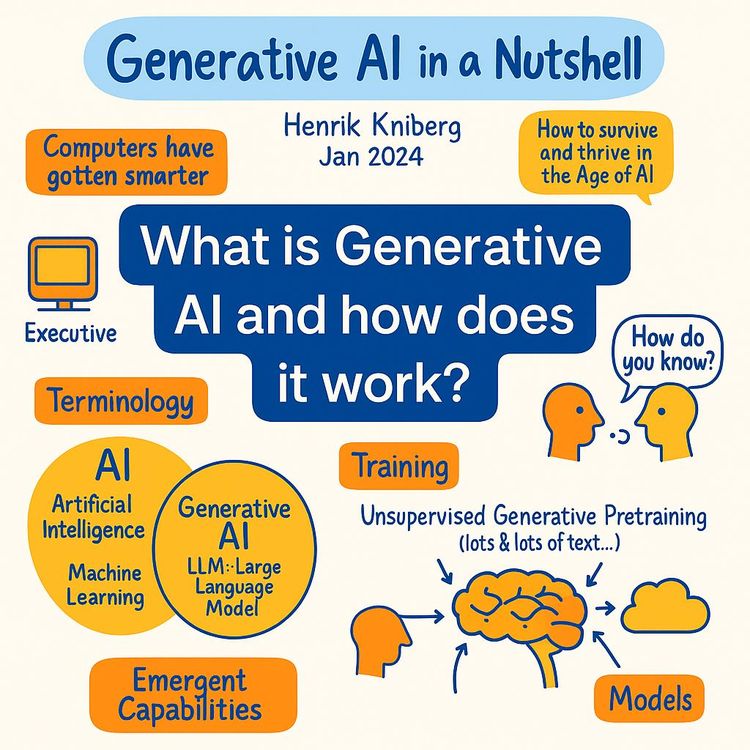
Video Course: What is Generative AI and how does it work?

Video Course: How to Use ChatGPT from Beginner to Professional
Video Course: How to Use Google Gemini for Google Workspace to Boost Productivity

Video Course: How to Use Claude 3.7 AI - Tips for Beginners!

Video Course: ChatGPT for Data Analytics: Full Course - from Beginners to Professional

Video Course: Generating Images and photos With ChatGPT?

Video Course: Generating Images & Photo's with MidJourney
Video Course: Generating Design's with Microsoft Designer and AI
Video Course: Generating Design's with Canva.com and AI
Join 20,000+ Professionals, Using AI to transform their Careers
Join professionals who didn’t just adapt, they thrived. You can too, with AI training designed for your job.