AI in Healthcare for Clinicians: Tools, Limits, and Safety (Video Course)
No coding required. This course maps how AI actually works in hospitals,from rule-based systems to machine learning,and why your clinical judgment matters. AI won't replace you. But it will change how you work.
Related Certification: Certification in Applying AI Tools Safely in Clinical Practice
Also includes Access to All:
What You Will Learn
- Differentiate rule-followers and learners in healthcare AI
- Classify AI tools by clinical function, risk, and transparency
- Recognize deep learning, NLP/LLMs, generative AI, and computer vision use cases
- Apply human-in-the-loop safety practices and validation principles
- Integrate AI tools into workflows, documentation, and education
- Advocate for data quality, governance, and ethical deployment
Study Guide
# AI Basics for Healthcare Professionals | Will AI Replace Doctors? ## Introduction You're a healthcare professional. You've heard the buzzwords,machine learning, deep learning, large language models, generative AI,and you're trying to figure out what actually matters for your practice. The headlines swing between utopian promises and doom-laden predictions. One day AI is going to cure cancer. The next day it's coming for your job. Here's the truth: neither of those extremes is accurate. This course is designed to give you a complete, practical mental framework for understanding artificial intelligence in healthcare. Not the hype. Not the fear. Just a clear map of what AI actually is, how it's actually being used in hospitals and clinics right now, and where it's heading. By the time you finish, you'll be able to look at any AI tool or headline and immediately categorize it, understand its strengths and limitations, and know what role you need to play in keeping patients safe. The most valuable thing you'll learn is this: understanding AI doesn't require advanced mathematics or coding skills. It requires a conceptual framework and clinical judgment,two things you already possess in abundance. Your clinical expertise is the most valuable asset in the AI revolution. This course will show you how to pair it with the right knowledge. Let's start with the foundational question that shapes everything else. --- ## Part One: The AI Umbrella,Two Families Artificial intelligence is not a single technology. It's an umbrella term covering a diverse collection of methods, systems, and approaches. Think of it like the word "vehicle." A bicycle, a sedan, a freight truck, and a motorcycle are all vehicles, but they operate on completely different principles and serve completely different purposes. The same is true for AI. Almost every AI system you will ever encounter in healthcare belongs to one of two families: **rule-followers** and **learners**. This distinction is not academic. It determines how much we can trust a system, how it should be used, and what kind of oversight it requires. In healthcare, where patient safety is non-negotiable, understanding this difference is essential. ### Family One: Rule-Followers Rule-followers are machines that execute a set of instructions written by humans. They do not learn. They do not adapt. They obey. If you give them the same input a thousand times, they will produce the same output a thousand times. This predictability is their superpower. Think about a simple formula you use in practice: maximum heart rate equals 220 minus age. That's a rule a human wrote. When a machine applies this formula, it's following instructions. It hasn't learned anything. If you feed it a non-numeric value, it will give you an error because it has no contextual understanding of what you're trying to do. Rule-followers are characterized by transparency, predictability, and high reliability. That makes them invaluable in healthcare settings where safety is paramount. Approximately half of the AI currently operating in hospitals belongs to this family. ### Family Two: Learners Learner systems are fundamentally different. No one writes the rules. Instead, the machine is shown massive amounts of past data and infers patterns on its own. This is also known as machine learning. Consider how a child learns to identify a cat. You don't give them a formal definition,"a small domesticated carnivorous mammal with retractable claws",and expect them to recognize every cat they encounter. Instead, you point at cats and say "cat." Over time, through repeated exposure to examples, the child internalizes what a cat looks like. They can then identify new cats they've never seen before. Learner systems work the same way. Give a machine ten thousand chest X-rays labeled "tuberculosis" or "no tuberculosis," and it will figure out the visual patterns that distinguish one from the other. Show it a new X-ray, and it will make its best guess based on what it learned. The key insight: rule-followers are transparent,you can see exactly why they made a decision. Learners are opaque,they find patterns in ways humans can't easily trace. Both have their place in medicine. --- ## Part Two: Rule-Following Systems in Detail Let's dive deep into the three main types of rule-followers you'll encounter in healthcare. ### 2.1 Expert Systems (Rule-Based Systems) Expert systems are the most straightforward AI implementations. A human expert encodes knowledge as a checklist or a set of if-then rules. The system follows the rules exactly. No deviation. No interpretation. Just execution. You encounter these systems every day outside medicine. Your bank's phone menu: "Press one for English, press two for Hindi, press three to speak with a representative." Government websites that determine eligibility based on age and income. These are rule-based systems. In healthcare, expert systems power a surprising amount of the software you already use: **Drug interaction alerts.** When you prescribe two medications that could interact adversely, a pop-up warning appears. A human pharmacologist documented the drug combinations and their potential reactions. The system simply cross-references your prescription against that database and alerts you. It's not making a judgment call,it's following rules. **Early warning scores.** Sepsis risk scores, PACU discharge readiness tools, and APGAR calculators built into electronic health records. These systems count inputs, compute scores, and flag whether a patient is safe or needs escalation. The rules were written by clinical experts based on evidence. **Infusion pump safety limits.** Your infusion pump refuses to deliver above a hard limit set by a human safety committee. This is not smart decision-making. It's a safety checkpoint. **The critical point:** For drug safety checks, you do not want a system to be "creative." You want a reliable, consistent application of established knowledge. A drug interaction checker that "thought outside the box" could kill someone. This is why expert systems remain foundational in healthcare AI. The defining characteristic is that the rules are fixed and non-negotiable. A human wrote them, a human approved them, and the machine executes them perfectly every time. ### 2.2 Fuzzy Logic Fuzzy logic extends rule-based systems to handle degrees of truth. Instead of strict yes/no outcomes, it allows values like "a little," "somewhat," and "a lot." This mimics human reasoning more closely because clinical reality rarely fits into binary boxes. You've probably used fuzzy logic without realizing it. Your washing machine that senses load size and adjusts wash intensity? That's fuzzy logic. Your air conditioner that gradually adjusts cooling based on ambient temperature? Fuzzy logic. Rice cookers with "fuzzy logic" labels? Same thing. In healthcare, fuzzy logic is used in certain closed-loop systems: **Closed-loop insulin delivery.** These systems make gentle, smooth adjustments to insulin delivery rather than abrupt on/off changes. If your blood sugar is creeping up, the system increases insulin slightly,not a massive bolus, just a subtle adjustment. The underlying logic was written by humans, but it handles the gray zones of clinical reality. **Depth of anesthesia monitoring.** Similar principle,the system makes smooth adjustments to anesthetic delivery based on multiple continuous signals, avoiding the jolting transitions that a binary system might produce. The key distinction from standard rule-based systems: a human still wrote the logic, but the system can handle intermediate values gracefully. It's better equipped to deal with the fact that patients don't follow clean categorical rules. ### 2.3 Search and Optimization Models Search and optimization systems evaluate many possible options very quickly and select the best one according to defined criteria. They follow rules, but they do so at a scale and speed beyond human capability. Everyday examples are everywhere: **Google Maps** evaluates numerous possible routes and returns the fastest one. It's not learning,it's searching through known roads and traffic data to find the optimal path. **Ride-hailing apps** match you with the nearest available driver. They're evaluating a straightforward optimization problem: who can get here fastest? **Chess programs** calculate millions of possible moves ahead to choose the best one. They're not creative,they're exhaustive. In hospitals, search and optimization models are already working behind the scenes: **Operating theater scheduling.** Building a surgical list that runs efficiently is a complex puzzle. These systems juggle surgeon availability, operating room capacity, equipment needs, and patient priorities to create a schedule that maximizes utilization. **Radiotherapy planning.** Calculating radiation doses that maximize tumor destruction while sparing healthy tissue is an optimization problem. The system evaluates thousands of possible dose distributions and selects the best one. **Organ donation matching.** Pairing donor organs with the most appropriate recipients requires weighing multiple factors,blood type, tissue match, urgency, geographic distance, wait time. Optimization systems handle this at scale. These systems may appear intelligent, but they're fundamentally performing fast searches guided by human-defined constraints. They're not making value judgments,they're executing criteria. --- ## Part Three: Machine Learning,When Machines Teach Themselves The transition from rule-followers to learners marks the most significant conceptual shift in AI. In machine learning, nobody writes the rules. Instead, the machine is shown a substantial volume of past data from which it identifies patterns. This is the "apprentice chef" approach. Instead of following a cookbook, the machine tastes, observes, and practices until patterns emerge. It develops an intuition for what works, even if it can't articulate the rules it's using. There are three primary flavors of machine learning, and each has different applications and limitations. ### 3.1 Supervised Learning Supervised learning is the most common and most mature form of machine learning. The key concept is **labeled data**,examples where the correct answer is already known. Here's how it works: 1. You provide thousands or millions of examples paired with correct answers 2. The machine identifies patterns that correlate with each answer 3. The system learns to label new, unseen examples correctly Think about Gmail's spam filter. It was trained on millions of emails, each pre-marked as "spam" or "not spam." From those labeled examples, the system learned what characteristics make an email spammy. Now it can label new emails it has never seen. Banks use the same approach for fraud detection. They train models on historical transaction data where fraud has already been identified. The system learns the patterns of fraudulent activity and can flag suspicious new transactions. In healthcare, supervised learning is already making a real difference: **Deterioration prediction.** Hospitals train models on ten years of patient records where outcomes are already known,who deteriorated, who didn't. The system learns the early warning signs,subtle changes in vital signs, lab values, and nursing observations,that precede deterioration. When a new patient starts showing those patterns, the system alerts the care team. **Retinal screening.** Researchers show a system thousands of retina photographs labeled "diabetic damage present" or "no diabetic damage." The system learns the visual patterns of diabetic retinopathy. It can then screen new images and flag those that need ophthalmologist review. **The keyword is labeled.** Supervised learning requires historical data with known outcomes. This is often abundant in hospital records and disease registries,which is why supervised learning dominates clinical AI research. But here's a critical point: the quality of a supervised model depends entirely on the quality of its labels. If the training data contains misdiagnoses, the model will learn those errors. This is where clinicians have a vital role,creating and validating the labels that train these systems. ### 3.2 Unsupervised Learning Unsupervised learning is different. No labels. No guidance. The machine is given a mountain of data and must find natural groupings and patterns on its own. This sounds abstract, but you encounter it constantly: **E-commerce sites** group you with similar shoppers based on your behavior patterns. They didn't label you,they found that you cluster with certain other users. **Streaming services** silently sort your viewing habits into clusters with other users to suggest content. The algorithm discovered those clusters without anyone defining them. In healthcare, unsupervised learning has produced one of the most striking examples of AI-driven discovery: **Breast cancer subtyping.** Breast cancer appears to the eye to be one disease. But when researchers used unsupervised learning on tumor molecular data, the system separated tumors into distinct subtypes on its own. It wasn't told what to look for,it discovered hidden structure in the data. Those subtypes turned out to have profound clinical significance. Some respond to hormone therapy. Others respond to Herceptin. Others require chemotherapy. The machine had discovered biological distinctions that now guide treatment decisions for patients worldwide. This is the power of unsupervised learning: it can uncover patterns that human experts haven't identified. It operates without ground truth, so its findings require careful validation by clinicians before they change practice. But as a discovery tool, it's unprecedented. ### 3.3 Reinforcement Learning Reinforcement learning is learning by trial and reward. The machine takes actions, receives a reward or penalty, and gradually learns the best strategy. Here's a simple analogy: a child receives pocket money based on how tidy their room is. Ten rupees for acceptable. Twenty rupees for good. Fifty rupees for spotless. No checklist is provided. But through trial and reward, the child quickly learns that tidier rooms earn larger rewards. The process works like this: 1. The machine tries an action 2. It receives a reward or penalty 3. It adjusts to maximize future rewards 4. Over many iterations, it develops an effective strategy You've seen this in gaming AI,the computer opponent that gets progressively harder to beat because it learns the strategies that maximize winning. In healthcare, reinforcement learning is still early. It remains mostly at the research stage. Potential applications include: **Insulin management.** Systems that fine-tune insulin delivery strategies by learning what keeps patients most stable. **Anesthesia depth monitoring.** Algorithms that optimize depth-of-anesthesia based on what kept previous patients most stable during procedures. Here's the critical caveat: reinforcement learning relies on trial and error. In healthcare, trial and error with real patients is unethical and dangerous. This means any clinical application of reinforcement learning must operate under firm human supervision. The concept of a **human-in-the-loop** is essential. The machine can suggest, but a human must approve. The machine can explore, but only within boundaries set by clinicians. This remains primarily a research tool rather than an established clinical technology. --- ## Part Four: Deep Learning,The Powerhouse Room Deep learning is a specialized and highly powerful subset of machine learning. The term sounds intimidating, but the underlying concept is straightforward. Deep learning is based on **neural networks**,layers of simple computational units loosely inspired by the way neurons in the brain pass signals. The "deep" in deep learning refers simply to the many layers in the network. Think of a neural network as a highly layered pattern spotter. Data enters at one end, passes through layer after layer of mathematical transformations, and emerges at the other end as a classification or prediction. Each layer detects progressively more abstract features. Early layers might detect edges in an image. Later layers might detect shapes. Final layers might detect entire objects. Deep learning excels at messy, unstructured data,images, sound, language. These are tasks that were nearly impossible for traditional rule-based programming. You can't write rules for "what does a cat look like" that cover every possible cat photo. But you can train a neural network on millions of cat photos until it recognizes cats. Deep learning powers the technologies described below. ### 4.1 Computer Vision Computer vision applies deep learning to images and video. The machine learns to recognize what's in a photograph, scan, or video. You use this technology constantly: **Face unlock on smartphones.** The phone learned your face from multiple images and can now recognize you. **Highway cameras reading license plates** for electronic toll collection. **Google Photos** allows you to search "beach" and retrieves all your beach photos without any manual tagging. The system learned to recognize beach scenes. In healthcare, computer vision is among the most impactful AI applications: **Chest X-ray screening.** An Indian company called Qure.ai has developed software that reads chest X-rays and flags possible tuberculosis or other abnormalities. This provides critical screening support in regions where radiologists are scarce. The machine serves as a tireless first pass, ensuring that imaging interpretation is available even in remote areas. **CT scan interpretation.** Systems that read CT scans for hemorrhage detection. They flag suspicious areas for radiologist review. **Fracture detection.** AI systems that identify fractures on X-rays, serving as a second reader for emergency departments. **Retinal screening.** Automated detection of diabetic retinopathy from retinal images. Here's the key point about clinical implementation: the machine is not replacing the radiologist. It serves as an always-available first pass. It screens images when no radiologist is available and flags those needing expert review. The clinical responsibility remains with the physician. ### 4.2 Natural Language Processing (NLP) and Large Language Models (LLMs) Deep learning applied to language has produced systems that can read, translate, summarize, and generate text. NLP focuses on natural human language rather than computer code. LLMs are large-scale language models trained on enormous corpora of text. You encounter these systems constantly: **Google Translate** switches between languages. **Autocomplete features** finish your sentences in messaging apps. **Voice assistants** like Alexa and Siri answer questions. **ChatGPT** and similar chatbots hold conversations, answer questions, and generate text. In healthcare, one of the fastest-growing applications is the **ambient scribe**. This technology listens to the consultation between a doctor and a patient and automatically writes the clinical note. It allows clinicians to focus on the patient rather than the screen. No more typing while the patient talks. No more charting after hours. Other clinical uses include: **Summarizing lengthy discharge summaries** in seconds. Instead of reading through pages of documentation, the clinician gets a concise summary. **Converting dictated words** into typed clinical reports. **Translating patient education materials** into multiple languages for diverse populations. Language is the core currency of clinical practice,from patient consultations to medical documentation. NLP and LLMs target this domain directly, which is why they're generating so much excitement. ### 4.3 Generative AI Generative AI refers to deep learning models that don't just recognize existing content but create new content,text, images, voices, music, and video. Everyday examples: **Apps that transform selfies** into cartoon or festival-themed portraits. **ChatGPT writing a birthday message** for your friend. **Tools that generate realistic images** of people or scenes that never existed. **Applications creating original music.** In healthcare, generative AI has several promising applications: **Patient education materials.** Drafting a patient education leaflet in plain language within seconds. Translating content between languages for diverse populations. This saves clinicians enormous time while improving patient understanding. **Synthetic training data.** Creating realistic but artificial chest X-rays of conditions like pneumonia. These can train systems and educate medical students without exposing real patient information. This is particularly valuable for rare conditions where real images are scarce. **Teaching materials.** Generating educational content for students and trainees, including case studies and practice questions. Here's the golden rule for clinical use: generative AI produces **drafts**, not final products. The AI can create a draft, but a human clinician must approve it before it's used in clinical practice. Unless a qualified professional approves it, using generative AI output is not ethical. This isn't a limitation,it's a safeguard. The AI handles the tedious work of creating a first version. The clinician applies judgment, catches errors, and ensures accuracy and cultural sensitivity. That's a partnership, not a replacement. ### 4.4 Robotics Robotics is AI embodied in a physical machine. It combines the software we've discussed with motors, wheels, arms, and sensors to act in the real world. Everyday examples: **Robot vacuum cleaners** navigate living rooms, avoiding obstacles and covering floor space efficiently. **Warehouse robots** move and pack parcels at fulfillment centers. In healthcare, robotics is visible in: **Surgical robotic systems** like the Da Vinci system. Surgeons operate these for procedures like prostatectomies and nephrectomies. The surgeon sits at a console and controls the robotic arms, which provide enhanced precision,better visualization, steadier movements, smaller incisions. Here's the critical point: the surgeon remains in full control. The robot does not decide or act independently. It's an advanced tool that extends the surgeon's capabilities, not an autonomous agent making clinical decisions. **Pharmacy robots** count and dispense tablets accurately. They reduce medication errors and free up pharmacy staff for more complex tasks. Robotics is a mature area of AI that continues to evolve alongside advances in sensing, control, and machine learning. --- ## Part Five: Emerging Concepts,Foundational Models and Multimodal AI Two additional concepts are important for understanding where AI in healthcare is heading. ### 5.1 Foundational Models Instead of building a separate model for every task, foundational models involve training one large, general-purpose model on a huge dataset and then adapting it to many different tasks. Here's a kitchen analogy: think of making dough. From a single batch of basic dough, you can make naan, roti, kulcha, or pizza base. The dough is the foundational model,one base substance shaped into many different final products. In technology, the same base model behind a large language model can write an email, summarize a paragraph, translate text, or answer questions. Rather than separate apps for each task, there's one adaptable model. In healthcare, a foundational model could be trained on a mountain of scans, reports, and patient records, then fine-tuned for specific jobs: **Reading chest X-rays.** **Detecting fractures.** **Drafting radiology reports.** **Answering patient questions.** This approach reduces the need to build new models from scratch for every use case. Train once, reuse many times. It's more efficient, more cost-effective, and potentially more powerful because the model benefits from diverse training data. ### 5.2 Multimodal AI Most current tools handle one type of input,text, image, or sound. Multimodal AI processes several input types simultaneously within the same model. For example, a user can provide an image and a text prompt together, and the model will produce an edited image as output. Or a model can listen to speech while reading text and watching video simultaneously. In healthcare, multimodal AI is closely aligned with clinical reasoning. A physician doesn't diagnose from an X-ray alone. They integrate: **The image.** **The patient's history.** **Laboratory values.** **Physical examination findings.** Multimodal AI attempts to replicate this integrated analysis by combining multiple data streams into a single model. It processes imaging, text, and lab data together, mimicking how clinicians actually think. This is considered the frontier of healthcare AI development. It's early, but it's where the field is heading. --- ## Part Six: The Complete Map of AI Let's put it all together. The entire landscape of artificial intelligence can be summarized as follows: **One umbrella:** AI **Two families:** **Rule-followers:** - Expert (rule-based) systems - Fuzzy logic - Search and optimization **Learners:** - Machine learning - Supervised learning - Unsupervised learning - Reinforcement learning - Deep learning (neural networks) - Computer vision - NLP and large language models - Generative AI - Robotics (AI with a physical body) This map enables you to place any AI headline or claim into its proper context. When you read about a new AI breakthrough, ask yourself: is this a rule-follower or a learner? What family does it belong to? What are its limitations? ChatGPT is one small room in a very big house. Understanding the whole house is what gives you professional advantage. --- ## Part Seven: Will AI Replace Doctors? This is the question everyone asks, and it deserves a direct answer. No. AI will not replace doctors. But doctors who understand AI will replace doctors who don't. Here's the reality: the future of AI in healthcare will not be characterized by autonomous machines replacing clinicians. Instead, it will be shaped by collaborative models in which AI handles repetitive, data-intensive, and pattern-recognition tasks while clinicians provide judgment, empathy, and accountability. Consider what AI can do: **AI can read images.** But it can't talk to a frightened patient about their diagnosis. **AI can draft notes.** But it can't build trust with a skeptical family member. **AI can flag patterns.** But it can't weigh a patient's values and preferences against statistical probabilities. **AI can suggest treatments.** But it can't take responsibility for the outcome. The clinical judgment, empathy, and accountability that define the healthcare profession are precisely the things AI cannot replicate. These are human capabilities, and they remain essential. What AI can do is handle the tasks that consume your time and energy: **Documentation.** Ambient scribes write your notes while you focus on the patient. **Screening.** Computer vision flags abnormal images for your review. **Literature review.** NLP tools summarize the latest research. **Patient education.** Generative AI drafts materials in plain language. **Administrative work.** Optimization systems build better schedules. This frees you to do what only you can do: provide judgment, empathy, and accountability. The professionals best positioned for this future are those who combine their clinical expertise with a working understanding of AI's capabilities, constraints, and ethical boundaries. They're not threatened by AI,they're equipped by it. --- ## Part Eight: Practical Applications and Best Practices ### For Clinical Practice **Rule-based systems** should be used to enforce safety and consistency. Drug interaction alerts, infusion limits, and early warning scores are safety-critical applications where you want predictable, transparent behavior. **Learning systems** can assist with screening, diagnosis support, documentation, and patient education. Use them as tools, not authorities. **Ambient scribes and NLP tools** can reduce documentation burden and allow you to spend more time with patients. This is one of the most immediately valuable applications of AI in clinical practice. **Generative AI** can rapidly produce drafts of educational materials, summaries, and research documents. But final content must always be human-reviewed. Never deploy AI-generated patient materials without personal review for accuracy and cultural sensitivity. **Computer vision tools** can extend diagnostic capability in underserved areas and serve as a second reader in radiology, pathology, and ophthalmology. Use them to expand access, not to replace expert review. ### For Education and Training Medical and nursing curricula should include foundational AI literacy: the ability to distinguish rule-based systems from machine learning, and to understand the ethical and safety implications of each. Case-based teaching should incorporate AI examples, including supervised labeling, unsupervised clustering, and the appropriate use of generative AI. Students and trainees should practice reviewing AI-generated drafts and maintaining a critical eye toward accuracy and bias. This is a skill that will serve them throughout their careers. ### For Institutional Policy and Governance Hospitals should inventory their AI systems according to the rule-follower/learner framework. This clarifies which systems require fixed rules and which need ongoing validation. Clear policies must govern the use of generative AI in clinical documentation and patient communication, with mandatory human sign-off. Procurement decisions should consider the need for human oversight, model transparency, and data governance. Ask vendors: can you explain how this system makes decisions? What data was it trained on? How is it validated? ### For Career and Professional Development Healthcare professionals seeking roles in AI should focus on augmenting their clinical expertise with practical AI literacy, including prompt engineering, dataset labeling, and model evaluation. New career pathways include: **Clinical AI advisors.** Clinicians who guide AI implementation in healthcare organizations. **Clinical informatics specialists.** Professionals who bridge clinical and technical domains. **Liaisons between care teams and technology vendors.** Translators who ensure AI tools meet real clinical needs. Your clinical value is the most important thing that will get you excellent jobs with good earning in the field of AI in healthcare. The AI experts who understand medicine are rare and valuable. Be one of them. --- ## Part Nine: Key Takeaways and Action Items ### The Essential Insights **AI is not one thing.** It's an umbrella term covering two fundamentally different families: rule-followers and learners. Confusing ChatGPT with all of AI is like mistaking a single room for an entire house. **Rule-followers underpin patient safety.** A significant portion of hospital AI is built on human-written rules. These systems are dependable, transparent, and appropriate for safety-critical tasks such as drug interaction checks and infusion limits. **Learning systems offer the most transformative potential.** Machine learning, especially deep learning, enables capabilities such as image interpretation, natural language processing, and content generation that were previously impossible to codify by hand. **Labeled data is essential for supervised learning.** The quality of a supervised model depends entirely on the quality of the labeled examples it's trained on. Clinicians have a critical role in creating and validating these labels. **Unsupervised learning can discover hidden clinical insights.** As demonstrated by the breast cancer subtype discovery, allowing models to find their own patterns can lead to breakthroughs that human experts may not have considered. **Reinforcement learning requires a human in the loop.** Because it learns through trial and error, reinforcement learning is not yet ready for direct clinical deployment without stringent oversight. **Generative AI produces drafts, not decisions.** In healthcare, any output from generative AI must be reviewed and approved by a qualified professional before use. **Robotics does not replace clinicians.** Surgical robots and pharmacy robots are tools under human control. They extend capability but do not assume responsibility. **Foundational and multimodal models are the future.** Training once and reusing across many tasks, and combining multiple data types simultaneously, are the emerging frontiers in AI development. **Clinical expertise is the most valuable asset.** Healthcare professionals don't need to become data scientists to work with AI. They need to understand its principles, limitations, and applications, and to pair that knowledge with their own clinical judgment. ### Action Items for Individual Clinicians Learn to classify AI tools you encounter at work using the two-family framework. Can the tool explain its rules, or has it learned patterns from data? This single question tells you how much you can trust it and what kind of oversight it needs. Familiarize yourself with at least one current NLP/LLM application for clinical documentation. Use it with appropriate oversight. This is where you'll see immediate value. Practice using generative AI to create patient education materials. But never deploy them without personal review for accuracy and cultural sensitivity. The draft is the AI's job. The approval is yours. Advocate for training and resources that build AI literacy among all clinical staff. The more your colleagues understand, the better your organization will implement AI tools. ### Action Items for Departmental Leaders and Educators Add AI fundamentals to orientation and ongoing education programs for all clinical roles. This isn't optional anymore,it's core competency. Develop specific training modules on rule-based systems, supervised and unsupervised learning, and generative AI, using real clinical examples from your specialty. Create multidisciplinary forums where clinicians, data scientists, and administrators can discuss AI implementation and safety concerns. The best AI implementations happen when clinical and technical expertise meet. ### Action Items for Institutional Leadership Establish clinical governance frameworks that require human oversight for all AI outputs used in patient care. No exceptions. Invest in transparent and explainable AI solutions, particularly in safety-critical applications. If a vendor can't explain how their system works, it doesn't belong in your hospital. Support pilots of multimodal AI and foundational models, while explicitly evaluating their integration into existing clinical workflows. These are the future,but they need careful introduction. Develop workforce strategies that recognize and reward AI-literate clinicians who can lead implementation efforts. These people are your bridge to the future. --- ## Conclusion Artificial intelligence is fundamentally reshaping healthcare. But its adoption will be most effective when clinicians possess a clear, structured understanding of what AI is and what it can do. The distinction between rule-following and learning systems provides a solid foundation for evaluating AI tools, appreciating their strengths, and guarding against their limitations. Rule-based systems will continue to provide the safety-critical backbone of hospital software, while deep learning, foundational models, and multimodal AI expand the possibilities for diagnosis, language processing, and knowledge creation. The overarching message is one of partnership, not replacement. AI can perform tasks that require speed, scalability, and pattern recognition. But it cannot replace the clinical judgment, empathy, and accountability that define the healthcare profession. The professionals who will lead healthcare's AI transformation are those who understand this balance, maintain human oversight, and combine their clinical expertise with a robust understanding of the technology. By doing so, they will not only enhance patient care but also create new opportunities for professional fulfillment and leadership in an increasingly AI-enabled healthcare system. You don't need to become a data scientist. You don't need to learn to code. You need to understand the map, recognize the tools, and maintain your clinical judgment as the final authority. Your clinical value is the most important thing you bring to this partnership. AI is the amplifier. You are the musician. The future of healthcare isn't AI replacing doctors. It's AI-empowered doctors providing better care than ever before. Be one of them.Frequently Asked Questions
Your Practical Guide to AI in Healthcare
This FAQ is your practical field manual for understanding artificial intelligence in a clinical environment. It is built on a single, foundational idea: to use AI safely and effectively, you must first understand what kind of system you are dealing with. The answers here break down the core concepts, cut through the hype, and give you a clear mental model for evaluating any AI tool you encounter. The focus is on providing clear, actionable knowledge that helps you make informed decisions, ask the right questions, and engage with AI as an informed professional, not a passive observer.
What are the two main families of artificial intelligence?
Every technology under the AI umbrella belongs to one of two fundamental families: rule followers and learners. This is the most important distinction you can make. Rule followers are systems where a human has explicitly written the instructions, such as "if this happens, then do that." The machine executes these rules perfectly but never adapts or learns anything new.
Learners, on the other hand, are systems where no one writes the rules. Instead, the machine is fed thousands or millions of examples and figures out the patterns on its own. Understanding which family a system belongs to is essential because it dictates how you should trust, interpret, and oversee the technology. Almost every AI you will meet in medicine belongs to one of these two families, or a hybrid of both.
Why is it important to distinguish between rule-following AI and learning AI in healthcare?
Healthcare is a safety-critical domain where the consequences of error are severe. We do not allow AI to hallucinate or experiment when patient safety is at stake. Rule-based systems are predictable, auditable, and cannot deviate from their programmed logic. For example, a drug interaction checker must produce the same correct warning every single time; it should never get "creative" about potential interactions.
This is why a large portion of healthcare AI models are rule-based: to prevent critical incidents and uphold patient safety. Learners, while powerful, carry the risk of unpredictable behavior. They require careful validation and often a human in the loop before they can be deployed in clinical settings. Knowing which type you are using tells you how much oversight is required.
What are expert systems (rule-based systems)?
Expert systems, also called rule-based systems, are machines that follow a checklist that a human wrote. They operate on pure if-then logic: if a specific condition is met, then a specific action is taken. These systems do not learn; they simply follow the structure they were given.
You already encounter these daily. Phone menus that say "Press 1 for English" are expert systems. Government websites that determine eligibility based on your age and income are expert systems. In healthcare, they are everywhere: drug interaction alerts, early warning scores for sepsis, APGAR calculators, and infusion pump safety limits that refuse to go above a hard limit. The key takeaway is that expert systems are dependable, predictable, and safe. They never learn, which is exactly what you want for critical decision support.
What is fuzzy logic and how does it differ from standard rule-based systems?
Fuzzy logic is a more sophisticated form of rule-based AI that deals in shades of gray rather than strict yes/no answers. It allows for values like "a little," "somewhat," or "a lot," which mirrors how humans actually think. A standard rule-based system is like a light switch,on or off. Fuzzy logic is like a dimmer switch, capable of smooth, gradual adjustments.
You likely use fuzzy logic daily without knowing it. Your washing machine, air conditioner, and rice cooker commonly operate on it, sensing conditions and adjusting their behavior in degrees. In the hospital, fuzzy logic appears in closed-loop systems that gently titrate insulin delivery or adjust the depth of anesthesia. A human still wrote the underlying logic, but fuzzy logic handles ambiguity and gradation far better than a plain on/off rule.
What are search and optimization models, and why are they important in medicine?
Search and optimization models examine thousands of possible options at lightning speed to identify the best one. These systems are not learning; they are rapidly applying rules to a vast search space to find the optimal solution. Think of Google Maps calculating the fastest route by comparing millions of path combinations, or a ride-hailing app matching you with the nearest driver.
In healthcare, these models are critical for operational efficiency and treatment planning. They power operating theater scheduling, ensuring the surgical list runs smoothly. They are used in radiotherapy dose planning to maximize tumor coverage while sparing healthy tissue. They even help in donor organ matching, finding the best recipient-donor fit based on complex constraints. These systems excel at juggling many competing priorities faster than any human could with a piece of paper.
What is the core idea behind machine learning?
Machine learning is the foundation of the "learners" family. The core idea is that nobody writes the rules. Instead, you feed the machine a massive amount of past data and let it find patterns on its own.
Think about how a child learns to identify a cat. You do not give the child a detailed written definition. Instead, you point at cats repeatedly,"this is a cat",until the child internalizes the features: whiskers, four legs, a tail. Machine learning is that process, performed at massive scale. You show the machine millions of examples, and it works out the underlying rule by itself. This is a fundamental shift from traditional programming, where a human must codify every piece of knowledge.
What is supervised learning?
Supervised learning is the most common form of machine learning. You present the machine with labeled examples,data where the correct answer is already known. For instance, you show thousands of emails already marked as "spam" or "not spam." The machine learns the patterns that distinguish one from the other. After training, it can classify new emails without human assistance.
Everyday examples include bank fraud detection, where the system learns what fraudulent transactions look like from historical data. In medicine, this is used for predictive analytics. You take ten years of patient records where you already know who deteriorated and who did not, then train the machine to spot early warning signs in future patients. Similarly, you can show a system thousands of retinal images already labeled as "diabetic damage present" or "no damage," and it learns to evaluate new images automatically. The keyword is labeled.
What is unsupervised learning?
Unsupervised learning involves giving the machine a pile of data with no labels at all and letting it find natural groupings on its own. The system identifies clusters of similarity that humans may not have pre-defined. This is like an explorer mapping a new territory without a guide.
Everyday examples include e-commerce recommendations. When a site says "customers like you also bought these items," the system has grouped you with a cluster of shoppers based on behavior patterns,nothing was labeled. A powerful healthcare example involves breast cancer. Researchers fed an unsupervised model molecular data from patients. The model sorted the tumors into distinct subtypes on its own. Later analysis showed these subtypes require completely different treatments. Nobody told the machine what to look for, yet it discovered hidden structure in the disease that now guides clinical decision-making.
What is reinforcement learning?
Reinforcement learning is the trial-and-reward paradigm. The machine learns by taking actions, observing the results (a reward or penalty), and adjusting its behavior to maximize the reward over time. It is a system of learning through consequences, not instruction.
A helpful analogy is a child receiving pocket money based on how tidy their room is,more money for a cleaner room. No checklist is given. The child experiments, observes which actions earn more, and gradually adjusts their behavior. In healthcare, this is still early and primarily research-focused. Potential applications include systems that fine-tune insulin delivery strategies based on what has kept patients most stable. Critically, because reinforcement learning relies on trial and error, a very firm human-in-the-loop approach is essential to ensure the machine's experiments never compromise patient safety.
What are neural networks, and what does "deep" mean?
Neural networks are computational systems loosely inspired by how human brain cells (neurons) work and pass signals along. The name sounds scary, but the concept is simple: neural networks are layered pattern spotters. Information flows through interconnected layers of mathematical units, and each layer extracts increasingly complex features from the data. The first layer might detect edges in an image, the next layer might detect shapes, and a later layer might detect a full face.
The term "deep" in deep learning simply means many layers. Stack enough layers together, and the machine becomes shockingly good at handling messy, complex inputs like pictures, sound, and human language. The deeper the network, the more sophisticated the pattern recognition it can perform, which is why deep learning has revolutionized fields like computer vision and speech recognition.
What is computer vision, and how is it used in medicine?
Computer vision is deep learning applied to images and video. The machine learns to recognize what is in a photograph, scan, or video. Everyday applications include face unlock on your smartphone and Google Photos allowing you to search for "beach" to retrieve all your beach photos without any manual tagging.
In medicine, computer vision is a powerful screening tool. AI systems can analyze chest X-rays to flag possible tuberculosis or other abnormalities, which is particularly valuable in regions lacking radiologists. It is also used for CT scan interpretation to identify bleeds or fractures as a first-pass screening tool, and for automating the detection of diabetic retinopathy in retinal scans. A key point is that in these applications, the machine is not replacing the radiologist. It serves as a tireless first pass that ensures a reading is possible even where no specialist is available. The clinical responsibility remains with the physician.
Certification
About the Certification
Become certified in AI for Healthcare Clinicians. You'll identify how AI operates in real hospitals, recognize where it falls short, and apply practical safety checks. Work confidently alongside AI while keeping your clinical judgment in charge.
Official Certification
Upon successful completion of the "Certification in Applying AI Tools Safely in Clinical Practice", you will receive a verifiable digital certificate. This certificate demonstrates your expertise in the subject matter covered in this course.
Benefits of Certification
- Enhance your professional credibility and stand out in the job market.
- Validate your skills and knowledge in cutting-edge AI technologies.
- Unlock new career opportunities in the rapidly growing AI field.
- Share your achievement on your resume, LinkedIn, and other professional platforms.
How to complete your certification successfully?
To earn your certification, you’ll need to complete all video lessons, study the guide carefully, and review the FAQ. After that, you’ll be prepared to pass the certification requirements.
Other AI Video Courses
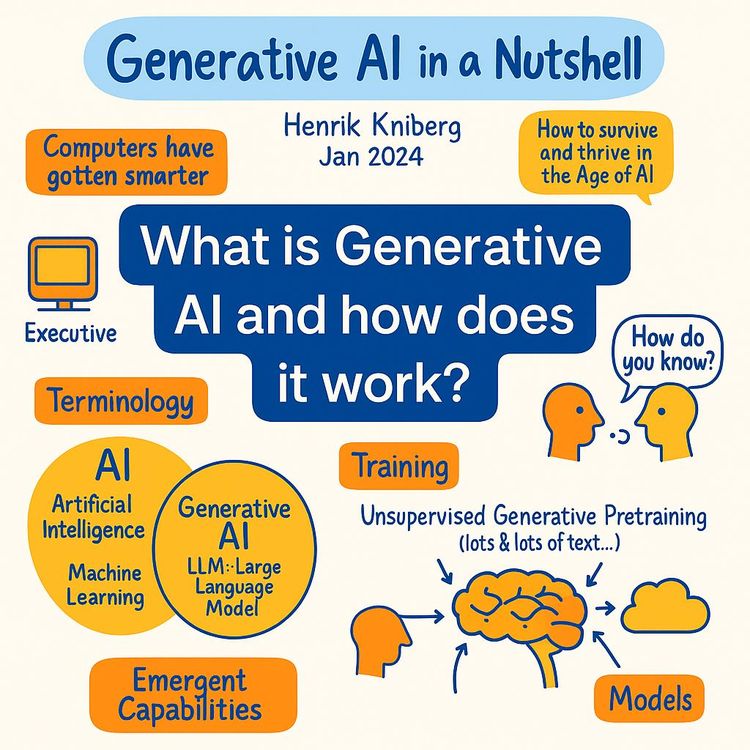
Video Course: What is Generative AI and how does it work?
Video Course: How to Use ChatGPT from Beginner to Professional
Video Course: How to Use Google Gemini for Google Workspace to Boost Productivity
Video Course: How to Use Claude 3.7 AI - Tips for Beginners!
Video Course: ChatGPT for Data Analytics: Full Course - from Beginners to Professional
Video Course: Generating Images and photos With ChatGPT?

Video Course: Generating Images & Photo's with MidJourney
Video Course: Generating Design's with Microsoft Designer and AI
Video Course: Generating Design's with Canva.com and AI
Join 20,000+ Professionals, Using AI to transform their Careers
Join professionals who didn’t just adapt, they thrived. You can too, with AI training designed for your job.