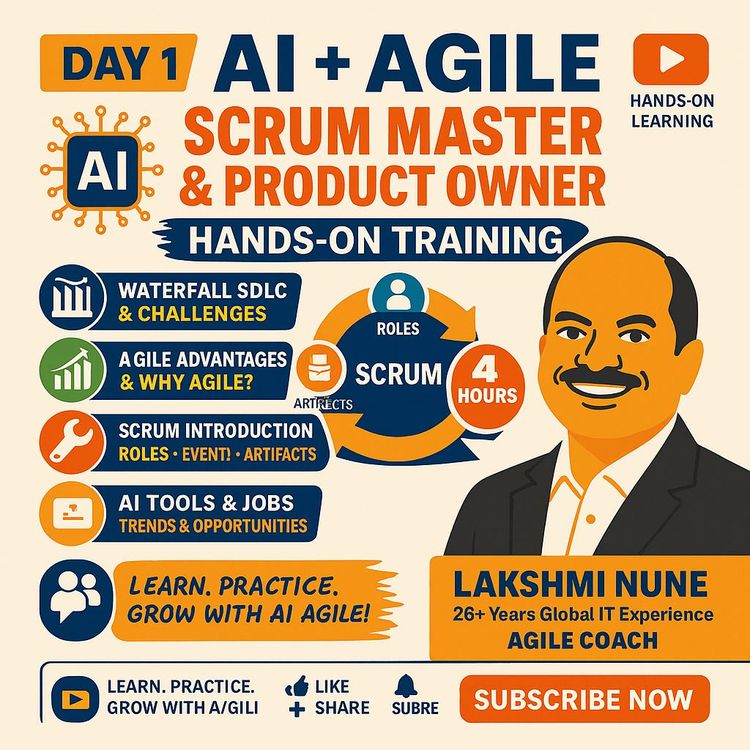
AI-Powered Scrum Master, Product Owner & Agile Project Management (Video Course)
This isn't theory,it's a practical playbook. Learn Agile and Scrum from the ground up, then discover how AI tools can draft user stories, predict risks, and streamline your workflow. Real examples, real prompts, and skills you can apply from day one.
Related Certification: Certification in Leading AI-Powered Agile & Scrum Teams
Also includes Access to All:
What You Will Learn
- Explain the SDLC, Waterfall limitations, and why Agile is superior
- Apply Scrum: roles, events, artifacts, and sprint-based delivery
- Use AI to generate user stories, roadmaps, risk registers, and meeting prompts
- Operate Jira and Confluence and build a portfolio of backlog, roadmap, and risks
- Prepare for career growth with CV optimization, mock interviews, and certifications
Study Guide
I've structured this as a complete, hands-on learning guide. It's built to take you from the very basics of how software gets made all the way up to using AI to supercharge your daily work as a Scrum Master, Product Owner, or Agile Project Manager. This isn't just theory,it's a practical playbook. ---Introduction: Why This Course Matters
Let's be honest about the state of work. The old way of doing things,waiting years for a product to be built, only to find out the market has moved on,is a fast track to irrelevance. We're in an era where customer expectations shift overnight, and technology evolves at a breakneck pace. To survive, let alone thrive, you need a different approach. That's where Agile comes in. It's not just a process; it's a mindset that prioritizes flexibility, speed, and, most importantly, delivering real value to customers, fast.
But here's the other piece of the puzzle: you can't be an effective Agile practitioner in this environment without leveraging Artificial Intelligence. It's no longer a "nice-to-have" skill. It's a core competency that separates the leaders from the laggards. AI tools can draft your requirements, generate your backlog, predict risks, and even help you land the job in the first place.
This guide is your complete, hands-on training ground. We're going to break down the entire landscape, from the failures of the Waterfall model to the intricate details of the Scrum framework, and then we're going to dive deep into the practical, daily applications of AI within those frameworks. You'll learn the concepts, see real-world examples, and get the tips and best practices you need to walk into any organization and make an immediate impact. Let's get to work.
Part 1: The Foundation - How Software Gets Built
Before we talk about the revolution, we have to understand the system it replaced. Every software project, whether it's a simple mobile app or a complex banking platform, follows a lifecycle. It's a predictable progression from an idea to a living, breathing product that users interact with. This is the Software Development Life Cycle (SDLC).
Think of it like building a house. You don't just start hammering nails. You first figure out what the owner needs (how many bedrooms, what style), then you hire an architect to draw up blueprints, then you get the builders in, then an inspector checks the work, and finally, the family moves in. After that, there's ongoing maintenance,fixing a leaky roof, repainting a room. Software is exactly the same.
The Six Stages of the SDLC
1. Requirement Gathering & Analysis: This is the "what do we want to build?" phase. Business stakeholders, clients, and users define their needs. This isn't just a wish list; it involves deep analysis to understand the core problems that need solving. The output is often a formal document called a Business Requirement Document (BRD), which captures the "what" and the "why" of the project.
2. System Design: Once we know what to build, we figure out how to build it. Architects and senior engineers create the technical blueprint. They decide on the system architecture, the database structure, the user interface flow, and how different parts of the system will talk to each other. This is where the "how" is defined.
3. Development/Coding: This is where the rubber meets the road. The development team,front-end engineers building what you see, back-end engineers building the logic, and database administrators managing the data,writes the actual code. They translate the design documents into a functional product.
4. Testing: This is the quality gate. A dedicated testing team takes the developed software and tries to break it. They verify that the features work as described in the requirements, they hunt for bugs and defects, and they ensure the overall user experience is smooth. This is a critical step to ensure you're not shipping a broken product.
5. Deployment/Release: The software is finally pushed to the production environment where real users can access it. This could be as simple as updating a server or as complex as a coordinated, multi-region rollout. This is the moment of truth.
6. Maintenance & Support: The work doesn't end at launch. The team now monitors the software for bugs, provides customer support, and rolls out enhancements based on user feedback. This phase continues for the life of the product.
The Traditional Approach: The Waterfall
The Waterfall methodology is the classic, linear approach to the SDLC. It's called "Waterfall" because progress flows in one direction,downward,like a waterfall. You finish one phase 100% before you move to the next. It looks logical on paper: Requirements -> Design -> Development -> Testing -> Release. No overlap, no going back.
This approach made sense in a world where things were predictable. But in today's environment, it's a recipe for disaster. Let's look at why.
The Four Fatal Flaws of Waterfall
1. The "Nokia Phone" Problem (Time-to-Market): Let's say you're building a banking app with 100 features. In a Waterfall project, you plan, design, and code all 100 features over two years. You finally release it, expecting a hero's welcome. But in those two years, your competitors have already launched apps with 50 features, gotten feedback, and iterated. Your product is a "Nokia phone" in a world of iPhones. It's technically complete, but it's completely out of touch with what the market wants. The delay in delivery is a silent killer.
2. The "Set in Stone" Design (Inflexibility): Imagine you're six months into a 12-month project. A major security breach hits your industry, and your business stakeholders demand a new, critical security feature. In Waterfall, this is a nightmare. The design is already signed off. To add a feature, you have to go back to the design phase, update the documents, then re-work the code, and then re-test everything. The cost and time involved are astronomical. The process is so rigid that it actively resists change, even when change is essential for survival.
3. The "Big Bang" Risk (Delayed ROI): In Waterfall, you invest heavily for years before you see a single dollar of return. You're spending money on development, testing, and infrastructure with no customer feedback to validate your decisions. The risk is enormous. What if you built the wrong thing? What if the technology becomes obsolete? You've bet the farm on a single, high-stakes release. It's a massive gamble.
4. The "Surprise" Ending (Lack of Customer Involvement): In a Waterfall project, the customer is typically involved at two points: the beginning, to sign off on requirements, and the end, to accept the final product. That's it. For months or years, the team works in a bubble, making assumptions about what the customer really wants. The result is almost always a product that is technically accurate to the original spec but misses the mark on the actual, evolving business need. It's a surprise, and not a good one.
Part 2: The Agile Paradigm Shift
Agile wasn't born in a boardroom. It was born out of frustration. In 2001, a group of seventeen software development thought leaders met to discuss better ways of building software. They were tired of seeing projects fail under the weight of heavy, bureaucratic processes. The result of that meeting was the Agile Manifesto, a simple but powerful document that would change the industry forever. It's not a methodology; it's a set of values and principles that guide how you think about work.
The Agile Manifesto: Four Core Values
Individuals and interactions over processes and tools: The best tools in the world mean nothing if the team doesn't communicate. A face-to-face conversation between a developer and a business analyst is worth more than a hundred pages of documentation. This value emphasizes that people are the primary drivers of success, not the software they use.
Working software over comprehensive documentation: The primary measure of progress is a functioning product. Documentation has its place, but it should be just enough to support the work, not a massive tome that slows everyone down. A working feature that a customer can use is infinitely more valuable than a perfectly formatted spec.
Customer collaboration over contract negotiation: Instead of hammering out a rigid contract and then disappearing for a year, Agile teams work with the customer throughout the process. This constant collaboration ensures that the team is always building the right thing. It turns the customer from a distant overseer into a partner.
Responding to change over following a plan: A plan is a great starting point, but it's not a straitjacket. Agile teams embrace change, even late in the development process. If a new requirement emerges, they welcome it and adjust their plan. This flexibility is a huge competitive advantage.
The Twelve Principles in Action
The four values are supported by twelve guiding principles. Let's translate them into real-world behavior:
1. Customer Satisfaction: Our highest priority is to satisfy the customer through early and continuous delivery of valuable software. You don't wait until the end; you deliver value from day one.
2. Welcome Change: Welcome changing requirements, even late in development. Agile processes harness change for the customer's competitive advantage. This is a superpower. When a competitor stumbles, you can pivot quickly.
3. Deliver Frequently: Deliver working software frequently, from a couple of weeks to a couple of months, with a preference for the shorter timescale. This creates a rapid feedback loop.
4. Business & Developers United: Business people and developers must work together daily throughout the project. No more throwing requirements over the wall. They are one team.
5. Motivated Individuals: Build projects around motivated individuals. Give them the environment and support they need, and trust them to get the job done. Micromanagement is the enemy of agility.
6. Face-to-Face Conversation: The most efficient and effective method of conveying information to and within a development team is face-to-face conversation. It's faster and reduces the chance of misinterpretation.
7. Working Software is Progress: Working software is the primary measure of progress. A slide deck showing a timeline is not progress. A working feature is.
8. Sustainable Pace: Agile processes promote sustainable development. The sponsors, developers, and users should be able to maintain a constant pace indefinitely. No death marches. Burnout is not a strategy.
9. Technical Excellence: Continuous attention to technical excellence and good design enhances agility. This means taking the time to write clean code, refactor when needed, and not take shortcuts.
10. Simplicity: Simplicity,the art of maximizing the amount of work not done,is essential. Always ask, "Is this feature absolutely necessary right now?" The answer is often no.
11. Self-Organizing Teams: The best architectures, requirements, and designs emerge from self-organizing teams. The people doing the work are best positioned to figure out how to do it.
12. Reflect & Adjust: At regular intervals, the team reflects on how to become more effective, then tunes and adjusts its behavior accordingly. This is the engine of continuous improvement. You don't just do the work; you get better at doing the work.
Why "Iterative and Incremental" Wins
The core of Agile is a shift from a "big bang" delivery to a continuous flow of value. Instead of delivering 100 features at once, you deliver the highest-priority features first. In our banking app example, an Agile team might deliver in 2-week sprints.
Sprint 1: Customers can open an account.
Sprint 2: Customers can open an account AND make a payment.
Sprint 3: Customers can open an account, make a payment, AND apply for a loan.
Each sprint delivers a working, tested, and potentially releasable product. This approach has profound benefits. You get to market faster. You get real customer feedback early, which allows you to course-correct. You reduce risk by investing small amounts of money in increments. And you build a product that actually solves the customer's problem, not the problem you assumed they had.
Part 3: A Look at Agile Frameworks
Agile is the philosophy, but you need a practical framework to implement it. There are several out there, each with its own strengths. The key is to understand what they are and when to use them.
Scrum, Kanban, XP, and SAFe
Scrum: This is the heavyweight champion of Agile frameworks. It's a lightweight, iterative framework with defined roles (Product Owner, Scrum Master, Developers), events (Sprints, Planning, Review), and artifacts (Backlogs, Increments). It's perfect for complex projects where requirements are likely to change. We'll be diving deep into this in the next section.
Kanban: If Scrum is a marathon with defined laps (sprints), Kanban is a continuous relay race. It's a visual system for managing work as it flows through a process. You have a board with columns like "To Do," "In Progress," and "Done." The key principle is to limit the amount of work in progress (WIP) to prevent bottlenecks. Kanban is ideal for support teams, help desks, or any environment where work arrives continuously and unpredictably. You don't plan sprints; you just pull the next item from the backlog when you have capacity.
Extreme Programming (XP): This framework is all about engineering excellence. It focuses on technical practices like Test-Driven Development (TDD), where you write the test before you write the code, and pair programming, where two developers work together at one workstation. XP is a great choice for teams that need to produce high-quality, defect-free code in the face of rapidly changing requirements.
Scaled Agile Framework (SAFe): When you have hundreds of people working on multiple products across a large enterprise, you need a way to coordinate them all. SAFe is a heavy-duty framework that provides structure for aligning multiple Agile teams. It introduces concepts like Agile Release Trains (ARTs) and Program Increments (PIs) to synchronize work and ensure everyone is marching towards the same strategic goals. It's complex, but it's designed for a complex problem.
Part 4: The Scrum Framework - A Deep Dive
Scrum is the most widely used Agile framework, and for good reason. It provides a simple, elegant structure that forces discipline and transparency. It's built on three pillars: Transparency (everyone sees the work and progress), Inspection (regularly checking the work and process), and Adaptation (adjusting your approach based on what you learn from inspection). This is called empiricism,you make decisions based on what you observe, not on what you predict.
The Three Core Roles
The Product Owner (PO): The PO is the "voice of the customer." They are singularly responsible for maximizing the value of the product. They own the Product Backlog and decide what the team works on next. Their primary activities include:
- Defining the product vision and strategy.
- Creating and maintaining the product roadmap.
- Managing the Product Backlog by writing user stories and defining acceptance criteria.
- Prioritizing work based on business value, not technical effort.
- Engaging with stakeholders to gather feedback and align on expectations.
The PO is a strategic role. They are constantly asking, "What is the most valuable thing the team can do next?"
The Scrum Master (SM): The SM is the "servant leader" and process coach. They are not the team's manager; they are the team's protector and facilitator. Their job is to ensure that the Scrum process is followed and that the team has everything it needs to be successful. Key responsibilities include:
- Facilitating all Scrum ceremonies (Sprint Planning, Daily Scrum, Review, Retrospective).
- Coaching the team on Agile principles and practices.
- Removing impediments and blockers that are slowing the team down.
- Shielding the team from external distractions and interruptions.
- Helping the Product Owner refine the backlog and communicate with stakeholders.
The SM is the glue that holds the process together, ensuring the team can focus on delivering value.
The Development Team: This is the cross-functional group of professionals who do the actual work. They are self-organizing, meaning they decide internally how to break down the work and who will do what. They are collectively accountable for delivering the product Increment at the end of each Sprint. This team includes designers, developers, testers, and database engineers. In Scrum, there are no titles; everyone is a "Developer" working towards a common goal.
The Five Scrum Events
Scrum uses events to create rhythm and regularity. Each event is a formal opportunity to inspect and adapt.
1. The Sprint: This is the heart of Scrum. It's a time-boxed period, usually 2 weeks, during which a "Done," usable, and potentially releasable product Increment is created. Sprints are the container for all other events. Each sprint has a clear Sprint Goal that defines what the team intends to achieve.
2. Sprint Planning: At the beginning of each Sprint, the entire Scrum Team meets to plan the work. The PO presents the top-priority items from the Product Backlog. The team then selects the items they believe they can complete and defines a Sprint Goal. They then break those items down into smaller tasks. The output is a Sprint Backlog.
3. Daily Scrum: This is a 15-minute time-boxed event held every day. It's a planning session for the next 24 hours. Each developer answers three questions: What did I do yesterday to help the team meet the Sprint Goal? What will I do today? Are there any impediments in my way? It's not a status report to the boss; it's a way for the team to synchronize and identify blockers.
4. Sprint Review: This happens at the end of the Sprint. The team demonstrates the new Increment to stakeholders and customers. They get immediate feedback, and the Product Owner can then adjust the Product Backlog based on what was seen. It's a working session, not a formal presentation.
5. Sprint Retrospective: This is perhaps the most important event for continuous improvement. It happens after the Review and before the next Planning. The Scrum Team gets together to discuss what went well, what didn't go well, and, most importantly, what specific actions they can take to improve their process in the next Sprint. This is where the team grows.
The Three Scrum Artifacts
Artifacts are the tangible things that provide transparency and focus.
The Product Backlog: This is an ordered, living list of everything that might be needed in the product. It contains features, bug fixes, enhancements, and technical work. The Product Owner is responsible for keeping it up-to-date and prioritized. It's never complete; it evolves as the product and market change.
The Sprint Backlog: This is the set of Product Backlog items selected for the current Sprint, plus a plan for delivering them. It's owned by the Development Team, who update it daily to reflect their progress. It's a detailed view of the work being done right now.
The Increment: This is the sum of all the completed Product Backlog items at the end of a Sprint. The key is that it must be "Done" according to the team's Definition of Done and in a usable condition. Each Increment builds on the previous ones, adding value.
Part 5: The AI-Powered Agile Practitioner
Now, let's get to the part that will truly set you apart. We're going to look at how to use AI tools like ChatGPT, Claude, and Gemini to not just do your job, but to excel at it. This is where the "Hands-On" part of this training kicks in. AI is your new superpower. It's not about replacing you; it's about augmenting your capabilities and freeing you up to do the high-value thinking.
AI for the Product Owner
The Product Owner's life is a constant battle to articulate needs, prioritize features, and manage stakeholders. AI can be an incredible ally.
Generating User Stories: Instead of staring at a blank page, you can give AI a high-level feature and ask it to generate a detailed user story. For example, you could prompt: "You are a Product Owner for a banking app. Write a user story for a customer who wants to freeze their credit card. Include the format 'As a... I want... So that...' and provide 5 acceptance criteria." The result is a well-structured story you can refine and add to your backlog.
Creating a Product Roadmap: You have a vision, but structuring it into a timeline with themes and milestones can be tedious. You can prompt AI: "Create a product roadmap for an e-commerce website for the next 6 months. The key features are a new recommendation engine, a mobile app update, and a loyalty program. Organize it by month and theme." AI can generate a structured plan that you can then visualize in a tool like Confluence or a presentation slide.
Drafting a Business Requirement Document (BRD): This is a massive time-saver. You can provide AI with the core objective and some key points, and it will generate a draft BRD with sections for background, scope, functional requirements, and stakeholders. You'll need to review and refine it, but you've just saved hours of typing.
Competitive Analysis: Instead of spending days scouring the web, you can ask AI: "Summarize the top 5 features of our main competitor's new mobile app. What are they doing well? What are they missing?" This gives you a quick, data-rich starting point for your own strategic planning.
AI for the Scrum Master
Scrum Masters are the facilitators and guardians of the process. AI can help you prepare for meetings, analyze data, and communicate more effectively.
Preparing for Retrospectives: Don't go into a Retrospective empty-handed. You can use AI to generate discussion prompts. For example: "Generate a list of 10 creative retrospective questions for a team that is struggling with missed deadlines. Focus on identifying bottlenecks and improving estimation." This injects fresh energy into your meetings.
Creating Risk Registers: Risk management is a key part of the SM's role. You can prompt AI: "As a Scrum Master, identify the top 10 risks for a project that is developing a new mobile payment feature. Categorize them as technical, business, or security risks. For each risk, suggest a mitigation strategy." AI can quickly populate a risk register that you can then review and add your own context to.
Drafting Stakeholder Communication: Need to write a status update for management? You can prompt AI: "Write a concise status report for senior management. The team is on track to meet the sprint goal, but we have a new dependency on the security team to review the API. Highlight this as a key risk." AI will generate a professional, clear update in seconds.
Analyzing Team Data: If you export your team's velocity or burndown chart data, you can ask AI to analyze it. For example: "Here is a list of story points completed in the last 4 sprints: [13, 21, 18, 25]. What is the trend? What might be the reason for the increase in the last sprint?" This data-driven insight is far more powerful than just looking at the chart.
AI for the Development Team
Developers are already using AI for code, but it can help with much more.
Breaking Down Tasks: Once a user story is selected for a Sprint, the team needs to break it down into technical tasks. AI can help. You can prompt: "Break down this user story into a list of development tasks: 'As a user, I want to reset my password so that I can regain access to my account.' Please include tasks for front-end, back-end, and testing." This gives the team a great starting point.
Writing Technical Documentation: No one likes writing docs, but they are necessary. AI can generate API documentation from code or create a draft of a system design document based on a description of the architecture. This is a huge burden lifted.
Generating Test Cases: Testers can use AI to generate a comprehensive list of test cases from a user story. This ensures better test coverage and frees up time for more complex exploratory testing.
Mastering the Art of the Prompt
The secret to getting value from AI is the quality of your prompt. It's a skill in itself. Here are a few best practices:
- Be Specific: Don't ask "Write a user story." Ask "Write a user story for a returning customer who wants to track an order. Use the standard format and include 3 acceptance criteria."
- Provide Context: Give the AI the information it needs to give you a good answer. "We are a B2B SaaS company that sells project management software to marketing teams."
- Specify the Format: Tell it what you want the output to look like. "Present the answer as a table," "Write it as a bulleted list," or "Draft an email in a professional tone."
- Iterate: Your first prompt won't be perfect. Treat it as a conversation. If the output isn't right, refine your prompt. "That's good, but make it more concise," or "Now add more detail to the acceptance criteria."
- Use Personas: Tell the AI who it is. "You are an expert Scrum Master with 10 years of experience in the fintech industry." This often yields more tailored and insightful responses.
Part 6: Tools of the Trade & Career Launchpad
Knowing the concepts is one thing; being able to demonstrate them is what gets you hired and promoted. Let's talk about the tools you need to master and how to build a portfolio that proves your skills.
Mastering Jira and Confluence
Jira is the industry standard for Agile project management. You need to be comfortable creating and managing a product backlog, planning sprints, tracking work on a Scrum or Kanban board, and using its reporting features to track velocity and progress. It's the central nervous system of your project.
Confluence is its companion, a team collaboration space. This is where you'll create and share your project documentation, meeting notes, roadmaps, and team agreements. It's where the "transparency" pillar of Scrum lives. You should know how to create a space, structure pages, and link everything together to create a single source of truth.
Building a Portfolio of Practical Artifacts
To prove you can do the job, you need more than just a certificate. You need a portfolio of real-world artifacts that you've created. Here are three you should focus on:
1. A Risk Register: Create a document that identifies, analyzes, and plans for potential risks to a project. You can use AI to generate the initial list and then refine it with your own insights. This shows you understand the importance of proactive risk management.
2. A Product Roadmap: Create a visual timeline of a product's strategic direction. Show the major themes, features, and milestones planned over the next few quarters. Use AI to help you structure the themes, then present it in a clean, understandable format.
3. A Sample Product Backlog: Build a well-organized and prioritized backlog for a hypothetical product. Use AI to generate the user stories and acceptance criteria. This demonstrates your ability to translate business needs into actionable work for a development team.
Leveraging AI for Your Job Search
You can even use AI to get your foot in the door.
Optimizing Your CV: Applicant Tracking Systems (ATS) scan CVs for keywords. You can paste a job description into an AI tool and ask it to "Identify the top 10 keywords and skills from this job description." Then, you can ensure your CV contains those exact terms. You can also ask AI to rewrite your CV bullet points to be more action-oriented and results-driven.
Mock Interviews: This is a game-changer. You can use AI as a mock interviewer. Prompt it: "You are a hiring manager for a Senior Scrum Master position. Ask me a series of behavioral interview questions. Start with a question about how I handle conflict within a team." You can then practice your answers, and even ask the AI for feedback on your responses. This is a safe, private way to prepare for the real thing.
Your Roadmap to Success
Here is a practical path you can follow to build your skills and career:
1. Master the Fundamentals: Internalize the Agile Manifesto, the Scrum Guide, and the differences between frameworks. This is your foundation.
2. Get Hands-On with Tools: Don't just read about Jira. Get a free account, create a project, build a backlog, and run a mock sprint. Same with Confluence. Create a space and start documenting.
3. Integrate AI into Your Daily Workflow: Start using AI for everything,writing emails, drafting documents, brainstorming ideas. The more you use it, the better you'll get at prompting it and the more value you'll unlock.
4. Build Your Portfolio: Create the Risk Register, Roadmap, and Backlog we talked about. These are your proof of work.
5. Get Certified: Consider pursuing certifications like Professional Scrum Master (PSM I) or Professional Scrum Product Owner (PSPO I). These validate your knowledge and show employers you're serious about your craft.
6. Practice Reflection: Apply the principle of the Retrospective to yourself. On a regular basis, ask yourself: What's working in my career journey? What's not? What am I going to do differently?
Conclusion: The Future is Agile and AI-Powered
We've covered a lot of ground, from the rigid, failing Waterfall model to the dynamic, iterative world of Agile, and then to the cutting-edge integration of AI. The message is clear: the old ways are no longer sufficient. To build products that people actually want, you need the flexibility of Agile. To be truly effective in that Agile world, you need the power of AI.
This isn't about learning a new process or a new tool. It's about adopting a new mindset. It's about valuing individuals and interactions over processes and tools. It's about welcoming change and responding to it with speed and grace. It's about using every resource at your disposal, including AI, to deliver value to your customers faster than anyone else.
The skills you've learned here are the keys to unlocking a successful and fulfilling career in project management and product development. But knowledge is only potential. The real power comes from application. So, start small. Use AI to draft your next email. Set up a Kanban board for your personal tasks. Practice writing a user story. The more you do, the more natural it becomes.
Your journey starts now. Go build something amazing.
Frequently Asked Questions
This FAQ exists to give clear, practical answers about applying AI with Agile, Scrum, and project management. It moves from basics to advanced topics so you can see how projects, people, tools, and AI all work together in real business environments.
What is a project and how does it differ from routine operations?
Key points:
A project is temporary and unique; operations are ongoing and repetitive. A project is a temporary initiative created to deliver a specific outcome, such as launching a mobile banking app, automating a claims process, or rolling out an internal HR portal. It has a clear start, end, scope, budget, and set of goals.
Operations keep the business running: processing payroll, handling customer support tickets, monitoring systems, or running daily reports. They repeat with relatively stable processes.
Projects frequently trigger changes in operations. For example, a project might introduce a new payment feature; operations teams then support it every day. Scrum Masters, Product Owners, and Agile Project Managers typically focus on projects that deliver or enhance products, while also considering how operations will support the result later.
Seeing this distinction helps you prioritize: projects create new value; operations protect and sustain it.
What is the Software Development Life Cycle (SDLC)?
Key points:
The SDLC is the end-to-end sequence every software initiative passes through, no matter which methodology you use. Typical stages are: requirement analysis, planning, design, development, testing, deployment, and maintenance.
In requirement analysis, business needs are clarified and documented (often in a BRD). Planning sets timelines, budgets, and resources. Design translates needs into technical blueprints. Development turns blueprints into code, databases, and integrations. Testing checks that reality matches expectations. Deployment puts the solution in front of users. Maintenance handles fixes, small improvements, and production support.
Agile and Waterfall don't remove SDLC stages; they simply organize and sequence them differently.
For a banking app, you might capture needs (balance view, transfers), design screens and APIs, build them, test transactions, release to the app store, and then keep improving based on user feedback.
What are the key roles in an IT project?
Key points:
Most IT projects involve business, delivery, and support roles. Business people define goals, constraints, and success criteria. They care about revenue, risk, regulation, and customer outcomes. Project Managers (or Agile Project Managers) coordinate scope, time, and cost, and keep everyone aligned.
Designers and architects translate business needs into structures: system diagrams, interfaces, data models, and integration patterns. Developers build the actual solution,front-end, back-end, and data. Testers verify that features behave as expected and that defects are caught early.
In Scrum, these responsibilities are wrapped into Product Owner, Scrum Master, and Developers, but the underlying work is similar.
In AI-enabled environments, an extra layer appears: people who are skilled at prompting AI tools to create drafts (user stories, test ideas, documentation) that experts then refine.
How is a project different from a product?
Key points:
A project has an end date; a product keeps evolving. Projects exist to deliver a specific outcome: "Implement a new claims portal" or "Launch AI-assisted customer support." Once delivered and transitioned, the project can close.
A product is a living system: your banking app, CRM platform, or internal analytics portal. It continuously evolves with new features, bug fixes, and improvements based on feedback and market shifts.
Scrum works especially well in product contexts because it prioritizes ongoing value instead of one big delivery.
In practice, your "project" might be to restructure how you manage the product: establish Scrum teams, define a backlog, set up Jira, and bring AI assistants into daily work. After that, you keep iterating as a product team instead of "starting another project" every time you want a new feature.
What is the Waterfall methodology and how does it work?
Key points:
Waterfall is a linear, phase-by-phase approach: requirements → design → development → testing → deployment → support. You aim to finish one phase completely before starting the next.
In a banking app with 100 features, you would first document everything in detail, then design the entire solution, then build all features, then test them, then release everything at once. Users see value only at the end.
This can work when the target is very stable,like certain regulatory systems or infrastructure projects,where change is rare or extremely expensive. But it becomes risky where customers, technology, or competition change quickly.
The big trade-off: better predictability on paper early on, but higher risk of building something that no longer fits by the time you ship.
What are the main challenges of using the Waterfall methodology?
Key points:
Waterfall's biggest friction points are late feedback, rigidity, and delayed value. Customers usually see working software only near the end, so any mismatch between expectations and reality appears very late.
Because requirements and design are "frozen" early, incorporating change later is expensive and politically painful. Teams often respond to new ideas with "we can't change that now." Testing happens at the end on a large batch of features, which tends to expose many defects at once.
This creates slow time to market, high rework costs, and higher business risk.
Imagine defining a full mobile app feature set, building for a long stretch, then realizing competitors have moved on and customer habits have shifted. The project technically "finished," but the product lands flat.
When is Waterfall still appropriate?
Key points:
Waterfall works when change is unlikely and constraints are strict. Examples include some government systems where law defines rules in detail, or physical infrastructure where altering the design mid-build is prohibitively expensive.
If requirements are stable, technology choices are clear, and stakeholders agree that scope changes will be rare or disallowed, Waterfall can be efficient. Documentation-heavy environments with strict approvals (legal, compliance, audit) may also prefer this model for traceability.
The practical question is: "How likely is it that we'll need to change direction in the middle?"
If the answer is "Almost not at all," Waterfall can be fine. If the answer is "Very likely," an Agile approach gives you far better odds of delivering something that still matters when it's released.
How do I choose between Waterfall and Agile for a project?
Key points:
Start with two questions: "How stable are the requirements?" and "How quickly do we need feedback from real users?" If requirements are rigid, change is rare, and deadlines relate to compliance, Waterfall may fit.
If customer needs, technology, or priorities change often, Agile is usually superior. Agile lets you make decisions later, using fresher information, instead of locking everything in upfront.
Also consider risk appetite and culture. Leadership that wants detailed long-term Gantt charts and fixed scope may struggle with Agile unless expectations are reset. Hybrid approaches are common: Waterfall at portfolio or contract level, Scrum or Kanban within delivery teams.
As an AI-aware leader, you can also simulate both paths: ask AI tools to model delivery timelines, risk factors, and likely rework for each option.
What is Agile and what problem does it solve?
Key points:
Agile is a mindset and set of practices for delivering value in small, frequent increments while staying flexible. It emerged to solve the core Waterfall problem: by the time you deliver, the goalposts have moved.
Instead of "build everything, then show it," Agile teams deliver thin slices of value every few weeks: a working onboarding flow, a basic reporting dashboard, a simple payment function. Each slice is usable, testable, and open to feedback.
Customers and stakeholders see progress, give input, and help re-prioritize next steps. This reduces the risk of building the wrong thing and helps teams respond to new information with minimal waste.
Agile is less about rituals and more about truth: what do users actually value, and how fast can you learn from them without blowing up your budget?
What are the four values of the Agile Manifesto?
Key points:
The Agile Manifesto highlights four preference pairs,things on the left matter more than the things on the right:
1) Individuals and interactions over processes and tools.
Teams that talk openly solve problems faster than teams buried in process charts.
2) Working software over comprehensive documentation.
Documents help, but working features are what customers pay for.
3) Customer collaboration over contract negotiation.
Ongoing conversation beats arguing about what the contract "really meant."
4) Responding to change over following a plan.
Plans guide; they don't dictate. When reality shifts, Agile teams adjust the plan instead of forcing reality to fit it.
What are the 12 principles of the Agile Manifesto?
Key points:
The 12 principles translate the four values into daily behavior. They emphasize early and continuous delivery, welcoming change (even late), frequent working increments, and daily collaboration between business and tech.
They also stress motivated people, direct communication, working software as the main measure of progress, sustainable pace, technical excellence, simplicity ("maximizing work not done"), self-organizing teams, and regular reflection to improve.
Practically, these principles give you a filter: "Does this practice help us deliver valuable working software sooner with less waste?"
For example, a Product Owner reviewing the backlog weekly with stakeholders is applying principles like collaboration, early delivery, and continuous improvement. A Scrum Master running focused retrospectives applies reflection and adaptation.
Why are organizations adopting Agile?
Key points:
Organizations adopt Agile because it shortens feedback loops and connects work to outcomes. Instead of betting the budget on a huge release, they place smaller bets and adjust based on real customer behavior.
Benefits include faster time to market, more flexible prioritization, higher customer satisfaction, better alignment between business and tech, and earlier risk visibility. Agile exposes truth earlier,about value, quality, and feasibility.
Teams collaborate more closely, blockers surface faster, and testing becomes continuous instead of a one-time stress event. Financially, you can stop or redirect initiatives earlier if they're not paying off.
Leaders also like that Agile metrics (velocity, lead time, cycle time) create a data-driven way to forecast and negotiate scope instead of relying purely on wishful thinking.
Is Agile only for software development?
Key points:
Agile started in software but now applies across many domains. Marketing teams run sprints to ship campaigns faster. HR teams run backlogs for policy changes. Operations teams use Kanban to manage continuous work.
The core ideas,short feedback loops, prioritization by value, empowered teams, continuous improvement,are universal. Anywhere you face uncertainty and frequent change, Agile principles can help.
For example, a marketing squad might plan a two-week sprint to launch ads, test messages, and adjust creative based on conversion data. A legal team might maintain a backlog of contract improvements and regulatory updates, addressing the highest-risk items first.
The mechanics (Scrum events, story points) may be simplified outside software, but the mindset of "test, learn, iterate" remains the same.
What is an MVP (Minimum Viable Product) and why does it matter?
Key points:
An MVP is the smallest version of a product that delivers real value to a real user and can be measured. It is not a broken or low-quality release; it is focused.
For a banking app, an MVP might be basic login, balance view, and simple transfers,no complex analytics, rewards, or AI insights yet. The goal is learning, not perfection.
By releasing an MVP early, you confirm whether users care enough to use it, where they get stuck, and which features truly matter next. This prevents teams from burning months on shiny ideas nobody uses.
AI tools make MVP thinking even easier: you can have AI generate variants of user flows, copy, or features, then test the simplest viable version with real customers before scaling.
What is Scrum?
Key points:
Scrum is a simple framework for building complex products in short, focused cycles called sprints. It combines clear roles (Product Owner, Scrum Master, Developers), fixed events (Sprint Planning, Daily Scrum, Sprint Review, Retrospective), and artifacts (Product Backlog, Sprint Backlog, Increment).
Teams work in small, cross-functional groups, typically fewer than ten people. They pick a sprint goal, select related backlog items, and deliver a usable increment at the end. Scrum is about rhythm: commit, build, inspect, improve, repeat.
It's popular because it creates structure without suffocating teams in process. AI now plugs naturally into Scrum: from backlog refinement to risk analysis and reporting, giving teams leverage while the framework keeps work human-centered and outcome-driven.
Certification
About the Certification
Get certified in AI-Powered Scrum & Agile Delivery. Prove you can run sprints, write strong user stories with AI, anticipate risks, and ship higher-quality products faster with real, on-the-job workflows.
Official Certification
Upon successful completion of the "Certification in Leading AI-Powered Agile & Scrum Teams", you will receive a verifiable digital certificate. This certificate demonstrates your expertise in the subject matter covered in this course.
Benefits of Certification
- Enhance your professional credibility and stand out in the job market.
- Validate your skills and knowledge in cutting-edge AI technologies.
- Unlock new career opportunities in the rapidly growing AI field.
- Share your achievement on your resume, LinkedIn, and other professional platforms.
How to complete your certification successfully?
To earn your certification, you’ll need to complete all video lessons, study the guide carefully, and review the FAQ. After that, you’ll be prepared to pass the certification requirements.
Other AI Video Courses
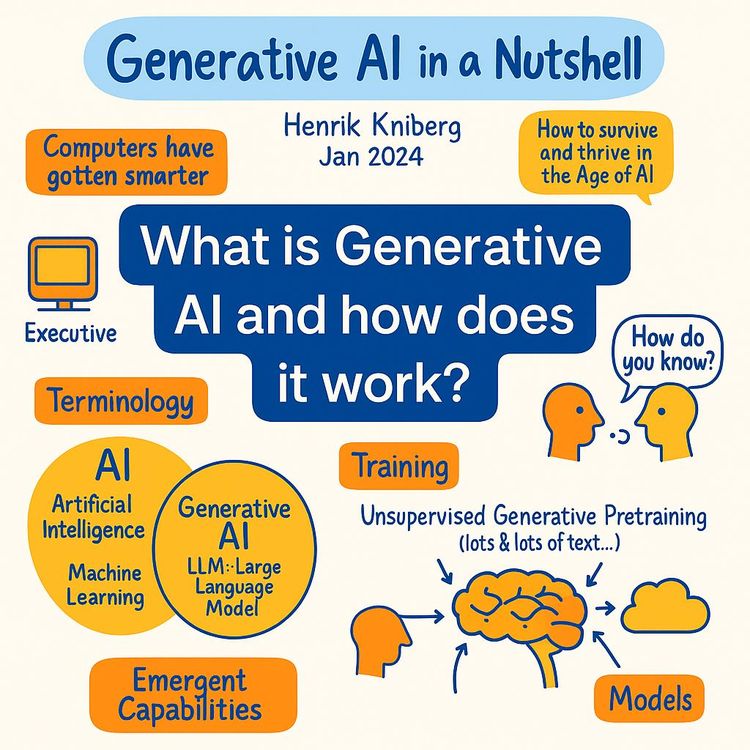
Video Course: What is Generative AI and how does it work?

Video Course: How to Use ChatGPT from Beginner to Professional
Video Course: How to Use Google Gemini for Google Workspace to Boost Productivity

Video Course: How to Use Claude 3.7 AI - Tips for Beginners!

Video Course: ChatGPT for Data Analytics: Full Course - from Beginners to Professional

Video Course: Generating Images and photos With ChatGPT?

Video Course: Generating Images & Photo's with MidJourney
Video Course: Generating Design's with Microsoft Designer and AI
Video Course: Generating Design's with Canva.com and AI
Join 20,000+ Professionals, Using AI to transform their Careers
Join professionals who didn’t just adapt, they thrived. You can too, with AI training designed for your job.