AI Readiness for SMBs: Cloud Run, GKE, APIs, and IaC (Video Course)
Lean team? This course gives you a sane, step-by-step way to get AI into production,API-first services, IaC, Cloud Run, and policy checks. Ship real features in weeks, keep costs predictable, and meet US/Canada/LATAM privacy needs without drama.
Related Certification: Certification in Deploying AI-Ready SMB Apps with Cloud Run, GKE, APIs & IaC

Also includes Access to All:
What You Will Learn
- Adopt API-first design to expose core data and services
- Deploy serverless containers (Cloud Run) from source using Buildpacks and CI/CD
- Define infrastructure and governance in code (IaC, policy-as-code, audit logging)
- Implement practical model integrations: RAG, vector stores, caching, and safe prompts
- Control cost, observability, and migration path from Cloud Run to GKE
Study Guide
Infrastructure Foundations for SMBs: Preparing Lean Teams for the AI Mandate (AMER)
AI isn't just another IT project. It's a new operating system for your business. The pressure is on, and for small and mid-sized organizations with lean teams, that can feel like someone dropped a jet engine on your desk and said "hook this up by lunch." This course is your blueprint for doing exactly that,practically, safely, and without torching your budget or your sanity.
We'll build from zero. You'll learn the core infrastructure principles that make AI adoption faster and less risky. You'll see how to go from prompt to production with serverless containers. You'll understand how to design an API-first business, enforce compliance through code, and evolve systems without grinding operations to a halt. You'll walk away with patterns, workflows, and a plan you can execute with a lean team starting this week.
This is written for the AMER region, so we'll touch on US, Canada, and Latin America realities,privacy laws, data residency, payment flows, language needs, and vendor ecosystems. We're not chasing trends here. We're building a foundation that compounds value over time.
The AI Mandate: What It Really Means for Lean Teams
The "AI mandate" is simple: use AI to operate smarter, serve customers better, and stay competitive. The messy part is going from desire to deployment. Most teams run into the same walls,especially SMBs where one person might wear five hats.
Common roadblocks you're probably familiar with:
1) Analysis paralysis. Too many options. Too much noise. No clear place to start. You're stuck debating the perfect model while your backlog grows.
2) Skill gaps. Your team is strong, but not staffed for MLOps, GPUs, or cloud-native everything. Hiring a platform team isn't realistic.
3) Technical anchors. Legacy systems with no APIs. Tools that worked fine until you tried to wire them into an AI workflow.
4) Infrastructure gaps. No GPUs. No autoscaling. Environments that crack the moment traffic spikes or a model needs extra memory.
5) Data silos. Your truth lives in five systems that don't talk, and the people who know where it lives are in meetings all day.
6) Security and scalability uncertainty. Everyone wants "secure and scalable," but what does that look like in infrastructure, code, and process?
7) Cost fear. The horror stories about surprise cloud bills. How do you experiment without burning cash?
There's a reason this happens. Teams try to construct a full-blown "AI platform" before they've shipped a single working loop. The antidote is a system-first mindset: simple parts that work, wired together with APIs, deployed via code, and evolved step by step.
Example:
A finance firm wants an AI-powered client insights dashboard. They wait for the perfect, enterprise-grade data platform and stall for months. A leaner approach: wrap the two most important data sources in simple read-only APIs, deploy them on a serverless container, and prototype the dashboard with a model endpoint. Ship in two weeks, evolve from there.
Example:
A retail SMB wants an LLM-powered support assistant. They try to unify all customer data first and get stuck integrating a decade of legacy. Better move: start with the top 50 help center articles, load them into a vector store, run a Cloud Run service that handles retrieval + LLM calls, and instrument everything. Add data sources over time.
The Mindset Shift: People, Process, Problem
A helpful mental model: People, Process, Problem. Not just "People, Process, Technology." Start with the user who benefits. Then define the process you're improving. Finally, scope the problem so it's solvable this quarter. Technology is the lever, not the destination.
Example:
People: Sales reps. Process: Proposal drafting. Problem: It takes two hours to assemble a proposal. Build: An internal API that pulls pricing + product summaries and a prompt-templated generator deployed on Cloud Run. Result: Ten-minute proposals.
Example:
People: Support agents. Process: Triage. Problem: Tickets get misrouted. Build: Intent classification microservice + routing API with Cloud Run + Pub/Sub. Measure: Drop misroutes by half in a month.
The Core Principles of an AI-Ready Infrastructure
Your infrastructure either accelerates AI or kills it softly. Four principles change everything for lean teams.
1) API-Driven Services. Every service you care about must be reachable by an API. That's how models, agents, and automations talk to your business. No API = dead end.
Example:
HR system has no API. Wrap it with a read-only Cloud Run service that exposes PTO balances for an internal assistant. Add caching to reduce load. Now your assistant answers PTO questions without manual lookups.
Example:
Your product catalog is in a legacy database. Add a small GraphQL or REST API on top, deployed serverlessly. That API then feeds both a recommendation model and your e-commerce frontend.
2) Infrastructure as Code (IaC). Infra must be defined in code. No click-ops in prod. Code is the truth, versioned, reviewed, and repeatable.
Example:
Use Terraform to define Cloud Run services, IAM roles, and logging sinks. Roll out to dev, stage, prod with a pipeline. Roll back in minutes if needed.
Example:
Parameterize your IaC to provision a GPU-enabled service only in prod regions, with CPU-only in dev. One codebase. Controlled cost. Predictable deployment.
3) Integrated Compliance and Governance. Bake security, auditing, and policy into your pipeline. You go faster when guardrails are automatic.
Example:
Add policy checks that block deployments if a service is public without auth, or if a container image lacks a signed provenance. Compliance by default.
Example:
Wire audit logs to a centralized log sink with retention and access policies in code. Security reviews shift from "where are the logs?" to "looks good."
4) Velocity as a first-class metric. You win by learning faster. Stable, frequent releases beat massive launches.
Example:
Ship a small RAG service for one department in a week. Watch usage. Add data sources only when usage validates value.
Example:
Adopt release trains: every Thursday you ship. Features wait if they're not ready. Reliability rises. Business trusts the cadence.
Gall's Law: Evolve From Simple Systems That Work
"A complex system that works is invariably found to have evolved from a simple system that worked." That line is your north star. Don't build a cathedral. Build a chapel, use it, expand it.
How to apply it:
- Start simple: one use case, one service, one model.
- Iterate and grow: add APIs, data sources, and automations with steady releases.
- Evolve based on evidence: usage data, errors, and user feedback drive the roadmap.
Example:
Start with a single webhook that ingests support emails and classifies them. Next iteration: auto-suggest replies. Later: auto-draft replies with human-in-the-loop approval. Each step works before the next.
Example:
Prototype an internal knowledge bot that answers from your policy docs. If agents love it, expand to product docs, then add CRM notes, then integrate with ticketing for suggested actions.
Modern Cloud Runtimes: Containers, Serverless, and What to Choose
Containers are the go-to unit: portable, consistent, and perfect for automation. Two main options matter here: Cloud Run and Google Kubernetes Engine (GKE). You can start on one and move to the other later; it's a two-way door.
Cloud Run: The Serverless Starting Point
Cloud Run runs containers without you managing servers. It scales to zero, bills per use, and removes a huge chunk of operational overhead. It's ideal for lean teams.
Key traits:
- Simplicity: deploy a container with a command. No clusters.
- Autoscaling: from zero to thousands of concurrent requests.
- Pay for what you use: per-request, per-millisecond billing.
- Optional GPUs for inference-heavy workloads.
When to use it:
- Web APIs, event handlers, batch tasks, AI inference services.
- Prototypes you might evolve into production services.
- Teams without deep Kubernetes expertise who want to ship fast.
Example:
A small media company deploys a thumbnail generation service that uses a vision model to select the best frame from videos. Traffic is spiky. Cloud Run scales up during uploads, then to zero at night.
Example:
A B2B SaaS vendor runs a compliance report generator. Each request triggers a workflow: fetch metrics, run prompts against templates, export PDF. Pay per request, not for idle time.
GKE: Power and Control at Scale
GKE gives you Kubernetes with fine-grained control over networking, storage, scheduling, and extensions. It's powerful, but more to manage. Use it when you truly need that control.
When to use it:
- Complex microservice meshes, stateful systems, or specialized networking.
- Teams that already have Kubernetes skills and a reason to use them.
- Workloads requiring custom schedulers or strict pod-level tuning.
Example:
A data platform team runs Kafka, Spark, and custom GPU inference services that need node-level tuning and a service mesh for zero-trust networking. GKE pays off.
Example:
An enterprise with multi-tenant workloads needs strict namespace isolation, custom ingress controllers, and shared services across teams. Kubernetes is the right substrate.
Migration note: Start on Cloud Run. If complexity grows, move the containers onto GKE. The container image and CI/CD pipeline stay mostly the same.
Key Concepts You'll Use Constantly
- Containers: ship once, run anywhere. Everything the app needs is in the image.
- Serverless: you don't manage the servers; you manage the service.
- GPUs and TPUs: accelerators for training and inference. Often overkill for CRUD apps, essential for heavy model workloads.
- Buildpacks: turn source code into secure containers without writing a Dockerfile.
Example:
You point Buildpacks at a Node.js repository. It detects Node, installs dependencies, sets the start command, and outputs a hardened image. Deploy to Cloud Run in minutes.
Example:
You have a Python FastAPI service. Buildpacks handles Python versions, wheels, and runtime layers. You focus on endpoints and prompts, not Dockerfiles.
Data Foundations for AI: From Silos to Usable APIs
Models are only as useful as the data they can reach. The most practical first step isn't a massive data lake,it's removing friction to critical data through APIs and lightweight pipelines.
Priorities for SMBs:
- Expose core data sources via APIs or event streams.
- Normalize where necessary at the edge of each service, not all at once.
- Add a vector store for semantic search when you need it.
- Track lineage and access in logs from day one.
Example:
Wrap your CRM's read endpoints with a caching API that normalizes contact fields. That one service feeds a lead scoring model and your sales ops dashboards.
Example:
Use a simple ETL job that runs nightly: export docs, chunk them, create embeddings, and upsert into a vector database. Your RAG service reads from there for fast answers.
Security, Compliance, and Governance: Make It Automatic
Security isn't a checkbox. It's a system of defaults that keep you safe while you move fast. In the AMER region, you'll likely meet standards like SOC 2, HIPAA, PCI DSS, CCPA in the US; PIPEDA in Canada; and local privacy laws in Latin America such as LGPD in Brazil and regulations in Mexico and other countries. The play is to codify policies so they run every time you deploy.
Must-do moves:
- Least privilege IAM: services get exactly what they need, nothing more.
- Service-to-service auth: no anonymous internal calls.
- Secret management: never hardcode keys; use a vault.
- Audit logging: enabled everywhere with retention policies in code.
- Policy as code: block noncompliant configs in CI/CD.
- PII controls: data masking/redaction, DLP scanning, and strict routing.
Example:
Your pipeline scans code and containers for secrets. If it detects a secret in the repo, it fails the build and opens a ticket with instructions to rotate keys.
Example:
Before deploying an API, a policy check ensures it requires authentication, has request logging, and doesn't expose debug endpoints. Fail builds that violate these rules.
Responsible AI controls to consider:
- Input/output filtering for PII.
- Prompt templates stored and versioned in code.
- Safety scoring on outputs before they're sent to users.
- Human-in-the-loop for high-risk actions (refunds, medical advice, compliance-sensitive content).
Cost and Capacity: How Lean Teams Stay in Control
Cost is not a mystery if you design for it. The serverless model helps: pay only when requests happen, scale to zero when they don't. You can enforce cost discipline with a few habits.
Essentials:
- Budgets and alerts at the project and service level.
- Concurrency tuning on Cloud Run to maximize efficiency.
- Rate limiting and quotas at the API gateway to prevent runaway usage.
- Caching model responses when appropriate.
- Separate dev/stage/prod projects with different spend limits.
Example:
A viral internal game built with "vibe coding" serves thousands of users. Cloud Run's per-request billing keeps the bill small,about the cost of a lunch for a month of heavy use,because it scales back to zero when no one's on it.
Example:
An inference service uses a GPU only during business hours via scheduled scaling. Nights and weekends, it drops to CPU-only or scales to zero. Performance stays high when needed, costs stay predictable.
AMER Realities: Regions, Compliance, and Multi-Language
Operating in the Americas introduces practical details you'll want in your foundation:
- Data residency: for US customers, keep data in US regions. For Canadian customers, consider Canada regions for PIPEDA-sensitive datasets. For Latin America, weigh latency and local laws; when in doubt, document your residency policy and get agreement from stakeholders.
- Privacy requests: build endpoints to handle "export my data" and "delete my data." Automate as much as possible and log everything.
- Multi-language: Spanish, Portuguese, French, and English content benefit from different models or prompts. Store language preference and route accordingly.
Example:
You host US healthcare-related data in a US region with strict IAM, audit logging, and a HIPAA-appropriate BAA in place. Non-health data can be multi-region to boost performance.
Example:
Your customer-facing chatbot detects language on the first interaction and uses the correct prompt templates and tone per locale. Translations are cached for cost control.
Practical Starting Points: Serverless Containers for the Win
Don't spin up a giant platform. Start with services you can deploy in hours, not months. Cloud Run is the obvious entry point for most SMBs and lean teams. You can get to value quickly and iterate from there.
Implementation Pattern 1: From Idea to Scalable App with Vibe Coding
"Vibe coding" turns prompts into code, fast. Use tools that generate a working app from your text description, then refine it like a sculptor. Move from idea to production in days.
Steps:
1) Prototype with a prompt. Describe the app: "Create a multi-category trivia game with a leaderboard; let users pick categories (sports, movies, history), generate questions with a model, auto-refresh questions. Include a REST API for scores."
2) Review and refine. Run it locally, tweak copy, improve prompts, and add simple logging.
3) Containerize automatically. Use Buildpacks to create a container image from the source,no Dockerfile required.
4) Deploy to Cloud Run. One command or click. Get a public URL with TLS. Add auth if internal-only.
5) Scale on demand. Cloud Run handles the spikes and drops to zero when idle.
Example:
You build the trivia app for a team-building day. It unexpectedly goes viral on social. The platform scales automatically. You pay only for the traffic that actually hit your endpoints.
Example:
An internal pricing assistant: prompt-generated UI + a backend that calls your pricing API and an LLM. Deployed on Cloud Run, instrumented with structured logs. The sales team uses it on day one; you iterate based on feedback.
Implementation Pattern 2: Source-to-Deploy for Existing Code
You likely have working code that just needs a modern home. The source-to-deploy pattern takes your repo, builds a secure container, and ships it without Kubernetes expertise.
Steps:
1) Connect to your repo. GitHub, GitLab, or your internal Git server.
2) Automated containerization. Buildpacks detect language, dependencies, and start commands; they produce a hardened image.
3) Deploy. Push to Cloud Run for immediate value or to GKE if you already run a cluster for other needs.
4) Wire CI/CD. On every push to main, run tests, build the image, run policy checks, and deploy to staging, then production after approval.
Example:
A legacy Flask app that generates compliance reports is moved to Cloud Run via Buildpacks. It gains HTTPS, autoscaling, and logs without touching Docker.
Example:
Your Node.js webhook processor for Stripe events is containerized and deployed in an afternoon. You add retries and dead-letter handling with Pub/Sub, visible in logs, ready for audit.
API-First Design: The Non-Negotiable Habit
An API-first posture is what makes your business programmable. If it matters, it needs an API. A few guardrails make your APIs reliable and AI-ready.
Best practices:
- Clear versioning: v1, v2, and deprecation windows.
- Authentication everywhere: service accounts or OAuth; no anonymous internal calls.
- Idempotency for write actions: safe retries.
- Rate limits and quotas: protect your systems and cost.
- Observability: structured logs, request IDs, error taxonomies.
- Documentation: generated from code annotations, with examples.
Example:
Inventory API with GET /inventory/{sku}, POST /inventory/reserve. The reserve endpoint uses idempotency keys to avoid double reservations when retries happen.
Example:
HR PTO API with GET /employees/{id}/pto and POST /employees/{id}/pto/request. The POST enforces a policy check and returns a workflow state that an AI assistant can poll.
Observability: Seeing the System Clearly
What you can't see will cost you. Logs, metrics, and traces are your nervous system. Make them consistent and actionable.
Practical moves:
- Structured logs with correlation IDs across services.
- Request latency, error rates, and saturation metrics on dashboards.
- Alerts that are specific and few, tied to business outcomes.
- Cost dashboards per service and per feature.
Example:
Your RAG service logs metadata for each query: document IDs retrieved, model used, response time, and whether the user clicked the suggested answer. Product can now improve relevance with actual behavior.
Example:
Anomaly detection on spend: if cost per thousand requests for a service jumps by a threshold, trigger an alert with the top offenders by endpoint.
Model Integration: Keep It Simple, Keep It Safe
Most SMB wins don't come from training massive models. They come from smart retrieval, prompt design, and careful integration.
Practical approach:
- Use managed model endpoints when possible.
- Add retrieval with a vector store for your proprietary data.
- Cache frequent responses and embeddings to reduce cost.
- Evaluate outputs with test sets and user feedback.
Example:
A support assistant uses embeddings created nightly from your help center. The RAG pipeline retrieves the top chunks, constructs a prompt, and returns a suggested answer with sources. Agents accept or edit, and that feedback is logged to improve retrieval quality.
Example:
Your sales email generator pulls product updates from an internal API and customer context from CRM. Prompt templates ensure compliance language. A human approves the first send to each account segment.
Compliance in the Pipeline: "Security by Construction"
Move compliance left. Your pipeline is where approvals live and policies execute. This keeps velocity high without sacrificing control.
Pipeline guardrails to include:
- Static analysis for code and IaC.
- Dependency and container vulnerability scans.
- Secrets scanning and automatic rotation tickets.
- Policy checks (public endpoints, encryption, logging).
- Signed images and provenance for supply chain integrity.
- Automated change records with links to commits, tickets, and tests.
Example:
A PR that tries to deploy a public endpoint fails if auth is missing. The pipeline comments with the exact policy and remediation steps. Developer fixes it in minutes.
Example:
Your deploy job signs the container image and stores an attestation. If an unsigned image appears in prod, it's blocked. Auditors love this trail; engineers barely notice it after setup.
Team Enablement: Skills, Rituals, and Lightweight Tools
You don't need a huge platform team. You need a small set of skills and some rituals that compound.
Core skills to develop:
- Cloud CLI basics: create services, deploy, tail logs, set perms.
- Git workflows: branching, reviews, rollbacks.
- Basic IaC: read and modify Terraform for common tasks.
- Prompt engineering for your domain: templates, variables, guardrails.
- Observability triage: read logs, identify patterns, fix fast.
Example:
A "golden path" repo with an example Cloud Run service, IaC templates, CI pipeline, logging setup, and a sample prompt store. New projects fork this and start shipping in an hour.
Example:
Weekly reliability review: top incidents, top slow endpoints, top cost spikes. Each meeting ends with one small improvement shipped that week.
Choosing the Right First Project: How to Win Early
Pick a problem that's visible, solvable, and low-risk. Your first win builds political capital and confidence. Criteria that help:
- Clear, narrow scope with a known user.
- Data you already have (or can access easily).
- Measurable success metric tied to time saved or revenue influenced.
- A stakeholder who wants this yesterday.
Example:
An internal support knowledge assistant for Tier 1 agents. Measure handle time and first-contact resolution on a sample. Decision-maker is the support manager who owns the metric.
Example:
A lead enrichment microservice for the sales team. Pulls info from public sources, summarizes with a model, and attaches it to leads in the CRM. Measure meeting set rate for enriched vs. non-enriched leads.
End-to-End Pattern: Vibe Coding + Source-to-Deploy + Cloud Run
Combine the two patterns for a rapid, safe delivery loop.
Flow:
1) Prompt-generate a minimal UI and backend for your use case.
2) Drop code into your golden path repo.
3) Buildpacks create a container image in CI.
4) Policy checks and scans run; if clean, deploy to staging Cloud Run.
5) Stakeholder accepts; deploy to prod with a tagged release.
6) Observe, iterate, repeat weekly.
Example:
You build a customer FAQ assistant in three days: a small UI, a retrieval backend, and logging. It ships to a pilot group on Friday. By the next Friday, you've tuned prompts, added two data sources, and cut average time to answer by half.
Example:
You modernize a monthly financial report generator. It moves to Cloud Run via Buildpacks, gets schedules for monthly/weekly runs, and emails results automatically. A two-day project replaces a painful manual process.
Migration Path: From Cloud Run to GKE Without Drama
If your needs outgrow Cloud Run, you can migrate thoughtfully. Keep containers portable and avoid runtime-specific dependencies from day one.
Steps to keep it smooth:
- Keep runtime-agnostic: 12-factor app principles, environment variables for config.
- Externalize state: use managed databases, object storage, and queues.
- Abstract service discovery: use a gateway or service URLs, not internal hostnames.
- Test in both environments early if you plan to migrate.
Example:
Your inference service moves to GKE for GPU scheduling control. The same container runs, but you now use node pools with GPUs and fine-tuned horizontal pod autoscalers. Everything else,CI, logs, APIs,stays consistent.
Example:
An event-driven pipeline shifts to GKE to colocate with a streaming platform. The app logic doesn't change; only deployment descriptors differ. Teams barely notice.
Measuring Progress: Practical, Non-Vanity Metrics
Measure the system, not the ego. A few metrics tell you if your foundation is working.
- Deployment frequency: how often do you ship safely?
- Lead time: how long from idea to production?
- Change failure rate: what percent of releases create incidents?
- Mean time to recovery: how fast do you fix?
- Infra coverage in code: percent of services defined in IaC.
- API coverage: percent of critical systems available via API.
- Cost per request: unit cost by service.
Example:
You move from monthly releases to weekly trains. Change failure rate declines because changes are smaller, reviewed, and revertable.
Example:
By exposing three core data sources via APIs, your time-to-prototype new AI features drops from weeks to days. That's API coverage paying off.
Common Traps to Avoid
No one is immune to these. Call them out so you catch them early.
- Building a platform before you build a product. Ship one use case first.
- Forklifting every dataset into a lake before proving value. Wrap, don't boil the ocean.
- Over-customizing models. Retrieval and prompts get you most of the win.
- Click-ops in production. If it isn't in code, it doesn't exist.
- Skipping security till "later." Later never comes when you're moving fast.
Example:
A team spends months building a full MLOps pipeline with no users waiting. Contrast that with a two-week RAG assistant that saves agents an hour a day. Sequence matters.
Example:
A DB admin opens a port for a one-off test in prod, forgets to close it, and it becomes a finding in an audit. If it's not through IaC and policy checks, it's a risk.
Action Plan: What to Do in the Next 30-60 Days
1) Run a lightweight AI readiness assessment.
- Which systems lack APIs?
- What infra is still click-configured?
- Where are logs missing or inconsistent?
- What data is essential for your first use case?
- Who is the stakeholder with a metric to move?
2) Pick one pilot with a fast path to value.
- Clear user, clear metric, data you already access.
- Time-box to a short delivery window for the first version.
- Use Cloud Run, Buildpacks, and a golden path repo.
3) Establish an API-first mandate for new services.
- Versioned, authenticated, observable APIs by default.
- Add gateway-level rate limits and auth patterns to your templates.
- Require code reviews for API design decisions.
4) Upskill your team on the essentials.
- Cloud CLI, IaC basics, CI/CD with policy checks.
- Prompt design and RAG patterns for your domain.
- Observability hygiene: logs, metrics, traces.
Example:
Week 1-2: Wrap your most-used data source in an API, deploy via Cloud Run with Terraform, and add structured logging. Week 3-4: Ship a minimal assistant that uses that API and a model endpoint. Week 5-6: Add one more data source and improve prompts.
Example:
Create a library of ready-to-use Terraform modules: Cloud Run service, log sink, budget, API gateway, and alert. Projects start with these and skip yak shaving.
Exercises You Can Run with a Lean Team
Try these to make the ideas tangible.
- Exercise: Ship a one-endpoint API. Wrap a CSV file of product SKUs with a GET /sku/{id}. Deploy on Cloud Run. Add request logging and an API key. Done in a day.
- Exercise: Build a minimal RAG pipeline. Take five policy docs, chunk and embed, store in a vector database. Create a Cloud Run service with a /ask endpoint. Log the top three retrieved chunks for every query.
Example:
A non-engineer on your team uses vibe coding to scaffold the UI for your RAG demo. An engineer wires the backend. You deploy together after adding auth.
Example:
The first day you instrument cost per request, you find a prompt that's too long. Trimming it reduces cost by a third with no quality drop.
Detailed Walkthrough: Two Reference Implementations
Reference Implementation A: Internal Knowledge Assistant
- Scope: Answer policy and product questions for support agents.
- Data: Policy PDFs and top 100 help articles.
- Steps:
1) ETL job runs nightly: split docs, generate embeddings, upsert to vector store.
2) Cloud Run API: POST /ask with question + user ID. Backend does retrieval, composes prompt, calls model, returns answer + sources.
3) Observability: logs contain request ID, retrieved doc IDs, latency, model cost estimates, and user feedback.
4) Security: service account auth, rate limits per user, PII filtering before model calls.
- Result: Agents save minutes per ticket; you have a clear metric and a weekly improvement cadence.
Example:
Week 2 you notice many queries ask about shipping time for specific regions. You add a Shipping API to the prompt for the latest data, and satisfaction scores jump.
Example:
You run a small A/B test on prompt templates and see a 12% lift in answer acceptance. You adopt the better template as code, rolled out with a tagged release.
Reference Implementation B: Lead Research Microservice
- Scope: Generate concise company summaries for sales.
- Data: Public web snippets, your CRM fields, recent product releases from your internal API.
- Steps:
1) Cloud Run API: POST /enrich with company URL or name.
2) Worker flow: fetch public data, dedupe, chunk, and rank. Retrieve internal product updates if relevant. Compose prompt and call model.
3) CI/CD: Policy checks ensure no PII leaves your environment and that the output includes citations for transparency.
4) Feedback loop: Sales can flag poor summaries; those cases are reviewed and added to an evaluation set.
- Result: Higher meeting rates, faster research, audit-friendly summaries with sources.
Example:
Your metrics show weekend usage is low. You scale the service to zero outside business hours to save cost, then warm it up each morning with a small canary load.
Example:
Sales in Brazil need Portuguese output with regional context. You add a locale parameter and language-specific prompt template. Adoption expands without a separate codebase.
Deep Dive: Buildpacks and CI/CD Without the Headaches
Buildpacks remove the friction of writing and maintaining Dockerfiles. They're perfect for lean teams that need secure, consistent container builds.
Typical pipeline:
- On push to main: run tests, run Buildpacks, scan the resulting image, sign it, and push to your registry.
- Policy checks run: IaC, public endpoints, mandatory logs.
- Deploy to staging: smoke tests hit /health and a sample endpoint.
- Manual approval or automated promotion to prod.
Example:
Your Python service uses a requirements.txt. Buildpacks cache dependencies between builds. Build times shrink, developers iterate faster.
Example:
You add a step that fails any build where the base image is older than your policy allows. No more "we forgot to update" vulnerabilities drifting into prod.
Data Pipelines: Keep Them Boring and Reliable
For most SMB AI use cases, simple daily or hourly jobs are enough at first. Boring is beautiful. Use managed services for storage and queues.
Patterns:
- Nightly embedding refresh jobs for docs.
- Event-driven updates when high-value content changes.
- Idempotent workers so retries are safe.
- Back-pressure and dead-letter queues for resilience.
Example:
When a new help article is published, a webhook triggers a job to embed and upsert it. No need to reprocess everything nightly.
Example:
Your ETL writes a checksum for each processed document. If a file hasn't changed, it's skipped. Resource use drops, pipelines run faster.
Security Details That Save You Later
Security details that seem small now become big wins under audit or incident response.
- Enforce HTTPS everywhere and pin TLS versions via config.
- Rotate keys on a schedule; track last-rotated time in a dashboard.
- Separate service accounts per service with scoped roles.
- Private egress for calls to model endpoints when possible.
- Encrypt data at rest and in transit; confirm with tests in CI.
Example:
You embed a policy that any public service must be fronted by an API gateway with rate limiting. A sudden spike one afternoon gets absorbed and logged, not passed through to your backend.
Example:
A secret is accidentally committed. The scanner flags it, the pipeline blocks, and an automated playbook rotates the secret and comments on the PR with remediation steps.
Architectural Patterns That Pay Off
- Strangler fig pattern for legacy: wrap and replace piece by piece.
- Backend-for-frontend: small services tailored to specific UIs.
- Event-driven integrations to reduce tight coupling.
- Feature flags for safe experimentation and controlled rollouts.
Example:
You replace a legacy Excel-based quoting system by first creating an API that reads the sheet. Then you redirect clients to the API, and finally you deprecate the sheet once stable.
Example:
A feature flag controls whether the assistant suggests replies automatically. You roll it out to 10% of agents, monitor results, and expand only when quality meets your threshold.
How to Communicate Progress to Leadership
Leaders don't want jargon. They want risk reduced, value delivered, and predictable cost. Present progress like this:
- Here's the single use case we shipped and the metric it moved.
- Here's the foundation added this month (APIs, IaC, logging).
- Here's the risk we eliminated (permissions, audit gap, cost spike).
- Here's what it enables next quarter (two new use cases we can ship faster).
Example:
"We reduced average ticket handle time by three minutes with the assistant. We also moved hiring data to an API and added audit logging. Next up: onboarding automation that uses the same foundation."
Example:
"Lead enrichment now runs serverless and costs fifty cents per hundred requests. We prevented overspend with new rate limits. Next iteration: language-specific prompts for LATAM accounts."
Key Insights and Truths to Build Around
- The AI mandate isn't a feature, it's a capability. Build the capability first.
- API-first + IaC + integrated governance = velocity without chaos.
- Small systems that work grow into complex systems that work.
- Serverless containers give lean teams a powerful on-ramp at low risk.
- Generative AI can write your first draft of the app itself; you sculpt it.
- Only a small fraction of organizations feel fully ready for AI. That's an opportunity if you move with discipline.
Example:
Because your services are API-first, a new AI feature is just another client. No rewrites. You go from idea to pilot in days, not months.
Example:
IaC reduces "works on my machine" problems to near zero. When an environment drifts, you rebuild from code and you're back in a known-good state.
FAQ for Lean Teams
Q: Do we need GPUs for everything?
A: No. Most wins are retrieval and orchestration. Use GPUs where inference latency or model size demands it, and only where it pencils out.
Q: What if our data is a mess?
A: Start by wrapping one useful source in an API. Don't wait for perfect. Add structure as you go and let usage guide the cleanup.
Q: Are we locked in if we start on Cloud Run?
A: You can move containers to GKE later. Keep state external and configs portable from day one.
Example:
You run CPU inference most of the time and switch to GPU only for a specific batch job window. The code is the same; the runtime changes via configuration.
Example:
You begin with a read-only API over your legacy ERP. When value is proven, you modernize write paths gradually, replacing the most painful workflows first.
Final Playbook: Checklist You Can Copy
- Mandate API-first for all new internal services.
- Put infra in code with Terraform; block manual prod changes.
- Add policy checks to CI/CD: auth required, logs enabled, images signed.
- Ship one AI use case on Cloud Run within a short, defined window.
- Instrument everything: logs, latency, cost per request.
- Review metrics weekly; ship one improvement each week.
- Train the team on CLIs, IaC, and prompts with short, focused sessions.
Example:
Run a one-hour "from zero to prod" session with your golden path repo. Everyone deploys a simple API, reads logs, and adds an alert. Confidence skyrockets.
Example:
Create a prompt library in Git with templates for different use cases. Changes go through PRs, get reviewed, and are rolled out like any other code.
Conclusion: Build the Foundation, Then Move Faster Than Everyone Else
AI isn't won by the flashiest demo. It's won by the teams who turn ideas into stable, observable, cost-aware services,over and over. For lean teams and SMBs, the path is clear: expose your business through APIs, define your infrastructure in code, bake compliance into your pipeline, and stand on serverless containers to remove operational drag.
Start with a small system that works. Keep shipping. Use vibe coding to accelerate prototypes, and source-to-deploy to modernize what you already have. When you hit constraints, step up to GKE with the same containers and the same discipline. Your reward is velocity without chaos, security without slowdown, and a compounding advantage: every new AI feature becomes easier than the last.
Take the next step this week. Wrap one data source in an API. Deploy one assistant on Cloud Run. Add one policy to your CI. Then do it again. That's how lean teams meet the AI mandate,and quietly outperform bigger ones.
Frequently Asked Questions
This FAQ cuts through the noise and answers the questions teams ask before, during, and after building an AI-ready foundation. It moves from first principles to implementation details, so you can go from "where do we start?" to "what do we scale next?" with clarity. Each answer offers practical guidance and examples for SMBs and lean teams operating in AMER, highlighting what matters, what to skip, and how to ship safely and quickly. Goal: make smart decisions faster, reduce risk, and ship useful AI,without bloated overhead.
The AI Mandate and Its Challenges
What is the "AI mandate"?
The AI mandate is the market pressure to embed AI into operations, products, and services to stay competitive. Customers expect faster answers, smarter features, and smoother experiences. Competitors are already using AI to trim costs and ship features. The mandate is less about hype and more about outcomes: efficiency, better decisions, and new revenue.
For SMBs, the win isn't building giant models. It's connecting existing systems with APIs, standing up a low-friction runtime, and plugging in managed AI services. Example: a regional retailer added AI-powered product search to its site via an API, lifted conversion, and cut support tickets,without a platform rebuild.
Why do organizations, especially those with lean teams, struggle with AI adoption?
Lean teams face real constraints: legacy systems, scattered data, limited GPU access, and tight headcount. Common blockers: inadequate infrastructure, fragmented data, skill gaps, and vendor complexity.
Example: a finance SMB had data split across spreadsheets, a CRM, and a billing system; no APIs; and manual reporting. They stalled on AI until they exposed APIs, standardized data formats, and automated deployments with IaC. The shift enabled quick wins: AI-generated summaries for sales and automated invoice categorization,both delivered within weeks.
What are the most common challenges teams face when starting with AI?
Teams wrestle with prioritization, enablement, integration, and cost. The big ones: picking the first use case, securing data, understanding app dependencies, managing vendor licensing, and scaling affordably.
Example: an HR tech startup wanted an AI resume screener. They hit issues with PII handling, rate limits, and model latency. Fix: start with a scoped pilot (support summaries), add an API gateway for rate limiting, cache results, and use scale-to-zero infrastructure. They built momentum without burning budget.
What is the "people, process, problem" framework?
It re-centers AI on outcomes. Start with the person, define the problem, then adjust the process. Tech supports that chain. Who is this for? What painful problem are we solving? How will behavior change?
Example: A support team drowning in tickets. Person: frontline agents. Problem: repetitive questions slow responses. Process: add an AI assist that drafts replies from your knowledge base, with human review. Result: faster resolutions and higher CSAT,no grand platform rebuild required.
Fundamental Concepts of AI Readiness
What does it mean for an organization's infrastructure to be "AI-ready"?
AI-ready infrastructure supports the full lifecycle,experimentation, deployment, and iteration,without constant firefighting. It rests on four pillars: API-first access to systems, Infrastructure as Code (IaC), built-in compliance and governance, and high delivery velocity.
API-first connects data and actions. IaC makes environments reproducible. Governance (identity, logging, auditing) is baked into pipelines. High velocity means quick deploys, safe rollbacks, and experimentation that doesn't disrupt core systems. Example: expose your CRM via an API, deploy a summarization microservice on a serverless runtime, and monitor usage with centralized logs and alerts.
What is "Infrastructure as Code" (IaC) and why is it crucial for AI?
IaC manages infra with code instead of manual clicks. That means versioning, reviews, and repeatable environments. For AI, it cuts setup time and prevents "snowflake servers." Speed, consistency, automation, and easy scaling are the payoffs.
Example: define a Cloud Run service, a GPU-enabled workload, and a database in Terraform. Spin up dev, test, and prod the same way. If a deploy introduces latency, roll back fast. Your infra becomes as testable and traceable as application code.
Why are APIs essential for integrating AI?
AI needs structured access to read, write, and orchestrate. Without APIs, your model can't fetch data or trigger actions. With APIs, AI can access data, perform tasks, and combine services into useful workflows.
Example: a sales assistant that reads deal notes from your CRM API, summarizes next steps, and opens a task in your project tool,no swivel-chairing. Secure APIs, an API gateway, and clear documentation make this possible.
What is Gall's Law, and how should it guide an AI strategy?
Gall's Law: complex systems that work evolve from simple systems that worked. For AI, skip big-bang platforms. Start simple, prove value, and iterate.
Example: launch an AI-powered FAQ bot using your knowledge base. If it reduces ticket volume and hits your SLA, expand to agent assist, then workflow automation. Each step funds and informs the next, instead of a long, fragile rebuild.
Cloud Infrastructure for AI
Certification
About the Certification
Get certified in AI Readiness for SMBs: deploy AI to production on Cloud Run and GKE, build API-first services, automate with IaC, add policy checks, control costs, and meet US/Canada/LATAM privacy requirements,ready to ship in weeks.
Official Certification
Upon successful completion of the "Certification in Deploying AI-Ready SMB Apps with Cloud Run, GKE, APIs & IaC", you will receive a verifiable digital certificate. This certificate demonstrates your expertise in the subject matter covered in this course.
Benefits of Certification
- Enhance your professional credibility and stand out in the job market.
- Validate your skills and knowledge in cutting-edge AI technologies.
- Unlock new career opportunities in the rapidly growing AI field.
- Share your achievement on your resume, LinkedIn, and other professional platforms.
How to complete your certification successfully?
To earn your certification, you’ll need to complete all video lessons, study the guide carefully, and review the FAQ. After that, you’ll be prepared to pass the certification requirements.
Other AI Video Courses
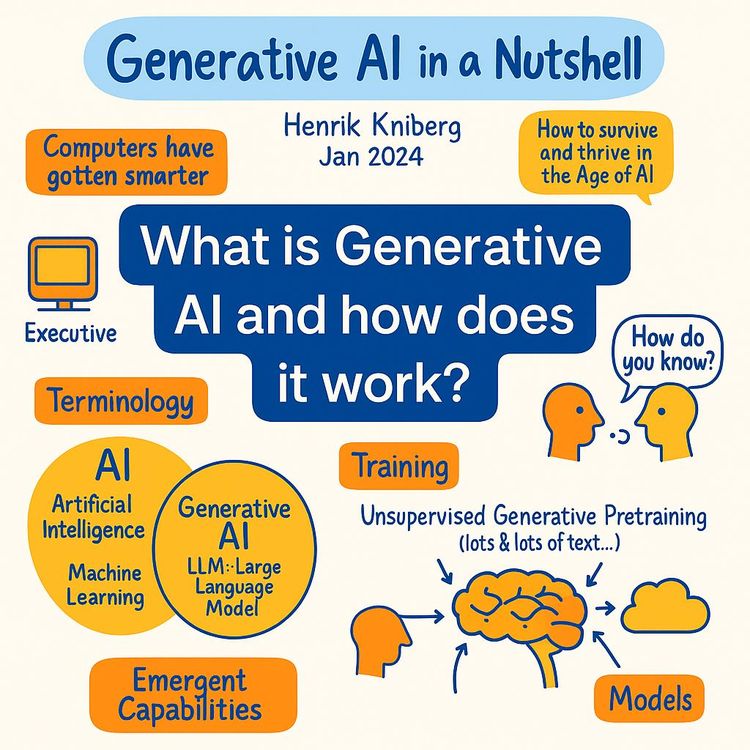
Video Course: What is Generative AI and how does it work?

Video Course: How to Use ChatGPT from Beginner to Professional
Video Course: How to Use Google Gemini for Google Workspace to Boost Productivity

Video Course: How to Use Claude 3.7 AI - Tips for Beginners!

Video Course: ChatGPT for Data Analytics: Full Course - from Beginners to Professional

Video Course: Generating Images and photos With ChatGPT?

Video Course: Generating Images & Photo's with MidJourney
Video Course: Generating Design's with Microsoft Designer and AI

Video Course: Generating Design's with Canva.com and AI
Join 20,000+ Professionals, Using AI to transform their Careers
Join professionals who didn’t just adapt, they thrived. You can too, with AI training designed for your job.