AI Research Playbook: Transformers, LLMs, Optimizers, Open Source (Video Course)
Go from basics to frontier with a hands-on path to AI research. Learn the math that makes models tick, build Transformers and optimizers from scratch, speed up training, and adopt open-source workflows,run clean experiments and ship results that count.
Related Certification: Certification in Building, Training, and Optimizing Open-Source Transformer LLMs
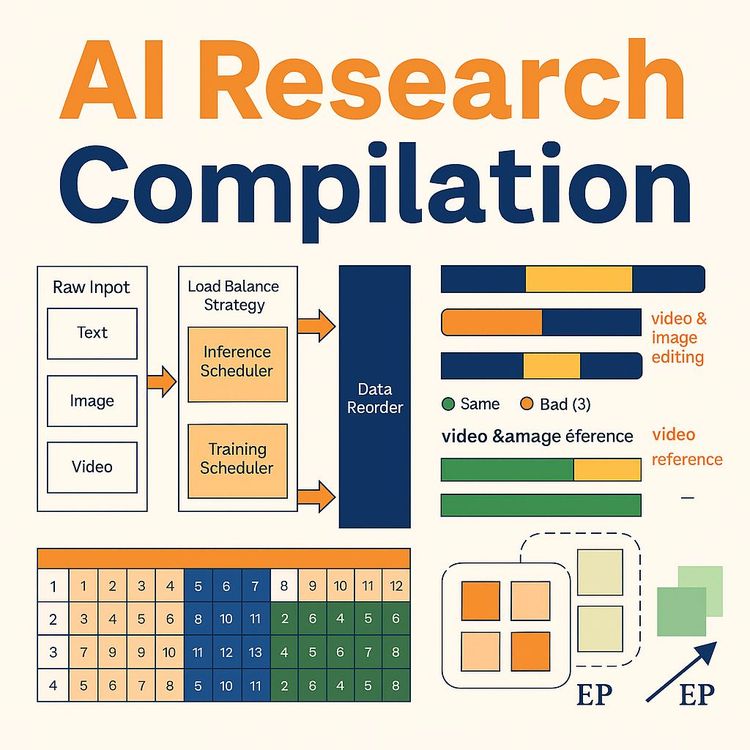
Also includes Access to All:
What You Will Learn
- Master core math: derivatives, SVD, entropy, cross-entropy, and KL
- Implement and debug MLPs and Transformer components from scratch
- Design reproducible, single-variable experiments and baselines
- Speed up LLMs with FlashAttention, KV cache, quantization, and BF16
- Apply advanced architectures: Hyperconnections and engram (n-gram) memory
- Contribute to open-source research with clean workflows and a public portfolio
Study Guide
AI Research Tutorial Compilation: From Fundamentals To Frontier
AI research isn't just coding complicated models or posting one big paper you hope takes off. It's a craft. A long-term discipline. And like any craft, the people who build unfair advantages are the ones who master the basics, produce consistently, and learn out loud.
This course covers the full path: the researcher's mindset, the math and systems you need to truly understand what you're building, the nuts-and-bolts of Transformers and optimizers, advanced architectures like Hyperconnections and Engram memory, and the exact open-source workflow that prepares you for lab-grade research. You'll get detailed explanations, practical examples, and best practices that keep your work clean, fast, and reproducible.
By the end, you'll have the clarity and confidence to do real research: design rigorous experiments, contribute to community projects, and build a portfolio that opens doors.
The Mindset: How Real Researchers Operate
Forget the fantasy of "one perfect idea." Research is a volume game with compounding returns. You produce, you learn, you refine. A few projects will matter a lot; you don't get to choose which ones in advance. Your edge is deep understanding, prolific output, and clear communication.
Deep theoretical understanding
You can't improve or debug what you don't understand. If an LLM writes code for you, it's your job to know exactly how it works. You should be able to defend every line, from loss functions like cross-entropy and KL divergence to why your activation function is there in the first place.
Example 1:
Before using a library's KL divergence, implement it for two Bernoulli distributions and two Gaussian distributions from scratch. Verify numerically that KL(P‖Q) ≠ KL(Q‖P) and explain why the asymmetry matters for training.
Example 2:
Manually code a two-layer MLP in your framework of choice (no high-level trainers). Add a classification head and cross-entropy, then train on a small synthetic dataset. Inspect gradients and confirm your backprop matches expectations.
Long-term perspective and prolific output
Even elite researchers have many projects with little attention. That's normal. Your job is to be consistent. Because the real learning happens in the act of building and publishing.
Example 1:
Commit to a "12 concepts in 12 weeks" series. Each week, publish a concise explainer (blog or video) on a core idea: dot product, softmax, backprop, LayerNorm, KL divergence, etc. Keep it simple. Keep it public.
Example 2:
Run monthly mini-projects: replicate one small result from a paper, optimize a training loop, or redesign an activation. Document what worked and what didn't. The archive becomes your public lab notebook.
Teach to learn
Teaching forces clarity. If you can't explain a concept to a beginner, you don't fully understand it yet.
Example 1:
Create a blog post that explains self-attention with only vectors, dot products, and softmax. Include drawings or simple numbers. No jargon. If a high-schooler can follow it, you nailed it.
Example 2:
Record a short video walking through backprop on a one-hidden-layer net. Show the chain rule by hand for a single sample, then map each derivative to your code variables.
Simplification as a rule
In code and writing, bloat kills momentum. Additions are liabilities. Deletion is a skill.
Example 1:
Refactor your training script by removing unused flags, merging duplicate utility functions, and centralizing logging. Fewer files, fewer surprises.
Example 2:
Rewrite your README from 1,200 words to 400 words that cover "what, why, how, baseline, contribute." If a newcomer can act in five minutes, you did it right.
Tip:
Before you add anything, ask: Can I delete something to get the same result? Can I prove this addition earns its keep with a measurable win?
The Roadmap: What To Learn And In What Order
Mastery isn't linear, but it is layered. Get the core math, then build systems intuition, then explore specializations. Revisit fundamentals often.
Core intuitions
Dot product, softmax, tensor ops, L1/L2 norms. These are the daily tools of deep learning.
Example 1:
Show how the dot product behaves as a similarity measure by comparing token embeddings: "cat"."dog" vs. "cat"."airplane." Normalize vectors and observe cosine similarity changes.
Example 2:
Demonstrate softmax temperature effects on a logits vector. Lower temperature sharpens distributions; higher temperature flattens. Plot both and discuss exploration vs. confidence.
Math fundamentals
Derivatives, chain rule, backprop, entropy, cross-entropy, KL divergence, and SVD. If math feels abstract, translate every symbol into a shape or a move in space.
Example 1:
Derive cross-entropy for a binary classifier and relate it to maximum likelihood. Then visualize how wrong predictions incur high loss compared to correct, confident ones.
Example 2:
Use SVD to decompose a simple 2×2 matrix. Plot how a circle transforms into an ellipse, then back to a rotated circle if you remove stretch (set singular values to 1).
Neural networks
Layers, activations, normalization, initialization, and how tensors flow. Understand why activations like ReLU, GELU, or SwiGLU exist in the first place.
Example 1:
Compare ReLU vs. SwiGLU vs. Squared ReLU on a small MLP for tabular data. Track training time and final accuracy; note stability and compute cost.
Example 2:
Train two identical models with and without LayerNorm on a sequence task. Observe exploding/vanishing gradients and how normalization stabilizes updates.
Transformers
Tokenization, self-attention, multi-head mechanisms, positional encodings, feed-forward blocks, and residuals. Why the architecture works and where it breaks.
Example 1:
Implement scaled dot-product attention for a tiny batch and verify that attention weights sum to 1 across the sequence dimension.
Example 2:
Compare sinusoidal vs. rotary positional encodings on character-level modeling. Track perplexity and extrapolation to longer sequences than seen in training.
Advanced topics
VAEs, diffusion models, Reinforcement Learning (Q-learning, policy gradients), State Space Models, and Geometric Deep Learning. Even if you don't specialize, understand the core ideas.
Example 1:
Train a tiny VAE on MNIST. Visualize the latent space by varying two dimensions and decoding back to images.
Example 2:
Build a basic gridworld and implement Q-learning vs. a policy-gradient method. Compare sample efficiency and stability trade-offs.
Transformers: The Working Engine Of Modern LLMs
Transformers turn sequences into structured context. The core mechanism is attention,comparing tokens to each other and deciding what matters now.
Tokenization
Text becomes numbers. It's either byte-level, BPE, or WordPiece. The tokenizer defines what the model "sees."
Example 1:
Tokenize "New York City" with two different tokenizers. Count tokens and inspect whether "New York" appears as one piece or two. Discuss downstream memory implications.
Example 2:
Subword tokenization in a multilingual setting: compare token counts for English vs. a morphologically rich language on the same sentence.
Self-attention and multi-head attention
Each token queries the rest of the sequence and aggregates weighted information. Multi-head attention lets the model attend to different "aspects" simultaneously.
Example 1:
Visualize attention maps in a small Transformer layer to see subject-verb agreement patterns across tokens.
Example 2:
Freeze all but one attention head and fine-tune. Observe how that head compensates and what behaviors degrade.
Positional encodings
Transformers don't know order by default. Positional encodings inject position information.
Example 1:
Train with sinusoidal embeddings and test on sequences longer than training. Track how perplexity grows with length.
Example 2:
Use rotary position embeddings and compare long-context capability vs. sinusoidal on a long-range dependency task.
Feed-forward networks and residuals
After attention, a per-token feed-forward network does non-linear transformation. Residual connections preserve information and stabilize gradients.
Example 1:
Remove residual connections in a toy Transformer and watch training collapse or slow drastically.
Example 2:
Compare two FFN setups: SwiGLU vs. Squared ReLU. Count parameters, measure throughput, and evaluate validation loss.
LLM Efficiency Toolkit: Make Models Fast And Affordable
Once you understand the architecture, the next edge is speed. You want more tokens processed per unit time and fewer resources per unit of capability.
Flash Attention
Computes attention with memory-efficient tiling and fusion.
Example 1:
Benchmark a small model with and without Flash Attention. Measure max context length and tokens per second on the same GPU.
Example 2:
For longer sequences, analyze memory usage differences and identify at what length Flash Attention becomes critical.
KV Cache
Stores key/value tensors for previously processed tokens to avoid recomputation during generation.
Example 1:
Generate a paragraph with and without KV cache. Compare latency per token after the first 100 tokens.
Example 2:
Use chunked attention with KV cache and verify quality is unchanged while throughput improves.
Grouped-Query Attention (GQA)
Reduces KV memory by sharing keys/values across groups of heads.
Example 1:
Train small models with MHA vs. GQA on the same dataset. Compare speed and validation loss.
Example 2:
Profile memory usage for inference with batch size > 1. Observe the benefit of fewer KV sets in GQA.
Quantization
Represent weights/activations in fewer bits.
Example 1:
Quantize a trained model to 8-bit weights and evaluate accuracy drop vs. speed gain on CPU.
Example 2:
Use 4-bit quantization for inference on a consumer GPU. Measure latency with and without quantization-aware calibration.
BF16 casting
Use BFloat16 to boost speed with minimal precision loss.
Example 1:
Train a small LM in FP32 vs. BF16 for a fixed number of steps. Compare wall-clock time and final loss.
Example 2:
Run a short finetune in BF16 on a consumer GPU and observe stability vs. mixed precision with autocast.
Tip:
Always tie speed claims to a target metric (e.g., time-to-reach loss X on dataset Y). Without a consistent target, "faster" is meaningless.
Case Study: Community-Driven LLM Development (Blueberry-Style)
Open-source research can feel chaotic unless you treat it like a lab. The winning model: tight scope, clean baselines, ruthless simplicity, and competition grounded in data.
Goal
Incrementally build a top-tier LLM by accelerating pre-training and improving architecture,starting with small GPT-level models and iterating upward. Use "speedruns": hit a target training loss in the shortest time possible with rules everyone agrees on.
Structure over chaos
Unstructured contributions create tangled code and wasted effort. Establish research questions, contribution lanes, and discussion protocols.
Example 1:
Define weekly targets like "Reduce time-to-loss 3.1 by at least 7% without hurting validation perplexity," and assign issues that point to single-variable experiments.
Example 2:
Use a shared dashboard that lists current best baseline, experiment queue, and open PRs with expected improvements and status.
Simplicity and deletion
Adding code is a cost. The top projects get faster by deleting and consolidating.
Example 1:
Replace three custom data loaders with one flexible loader that covers all use cases. Remove two thousand lines of edge-case code.
Example 2:
Drop a marginal feature that adds complexity for a 1% speedup. If it isn't a clear win on the scoreboard, it goes.
Rigorous benchmarking
Every change must beat a baseline on a shared metric. No exceptions.
Example 1:
"Time-to-loss 3.00" at sequence length 512, batch size fixed, dataset fixed, hardware documented. CI runs two passes to amortize warmup.
Example 2:
Secondary checks: throughput (tokens/s), peak memory, validation perplexity. A faster model that generalizes worse isn't an improvement.
Scientific rigor (single-variable changes)
One change per experiment. Mixed changes contaminate signal.
Example 1:
Swap SwiGLU for Squared ReLU in FFN only. Keep all else identical. Report speed, params, and loss deltas.
Example 2:
Try Muon vs. AdamW with the same learning-rate schedule. Do not change anything else. Repeat runs to estimate variance.
Implemented wins
These are representative, not exhaustive,document all settings and results for credibility.
Example 1 (Squared ReLU vs. SwiGLU):
Simplify FFNs by replacing SwiGLU with Squared ReLU to remove a linear layer. On small LMs, this often increases throughput with negligible loss changes.
Example 2 (Hyperparameter optimization):
Perform learning-rate and weight-decay sweeps for AdamW and Muon. Establish reproducible baselines, then share configurations in the repo for future comparisons.
Example 3 (BF16 casting):
Cast the entire model to BF16 for short runs to improve speed. Verify that numerical stability holds at your batch size and sequence length.
Deep Dive: Optimizers And The Ill-Conditioned Problem
Optimizers are leverage. A small improvement boosts every training run, every model, every lab that uses it. To push optimizers forward, you have to understand the geometry underneath.
The core problem: ill-conditioned loss surfaces
When some directions are steep and others are flat, a single learning rate overshoots on one axis and barely moves on another. Training becomes slow or unstable.
Example 1:
House price model with inputs "square footage" (thousands) and "bedrooms" (single digits). Gradients explode for one feature and vanish for the other because of scale, not importance.
Example 2:
Image classification with raw pixel intensities (0-255) mixed with a binary flag. Without normalization, the pixel channels dominate the gradients.
SVD: the geometric lens
Any matrix can be decomposed into rotation (U), stretching (Σ), and rotation (Vᵀ). The condition number,the ratio of the largest to smallest singular value,reveals how distorted your space is.
Example 1:
Decompose a 2D matrix and visualize how a unit circle becomes an ellipse with major/minor axes equal to singular values. High elongation means a high condition number.
Example 2:
Simulate gradient descent on an anisotropic quadratic bowl. Show that steps zig-zag along the long axis, slowing convergence dramatically.
Orthogonalization and Muon-style methods
Idea: transform the gradient update into something close to a pure rotation (orthonormal matrix). All singular values go to 1, eliminating stretch/squish so every direction gets an appropriate step.
Example 1:
Compare plain SGD vs. an orthogonalized update on a toy quadratic. Plot convergence speed and stability for both.
Example 2:
Run AdamW vs. Muon on a small Transformer pretraining task. Hold batch, sequence length, and LR schedule constant. Measure time-to-loss and final validation perplexity.
Why not use full SVD?
It's expensive. That's why practical methods use approximations like Newton-Schulz iteration to estimate matrix inverse square roots or related transforms that induce orthogonality faster.
Tip:
When testing optimizers, sweep learning rates and track variance across seeds. One cherry-picked run proves nothing. Report medians and include standard deviations.
Advanced Architectures: Hyperconnections And Engram Memory
The next wave of efficiency comes from decoupling memory from compute and carrying richer token state without exploding cost. Two ideas stand out.
Hyperconnections (multiple token streams)
Instead of representing each token with a single vector, represent it with multiple streams. Collapse streams before expensive operations (like attention), process once, then re-expand. This preserves richer information at near-constant compute.
Example 1:
Use four streams per token. Before attention, compute a weighted sum to collapse to one vector, run attention once, then expand back via learned mixing. Track throughput and compare to a naive four-attention-heads-per-stream approach.
Example 2:
Analyze error types: models with hyperconnections may retain factual or syntactic cues better across long contexts because multiple streams maintain complementary signals through blocks.
Engram-based memory (n-gram embeddings)
Offload factual recall to an external memory keyed by frequent n-grams. Retrieve a pre-computed context vector and inject it into the hidden state, reducing the burden on attention layers for common facts.
Example 1:
Map "Alexander the Great" or "New York City" to indexes via a hash table and retrieve dense context vectors. Add them to token states to accelerate recall without recomputing context from scratch.
Example 2:
Benchmark QA tasks with and without engram memory. Expect faster convergence or reduced compute for similar quality when the task involves repetitive knowledge retrieval.
Tip:
Design for collisions and staleness. Use multi-hash lookups or small associative caches. Periodically refresh memory entries from updated model snapshots to prevent drift.
Experiment Design: How To Do Science You Can Trust
If your experiments aren't reproducible, you're guessing. The workflow matters as much as the code.
Baselines you can beat
Lock a baseline with precise configs: data splits, tokenization, batch/sequence length, optimizer, LR schedule, and hardware. Document everything.
Example 1:
"Baseline A": time-to-loss 3.00 on TinyBooks, seq len 512, batch 8, AdamW, cosine LR, GPU model X. CI validates two runs and averages time.
Example 2:
Establish acceptable variance by running the baseline three times with different seeds. Record median and standard deviation. Any improvement must exceed noise.
Single-variable changes
One change at a time. If you must stack changes, do ablations to isolate contributions.
Example 1:
Replace SwiGLU with Squared ReLU. Then, in a separate run, add BF16. If both help, test them together and compare to individual gains.
Example 2:
Test Muon vs. AdamW. Then keep optimizer fixed and test a new LR schedule. Don't blend optimizer and schedule changes in one jump.
Reproducibility and logging
Set seeds. Log metrics, configs, and environment details. Save exact package versions and git commits.
Example 1:
Export a JSON "experiment card" with all settings and a linkable artifact that others can rerun.
Example 2:
Automate your training script to print both warmup and steady-state speed. Without separating these, people overestimate performance.
Tip:
Write a one-click runner script. If a newcomer can replicate your baseline in one command, your project is ready for real collaboration.
Open-Source In Practice: How To Contribute Like A Pro
Think like a maintainer. Your goal is to reduce cognitive load for everyone else, while delivering measurable wins.
Project structure and goals
North Star objectives keep everyone aligned: "fastest time-to-loss for GPT-1-scale baseline" or "enter leaderboard with model X."
Example 1:
README includes: goal, baseline metrics, quickstart, hardware assumptions, contribution guide, and a small "first issues" list.
Example 2:
Issues are atomic: "Implement Squared ReLU FFN; hold params constant; target ≥5% throughput gain; report loss delta and memory use."
Contribution workflow
Fork, sync, feature branch, baseline measurement, implement, test, PR to development branch with crisp description and metrics. No raw AI text pasted into PRs without human editing.
Example 1:
Branch name: feature/ffn-squared-relu. PR body: baseline run result, your run result, hardware, config diff, and a 2-3 sentence rationale.
Example 2:
Two-pass rule for performance: first pass compiles kernels; second pass measures true speed. Include both times in your PR.
Tip:
Small, targeted PRs get merged. Big, mixed changes rot in review. One idea per PR.
Hyperparameter Optimization: Where Subtlety Pays
Hparam tuning is where a lot of "secret sauce" lives. But it doesn't have to be mysterious if you keep it structured.
What to tune first
Learning rate and schedule, weight decay, warmup steps, gradient clipping, and batch size. Start with LR and batch size before tinkering with exotica.
Example 1:
Grid search for LR in {1e-3, 5e-4, 3e-4, 1e-4} for AdamW. Keep all else fixed. Pick the LR that reaches target loss fastest without spikes.
Example 2:
For Muon-like optimizers, try slightly higher or lower LRs than AdamW's best. Some optimizers prefer different LR regimes due to their normalization behavior.
Tip:
Use small, representative runs for tuning. Then confirm on the full training schedule before locking choices.
Information Theory Essentials For Researchers
Entropy, cross-entropy, and KL divergence aren't just equations. They're mental models for what learning is doing under the hood.
Entropy
Measures uncertainty. High entropy: spread-out beliefs. Low entropy: confident beliefs.
Example 1:
Compare entropy for distributions [0.25, 0.25, 0.25, 0.25] vs. [0.97, 0.01, 0.01, 0.01]. Discuss implications for exploration vs. overconfidence.
Example 2:
In RL, add an entropy bonus to encourage policy exploration. Show how it prevents premature convergence to suboptimal actions.
Cross-entropy
Measures how well predicted distributions match the true labels.
Example 1:
Compute cross-entropy for a correct class probability of 0.9 vs. 0.6. The penalty grows steeply as confidence drops.
Example 2:
On language modeling, track cross-entropy per token and convert to perplexity. Perplexity is exp(cross-entropy).
KL divergence
Measures how one distribution differs from another. Asymmetric and sensitive to support mismatches.
Example 1:
KL(P‖Q) where P assigns zero probability to an event that Q thinks is likely. The divergence explodes, signaling a hard disagreement.
Example 2:
In distillation, teacher vs. student distributions: minimizing KL ensures the student learns teacher's confidence structure, not just argmax labels.
State Space Models, GNNs, And When To Use Them
Transformers aren't the only game. State Space Models (SSMs) and Graph Neural Networks (GNNs) solve problems Transformers don't naturally fit.
SSMs
Great for long sequences with linear-time inference and stable memory handling.
Example 1:
Time-series forecasting where sequence length is huge. Compare inference cost vs. a Transformer baseline.
Example 2:
Audio tasks where local dependencies are long but structured. SSMs often match quality with lower compute.
GNNs
Operate on nodes and edges, ideal for relational data.
Example 1:
Predict properties of molecules as graphs. Show how message passing captures bond relationships better than plain sequences.
Example 2:
Fraud detection on transaction graphs, where communities and paths carry signal beyond raw features.
Reinforcement Learning: Short Tour Of The Essentials
Even if you don't plan to specialize, you'll encounter RL ideas in fine-tuning and control problems.
Q-learning
Learn a value for each action in each state, then act greedily with exploration sprinkled in.
Example 1:
Gridworld with obstacles and reward at a goal. Plot the learned Q-values and policy arrows on the map.
Example 2:
Use experience replay to stabilize learning by breaking correlation in samples.
Policy gradients
Directly optimize a parameterized policy.
Example 1:
CartPole with a simple policy network. Track total reward over episodes and variance reduction from baselines.
Example 2:
Add entropy regularization to encourage exploration early, then anneal it.
Actionable Playbook: How To Start Building Your Portfolio Now
Make it public. Make it simple. Make it measurable. Three commitments that will set your trajectory.
Start a technical blog or video series
Choose one concept per week and teach it back to the internet.
Example 1:
"Attention in 5 minutes": dot products, softmax, masking, and one page of diagrams. No fluff.
Example 2:
"KL divergence with pictures": show asymmetry and practical uses in distillation and VAEs.
Contribute to an open-source project
Find a repo with clear rules and a measurable baseline.
Example 1:
Replicate an existing speedrun result on your hardware. Post logs and confirm parity. This builds trust instantly.
Example 2:
Pick a first issue like "Implement Rotary Embeddings." One PR. One improvement. Clear metrics.
Prioritize foundational math
Use LLMs as study buddies to generate practice problems,then you solve and verify.
Example 1:
Ask for five chain-rule exercises on simple neural nets. Solve by hand, then confirm numerically in code.
Example 2:
Request SVD intuition prompts: transform random 2×2 matrices and visualize the ellipse they create.
Adopt a delete-first mindset
Default to subtraction. Only add features that deliver outsized results.
Example 1:
Remove a custom metrics logger and use a lightweight one-liner. Fewer moving parts, easier reproduction.
Example 2:
Consolidate three config files into one structured YAML. Fewer places for drift.
Implications & Applications: Students, Educators, Industry
These principles work at any scale,from solo researchers to institutions.
Students and aspiring researchers
Build a public portfolio of explainers and small replications. Labs value people who can think clearly, teach themselves, and collaborate.
Example 1:
Document three reproduced results from influential repos. Include configs, seeds, and minor variations you tested.
Example 2:
Publish a short "research diary" each week with what you learned, what failed, and what's next.
Educators and institutions
Project-based courses with open-source infrastructure teach research more effectively than lecture-only formats.
Example 1:
Run a class "speedrun": teams compete to hit a loss target with a shared baseline and fixed hardware budget.
Example 2:
Grade contributions by PR quality, benchmarking rigor, and clarity of experiment write-ups,not page counts.
Industry professionals
Apply delete-first design, baselines, and single-variable experimentation to your R&D pipeline.
Example 1:
Institute time-to-metric targets for all training jobs. No merges without beating the baseline or proving a clear qualitative win.
Example 2:
Hold weekly "ablation reviews" where teams present minimal changes that yielded measurable improvements.
Practice: Questions To Test Your Understanding
Multiple choice
1) What is the primary purpose of an orthonormal matrix in a neural network optimizer?
a) Increase learning rate
b) Rotate a vector without stretching or squishing it
c) Store memory about common n-grams
d) Increase parameter count
2) In simplification-first projects, what should a contributor prioritize?
a) Many features per PR
b) The most complex libraries
c) Minimum code necessary and deletion of bloat
d) AI-generated documentation
3) Main benefit of Hyperconnections?
a) No need for activations
b) Hold more information in parallel streams while saving compute on heavy ops
c) Only linear layers, faster than attention
d) Only for image models
Answers:
1-b, 2-c, 3-b
Short answer
1) What is an ill-conditioned loss surface and why is it hard for a single learning rate?
2) Describe U, Σ, Vᵀ in SVD and what each does geometrically.
3) What problem do n-gram embeddings (engram memory) solve?
4) Why measure your baseline on your own hardware before submitting a PR?
Discussion prompts
1) If citations lag, how else can a junior researcher gauge traction? Consider replications, reuse, forks, community adoption, and cross-lab mentions.
2) How do you balance risky, novel ideas with incremental improvements in an open-source project?
3) Draft best practices for using AI coding assistants without sacrificing deep understanding.
Common Pitfalls And How To Avoid Them
Most mistakes aren't technical. They're process mistakes that compound.
Too many variables at once
It feels faster. It wrecks signal. Change one thing.
Example 1:
Don't swap optimizer, LR, and activation in one run. You won't know what helped.
Example 2:
If you need to test a combo, do the singles first, then the combo. Show the delta each way.
Poor documentation
People can't reproduce vague instructions.
Example 1:
Replace "Ran on my GPU" with exact model, driver, framework version, and batch/seq configs.
Example 2:
Include seed values and dataset splits. "Same dataset" is not specific enough.
Feature creep
Every addition has a maintenance cost.
Example 1:
Ask: Will this be used by 80% of contributors? If not, keep it out or park it in an optional module.
Example 2:
Enforce PR templates that require justification and measured benefit.
Putting It All Together: A Sample 6-Week Sprint
Use this as a template. Adapt to your pace and compute.
Week 1: Foundations
Implement a two-layer MLP with cross-entropy. Write a blog on KL divergence with two examples and visualizations.
Week 2: Attention
Build scaled dot-product attention and a small Transformer block. Publish a 5-minute video explaining softmax temperature and attention masks.
Week 3: Baselines
Clone a community LLM repo. Reproduce the baseline on your hardware with two-pass timing. Submit a doc-only PR improving the README for clarity.
Week 4: Optimization
Run LR sweeps for AdamW on the baseline. Submit a PR documenting the best config with evidence.
Week 5: Architectural tweak
Implement Squared ReLU FFN as a single-variable change. Measure time-to-loss and perplexity. Submit a PR with clean metrics.
Week 6: Memory or precision
Add engram memory or BF16 casting (pick one). Benchmark, write up trade-offs, and publish your results.
Frequently Asked Questions
Q: Can I rely on AI to write most of the code?
A: Use it as an assistant, not a crutch. If you can't explain the code line by line, you can't fix it when it breaks,or push it forward.
Q: How do I know what to learn next?
A: Follow friction. If you struggle to explain a loss function or optimizer behavior, that's your next lesson. Teach it publicly to lock it in.
Q: When is a speedup "worth it"?
A: When it's measurable, reproducible, and doesn't degrade quality. And when the code cost is small relative to the gain.
Additional Resources For Continued Study
Papers and repos
μ-Parametrization and optimizer theory, small LLM repos with speedrun optimizations, and minimal chat model implementations. Seek the latest papers on Hyperconnections and memory-augmented LMs for implementation detail.
Conceptual learning
Visual math channels for SVD, eigenvalues, and matrix intuition. Classic Transformer explainers with diagrams and step-by-step breakdowns.
Further topics
CUDA and kernel basics, GNNs, Mixture-of-Experts, quantization and compression techniques.
Verification: Have We Covered The Essentials?
Mindset
Deep understanding, long-term volume, teach-to-learn, delete-first simplicity.
Open-source case study
Goals, structure over chaos, deletion, benchmarking, single-variable rigor; examples like Squared ReLU, hyperparam sweeps, BF16.
Optimizers
Ill-conditioned surfaces, SVD geometry, orthogonalization, Muon-style methods, Newton-Schulz intuition.
Architectures
Hyperconnections (multi-stream tokens) and Engram memory (n-gram embeddings) with concrete benefits and pitfalls.
Roadmap
Core math, neural nets, Transformers, VAEs/diffusion, RL, SSMs, LLM efficiency (Flash Attention, KV cache, GQA, quantization), and practical experiment design and collaboration workflow.
Conclusion: Your Edge Is Depth, Consistency, And Clarity
You don't need secret access or special credentials to do meaningful AI research. You need a bias for fundamentals, a habit of publishing, and the discipline to keep things simple. That's the whole game.
Master the math so you can see what your model is actually doing. Build small systems by hand so the abstractions never trick you. Contribute to open-source projects with measurable improvements. Delete more than you add. And teach everything you learn.
Do this for long enough and your output compounds. Some experiments won't get attention. A few will. But all of them will make you a better researcher. The work is the reward,and the best way to build work that moves the field forward.
Now pick one concept from this course, explain it publicly, and run your first baseline. The rest will follow.
Frequently Asked Questions
This FAQ distills core questions people ask before, during, and after working through AI research tutorials. It clarifies principles, shares implementation advice, and translates advanced concepts into practical steps. You'll find guidance on mindset, collaboration, experiment design, LLM efficiency tricks, and optimizer math,plus examples that map to business outcomes. Each answer aims to be actionable and concise, so you can move from theory to proof-of-concept without spinning your wheels.
Foundational Principles of AI Research
What is the most crucial prerequisite for conducting effective AI research?
Short answer:
Deep, end-to-end understanding of the system you're changing. You can't improve what you don't fully grasp. That means knowing the math (e.g., KL divergence, cross-entropy), the architecture (e.g., transformers), and the implementation well enough to explain every line of code.
Why it matters:
Without this foundation, tweaks become guesswork and debugging becomes luck. Real progress comes from precise changes informed by first principles.
Practical move:
Implement new concepts manually the first time (even a minimal version). Build a toy transformer, compute cross-entropy by hand for a batch, or step through backprop on a single layer.
Business example:
A team cut training costs for a domain-specific LLM by understanding tokenization effects on sequence length, then adjusting d_model and head counts for optimal GPU throughput.
How should an aspiring AI researcher approach their long-term career?
Short answer:
Think in seasons, not sprints. Produce consistently, publish often, and let impact compound. Most papers won't move the needle; a few will,if you keep showing up.
System:
Ship small research notes, ablations, and blog posts. Codify experiments in public repos. Iterate on a focused theme (e.g., LLM efficiency).
Mindset:
Outcome uncertainty is the price of meaningful work. Optimize for learning velocity and reusable assets (code, datasets, experiment templates).
Business example:
A research engineer wrote monthly posts on inference optimization. Two went viral later, leading to partnerships and budget for larger experiments.
What is the role of citations in evaluating research quality?
Short answer:
Citations are a lagging, noisy signal. Quality isn't always reflected in counts, especially early on.
Better focus:
Prioritize novelty, clarity, and measurable results. Show baselines, ablations, and reproducible code. Adoption in production, forks, and issues resolved can be stronger signals than early citations.
Reality check:
Some widely used techniques live in low-citation papers; some highly cited work has little practical pull-through.
Business example:
A speedup method with few citations drove a meaningful reduction in cloud bills for a mid-size company because it was easy to implement and clearly benchmarked.
Why is writing blogs or explanatory content important for an AI researcher?
Short answer:
Teaching forces clarity. Explaining an idea exposes gaps in your thinking and solidifies real understanding.
Career leverage:
Public artifacts act as proof of work: code, posts, notebooks, and walkthroughs show how you think and solve problems. This attracts collaborators and roles.
Tactic:
After each experiment, draft a short "what changed, what moved, what broke" note. Include plots, configs, and a minimal reproducible example.
Business example:
A blog series on tokenizer choices vs. average sequence length helped a content platform cut inference latency by reducing unnecessary tokens.
Can I use AI assistants like Gemini or Claude for AI research?
Short answer:
Yes,use them as accelerators, not crutches. They speed up coding, debugging, and drafting, but they don't replace your thinking.
Best practices:
Use AI to scaffold code, then verify every line. Brainstorm ideas, but validate with constraints (e.g., memory, kernel availability, multiples of 64 for dimensions). Never paste raw AI text into PRs; rewrite for precision.
Human-in-the-loop:
Novel ideas, problem framing, and trade-off decisions remain your job.
Business example:
A team used an assistant to generate ablation scaffolds, then manually tuned learning rates and batch sizes to fit GPU memory for a tight deadline.
What is the "thousand-hour secret" to becoming a successful AI researcher?
Short answer:
Time in the chair. Pick a thread (LLMs, diffusion, optimizers) and run focused cycles: study → implement → experiment → write. Repeat until the feedback loop hums.
Why it works:
Depth compounds. Concepts start cross-linking, experiments get cleaner, and results get sharper.
How to apply:
Create a weekly quota of tokens processed, experiments run, and write-ups shipped. Keep a running log of failed ideas and why they failed.
Business example:
A startup founder spent focused blocks reproducing small LLMs. Within months, the team shipped a lean retrieval stack that lowered support costs.
Is a strong math background necessary for AI research?
Short answer:
Yes for serious work. You need calculus (gradients, chain rule), linear algebra (matrix ops, SVD), and probability/information theory (entropy, KL, cross-entropy).
Approach:
Pair theory with implementation. For each concept, write a tiny notebook: compute gradients by hand, visualize dot products, simulate KL divergence on toy distributions.
Payoff:
You'll debug faster, design better experiments, and make principled trade-offs.
Business example:
Understanding softmax saturation led a team to adopt QK normalization and avoid training stalls on a tight schedule.
Managing Collaborative AI Projects
What are the key principles for managing a collaborative open-source AI research project?
Short answer:
Define a measurable goal, structure tasks, keep code minimal, communicate early, and enforce high-quality contributions.
What to do:
Set a clear target (e.g., fastest time to a given loss). Maintain a prioritized backlog with baselines. Gate changes through discussion. Keep the codebase simple and documented.
Why it works:
It prevents drift, reduces review load, and keeps experiments comparable.
Business example:
A consortium hit a speedrun target by managing issues like mini-research tasks with strict acceptance criteria and reproducible scripts.
How should code contributions be managed in a research project?
Short answer:
One idea per PR, with evidence. Include baseline vs. new results, clear rationale, and minimal code changes.
Checklist:
Establish baselines, run controlled experiments, add clear logs/plots, and avoid stylistic churn mixed with features.
Why:
Isolating variables is the only way to attribute improvements and avoid regressions.
Business example:
A company cut review time by half by enforcing "single-change PRs" and standardized experiment templates.
What is the philosophy of "deleting stuff" in AI research and coding?
Short answer:
Default to removal. Every line you add is future maintenance, potential bugs, and cognitive load.
How to apply:
Before adding a feature, try removing or simplifying. Prefer small, composable utilities over sprawling frameworks. Keep docs terse and useful.
Result:
Faster onboarding, fewer bugs, clearer experiments.
Business example:
Deleting unused data loaders and a half-supported scheduler reduced training crashes and made the code approachable for new contributors.
How can research tasks be structured effectively in a collaborative environment?
Short answer:
Turn ideas into testable questions with baselines, steps, and success criteria.
Template:
"Replace SwiGLU with Squared ReLU on 150M params; target same perplexity, faster wall-clock. Baseline: X minutes to Y loss." Include exact configs, seeds, and eval scripts.
Benefit:
Contributors align on execution and evidence, not speculation.
Business example:
A distributed team progressed faster by breaking a complex optimization plan into bite-sized, benchmarked tasks.
How are LLM training "speedruns" used to advance AI research?
Short answer:
They create a competitive, measurable loop: fixed dataset, fixed target loss, beat the time with one change at a time.
Why it's useful:
Even small percentage gains save large budgets at scale. It's also ideal for open collaboration: clear rules, reproducible runs, public leaderboards.
Playbook:
Set a baseline; change one variable (optimizer, activation, data pipeline); remeasure. Publish configs and seeds.
Business example:
Ops teams ported speedrun wins to production, shaving costs on continual pretraining.
Technical Concepts and Implementation
Certification
About the Certification
Get certified in applied AI research: Transformers, LLMs, optimizers. Build from scratch, speed training, run reproducible experiments, use open-source workflows, and ship results that improve product metrics.
Official Certification
Upon successful completion of the "Certification in Building, Training, and Optimizing Open-Source Transformer LLMs", you will receive a verifiable digital certificate. This certificate demonstrates your expertise in the subject matter covered in this course.
Benefits of Certification
- Enhance your professional credibility and stand out in the job market.
- Validate your skills and knowledge in cutting-edge AI technologies.
- Unlock new career opportunities in the rapidly growing AI field.
- Share your achievement on your resume, LinkedIn, and other professional platforms.
How to complete your certification successfully?
To earn your certification, you’ll need to complete all video lessons, study the guide carefully, and review the FAQ. After that, you’ll be prepared to pass the certification requirements.
Other AI Video Courses
Video Course: What is Generative AI and how does it work?

Video Course: How to Use ChatGPT from Beginner to Professional
Video Course: How to Use Google Gemini for Google Workspace to Boost Productivity
Video Course: How to Use Claude 3.7 AI - Tips for Beginners!

Video Course: ChatGPT for Data Analytics: Full Course - from Beginners to Professional

Video Course: Generating Images and photos With ChatGPT?

Video Course: Generating Images & Photo's with MidJourney
Video Course: Generating Design's with Microsoft Designer and AI

Video Course: Generating Design's with Canva.com and AI
Join 20,000+ Professionals, Using AI to transform their Careers
Join professionals who didn’t just adapt, they thrived. You can too, with AI training designed for your job.