AI Training Playbook for Local Government Teams (Video Course)
Suddenly the "AI person" at your agency? This course gives you a clear, field-tested playbook to build practical AI training, write usable policies, manage risk, and get coworkers and leaders moving with you,without needing a technical background.
Related Certification: Certification in Implementing AI Training for Government Teams
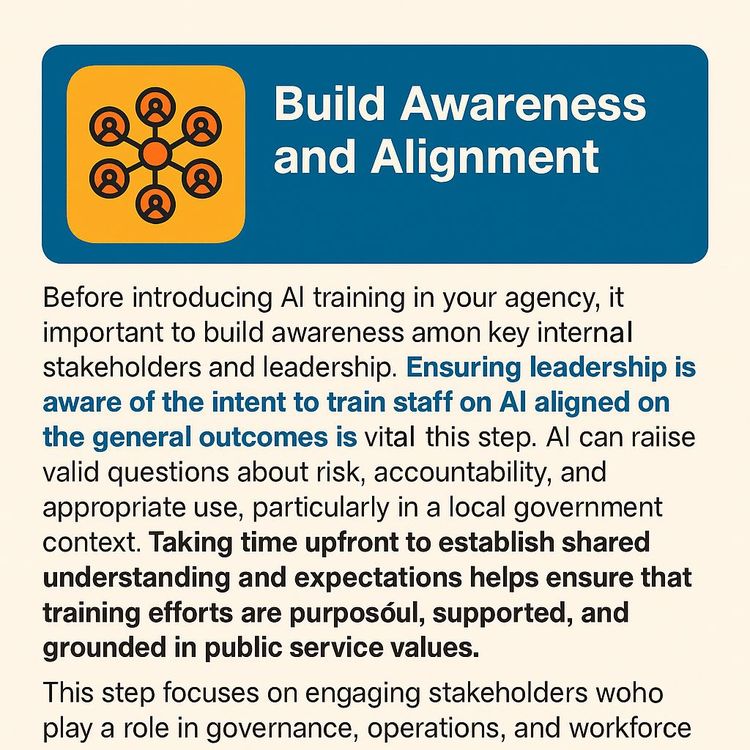
Also includes Access to All:
What You Will Learn
- Conduct workforce AI readiness surveys and stakeholder mapping
- Design tiered, role-based training from foundational to advanced
- Develop risk-aware, specific AI policies and approved-tool lists
- Create use-case repositories and knowledge-transfer assets
- Measure success by confidence, adoption, and policy compliance metrics
Study Guide
Introduction: Why This Course Exists
Let's be honest about something. If you're reading this, there's a decent chance you didn't ask for the job you're doing right now. Maybe you're a grant writer who asked one too many questions about artificial intelligence in a staff meeting. Maybe you're a project manager who mentioned ChatGPT once and suddenly became the "AI person." Maybe you're an innovation consultant who got handed a task that felt impossible. You're not alone in this. Across local government, there's a pattern that keeps repeating itself: employees without AI titles, without technical degrees, without any formal training, are being assigned responsibility for their agency's AI strategy. This course is built for you.
Here's what we're going to do together. We're going to walk through a field-tested playbook that was developed through the Gov AI Coalition's Training Working Group and refined through real implementation experience in municipal government. This isn't theory. It's not abstract. It's a practical, phased approach to building AI training capacity from the ground up, even when you have no idea where to start. By the end of this course, you'll know exactly how to assess your workforce's AI readiness, how to build a training program that actually meets people where they are, how to develop policies that protect your agency without paralyzing it, and how to measure success in ways that matter. You'll also discover a massive ecosystem of resources that means you never have to reinvent the wheel.
The core premise of everything we're about to cover is simple: AI readiness is not a technology problem. It's a people problem. And people problems require patience, empathy, and a willingness to move at a pace that feels sustainable. Let's get into it.
Section 1: The Accidental AI Officer Phenomenon
Let's start by naming the elephant in the room. There are roughly 30,000 cities, towns, and counties in the United States. Only a fraction of them have formal AI officers or dedicated AI programs. That leaves an enormous gap. And into that gap step people like you: employees who expressed curiosity, who asked questions, who showed even a glimmer of interest in what AI could do for their agency. One day you're asking questions. The next day you hear the words every accidental AI lead eventually hears: "You seem passionate about this. Do you want to take it on?"
Here's what's striking about this phenomenon. The people getting drafted into AI leadership come from surprisingly diverse backgrounds. They're grant writers who understand how to tell a compelling story about public value. They're project managers who know how to herd cats and keep things moving. They're field personnel who understand the operational realities that desk-bound planners never see. None of them have computer science degrees. Most of them have never written a line of code. And yet they're expected to lead their agency into an AI-enabled future.
This creates a very specific kind of pressure. You're expected to be the expert, but you don't feel like one. You're exposed to all the scary stuff , cybersecurity threats, data breaches, the possibility that one wrong call could expose sensitive constituent information. It feels heavy. It feels like, oh my gosh, could we be taken for ransom because I make the wrong call? But here's the thing you need to hear right now: this is not a one-person job. It never was. And the playbook we're exploring was created specifically for people in your position.
Let me share a bit of the origin story, because it matters. The playbook was born from the experience of a senior innovation consultant who found herself completely overwhelmed. She was drowning in information. Every day there was a new tool, a new threat, a new article about what governments should be doing with AI. And none of it was written for her. It was either too technical , full of machine learning jargon and computer science concepts , or it was too superficial, just vague platitudes about "embracing innovation." She needed something in the middle. She needed guidance that treated her like an intelligent person who just didn't happen to have a technical background. So she helped build that thing herself.
The playbook is explicitly designed for what we might call the "under the hood AI people." Not the engineers who build the models. Not the cybersecurity specialists who defend the networks. The people in the middle who need to discuss AI in practical, conversational terms. The people who need to translate between the highly technical teams and the general staff who just want to know what they can and can't do. If that sounds like you, you're in the right place.
Section 2: The Design Philosophy Behind the Playbook
Before we dive into the tactical stuff, you need to understand the philosophy that underpins everything. The playbook was built on five core design principles, and these principles will serve you well whether you're following the playbook exactly or adapting it to your own context.
Accessibility first.
This is the non-negotiable foundation. Everything in the playbook is written in plain language. No computer science jargon. No assuming prior knowledge. The goal is that someone with zero technical background can pick it up and feel like it was written for them , because it was. This matters more than you might think. In government settings, you're dealing with employees who range from completely AI-averse to wildly enthusiastic. If your training materials require a decoder ring to understand, you've already lost the people who need the most help.
Self-directed.
Here's a liberating thought: there is no single correct starting point for AI adoption. Some agencies begin with policy. Some begin with training. Some begin with identifying use cases. Some begin with a survey. The playbook doesn't force you down a prescribed linear path. You start where you want to start, based on your agency's context, readiness, and pain points. This flexibility is crucial because every agency is different. A small town with a staff of fifty has different needs than a major metropolitan city with thousands of employees.
Resource curation.
This is a big one. The playbook doesn't ask you to create anything from scratch. Instead, it compiles existing tools, templates, and resources from across the government AI ecosystem. The philosophy here is simple: there's no reason to reinvent anything when it comes to AI because people are already doing that work. Hundreds of agencies have already wrestled with AI policy. Thousands of practitioners have already created training materials. Your job is not to create from nothing. Your job is to find what already exists, adapt it to your context, and make it work for your people.
Practical grounding.
This playbook isn't academic. It's based on real implementation experience in Salt Lake City, Utah, and it's supported by the Gov AI Coalition, a network of roughly 900 agencies. That means the guidance has been tested in actual government environments, with actual employees, facing actual constraints. You're not getting theory from a consultant who's never set foot in a city hall. You're getting lessons from people who have lived this.
Risk-aware.
Finally, the playbook balances enthusiasm for AI with a sober understanding of data protection responsibilities. It doesn't pretend AI is risk-free, and it doesn't pretend the risks are insurmountable. It just acknowledges that you have a duty to protect constituent data, and your training programs need to reflect that duty.
These five principles , accessibility, self-direction, curation, practicality, and risk-awareness , are the lens through which everything else in this course should be viewed. Keep them in mind as we move through the phases.
Section 3: Phase One , Initiation and Alignment
So you've been handed the AI responsibility. Now what? The first phase of the playbook is all about building awareness and aligning stakeholders. Before you can train anyone, before you can write a policy, before you can do anything, you need to understand the landscape you're operating in.
The foundational question of this phase is simple: who are the key players you need to work with? And that's not as obvious as it sounds. You might immediately think of IT, and yes, they're important. But you also need to think about risk management. And legal. And leadership. And HR. And the departmental representatives who actually understand the operational work that AI might transform.
Here's the thing about stakeholders: different departments will have divergent views on AI direction, and that's not a bug, it's a feature. Legal teams focus on liability. What happens if an AI tool makes a decision that harms a resident? Who's accountable? IT teams focus on security. Can this tool be integrated into our existing infrastructure without creating vulnerabilities? Program staff focus on efficiency. Will this help me get my work done faster and better? These perspectives are all valid, and they will naturally come into tension. The initiation phase creates space for these perspectives to surface and align.
One of the first activities in this phase is understanding leadership's baseline knowledge of AI. This is critical, and it's often overlooked. You need to know what your leaders currently understand about AI's capabilities, its risks, and its potential applications in government. If your city manager thinks AI is just a fancy autocorrect, you have a different challenge than if your city manager is already using AI tools in their daily work. The Gov AI Coalition has resources to help leaders build this foundational understanding, and we'll get to those later.
You also need to clarify "the why" early and often. Why is your agency pursuing AI adoption? Is it to improve resident services? To address staffing shortages? To streamline internal processes? To keep pace with peer agencies? Whatever the reason, it needs to be articulated clearly and repeated constantly. Here's why this matters: without a clear "why," you get scope creep. Suddenly your AI initiative is trying to solve every problem in the agency, and you're drowning in competing priorities. The playbook emphasizes preventing this from the start. Write down your why. Share it with your stakeholders. Come back to it when things get confusing.
And finally, you need to secure a decision-maker champion. This is non-negotiable. You need someone with authority who can help move initiatives forward and make decisions when obstacles arise. As the playbook puts it: "A lot of decisions will have to get made, so you need to find who that person is who can help you get a decision over the finish line." This might be a department head. It might be a deputy city manager. It might be the city manager themselves. Whoever it is, they need to understand the importance of what you're doing and be willing to advocate for it when you hit roadblocks.
Let me give you a concrete example of why this matters. Imagine you've identified that your agency needs an enterprise AI tool, but procurement is dragging their feet because they've never purchased anything like this before. Without a champion, you're stuck in procurement limbo for months. With a champion, someone can make a call and say, "This is a priority, let's find a way to make it work." That's the difference a decision-maker champion makes.
Another example: you've developed a training program, but departments are resistant to releasing their staff for training because they're understaffed. A champion can help make the case that this training is essential, not optional, and that the short-term productivity cost is worth the long-term gain.
Section 4: Training as Risk Management
Here's an insight that will change how you talk about AI training with your leadership: AI training is not merely a professional development activity. It's a risk management function. This reframing is powerful because it shifts the conversation from "should we spend money on training?" to "how can we afford not to?"
Think about what happens when employees use AI tools without any training. They don't know what data they should and shouldn't enter into public tools. They don't understand the risks of sharing sensitive constituent information with a chatbot that stores and uses that data for training. They can't recognize AI-powered social engineering attempts because the scams have gotten so sophisticated. In other words, untrained employees are a liability. And training them is not an expense , it's an investment in reducing that liability.
So what does risk-focused training actually need to cover? The playbook identifies several key areas that go beyond simple policy compliance. First, basic prompting skills and effective AI usage techniques. Employees need to know how to actually use these tools productively. Second, understanding data risks when entering sensitive information into AI tools. This is the "what not to put in the chat box" training. Third, awareness of AI-powered social engineering threats , scams, phishing attempts, voice-cloning phone calls that sound exactly like your city manager. And fourth, practical know-how for developing AI use cases that align with policy and serve the public good.
Now, here's a counterintuitive point that the playbook makes, and it's one of the most important things you'll hear in this entire course. The people who are most excited about AI, the power users, the ones who are ready to build custom chatbots and automate everything , sometimes those are the people you should be most concerned about. As the playbook puts it: "The people that are ready to build robots, sometimes those are the ones that I'm most concerned about because I don't know if they're building the robots with the guardrails."
Let me unpack that. A novice employee who doesn't know anything about AI is a manageable risk. They're probably not going to do anything dangerous because they don't even know what's possible. But a highly skilled employee who is building AI applications without oversight? That's a different story. They have the technical capability to do something risky, and if they're not working within the guardrails, they could expose sensitive data, create biased systems, or make decisions that have real consequences. This is why some level of universal training is necessary regardless of skill level. You can't just say "the experts don't need training." The experts might need it the most.
Here's another example of training as risk management. Consider the AI-powered scam problem. In the past, you could spot a phishing email because of bad grammar, weird formatting, or obvious red flags. Those tells are disappearing. AI can now generate convincing emails, authentic-sounding voice messages, and even realistic video calls. As the playbook notes, "You don't have the same tells anymore. They're really hard to spot." A city employee who receives a call that sounds exactly like their department head asking for sensitive information needs to know that this is a potential scam. That's not technical training. That's awareness training. And it's essential for everyone.
Section 5: Assessing Workforce Readiness , The Role of Surveys
You can't build a training program that meets your workforce's needs if you don't know what those needs are. That's where surveys come in. The survey is the cornerstone of the playbook's assessment approach, and it's one of the first things you should do when you're getting started.
Let me give you a concrete example of what this looks like in practice. Salt Lake City conducted an internal citywide survey to assess AI readiness. They have a workforce of roughly 3,000 people, and they generated approximately 800 responses. That's a strong response rate for an internal survey, and it gave them a solid picture of what was happening across the organization.
What did they find? The results revealed a striking polarization. The majority of respondents had received no formal AI training at all. They were learning as they went, piecing together knowledge from articles, YouTube videos, and trial and error. But there was also a smaller group that identified as "power users" , people who were already experimenting with AI extensively and requesting advanced training on things like building chatbots. The gap between these two groups was enormous. You had people who didn't know what a prompt was, and you had people who were ready to build custom AI applications. Designing a single training program that serves both groups is impossible. You need tiers.
Here's the good news: you don't have to create your survey from scratch. The playbook includes survey templates, example questions, and guidance on crafting effective instruments. You can also use large language models to help draft survey questions. Just describe what you're trying to learn , current AI usage, training history, confidence levels, desired training topics , and ask the AI to generate a draft survey. Then edit it to fit your local context. This is a perfect example of the "don't reinvent the wheel" philosophy in action.
When you're designing your survey, think about what you actually need to learn. Here are some questions worth asking:
Are employees currently using AI tools in their work? If so, which ones? Have they received any formal AI training, or are they self-taught? How confident do they feel about using AI? What would they like to learn? What concerns or barriers are holding them back? Do they understand the agency's policy on AI use?
The answers to these questions will shape everything you do next. If you discover that most employees have never used AI and are nervous about it, your training program needs to start with foundational concepts and lots of reassurance. If you discover that a significant minority are already power users, you need advanced tracks for them. If you discover that nobody understands the policy, your policy training needs to be a priority.
One more thing about surveys: they're not a one-time event. The playbook emphasizes continuous assessment. You should be surveying employees before training, after training, and at regular intervals to track progress and identify emerging needs. AI is evolving rapidly, and your workforce's relationship with it will evolve too. Your assessment approach needs to keep pace.
Section 6: Policy Development and Delivery
Let's talk about policy. This is one of the areas where agencies often get stuck, and the playbook has some very practical guidance for getting unstuck.
The first piece of advice is simple: begin with existing templates rather than blank documents. The Gov AI Coalition offers policy and governance templates that have been used by hundreds of agencies. These templates have been tested, refined, and adapted across a wide range of government contexts. Starting from a proven template saves you weeks of work and helps you avoid common pitfalls. You can then customize the template to fit your agency's specific needs, data protection requirements, and operational realities.
The second piece of advice is a mindset shift: recognize that policies will become outdated quickly. The AI landscape is changing so fast that any policy you write today will need revision within a year, maybe sooner. This means the perfect policy is a myth. As one practitioner put it, "Perfect today is not going to be perfect tomorrow." So don't chase perfection. Get something in place, learn from it, and iterate.
This leads to the third piece of advice: start with a basic policy. Salt Lake City's first policy was relatively simple. It basically said: don't enter certain kinds of sensitive data into AI tools, use your work email rather than personal accounts, and follow common sense. That was enough to start. As they learned more, as employees provided feedback, and as use cases emerged, the policy evolved into something more comprehensive.
And here's an important implementation insight that emerged from employee feedback. When Salt Lake City surveyed their employees about what they wanted from AI policy, they got a surprising answer. As the playbook describes it: "Good city employees, they want to know exactly what tool I can use. What can I exactly do? Like they want specifics."
Now, this is interesting because there's a common assumption in the AI world that employees want freedom and flexibility. Give people open-ended permission and they'll figure it out. But in practice, many government employees want the opposite. They want clear guardrails. They want to know exactly which tools are approved, exactly what they can do with those tools, and exactly what's off-limits. This is especially true for employees who are risk-averse or anxious about making mistakes. Open-ended flexibility can feel like a trap. Specificity feels like safety.
This feedback led Salt Lake City to become more specific about approved tools and use cases as the policy matured. Instead of saying "employees may use AI tools in accordance with this policy," they started saying "these specific tools are approved for these specific use cases, and here's how to access them." That level of specificity reduced anxiety and increased adoption.
Let me give you an example of what this looks like in practice. Instead of a policy that says "employees may use generative AI for work purposes," a more specific policy would say: "Employees may use [Approved Tool A] for drafting emails, summarizing documents, and generating first drafts of reports. Employees may not use [Approved Tool A] for [specific prohibited use cases]. The following data types may never be entered into any AI tool: [list of prohibited data types]." See the difference? The specific policy gives employees a clear mental model of what they can and can't do.
Another example: instead of saying "employees must protect sensitive data," a specific policy would list exactly what counts as sensitive data in your agency , constituent personal information, medical records, financial data, personnel files, confidential legal communications, and so on. This removes ambiguity and makes compliance easier.
Section 7: The Training Delivery Spectrum
Now we get to the heart of the playbook: how to actually deliver training. The playbook outlines a tiered approach that recognizes different employees have different needs. Not everyone needs the same training, and pretending otherwise is a waste of everyone's time.
Tier 1: Foundational Policy Training.
This is the baseline. It's required for employees with work-issued computers, and it focuses on responsible AI use, approved tools, and prohibited data types. It covers risk awareness: what not to enter into public AI tools, what the policy says, and why it matters. This training is essentially your risk management function in action. It ensures that every knowledge worker in your agency understands the basic rules of the road.
Tier 2: Skill-Based Training.
This tier is optional but encouraged. It includes lunch-and-learns, workshops, and hands-on sessions that develop practical skills. The focus here is on prompting techniques, productivity use cases, and getting real value from AI tools. The playbook emphasizes that these sessions should be interactive rather than passive. Nobody learns to use AI by watching a recorded video. They learn by doing, by experimenting, by making mistakes in a safe environment. So your skill-based training should be designed for active participation.
Tier 3: Advanced and Role-Specific Training.
This tier is for specific groups with specialized needs. Attorneys might need training on AI for legal research and document review, with a focus on confidentiality. Public safety personnel might need training on AI for incident reporting and evidence analysis, with a focus on chain of custody and accuracy. Technically advanced users might need training on building custom GPTs and specialized AI assistants. The playbook also mentions knowledge management applications , helping departments build internal policy assistants or knowledge bases that make institutional information more accessible.
Tier 4: Leadership and Officials Training.
Finally, you need to ensure your decision-makers understand AI fundamentals. This includes elected officials and council-level engagement. The playbook provides materials designed specifically for this audience. Why is this important? Because leaders make policy decisions that affect the entire agency. If your city council doesn't understand what AI can and can't do, they might pass regulations that are either too restrictive or not restrictive enough. Leadership training supports informed policy decisions at the governance level.
Now, here's a critical point about who actually needs training. The playbook emphasizes that not all employees need the same training , and some might not need any desktop AI training at all. Consider field workers who are not assigned computers and rarely check email. Do they need to know how to craft a prompt? Probably not. But do they need awareness of AI-powered scams? Absolutely. Anyone can be susceptible to sophisticated social engineering, regardless of whether they use a computer in their daily work.
So your training strategy should be differentiated. Knowledge workers who spend their days on laptops need the full spectrum. Field workers who are rarely in front of a screen need targeted awareness training. Executives need leadership-level education. The key is to match the training to the role.
Section 8: Use Cases and Knowledge Sharing
Let's talk about use cases. This is where AI stops being abstract and becomes concrete. A use case is simply a documented example of how AI is being used in your agency , what problem it solves, what tools are involved, what prompts are used, and what risks are associated with it.
The playbook emphasizes building a use case repository and learning from peer agencies. This serves multiple purposes. It creates institutional knowledge that survives staff turnover. It provides examples that other departments can learn from and adapt. And it can serve as a transparency tool that builds public trust.
Let me give you some concrete examples. The City of Long Beach, California maintains a public-facing use case registry. Anyone can go and see how the city is using AI , what tools, what purposes, what data is involved. This is a powerful transparency tool. It shows residents that the city is using AI responsibly and gives them visibility into how their tax dollars are being spent on technology. It also serves an educational function, helping other agencies see what's possible.
Salt Lake City is building a different kind of repository. They're using SharePoint to create an internal use case database. Each entry includes the specific use case, example prompts, and associated risk information. So if someone in the public works department wants to try using AI for report generation, they can search the repository, find a relevant use case, see how it was done, understand the risks, and replicate it in their own context. This dramatically lowers the barrier to adoption.
And here's one of the most powerful applications the playbook highlights: knowledge transfer. Think about the aging workforce in government. Many agencies have experienced staff who are nearing retirement, and they're about to walk out the door with decades of institutional knowledge. Some of these veteran employees are using AI to capture that knowledge before they leave. As the playbook describes it: "Some of our inspection staff... are building their own knowledge base on AI and then sharing it with their incoming staff as a way almost as knowledge transfer."
Let me give you a specific example of how this works. Imagine a senior building inspector who has 30 years of experience. They know every code, every common violation, every trick for spotting problems that less experienced inspectors would miss. Before they retire, they work with an AI tool to build a knowledge base. They feed it their expertise , the codes, the common issues, the inspection workflows, the tips and tricks. They create a chatbot that can answer questions from new inspectors. When they retire, their knowledge doesn't retire with them. It's embedded in a tool that their successors can use.
This transforms AI training from a compliance exercise into an institutional asset. It's not just about teaching people to use a tool. It's about preserving organizational wisdom. And it's a compelling story to tell leadership when you're making the case for AI investment.
Section 9: Measuring Return on Investment
At some point, someone is going to ask you: what's the return on investment for all this AI training? And if you try to answer with traditional efficiency metrics alone, you're going to struggle. Time saved, faster turnaround, fewer errors , these are important, but they don't capture the full picture.
The playbook makes a compelling argument for expanding how we think about ROI. It emphasizes "comfort level with AI as a part of return on investment." This might sound soft, but it's actually deeply practical. Think about it: if an employee is afraid to use the technology they have access to because they don't know enough or haven't been trained, that's not efficient government. The tool is sitting there, licensed and paid for, and the employee is avoiding it because they're scared. Training that moves an employee from fear to familiarity has real economic value, even if it doesn't show up in a traditional time-saving metric.
So what does meaningful measurement look like? The playbook suggests several approaches. First, pre- and post-training confidence assessments. Ask employees how confident they feel about using AI before the training and after the training. The change in confidence is a measurable outcome. Second, adoption rates among previously hesitant employees. Are people who never touched AI tools starting to experiment with them? That's progress. Third, understanding of permissible versus prohibited uses. Do employees actually understand the policy after training? Can they articulate what they can and can't do? Fourth, movement along a continuum from fear to familiarity. Even employees who choose not to use AI after training represent progress if they now understand the tool and have made an informed decision.
Let me give you an example of what this looks like in practice. An employee attends your foundational AI training. Before the training, they rated their confidence at 2 out of 10. They were nervous about doing something wrong, about breaking policy, about looking foolish. After the training, they rate their confidence at 6 out of 10. They still don't use AI in their daily work , they haven't found a use case that fits their role. But they understand what the tool is, what it can do, and what the rules are. If you measure ROI only by adoption, you'd call this training a failure. But if you measure ROI by understanding and confidence, it's a success. The employee is no longer a risk factor. They're not going to accidentally expose sensitive data because they don't know better. And when a use case does emerge in their department, they'll be ready to engage with it.
Here's another example. A department head was skeptical about AI. She attended a leadership training session and came away with a better understanding of both the possibilities and the risks. She still hasn't implemented AI in her department, but she's stopped blocking her staff from experimenting with it. That's a measurable outcome. The training changed her posture from obstruction to permission.
The playbook's message is clear: don't limit your ROI measurement to time saved. Measure confidence. Measure understanding. Measure informed decision-making. These are the leading indicators that will eventually produce the lagging indicators of efficiency and cost savings.
Section 10: The Resource Ecosystem
One of the most valuable things this playbook does is curate the resources that already exist in the government AI space. This reflects the principle that "there's no reason to reinvent anything when it comes to AI because people are already doing that work." Let me walk you through the key resource categories.
Governance frameworks.
The Gov AI Coalition offers policy and governance templates that have been adopted by hundreds of agencies. There's also the NIST AI Risk Management Framework, which provides a structured approach to managing AI-related risks. These frameworks give you a solid foundation without requiring you to start from scratch.
Training materials.
There are excellent existing courses and training resources. "Responsible AI for Public Professionals" is a tool-agnostic course that teaches the fundamentals without tying you to a specific vendor. Apolitical offers courses with an international perspective, which can be valuable for understanding different approaches to AI risk tolerance. These resources can be integrated into your training program rather than having to create everything yourself.
Policy examples.
Many coalition member agencies have published their AI policies, and these are available as reference materials. You can see how different agencies have handled data protection, tool approval, and use case governance. This is incredibly valuable when you're developing your own policy.
Use case registries.
The City of Long Beach maintains a public-facing registry, and other coalition members have similar resources. These provide concrete examples of how AI is being used in government, which can spark ideas and inform your own use case development.
Organizational networks.
This is where the power of community comes in. The Gov AI Coalition has roughly 900 member agencies. City AI Connect is a West Coast-oriented network. RIDDA is an international organization. These networks connect you with peers who are facing the same challenges you are. You can ask questions, share lessons, and learn from each other's mistakes.
Municipal toolkits.
The National League of Cities offers practical toolkits, including "Demystified AI" and resources on training municipal staff. These are designed specifically for local government audiences and are accessible to non-technical readers.
The playbook also notes that the Gov AI Coalition produces a related series of playbooks. The current playbook focuses on using external resources and building foundational training. The next playbook covers custom program development , building your own internal education and training plan. A subsequent playbook covers advanced topics like AI agents and custom GPTs. So as your agency matures in its AI journey, there are resources to support you at each stage.
Here's my advice: before you create anything, spend a week exploring what already exists. Join the Gov AI Coalition if you haven't already. Look at policy templates. Browse use case registries. Take a free online course. You'll quickly discover that the ecosystem is rich with resources, and your job is to curate and adapt, not create from nothing.
Section 11: The Human Element , Generational and Learning Differences
Let's talk about the people you're training. Because here's the reality: today's government workforce spans at least four to five generations, and each generation has a different relationship with technology.
Consider the older workers in your agency. They've navigated the transition from typewriters to word processors, from paper files to networked computers, from landlines to smartphones, from the early internet to cloud computing. They've had to learn new technology over and over again for their entire careers. Some of them are experiencing what we might call "technology fatigue." They're tired of learning new tools. They've seen technology promises come and go. And now you're asking them to learn AI. You need to meet them where they are, with patience and support.
Now consider the younger workers. Many of them encountered AI in educational settings. They've used ChatGPT to write essays, to brainstorm ideas, to help with homework. They approach AI with more confidence. But here's the catch: confidence isn't the same as competence. They might be comfortable with consumer AI tools but completely unaware of the data protection requirements that apply in a government context. They might not understand that you can't paste a resident's personal information into a public chatbot. So their training needs are different from older workers' needs.
And then there are the mid-career professionals, the ones in the middle. They might be initially resistant to AI, worried that it will make their skills obsolete. But when they combine their deep expertise with AI tools, they can become powerful advocates. The playbook notes that agencies that invest in training veteran staff , those with 30 to 35 years of experience , often see remarkable results. These experts identify valuable use cases that younger workers would never think of because they understand the operational context so deeply. They become champions of AI adoption.
The playbook also emphasizes that different learning styles require different training formats. Some people learn by reading. Some learn by watching. Some learn by doing. Some need to have their hand held a little, and the playbook positions this as a legitimate and important training need. There's no shame in needing extra support when learning a complex new technology. In fact, agencies that create space for questions people are embarrassed to ask tend to see better outcomes than agencies that just push out training videos and hope for the best.
Here's the guiding principle: "With AI, the priority really needs to be moving employees along with us. Not forcing... it's okay, let's just move slowly together." This is so important. If you try to force AI adoption, you'll create resistance and resentment. If you move at a pace that respects people's comfort levels, you'll build trust and momentum.
Let me give you an example. In one agency, there was a senior employee who was deeply skeptical of AI. She'd been burned by technology changes before and didn't see why this would be any different. Rather than forcing her into training, the AI lead took a different approach. They had a conversation. They listened to her concerns. They acknowledged that AI wasn't going to solve every problem and that her skepticism was understandable. Then they showed her one specific use case that addressed a pain point she'd been complaining about for years , a tedious reporting process that ate up hours of her week. They demonstrated how AI could draft a first version of the report in minutes. She was still skeptical, but she was curious. She agreed to try it on one report, with the understanding that she could reject the AI's output entirely. That single experiment changed her mind. She's now one of the strongest advocates for AI in her department.
That's what moving employees along with you looks like. It's not about forcing. It's about listening, finding the right use case, and letting the value speak for itself.
Section 12: Practical Implementation Guidance
Let's get practical. Here are the common pitfalls to avoid and the lessons that have emerged from real implementation experience.
Pitfall one: Going too fast.
Everybody wants to go real, real fast. There's pressure to show progress, to demonstrate that the agency is "doing something" about AI. But going too fast leads to poor decisions. You might adopt a tool that doesn't fit your needs. You might implement a policy that creates more problems than it solves. You might roll out training that misses the mark because you didn't take time to understand your workforce. The playbook's advice is direct: go at the pace you're comfortable with. Moving deliberately is not the same as moving slowly. It's moving wisely.
Pitfall two: Overlooking HR.
Your HR department needs to be involved early. They can help you navigate questions about required training designations, staff workload concerns, and how to integrate AI training into existing professional development frameworks. If you leave HR out, you'll hit speed bumps that could have been avoided.
Pitfall three: Assuming one training fits all.
We've already covered this, but it bears repeating. Different departments, roles, and generational groups have different needs. A one-size-fits-all approach will leave most people either bored or lost. Use the tiered approach we discussed.
Pitfall four: Neglecting security awareness.
AI-powered scams are increasingly sophisticated. Voice cloning, convincing phishing emails, deepfake videos , these are real threats that every employee should know about. Don't assume people can spot them. The tells are gone. You need explicit awareness training.
Pitfall five: Ignoring the communication gap.
Technical experts often struggle to communicate with non-technical staff. They use jargon. They make assumptions. The playbook provides language and approaches that bridge this gap. The goal is to talk about AI in a casual, accessible way, not in a computer science way or a cyber angle.
Now let's talk about some positive lessons from implementation. Start with low-stakes internal use cases. Test AI on internal, lower-risk workflows before anything that touches the public. This reduces risk and allows for learning. Build an internal pilot. If you don't have use case data because few employees are using AI, a controlled pilot can generate that foundational documentation. Collect feedback continuously. Employee feedback on policy clarity and training effectiveness should drive iterative improvements. And embrace case study documentation. Write up your implementation experiences , both successes and failures , and share them with the broader public sector community. Your lessons can help other agencies avoid your mistakes.
Section 13: Action Items for Every Stage
Let me give you concrete actions depending on where your agency is in this journey.
If you're just beginning:
First, identify a champion. Designate someone , even part-time , to coordinate AI training efforts. Ideally this is someone who can relate to both novices and power users. Second, conduct a workforce survey. Assess current AI usage, training history, interest levels, and confidence. Draft questions with the assistance of an LLM, then customize for your local context. Third, review existing resources. Before creating anything new, examine the targeted resources from the Gov AI Coalition, National League of Cities, and peer agencies. Fourth, establish a baseline policy. Adopt a basic use policy quickly. You can refine it later. Fifth, secure a decision-maker sponsor. Find a leader who can help move initiatives forward and make decisions when obstacles arise. Sixth, start with universal awareness training. Provide brief scam-awareness education for all staff, regardless of computer access.
If you're one to two years into implementation:
Formalize your training tiers. Differentiate between required policy training for knowledge workers and optional skill-based training. Consider departmental-specific training for specialized roles. Build a use case repository. Catalog internal AI applications with example prompts and risk notes. Consider making it public for transparency. Measure confidence. Implement pre/post training assessments to track comfort levels and understanding, not just completion rates. Engage veteran employees. Actively recruit staff with 30-plus years of experience to test AI tools. Their institutional knowledge makes them uniquely positioned to identify valuable applications. And address the advanced user risk. Develop oversight mechanisms for employees building advanced AI applications to ensure guardrails are maintained.
If you're operating at scale:
Publish case studies. Institutionalize a culture of sharing implementation experiences, including successes and failures. Maintain updated policy templates. Given how quickly AI evolves, review your templates on a defined schedule. Expand interagency networks. Support multiple complementary networks to reach the more than 30,000 municipalities not yet participating in AI coalitions. And capture both short-term and long-term metrics. Measure interim indicators like comfort and adoption alongside longer-term outcomes like time saved and resident satisfaction.
Section 14: The Bigger Picture
Let's step back and look at the bigger picture. Why does all of this matter? Because AI is transforming government operations, whether agencies are ready or not. Employees are already using AI tools , personal accounts, free versions, whatever they can access. The question is not whether your agency will engage with AI. It's whether that engagement will be intentional and governed, or chaotic and risky.
The playbook's fundamental insight is that AI training in government must start with people, not technology. It's about building confidence, understanding, and capability from the ground up. It's about recognizing that the accidental AI officers , the people who asked too many questions and got assigned the tasks , are not a problem to be solved. They're an asset to be supported. They're the people who care enough to ask questions, who are passionate enough to take on an impossible task, who are willing to learn in public and figure things out as they go.
The playbook validates their experience. It tells them: you are not alone. The path has already been charted. The resources are available. And the approach is tested. You don't need to be a computer scientist to lead AI adoption in your agency. You need to be a people person, a coordinator, a communicator, and a curator. You need to be someone who can listen to your workforce, understand their needs, and connect them with the tools and training that will help them serve the public better.
One more thing about pace. There's enormous pressure in the AI space to move fast. Vendors want you to buy their products. Consultants want you to hire them. Leadership wants to see progress. But the playbook holds a clear message: everybody wants to go real, real fast, but honestly, the advice is to go at the pace you're comfortable with, because you can make some wrong decisions if you go too fast. This is not a race. It's a marathon. The agencies that thrive will be those that invest in their people first, building a foundation of understanding and trust that can support whatever technological changes come next.
Conclusion: Your Next Steps
We've covered a lot of ground in this course. Let me leave you with the key takeaways that matter most.
Frequently Asked Questions
Certification
About the Certification
Become certified in AI Training for Local Government Teams. You'll gain the skills to build practical AI training, write usable policies, manage risk, and move coworkers and leaders forward,no technical background needed.
Official Certification
Upon successful completion of the "Certification in Implementing AI Training for Government Teams", you will receive a verifiable digital certificate. This certificate demonstrates your expertise in the subject matter covered in this course.
Benefits of Certification
- Enhance your professional credibility and stand out in the job market.
- Validate your skills and knowledge in cutting-edge AI technologies.
- Unlock new career opportunities in the rapidly growing AI field.
- Share your achievement on your resume, LinkedIn, and other professional platforms.
How to complete your certification successfully?
To earn your certification, you’ll need to complete all video lessons, study the guide carefully, and review the FAQ. After that, you’ll be prepared to pass the certification requirements.
Other AI Video Courses
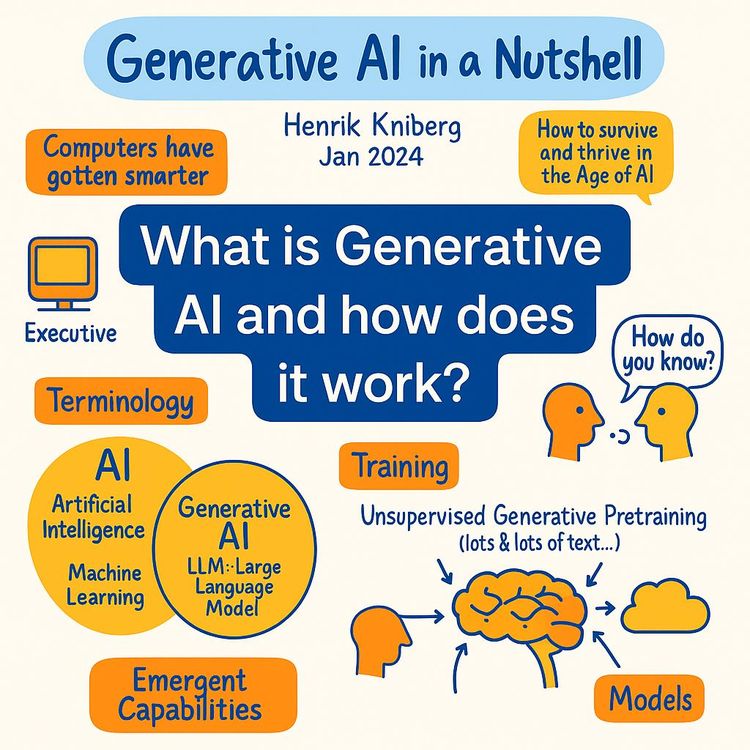
Video Course: What is Generative AI and how does it work?
Video Course: How to Use ChatGPT from Beginner to Professional
Video Course: How to Use Google Gemini for Google Workspace to Boost Productivity

Video Course: How to Use Claude 3.7 AI - Tips for Beginners!
Video Course: ChatGPT for Data Analytics: Full Course - from Beginners to Professional

Video Course: Generating Images and photos With ChatGPT?

Video Course: Generating Images & Photo's with MidJourney
Video Course: Generating Design's with Microsoft Designer and AI
Video Course: Generating Design's with Canva.com and AI
Join 20,000+ Professionals, Using AI to transform their Careers
Join professionals who didn’t just adapt, they thrived. You can too, with AI training designed for your job.