Build a Profitable One-Person Business with Claude (Video Course)
Build a real, revenue-generating business solo by directing AI agents instead of grinding alone. This 5-hour course gives you a proven five-stage pipeline to validate ideas, ship fast, close clients, and scale without a team. No hype, just repeatable systems.
Related Certification: Certification in Launching Profitable One-Person Businesses with Claude
Also includes Access to All:
What You Will Learn
- Orchestrate AI agents (Code, Design, Dispatch) to replace teams and execute complex tasks.
- Use AI-driven discovery, Reddit social listening, and competitive gap analysis to validate ideas.
- Ship MVPs rapidly with design-first workflows, parallel sub-agents, and concise product briefs.
- Automate content, voice analysis, and outreach via a Second Brain and scheduled distribution.
- Close clients with AI-crafted proposals, a repeatable five-step sales pipeline, and tiered offer stacks.
- Scale from founder to CEO by systemizing work, delegating (80% rule), and working on the business.
Study Guide
Here is a comprehensive, in-depth course on building a one-person AI business with Claude. It's structured as a complete learning guide, written in a natural, conversational tone, and covers every point from the briefing and study guide in detail. --- # Start a One Person Business with Claude: The Complete Execution Guide Welcome. You're about to learn one of the most valuable skill sets of the modern era: how to build a real, revenue-generating business as a solo founder, not by working harder, but by directing an AI-powered workforce. This course is a complete blueprint. It's not about theory or hype; it's about the exact, repeatable systems you need to find a validated idea, build a product, market it, close clients, and scale,all by yourself, but with the power of a full team behind you. The central premise here is that traditional barriers to entrepreneurship are gone. You don't need a technical co-founder, a marketing agency, or a design team. You need a new kind of operational skill: the ability to orchestrate AI agents. This guide will show you how. The insights here are drawn from a modern, execution-focused methodology that leverages the Claude ecosystem,Code, Design, Dispatch, and more,to replace entire departments with a single, intelligent system that you manage. We'll walk through a proven five-stage pipeline: Discovery, Build, Distribution, Monetization, and Scaling. This isn't just about tools though. We'll cover the crucial mindset shifts, like moving from being a builder to being a manager, and from working *in* your business to working *on* it. By the end, you'll have a complete operational manual for building what we call an "AI-Orchestrated Enterprise." --- ### Module 1: The New Entrepreneurship Paradigm Let's start by understanding the massive shift happening in the world of work and business. The idea of a one-person business is not new, but what's changed is its ceiling. For decades, a solo founder was limited. You could only do so many hours of client work, write so much code, and handle so much customer service. To grow, you had to hire. Hiring means overhead, management, and dilution of your vision. But that's all changed. Now, a single person can execute at a level comparable to a well-funded startup. The tools are no longer simple chatbots that answer questions. They are autonomous agents that can plan, reason, and execute complex tasks across multiple domains. This is the core of the new paradigm: you aren't just using AI; you're managing it. #### The Three-Pillar Ecosystem To make this concrete, let's look at the core infrastructure of this new business model. It revolves around three powerful agents that work in concert. **The Code-First Agent (e.g., Claude Code): The Worker** This is the engine of your operation. It's not just a code generator; it's an autonomous software engineer. This agent can: - **Plan and Reason:** You give it a high-level goal, like "build a customer portal," and it breaks it down into logical steps, anticipates problems, and designs solutions. - **Navigate Entire Codebases:** It reads and understands thousands of files, making it effective on both greenfield projects and existing, messy codebases. - **Write, Execute, and Iterate:** It writes files, runs terminal commands to test its own work, identifies errors, and fixes them without needing you to hold its hand. - **Manage Sub-Agents:** This is the superpower. It can spawn multiple instances of itself to work on different parts of a problem simultaneously. For example, when building a complex web app, you could have one sub-agent handle the backend API routes, another design the database schema, and a third build the front-end components. They all share context and report back to the main agent, who then integrates their work into a cohesive whole. This concurrency compresses a week of solo development into a single, focused day. **The Design Agent (e.g., Claude Design): The Creative Director** This is your designer, available on demand. It transforms conversational prompts into polished, visual outputs. Need a landing page? Describe it. Need a pitch deck? Provide the content. Need UI prototypes for a mobile app? Just talk it through. The magic here is in the handoff. Instead of creating designs that a developer then has to painstakingly recreate, you can hand the design agent's output directly to the code agent. It will translate the visual design into production-grade front-end code. This is a game-changer. It saves hours of "make the button a little more blue" iterations and basically removes the need for tools like Figma or Canva in many workflows. **The Remote Command Agent (e.g., Claude Dispatch): The Supervisor** This is your connection to the office, from anywhere on your phone. This tool lets you delegate tasks to your computer and have them executed even when you're away. Imagine you're on the couch with your phone. You can send a message: "Run the content generation skill on last week's YouTube transcript and stage the results for my review." The agent will then log into your desktop environment, interact with your files and applications, execute the task, and have everything waiting for you when you sit down. This effectively provides you with a remote employee that is always on, always ready, and can work while you sleep. It's a critical component for scaling because it untethers you from your desk. --- ### Module 2: Stage 1 - Discovery: Finding the Validated Idea The biggest mistake most aspiring entrepreneurs make is building something nobody wants. They fall in love with an idea or a technology, spend months building, and then find zero demand. This course is built on a different principle: data over assumptions. The Discovery stage is about using AI to de-risk the entire process. We're not guessing; we're doing targeted market research. You need to validate that a problem exists, that people are actively seeking a solution, and that existing solutions are flawed in a way you can exploit. #### AI-Powered Ideation The process starts with a structured prompt to your AI research engine (Claude Code). You don't just ask "What business should I start?" Instead, you provide context: your target market, their potential pain points, your budget, and any constraints. The agent then browses the web, synthesizes information, and returns a ranked list of business ideas, complete with reasoning. Crucially, you instruct it to deliver this as a polished HTML file, not a simple text response. This transforms raw research into a professional-looking report instantly. You're not just getting ideas; you're getting a synthesized analysis of market opportunities, ready to be reviewed. #### Social Listening on Reddit Once you've identified a top idea, the next step is to dive deep into the community. The instruction is simple: find five Reddit communities where your target customers hang out and complain about the problem you're solving. Reddit is a goldmine for market research because of its anonymity. People are brutally honest there. They don't sugarcoat their frustrations. This is where you find the unfiltered "voice of the customer." Claude Code will: 1. Search for relevant subreddits. 2. Identify the most upvoted posts and comments related to your specific problem. 3. Extract the exact language, phrases, and sentiments people use. This isn't just about validating demand; it's about collecting marketing copy. When you know the exact words your prospects use, you can craft messaging that resonates instantly. You're not speaking at them; you're speaking *in their language*. #### Competitive Gap Analysis You've found a problem, but you're almost certainly not the first to see it. So, who else is solving it? Your AI agent now researches your competitors. It will: - List the main players in the space. - Analyze their pricing structures and business models. - Scrape reviews from platforms like G2 or Trustpilot. - Identify the top three complaints users have about each major solution. The key insight here is the **Gap**. The space between what competitors are offering and what users are complaining about is where your product should live. If your competitors are fast but expensive, your product can be slower but affordable. If they are feature-rich but complex, your opportunity is a simple, user-friendly version. You're not building a "me-too" product; you're building *the solution* to the problem everyone is complaining about. #### Remote Orchestration This entire research phase can be managed from your phone using the Dispatch tool. You can initiate a research task, monitor its progress, and assign follow-up actions without being in front of a computer. What used to take a full week of manual research can be accomplished in a focused two-hour AI session, completely operated from your couch. This is the power of remote execution. --- ### Module 3: Stage 2 - Build: Creating the MVP at Light Speed You have a validated problem and a clear gap in the market. Now, the goal is to build a functional product fast. The keyword is **MVP: Minimum Viable Product**. It's not about perfection; it's about creating a tool that is just good enough to test your core hypothesis with real users. #### Speed Over Perfection The philosophy is uncompromising. Resist the urge to add features. Every hour you spend on a "nice-to-have" feature is an hour you're not putting your product in front of real customers. A mediocre product in the market is infinitely more valuable than a perfect product in a folder. Use AI to ship at a pace that would be impossible otherwise. Let the AI write the code,it's faster, and it doesn't get bored. #### Design-First Development Before a single line of code is written for user-facing features, start with design. Use the Design agent to create: - Full UI prototypes. - Landing page layouts. - Dashboard designs. - Core user flows. This is a conversation, not a design exercise. You describe what you want, and it generates visual options. This eliminates the messy back-and-forth of traditional design. Once you're satisfied with the visual prototype, you hand it off to the Code agent. It then produces the production front-end code that matches your approved design exactly. This single workflow saves an enormous amount of time and frustration. #### Parallel Development with Sub-Agents For complex applications, you need to build in three dimensions simultaneously. This is where the Code agent's sub-agent feature becomes critical. Let's say you're building a software-as-a-service (SaaS) dashboard. You can instruct the main agent to spin up three sub-agents: 1. **Sub-Agent A (Backend):** Its task is to build the API endpoints, handle the database queries, and set up authentication. 2. **Sub-Agent B (Database):** It's responsible for designing the data schema, creating the models, and writing migrations. 3. **Sub-Agent C (Frontend):** It's taking the approved UI design and turning it into React components, connecting them to the API. All three agents share context in a unified logic or "brain," ensuring they don't create conflicts. The main agent acts as an orchestrator, integrating their work and ensuring the final product is cohesive. This parallel architecture collapses a week of solo development into a single day. #### The Power of the Product Brief There is a simple best practice that will double the quality of your AI build sessions: provide a product brief. Before you ask Claude Code to start writing code, give it a two-paragraph brief that covers: - What the app does and the problem it solves. - Who the target user is. - The tech stack you want to use. - The specific goal for the *current* build session. This simple context prevents the AI from making incorrect assumptions and ensures it's aligned with your vision from the very beginning. --- ### Module 4: Stage 3 - Distribution: The Automated Marketing Engine Many founders build a product and *then* ask "how do I market it?" That's backwards. The moment you start coding, you should be posting on social media. This is "building in public," and it's a powerful lead-generation strategy. You're building an audience and creating anticipation for a product that might not even be finished yet. The marketing stage isn't about just posting randomly; it's about building a system that generates content and distributes it automatically. #### The Automated Content Pipeline The goal is to turn a 45-minute daily chore into an 8-minute review process. Here's the workflow: 1. **Inputs:** You provide two things. First, a knowledge base (often a Google Doc) containing your best-performing past posts, LinkedIn contributions, and YouTube scripts. Second, a voice memo (transcribed with a tool like WhisperFlow) or a few bullet points about what you've been building or learning this week. 2. **AI Processing:** Claude Code analyzes the voice memo against your knowledge base and generates a suite of content, including: - Three different posts for X (Twitter). - A professional LinkedIn post. - A short-form video script for Instagram Reels or YouTube Shorts. - Visual assets are generated in Claude Design for social posts and thumbnails. 3. **Distribution:** This content is then auto-posted via APIs. Your AI agent can generate the posts and schedule them on the platforms for you. 4. **Review:** You don't have to write a single word. Your only job is to review and approve the generated content. This entire pipeline transforms marketing from a soul-destroying grind into a simple management task. #### Building the "Content OS" and Your "Second Brain" To make this automated pipeline work, you need a structured system. This is where the "Second Brain" comes in. The architecture is: - **Storage (e.g., Obsidian Vault):** A folder structure that organizes your content and knowledge. This is your Creative "Operating System." - **AI Manager (e.g., Claude Code):** The agent that processes, creates, and manages the content within that vault. The vault has specific folders: - **Inbox:** Where new long-form content (scripts, transcripts) is dropped. - **Voice:** Where your scraped social media data, organized by platform, is stored. - **Library:** Where long-form assets like YouTube video scripts are kept. - **Repurpose:** Where the AI-generated short-form content is saved, organized by platform. - **Skills:** Where reusable AI skill definitions are stored as files. - **Meta:** For system configuration files like the main `claude.md` file. This file, `claude.md`, is crucial. It lives in the vault's root and tells the AI agent: - Who you are and what your business does. - The map of the vault (what each folder is for). - Rules for how to interact with the second brain. This turns your note-taking app into a powerful content production engine. #### Voice Analysis A major challenge with AI-generated content is that it can sound robotic and generic. To fix this, you use AI to analyze your own voice. The process involves: 1. **Scraping:** Use MCP servers (like Apify) to scrape your existing content from social platforms like Instagram, LinkedIn, and X. 2. **Storing:** Save all this content as markdown files in the "Voice" folder of your second brain. 3. **Analyzing:** Instruct Claude Code to analyze this content and create a "Voice Analysis" document that decodes your writing style. It will identify your hook patterns, your sentence rhythm, recurring themes, and signature phrases. Once this document is created, every piece of content the AI generates for you will be filtered through your "voice." It will sound like you. Even if you're starting from zero, you can add the content of creators you admire and ask the AI to emulate that style, creating a distinct brand voice from day one. #### Automated Outreach For B2B businesses, marketing isn't just content; it's direct outreach. Claude Code can run a personalized outreach pipeline. Given your Ideal Customer Profile, your offer, and your target tone, the AI will draft: - Personalized DMs for social media. - Email sequences for cold outreach. - Follow-up messages. It can store all of this in a simple, copy-paste UI. This removes the "blank page" problem from sales and ensures you're consistently reaching out to potential clients. --- ### Module 5: Stage 4 - Monetization: Closing Clients and Winning Proposals This is where your effort turns into revenue. This stage is about converting interest into paying clients and delivering on your promise. #### The AI-Assisted Proposal For high-ticket clients, a simple Word document proposal is a liability. It doesn't convey competence. Using Claude Co-Work (the proposal and sales agent), you can create proposals that close. The process is simple: you feed it the transcript from a sales call. It synthesizes the client's needs and, using branding and system architecture diagrams from the Design agent, generates a polished, branded slide deck proposal. A specific example: A client expects to spend $60,000 to solve a problem. You present a $2,000 proposal that looks better than their own company's internal deck. The perceived value instantly skyrockets. The clients have a "wow" moment because they see the expertise and professionalism in the sales document itself. This isn't just a proposal; it's a powerful sales tool that creates a significant competitive advantage. #### The Five-Step Client Pipeline Success in sales isn't about being a smooth talker; it's about having a repeatable system. Here is the five-step pipeline you'll use: 1. **Identify Pain:** Use AI to research what costs businesses money. This isn't about identifying "needs" but about finding expensive problems worthy of solving. Focus on quantifiable outcomes, like saving hours or preventing client churn. 2. **Create a Minimal Viable Offer (MVO):** Before you build anything, define your **MVO**. This is a testable service spec. It must clearly state: - Who the target audience (ICP) is. - The specific problem you're solving. - A clear list of deliverables. - Your pricing. - The delivery timeline. 3. **Outreach:** Get in front of the right business owners. Start with your personal network. Know a barber with a bad website? Pitch them. Use tools like LinkedIn Sales Navigator for B2B outreach and craft personalized, data-backed direct messages. 4. **Discovery Call:** Use a structured sales call to position yourself as an expert. The goal isn't to pitch; it's to diagnose. Ask questions to uncover the pain points you identified during research and show the prospect what a solution would look like. 5. **Close and Deliver:** Close the deal with your polished, AI-generated proposal. Then, deliver exceptionally. Your first client isn't just a source of revenue; they are your first case study and an opportunity to upsell larger projects. #### The "Capability Gap" and the "Learning Loop" Two concepts explain why technical founders often fail at sales. - **The Capability Gap:** This is the disconnect between your technical building skills and your ability to secure paying clients. You can build anything, but you can't get anyone to buy it. This gap is bridged only by implementing a sales system. - **The Learning Loop:** This is a destructive pattern of consuming endless educational content ("watch videos, get motivated") without taking action. It leads to building things with zero sales, which demotivates you and sends you back to watching more videos. Breaking this loop is the most critical, non-technical skill you need. The only way to break it is to act on a system, not consume more information. #### Defining the Offer Stack You don't just have one offer; you have a ladder of offers to move clients up. - **Tier 1: Low-Ticket ("Trojan Horse"):** This is a small, low-risk offer to get your foot in the door. Examples include a simple landing page ($500) or a basic AI chatbot implementation. - **Tier 2: Mid-Tier Solution:** Once trust is established, pitch a larger integration project, like connecting their CRM to an automated email system ($2,000). - **Tier 3: High-Ticket Retainer:** This is where you automate multiple business processes for a monthly fee. For example, you might build a "Second Brain OS" for a knowledge worker ($4,000 build fee + $600/month retainer). - **Tier 4: Enterprise Build:** This is the highest level, where you build entire AI systems and "AI employees" to transform a business, justifying fees of $10,000 to $50,000 or more. For example, you might install a system so that the business "stops breaking things" when a key employee quits. --- ### Module 6: The "Second Brain OS" - A Case Study This is a practical, tangible example that demonstrates the entire pipeline we've covered. The product is a knowledge management system built on Obsidian for a specific target audience, which we'll call the "Second Brain OS." This serves as a template you can adapt to any niche. - **Discovery:** Use AI to analyze subreddits and online forums for project managers, consultants, or academics. The pain point is likely information overload, scattered notes, and a feeling of "I know I've done this before, but I can't find it." The ICP is the "Overwhelmed Professional." - **Build:** Instead of building a new app, you build a packaged template. With AI, you can create the complex Obsidian vault structure, the folder system, the data views, and a configuration file, all ready to hand off. - **Offer:** You structure a high-ticket offer: a $4,000 build fee and a $600 monthly retainer to install the system, customize it for the client, and provide ongoing support and training. This is a service, but with a productized deliverable. - **Marketing:** You create content targeting the "Overwhelmed Professional." Your landing page doesn't sell "creative AI," it sells "a system that stops client knowledge from living in six people's heads." The value proposition is clear and data-backed. - **Monetization:** Your proposal is a beautifully designed deck. You close the client, install the system in 10 days, and now you have a recurring $600/month retainer. This is a repeatable, scalable model. Find a pain, package a solution, and deliver it with AI. --- ### Module 7: Stage 5 - Scaling: From Founder to CEO You have a business with a product and clients. Now, how do you grow beyond your own bandwidth? This is the most difficult transition for a solo founder: moving from being the "technician" who does all the work to becoming the "CEO" who directs the system. #### The "In vs. On" Framework The first step is to separate your tasks into two buckets. - **Working IN the business:** This includes doing the service yourself, answering every email, manual fulfillment, and being the bottleneck for everything. If you're doing this, you don't own a business; you own a job. - **Working ON the business:** This is about strategy, designing new offers, building systems and SOPs, hiring, and making the "10X decisions" that drive growth. The goal is to spend the majority of your time working *on* the business, not *in* it. #### The 80% Rule This is a critical rule for delegation: **If someone or something (human or AI) can do a task at least 80% as well as you can, delegate it.** Your time is your most valuable asset. If a video takes you four hours to edit, and you can find someone who does it at 80% of your quality, you should hire them. Your 100% of time on high-value tasks is worth more than your 180% on this one task. This rule applies to: - AI Agents: They can already do many things at 100% of your quality (data analysis, code generation). - Human Employees: For tasks AI can't handle, like high-touch client communications, you hire people. Clinging to tasks because of perfectionism or ego is the biggest bottleneck to scaling. Your obsession with doing things "the right way" (your way) prevents your business from growing. #### The Scaling Action Plan To scale, you need to move from knowing these concepts to applying them. 1. **Adopt a "System-First" Mindset:** Stop consuming tutorials and start building your repeatable business system. 2. **Build a Content OS and Automate the Funnel:** Set up your Second Brain and your content pipeline so that marketing runs on autopilot (8 minutes of review per day). Start marketing *before* your MVP is finished. 3. **Master the AI-Assisted Proposal:** Implement the system for creating high-quality, branded proposals to increase your close rate. 4. **Define Your Offer Stack:** Create your "ladder" of offers so you have a clear path to move clients from low-ticket to high-ticket, high-margin retainers. 5. **Embrace the 80% Rule:** Ask "What am I doing that someone else could do 80% as well?" for every task on your list. Delegate or automate those tasks today. Use AI agents for technical work. Hire humans for high-touch work. 6. **Implement a Weekly "In vs. On" Review:** Audit your time every week. Ensure a growing majority of your time is spent designing systems, developing strategy, and not executing repetitive tasks. --- ### Module 8: Advanced application - Building an "AI E-Commerce Ad Engine" Let's take everything we've learned and apply it to a more complex, advanced project. This is an example of the kind of high-ticket SaaS you could build and sell. The concept is an AI tool that can: 1. Scrape high-performing competitor ads from Facebook. 2. Analyze *why* they are performing well using vision AI. 3. Duplicate the winning ad's structure with your client's branding. 4. Produce multiple variations for efficient A/B testing. #### Technical Architecture - **Data Source:** You'll use a third-party API like Foreplay, which provides access to a massive library of advertisements (27+ million). This gives you the data on what's working. - **Image Generation:** Google's image generation API (like Gemini) is used to create branded variations of the original ads. - **Pipeline Flow:** 1. Search for a brand by name in the ad library. 2. Retrieve a list of their ads. 3. Fetch ad details, including duration. A long-running ad indicates it's a high performer. 4. Run a vision AI model to analyze the ad's creative, extracting the hook, visual hierarchy, and key selling points. 5. Generate exact replicas with your client's branding and copy. 6. Generate creative variations (different colors, layouts) to test. #### The Development Process - **Use Plan Mode:** Before building, you use plan mode in Claude Code to think through the architecture and define the best approach. - **Define the Stack:** Use Next.js for the front-end and backend API routes. - **Manage Dependencies:** Keep API keys in secure environment variables. - **Debug with AI:** You'll inevitably hit API errors, rate limits, and storage issues. The AI agent's ability to read error messages and debug its own code is what makes this complex project feasible for a solo developer. This is a prime example of a "trendy problem" business. Building AI-powered tools for e-commerce marketers is a high-demand, high-value service. You could productize this tool, build a SaaS platform around it, offer subscription tiers, and scale it. It's a far cry from a simple landing page, but it's an achievable goal with the AI orchestration skills you've learned. --- ### Module 9: The Master Sales Process and Your Identity Shift At the end of the day, your business isn't just about building; it's about selling. Ultimately, it means shifting your identity from that of a builder to that of an owner. #### Sticky Problems vs. Trendy Problems This distinction will help you structure your long-term strategy. - **Sticky Problems:** These are long-standing pains that exist regardless of technology trends. Examples include lead generation for local businesses, email campaign management, or setting up automated bookkeeping. These are problems that don't go away. When you build a business around a sticky problem, you are building long-term equity. - **Trendy Problems:** These are problems tied to new technologies. For example, helping businesses install a particular new AI agent. These have a short window of high profitability, but that window closes as the technology becomes more mainstream or commoditized. The best strategy is a mix: use "trendy problems" for short-term cash flow and "sticky problems" for long-term business building. #### Starting with Your Network Where do you find your first clients? Don't look for billion-dollar companies. Look at your immediate surroundings. - **Local Business:** Look at your local barber, dentist, or restaurant. They often have bad websites, no chatbots, and manual call handling. There's a clear opportunity to improve their operations with simple AI. - **Your Professional Network:** Contact past colleagues, employers, or fellow alumni. They know you and trust you, making it easier to land an initial engagement. The first client, at a lower price, is an investment in your case study. Your second client is attracted by the first client's results. By your third client, you have a track record that makes closing significantly easier. #### The Identity Shift Success in this domain isn't a technical challenge; it's an identity shift. You must stop seeing yourself as a "builder seeking knowledge" and start seeing yourself as an "owner running a system." This means: - Your value isn't your ability to type code; it's your ability to orchestrate a system that monetizes a problem. - Your business model is not about building a bigger portfolio; it's about running a repeatable system of: **Offer → Outreach → Call → Close**. - Your key skill is not software development; it's management. You manage AI agents, and eventually, you manage humans. --- ### Conclusion: The Future Is Orchestration You now have the complete framework. We've covered the shift from a solo worker to an AI orchestrator, the five stages of the pipeline, and the detailed tools and techniques you need to execute them. We've looked at how to use AI for research, build at light speed, create automated marketing systems, close clients with high-ticket proposals, and delegate for scale. The key takeaways are simple, but their application is profound. First, **systems over skills**. Technical skills are easy for AI to replicate. The differentiator is your ability to design a repeatable system for finding pain, building an offer, and generating leads. Focus on building the system, not just the product. Second, **data beats assumptions**. Use the vast amount of data available to you through AI to make informed decisions. Mine platforms like Reddit for unfiltered customer language and create solutions where the market gap exists. Third, **speed is your only advantage**. The smallest viable product is your starting point. Get to market fast, start marketing before the product is finished, and iterate based on real feedback. Fourth, **the founder coordinates, not creates**. Your job is to manage the outputs of your AI employees and, eventually, your human employees. This shift in mindset will allow you to scale. Finally, to break the vicious learning loop, you must adopt a "system-first" mindset and just start. The technology is ready. The playbook is here. The only missing piece is your action. Your future isn't about working harder; it's about thinking smarter and orchestrating the digital workforce that is now available to everyone. This is not just a workaround; it's a new, definitive business paradigm. The opportunity is right in front of you. Go build your system.Frequently Asked Questions
Introduction
This FAQ is a practical reference for anyone building a one-person business with Claude. It covers the full arc,from understanding what this model actually means, to validating ideas, building products, creating content, closing clients, and scaling beyond your own capacity. The questions here reflect the real friction points people hit when they start, whether that's figuring out which tool does what, or wrestling with the mental shift from builder to operator. If you're new, start at the top and work through the foundational questions first. If you're already building, jump to the sections that match where you're stuck.
Foundational Concepts
What exactly does "one-person business" mean in the context of AI?
A "one-person business" in this context refers to a company that is intentionally built to be operated by a single person, leveraging artificial intelligence and automation to handle the work that would traditionally require a full team. This model is made feasible by advancements in AI, allowing a single operator to handle tasks ranging from software development to marketing, sales, and operations. Instead of hiring a software engineer, a writer, and a marketing specialist, a solo founder can use various AI tools to perform all these roles autonomously and efficiently, powered by AI agents and automated systems. The goal is to create a lean operation that prioritizes speed and efficiency to generate revenue without a large, traditional payroll.
What is the role of a "Second Brain" in an AI-powered business?
A "Second Brain" is a personal knowledge management system that acts as a central repository for all of your business's information, including content ideas, customer research, and standard operating procedures (SOPs). In an AI-powered context, this system is not just a static folder; it's an active, searchable database that an AI agent like Claude Code can interact with. It allows the AI to access your unique voice, learn your business's historical performance, and automate tasks like content repurposing and analysis. The AI uses this "brain" to understand your brand and communicate with your audience in a consistent, authentic voice, transforming raw data and ideas into a strategic asset for growth.
What is the capability gap and how do I bridge it?
The capability gap is the disconnect between your technical building skills and your ability to secure paying clients. You might be able to build impressive applications with Claude Code, but if you can't convert that skill into revenue, the gap remains. Bridging it requires three components: a defined offer (your MVO), an outreach method that gets you in front of the right buyers, and a discovery call process that positions you as the expert. The gap isn't about learning more,it's about implementing a commercial system.
Most people try to close it by consuming more educational content, which actually widens it. The fix is to stop building and start selling. Take your existing skills, package them into a specific offer, and begin outreach today. Your first client will teach you more than a hundred more hours of tutorials.
What is the learning loop and how do I break it?
The learning loop is a destructive pattern where you continually consume educational content without taking action. It goes like this: you watch a video, get motivated, start building something, hit zero sales, get demotivated, and go back to watching more content. The loop keeps you busy but never produces revenue.
Breaking it requires a hard shift in behavior. Instead of watching another tutorial, pick one offer and one outreach channel. Send ten personalized messages to potential clients today. The system that breaks the loop is: define your offer, validate it with real conversations, and only then build. Action is the only antidote. Every hour spent consuming content is an hour stolen from your first sale.
Ideation and Market Validation
How do you use AI to identify and validate a business idea?
The AI-driven approach to ideation uses research and reasoning to avoid relying on hunches. The process involves several key steps: discovering pain points by using deep research to find problems and complaints within specific online communities like Reddit, analyzing competitors by examining their pricing, reviews, and customer feedback to identify gaps in the market, and extracting customer language by summarizing the words customers use to describe their frustrations,which becomes valuable for targeted marketing and sales messaging. This validation process, once a matter of weeks, can be compressed into a focused AI session.
You walk away with a validated idea, a competitive analysis, and the exact language your prospects use, all in a single afternoon.
How can AI help create a detailed Ideal Customer Profile (ICP)?
With AI, you can move beyond generic demographics. The process starts by providing the AI with a high-level business goal, and it then generates a detailed ICP based on a pain points framework. It helps identify buyer triggers by asking the right questions, such as, "What is the 'key employee quit' moment for your product?" This enables you to create hyper-targeted content and marketing campaigns that resonate with a specific, high-intent audience.
The AI can even generate this ICP in a structured format, allowing you to focus on a specific niche, such as industries where knowledge and process are the product, like accounting or law firms. You can also ask Claude to rank multiple ICPs based on speed-to-first-sale, so you know which niche to pursue first.
What is a "Minimal Viable Offer" (MVO) and how do I create one?
A Minimal Viable Offer (MVO) is a way to test a business idea without building anything. It's a framework for identifying a specific problem and outlining a solution before spending time on development. An AI will guide you through writing an MVO by focusing on the answers to key questions: pain,what exactly costs the business money; business type,who specifically has this pain, such as local businesses; outcome,what is the ultimate result you will provide and how much is it worth to them; and validation,would they pay for this solution right now. By using AI to write a detailed MVO, you can market-test the idea and even build a full application around it.
This de-risks your efforts before you write a single line of code.
What are buying triggers and why do they matter?
Buying triggers are events or circumstances that make a prospect ready to purchase a solution. Common examples include a key employee quitting, the founder taking a vacation and watching the agency fall apart, growth creating chaos and system problems, or onboarding needing to speed up before the next hire. Your content and outreach should target these triggers directly.
For instance, a LinkedIn post that opens with "Did your star employee just walk out the door?" connects immediately with founders experiencing that exact problem. When you know the triggers, you can craft messaging that feels like it was written for each prospect personally. This is far more effective than generic marketing that talks about features or benefits in the abstract.
What are disqualifiers in an ICP and why should I define them?
Disqualifiers are the characteristics that explicitly define who is not your customer. If your target is non-technical business owners, you should disqualify AI-savvy SaaS founders who think "I can build this myself." Defining disqualifiers prevents wasted marketing spend and keeps your positioning sharp.
When you try to appeal to everyone, you appeal to no one. A well-defined ICP document includes both the positive attributes of your ideal client and the negative attributes that should send them elsewhere. This clarity also helps your AI tools generate better outreach because they know exactly who to target and who to skip. Your ICP process should explicitly state these disqualifiers so your entire marketing system stays focused.
What is the difference between sticky and trendy problems?
Sticky problems are long-standing pains that persist regardless of technology trends,like lead generation for roofers or email campaign management for agencies. Trendy problems are tied to new technologies and have a limited relevance window as the technology evolves or becomes commoditized,like installing OpenClaw for businesses. Target sticky problems for long-term businesses; use trendy problems for rapid short-term revenue.
The Arise ideation framework helps you distinguish between them. If you're building a sustainable one-person business, focus on sticky problems that will still exist in five years. If you need quick cash flow and you're comfortable pivoting, trendy problems can be lucrative for a few months. The key is knowing which game you're playing so you don't invest long-term effort into a short-term opportunity.
The Claude Ecosystem
What are the key components of the Claude AI ecosystem?
The core of this business model revolves around an ecosystem of interconnected tools. Claude Code is an AI agent that operates within a development environment to handle coding, file management, and complex system automation. It can plan and execute long projects by breaking them down into tasks. Claude Design is a visual design tool that allows you to generate UI prototypes, landing pages, and other visual assets using natural language prompts. Claude Dispatch is the orchestrator that takes high-level instructions and manages tasks across multiple systems, including your desktop, mobile, and the other Claude tools. Together, these tools form the backbone of the one-person operation.
They handle everything from product development to design and operational workflow.
How do Claude Code, Claude Design, and Claude Dispatch work together?
These three tools create a pipeline. Claude Design is used to create a visual prototype based on a simple prompt. Once the design is approved, it can be directly handed off to Claude Code, which will generate the production-ready code. Claude Dispatch then manages the entire process, allowing you to control the workflow from your phone and run the task on your local machine. The process is fully integrated: you can design and have the code built in a single afternoon.
This eliminates the friction of switching between separate tools and keeps everything in one seamless workflow. You can also trigger the entire pipeline remotely, so you can start a build from your phone while you're away from your desk.
What role do "sub-agents" play in building a product?
Sub-agents are a feature that allows Claude Code to use multiple, independently running AI agents to work on different parts of a complex project simultaneously. In the context of a build, you could have one sub-agent handling the backend APIs, another setting up the database, and a third building the front-end components and user interface. These sub-agents share context and report back to a main agent, which orchestrates the entire process.
This approach drastically reduces development time, turning what used to be a week's worth of work into a single day by working on multiple tasks in parallel. The main agent stitches everything together, ensuring consistency across the codebase.
What is Claude Co-Work and how does it fit into the workflow?
Claude Co-Work is a collaborative AI workspace that handles document generation and analysis tasks. In practice, it's the tool you use for drafting proposals from sales call transcripts, generating service agreements, and producing polished client-facing documents. It fills the gap between raw AI output and professional business communication.
While Claude Code focuses on technical builds and Claude Design handles visuals, Co-Work manages the written deliverables that keep your business running smoothly. You can feed it a transcript, meeting notes, or a rough outline, and it returns a structured, branded document ready for client review. This is particularly useful for the sales process where speed and polish matter.
When should I use sub-agents versus a single Claude Code session?
Use sub-agents when you're building something with multiple independent components that can be developed in parallel,like a full-stack application with backend, database, and front-end layers. Use a single session for focused tasks like debugging, refactoring, or writing a specific function. The rule of thumb: if the work can be split into parallel tracks without creating conflicts, use sub-agents.
If the tasks are sequential or deeply interdependent, a single agent keeps context clearer. Sub-agents shine when you have a clear product spec and a well-defined architecture. They also require more upfront planning because you need to tell the orchestrating agent exactly what each sub-agent should handle.
Building Your MVP
How do I avoid feature creep when building with AI?
Feature creep is the constant temptation to add just one more thing before shipping. It's the enemy of every builder, and AI makes it worse because adding features is so easy. The fix is a strict product brief that defines exactly what you're building today.
Write two paragraphs covering what the app does, who it's for, the tech stack, and today's build target. Give Claude Code one clear task per session. Don't combine multiple major features into a single agent task. When you feel the pull to add something new, write it down in a backlog and move on. A shipped MVP that solves the core problem beats a feature-complete application that never launches. Remember, your goal is validation, not perfection.
What is the design-first development approach?
Design-first development means creating visual prototypes before writing any code. You use Claude Design to generate full UI prototypes, landing page layouts, dashboard designs, and onboarding flows,all from conversation. Once you're satisfied with the visual design, you hand it off to Claude Code to generate production front-end code that matches the design exactly.
This eliminates the messy iteration cycle of prompting for individual design fixes after code is written. It also saves you the cost of design tools like Figma or Canva. The workflow reduces design-planning time and ensures you're not rebuilding user interfaces repeatedly. For any user-facing feature, start with design before code.
How do I structure a product brief for Claude Code?
A strong product brief includes four elements: what the app does, who it's for, the tech stack, and today's build target. This brief alone doubles the quality of your output.
For example: "This app helps roofing contractors generate instant quotes from photos of damaged roofs. It's built with Next.js and uses a vision model for damage detection. Today, I want you to build the quote submission form and the backend API endpoint that processes the image." State your sprint scope clearly. One clear task per session. If you give Claude Code too much at once, the output quality degrades and you spend more time fixing than building.
Content and Marketing Automation
How does this system help with marketing without a large team?
The system enables a solo founder to build a content engine by using AI to handle the entire content pipeline. You provide source material and a rough outline, and the AI uses your existing content and voice to generate multiple variations of posts for different platforms like X and LinkedIn. It can auto-generate image thumbnails through Claude Design, and then use Dispatch to review and execute the entire content calendar. This effectively replaces the work of an entire marketing department.
A single founder can consistently post polished content across multiple channels with minimal daily effort. The workflow reduces a 45-minute-per-day content process to about 8 minutes of review time.
Certification
About the Certification
Get certified in directing AI agents to build a profitable solo business. You'll prove you can validate ideas, ship fast, close clients, and scale revenue without a team,using repeatable systems that actually work.
Official Certification
Upon successful completion of the "Certification in Launching Profitable One-Person Businesses with Claude", you will receive a verifiable digital certificate. This certificate demonstrates your expertise in the subject matter covered in this course.
Benefits of Certification
- Enhance your professional credibility and stand out in the job market.
- Validate your skills and knowledge in cutting-edge AI technologies.
- Unlock new career opportunities in the rapidly growing AI field.
- Share your achievement on your resume, LinkedIn, and other professional platforms.
How to complete your certification successfully?
To earn your certification, you’ll need to complete all video lessons, study the guide carefully, and review the FAQ. After that, you’ll be prepared to pass the certification requirements.
Other AI Video Courses
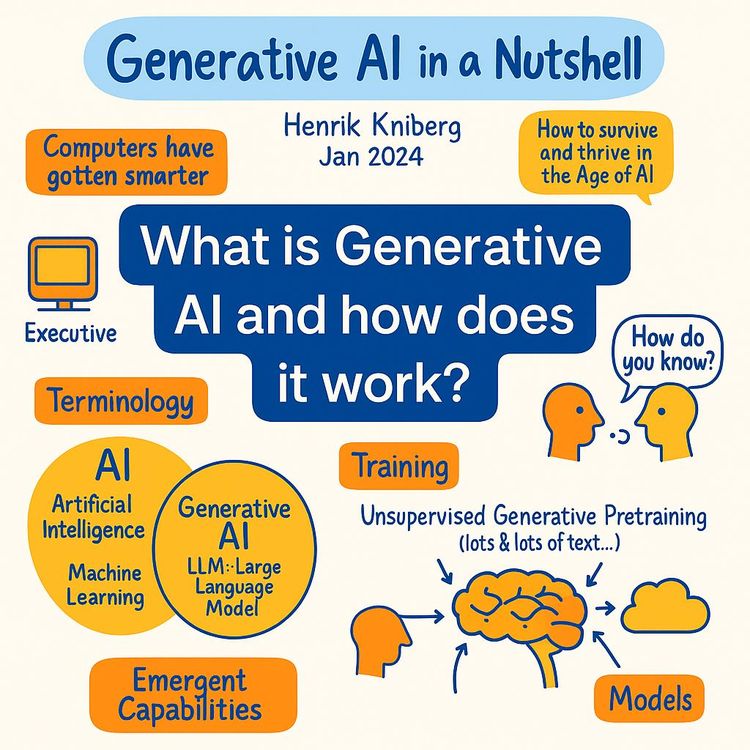
Video Course: What is Generative AI and how does it work?

Video Course: How to Use ChatGPT from Beginner to Professional
Video Course: How to Use Google Gemini for Google Workspace to Boost Productivity

Video Course: How to Use Claude 3.7 AI - Tips for Beginners!
Video Course: ChatGPT for Data Analytics: Full Course - from Beginners to Professional

Video Course: Generating Images and photos With ChatGPT?
Video Course: Generating Images & Photo's with MidJourney
Video Course: Generating Design's with Microsoft Designer and AI

Video Course: Generating Design's with Canva.com and AI
Join 20,000+ Professionals, Using AI to transform their Careers
Join professionals who didn’t just adapt, they thrived. You can too, with AI training designed for your job.