Build AI Products Without a Coding Background (Video Course)
Stop using AI as a search engine. This 5-hour masterclass gives you a practical, step-by-step path to design, build, and ship real AI products and workflows from scratch,no math textbooks or burnout required.
Related Certification: Certification in Building AI Products Without Coding
Also includes Access to All:
What You Will Learn
- Describe how LLMs work: tokens, embeddings, attention, training vs inference
- Identify your level on the five-level AI builder ladder and plan the next move
- Use the POWER framework to discover and prioritize practical AI opportunities
- Build and iterate prototypes with vibe-coding tools (AI Studio, Lovable) and export code
- Design and orchestrate automated workflows with n8n, Zapier, Make and human-in-the-loop checks
- Ship full-stack AI products using GitHub, coding agents, Supabase, OpenRouter, Vercel, and analytics
Study Guide
Introduction: From AI Consumer To AI Builder
Most people are using AI like a slightly smarter search engine. A few prompts here, a quick rewrite there, maybe a summary of a document when they're tired.
But underneath that casual usage, there's a quiet divide growing: on one side, you have people who consume AI. On the other side, you have people who build with it.
This course is about crossing that divide.
You're going to move from "I kind of know how to use ChatGPT" to "I can design, build, and ship AI products and workflows that solve real problems for myself, my team, and my customers." Not as a fantasy. As a practical, step-by-step skill set.
Across this masterclass, we'll go from first principles to full-stack:
Example: We'll start with what AI actually is (beyond the buzzwords), then move through real product architectures, builder levels, the POWER framework, and finally into a full modern stack where you export agent-built code to GitHub, refine it with coding agents, and deploy it to the internet.
By the end, you'll be able to:
- Understand the AI market and why builders are in demand
- Explain how large language models (LLMs) work in simple language
- Avoid the fundamentals trap and learn AI the way professionals actually do
- Place yourself on the 5-level AI builder ladder and know your next move
- Use the POWER framework to find and execute real AI opportunities
- Build prototypes with "vibe coding" tools like AI Studio or Lovable
- Orchestrate automated workflows with tools like n8n or Zapier
- Own a full AI product tech stack from code to production
- See how AI can help with massive problems in healthcare, education, and beyond
This isn't academic theory. It's the playbook people are quietly using to multiply their leverage in their careers and companies. And you can learn it from scratch.
1. The New AI Economy: Why Builders Matter
Let's start with reality, not headlines.
In the last few years, a handful of AI-native companies went from zero to multi-billion-dollar valuations faster than almost any previous generation of startups. Think about names like OpenAI, Anthropic, xAI. They didn't slowly grind their way up over decades. They rode a new technological curve from day one.
At the same time, older giants like Google, Microsoft, Meta, and Nvidia didn't just grow steadily. They experienced step-changes in value as they leaned into AI. Nvidia, which used to be "the gaming GPU company," is now the essential hardware backbone of generative AI.
And then there's the second wave: companies built directly on AI infrastructure rather than building the models themselves.
Example: Glean builds AI-powered search over a company's internal docs and knowledge. Instead of hunting through ten different tools, employees just ask questions in natural language and get answers sourced from their own data.
Example: Perplexity takes web search and fuses it with LLMs to give conversational, citation-backed answers instead of blue links. It's not a research paper generator; it's a new interface for curiosity and decision-making.
These companies are not just "using AI." Their entire product is an AI-powered behavior: understanding, transforming, and generating information at scale.
Then you look at enterprise behavior. Reports from places like MIT, Stanford, and McKinsey keep pointing to the same reality:
- More than half of companies are willing to pay higher salaries to people with AI skills
- AI shows up in job descriptions across marketing, sales, ops, product, and leadership
- Among professional skills, AI now sits next to communication and management as a top priority
And the specific AI-related skills companies care about are very telling:
Example: "Building with AI" , not just prompting, but actually turning AI into tools, workflows, and products that solve problems.
Example: "Judgment" , when AI can do almost anything you ask, the critical skill becomes knowing what should be done, for whom, and where to draw the line.
You're not getting hired just because you know which button to click in some AI interface. You're getting hired , or promoted, or funded , because you can turn AI capability into business outcomes.
2. The Internet Analogy: Where AI Really Is
People love to ask: "Is AI a bubble? Is this just like the dot-com bust?"
The dot-com era actually gives a useful lesson. Many companies died. Valuations crashed. But look at the top global companies today: they're mostly internet-first or internet-native businesses. The technology wasn't fake; the timing and hype around specific bets were just messy.
With AI, we're in a comparable early phase to the internet's dial-up era. Back then:
- Search engines appeared only a few years after the internet became accessible
- E-commerce followed shortly after that
- Social networks and web-based email showed up much later
- Food delivery, ride-sharing, streaming , those took a couple of decades
We're at that early stage for AI. Yes, we have chatbots, coding copilots, and meeting note-takers. But if you zoom out, those are like the early search engines and basic e-commerce sites of AI.
The useful mental model: maybe 1% of AI's future use cases are currently visible. The other 99% are still locked in the heads of people who understand their domain deeply but haven't yet paired that knowledge with AI-building skills.
Example: A logistics manager who understands supply chain pain points better than any consultant , but doesn't yet know how to build an AI tool to optimize routes and inventory.
Example: A school principal in a rural area who understands exactly why students fall behind , but doesn't yet know how to create AI-supported tutoring or tracking systems tailored to her reality.
This is where you, as a builder, become dangerous: you combine domain understanding with the ability to turn AI from "cool demo" into "working product."
3. How To Learn AI Without Burning Out (Purpose-Driven Learning)
Now let's address the trap that quietly kills most AI learning journeys.
Search "how to learn AI" and you'll get a familiar stack:
Mathematics → Statistics → Machine Learning → Deep Learning → AI → Applications.
If you're trying to become a researcher, that path makes sense. But if you're a product manager, marketer, founder, operator, or just someone who wants to build useful tools… starting at math is exactly how you burn out in a week.
Think about driving. You don't need to understand combustion physics or gearbox engineering to be an excellent driver. You learn the controls, the principles, the edge cases, and you practice by actually driving. Mastery comes from applied context, not engine diagrams.
AI is the same. If you try to grind through linear algebra before you've ever built a tiny tool that saves you twenty minutes a day, you'll quit.
Purpose-driven learning flips it:
- Start with a problem you care about
- Use AI to build a rough solution as fast as possible
- Let the gaps in your understanding pull you into the right fundamentals , not the other way around
Example: An MBA student needed to choose subjects out of twenty options with different credits, prerequisites, and schedules. Instead of overthinking, he built a small AI-powered app where you input your preferences and constraints. The app suggested optimal subject combinations. He learned exactly the pieces of AI and app-building required to make that work , nothing more, nothing less at first.
Example: A forty-eight-year-old grocery shop owner in a small town, with zero coding background, was drowning in manual inventory tracking. Using Lovable and Google AI Studio, he described the system he wanted: track incoming stock, predict when popular items would run low, auto-generate supplier order proposals. The AI tools generated most of the logic and interface. He learned only what he needed to tweak and operate that app.
Notice the pattern: they didn't "complete a fundamentals course" before starting. They started, then picked up fundamentals on demand, guided by their own frustration and curiosity.
You'll learn AI much faster if you treat it the same way. Pick a use case that already itches. Build to scratch it. Let the process force you to learn what matters.
4. Mental Models & Vocabulary: Becoming AI-Literate
To build confidently, you do need some conceptual language. Not math-heavy theory, but the kind of vocabulary that lets you reason about what you're doing and talk to technical people without feeling lost.
We'll cover:
- How large language models (LLMs) are trained
- What tokens, vectors, and embeddings are
- Why the attention mechanism mattered so much
- GPUs and why hardware suddenly became sexy
- The difference between training and inference
- A simple model for what LLMs actually do: Understand, Transform, Generate
- Two big limitations you must design around
4.1 How Large Language Models Learn
Think of an LLM like a child going through two big phases: exposure, then education.
Phase 1: Pre-training (raw exposure)
This is where the model "reads the internet."
- It consumes massive amounts of text: websites, books, articles, code
- That text is cleaned and broken into tokens (small chunks of text)
- Each token is turned into numbers (vectors) so a computer can work with it
- The model learns to predict the next token, over and over, across billions of examples
The result is a base model:
Example: A base model "knows" language patterns, facts, and relationships the way a widely read teenager does , lots of knowledge, but no clear sense of boundaries, ethics, or how to behave in different contexts.
Phase 2: Post-training (education + values)
Once you have this raw capability, you still don't want it talking directly to users. It will say wild things, include harmful content, and confidently guess when it doesn't know.
So labs do post-training with two main approaches:
- Supervised fine-tuning (SFT): give the model input-output pairs and teach "this is the correct kind of answer"
- Reinforcement learning from human feedback (RLHF): let the model generate multiple answers, have humans rank them, and use that ranking as a reward signal
Example: To teach helpfulness, a model might be given thousands of question-answer pairs where the "good" answer is clear, concise, and safe, and the "bad" answers are rambling, rude, or evasive. SFT nudges the model toward the good ones.
Example: To teach honesty, models are deliberately asked questions about things that don't exist ("Summarize the book 'The Purple Moon Treaty'"). The preferred answer is "I don't know such a book," and RLHF reinforces that instead of a hallucinated summary.
There's also a newer technique you'll hear about: distillation. Instead of paying thousands of humans to rate every answer, you can sometimes use an already strong model (like Claude or GPT) to act as the teacher, generating high-quality responses that become training data for a smaller or newer model.
4.2 Tokens, Vectors, and Embeddings (Without The Headache)
Computers don't understand words. They understand numbers. So every piece of language that flows through an LLM goes through a translation layer.
Tokens are chunks of text. They might be full words, parts of words, or punctuation. When you type a sentence into ChatGPT or Claude, you're really sending a sequence of tokens.
Vectors are how we turn tokens into numbers. Imagine trying to represent "king," "queen," "man," and "woman" numerically. One crude approach would be to pick features like gender, royalty, and authority, then assign numbers for each word.
In practice, modern models use hundreds or thousands of dimensions to represent very rich meaning. We call these vector representations **embeddings**.
Example: Two different product descriptions that use different words but describe the same thing (like "wireless earbuds" vs "Bluetooth in-ear headphones") will end up with embeddings that are numerically close in vector space. This is how semantic search works.
Example: A customer complaining about "my app crashing every time I try to upload a photo" and another saying "your product keeps freezing when I share images" will produce similar embeddings, even though the phrasing is different. Your AI support system can treat them as the same type of issue.
This idea of embeddings extends beyond text. Pixels in an image are already numbers (RGB values). You can run those through a model and get an embedding for an image, a video frame, or an audio clip. That's how multimodal models can "understand" visuals and sound.
4.3 Attention: Why "Bat" Can Mean Two Different Things
Old-school language models used to treat words mostly in isolation. That leads to obvious problems with ambiguity.
Take the word "bat" in these two sentences:
- "The bat flies in the night and eats insects."
- "Sachin uses his bat to smash a century."
Humans immediately know which "bat" is which because we pay attention to context. The words around "bat" tell us which meaning is correct.
The attention mechanism does something similar in models. It lets the model look at every word in a sentence and weigh how relevant it is to every other word.
Example: In "She unlocked the bank vault with a code," attention highlights relationships between "unlocked," "bank," "vault," and "code." It steers the model away from thinking of a riverbank and toward financial institutions.
Example: In translation, attention helps the model decide which words in a long source sentence line up with which parts of the translated output, so it keeps meaning intact even when grammar and word order change.
This mechanism is at the heart of the transformer architecture , the backbone of basically every modern LLM.
4.4 GPUs, Training, and Inference
All this vector math isn't cheap. When you multiply giant matrices again and again, you need hardware built for massive parallelism.
CPUs are good at doing a lot of different things in sequence. GPUs are good at doing a huge number of the same kind of operation in parallel. That's exactly what you need for training and running LLMs.
Example: When a lab trains a new frontier model, they're renting or owning clusters of GPUs that chew through enormous datasets over weeks or months. That's training.
Example: When you send a prompt to ChatGPT or Claude, that's inference. You're hitting a trained model, and the GPUs are doing far less work per request, but at enormous scale across millions of users.
As a builder, you don't need to worry about training. You're living almost entirely in inference land , using pre-trained models and focusing on how to prompt, chain, orchestrate, and embed them into products.
4.5 Understand → Transform → Generate: The Three Things LLMs Actually Do
Every LLM use case can be mapped onto three basic functions:
Understand
The model reads or listens to something and makes sense of it.
Example: You paste a legal contract in and ask, "Explain this to me like I'm twelve. What are the key risks I'm taking on?"
Example: You feed a user interview transcript into an LLM and ask it to pull out pain points, desires, and repeated themes.
Transform
The model converts one representation into another while preserving core meaning.
Example: Turning a podcast transcript into a blog post, bullet-point summary, and social media snippets.
Example: Translating an internal technical design doc into a client-friendly proposal without jargon.
Generate
The model produces something new based on a prompt, pattern, or structure.
Example: You describe an app idea and the model writes code for a working prototype.
Example: You write a rough bullet list and the model generates a polished slide deck narrative around it.
When you think in these three verbs, you stop getting lost in features and start seeing what your product or workflow is actually doing with AI.
4.6 Two Hard Limits: Hallucination and Context
AI isn't magic. There are structural limits you must design around.
Hallucination
The model's job is to predict the next token. If it doesn't know something, it doesn't naturally say "I don't know." It guesses , often in a confident tone.
Example: Ask for "the key findings of a non-existent research paper" and a naive model will happily invent authors, methods, and conclusions that sound plausible but are completely made up.
Example: Have a model summarize an outdated internal process without giving it current docs, and it will reconstruct something that looks right but doesn't match your present reality.
Good post-training and clear system prompts can dramatically reduce this, but never fully eliminate it. Your designs need checks, retrieval from real data, or explicit fallbacks like "I don't know."
Context window
Every model has a limit on how much input plus output it can handle in one go. If you try to shove an entire company knowledge base into a single prompt, it will either fail or cost a fortune and degrade in quality.
Example: A support agent that tries to include all product docs in every single request will perform worse than one that retrieves only the relevant FAQ section or knowledge article based on embeddings.
Example: A meeting assistant that keeps stuffing the full transcript into each summarization step will hit context limits and start dropping important details; splitting by sections and stitching summaries works better.
As a builder, you respect these limits and work around them with retrieval, chunking, and smart prompt design.
5. Under the Hood: How Real AI Products Work
Let's demystify a few concrete products. Once you see how they actually work, you'll stop thinking "this is magic" and start thinking "oh, I can build that."
5.1 Meeting Note-Takers: Granola, Fireflies, Otter
Tools like Granola join your calls and return beautifully structured notes. Here's what's actually happening:
1. The tool connects to your Zoom/Meet/Teams calendar and joins as a silent participant.
2. It records audio and runs speech-to-text to produce a transcript.
3. It sends that transcript to an LLM with a carefully designed system prompt.
4. The model returns a structured output (title, key points, decisions, action items, open questions, owners, deadlines).
The secret sauce isn't "access to a magic model." It's the system prompt and data flow.
Example: The system prompt might say, "You are an expert chief of staff and notetaker. Given the following raw transcript, produce: 1) a concise meeting title, 2) a brief summary, 3) bullet-point key decisions with owners and deadlines, 4) action items grouped by person, 5) open questions."
Example: A variation for sales calls could add, "Identify buying signals, objections, competitors mentioned, and next steps that move the deal forward." Same underlying pattern, different prompt and post-processing.
If you can design that prompt and route the transcript correctly, you can build your own tailored meeting assistant.
5.2 Travel Assistants and Agents: The MakeMyTrip "Myra" Pattern
Consider a travel assistant like Myra. A user says: "Book me a flight from Delhi to Bangalore next Friday, morning only, aisle seat if possible."
Underneath, this interaction uses three core components:
- A database of flights, prices, routes, and availability
- APIs to search and book those flights
- An LLM acting as the brains that turn messy human language into structured API calls
Here's the flow:
1. The user sends a natural-language request.
2. The LLM is given a system prompt that describes the available APIs: search, filter, book, modify, cancel , including what parameters each needs (origin_city, destination_city, date, seat_type, etc.).
3. The LLM outputs a structured JSON block specifying which API to call and with which parameters.
4. The backend runs that API call, gets back options, and either books or asks the user to confirm.
Example: The model might output: { "action": "search_flights", "from_city": "Delhi", "to_city": "Bangalore", "date": "next_friday", "time_window": "morning" }, which your system then turns into a live query.
Example: After the user picks a flight, another structured output might be { "action": "book_flight", "flight_id": "AI-202", "seat_pref": "aisle", "user_id": "1234" } leading to a booking API call.
This is what we call an agent: an LLM + tools/APIs + the authority to act (often gated by confirmations).
Every time you hear "AI agent" in a product, think: LLM + instructions + tools + guardrails.
5.3 Structured Outputs and MCP
For this to work reliably, your LLM can't just reply in prose. It has to output predictable, structured data.
That's where formats like JSON or XML come in.
Example: Instead of "Sure, I'll book your flight," the model must respond with something like: { "intent": "book", "entity": "flight", "flight_id": "AI-202", "confirm": true }. That's machine-consumable.
Example: In a CRM agent, the model's response could be: { "intent": "create_lead", "name": "John Doe", "company": "Acme Corp", "score": 92, "next_step": "schedule_demo" } which your automation tool can use to update records.
The Model Context Protocol (MCP) is an emerging way to standardize how we expose tools and APIs to LLMs so they know what actions they can take and how to describe them. You don't have to master MCP to start, but understanding that "agents need structured outputs and explicit tools" keeps your mental model honest.
6. The Five Levels of AI Builders: Your Roadmap
Right now, you're somewhere on a ladder. Knowing where you are makes it much easier to see your next step.
We'll use five levels:
- Level 0: Analysis Paralysis
- Level 1: Daily AI User
- Level 2: Micro-Utility Creator
- Level 3: Prototype Builder (Vibe Coder)
- Level 4: Workflow Orchestrator
- Level 5: Full-Stack AI Product Builder
6.1 Level 0 , Analysis Paralysis
Level 0 has two flavors:
- "AI is hype, it's all fake, it'll blow over."
- "AI is important, but I'm overwhelmed, so I'll watch a few videos and do nothing."
The result is the same: no experiments, no tools tried, no problems solved.
Example: Someone spends hours debating on social media about whether AI will destroy jobs but has never opened ChatGPT or Claude for their own work.
Example: A manager keeps forwarding AI newsletters to their team but never carves out one block of time to sit with a single tool and solve a pain point.
Nothing moves until you try things. The cure for Level 0 is not more information; it's a tiny, low-stakes build.
6.2 Level 1 , Daily AI User
At this level, you use tools like ChatGPT, Claude, Gemini as part of your normal day.
- You ask for email drafts, summaries, suggestions
- You brainstorm marketing copy or product names
- You debug some code occasionally
- You use AI like a smarter assistant sitting in another tab
Example: Before a performance review, you paste in a rough bullet list of your achievements and ask the model to turn it into a clear, assertive self-review in your company's tone.
Example: You feed a long PDF report into an LLM and ask for a structured breakdown: key insights, red flags, recommended actions.
6.3 Level 2 , Micro-Utility Creator (Gems, Custom GPTs, Claude Skills)
Level 2 is where you start to crystallize your best prompts and workflows into reusable tools.
You stop retyping instructions every time and instead build micro-utilities on platforms like:
- Google Gems
- OpenAI Custom GPTs
- Claude Skills
Example: Résumé-Job Description Matcher. You create a Gem or Custom GPT that takes a résumé and a job description, then: 1) scores the match, 2) suggests bullet-level edits, 3) drafts a tailored cover letter. The next time you apply for a role, you paste two things, not twenty prompts.
Example: Sales Email Refiner. You build a Claude Skill where your reps paste their raw outreach email and ICP description; the skill then rewrites the email for clarity, personalization, and brevity, and outputs three variants.
Claude Skills add an important pattern: progressive disclosure.
A skill is just a text file with three parts:
- Name
- Description
- Full instructions
Example: A skill called "Frontend Design" might have a description like, "Create distinctive, modern UI designs that avoid generic templates, using Swiss-style layout, soft gradients, and clear hierarchy." The full instructions (hidden until needed) would spell out layout rules, color systems, spacing scales, and component patterns.
Example: A "Job Interview Coach" skill might describe what kinds of interviews it helps prepare for, while the detailed instructions include specific frameworks (STAR method, behavioral question banks) that only load when you actually start interview prep.
6.4 Level 3 , Prototype Builder (Vibe Coding)
Level 3 is where you step into building actual apps, without traditional coding, using "vibe coding" platforms like:
- Google AI Studio
- Lovable
- Replit's AI modes
- Bolt (Vercel's builder)
These platforms all share a similar loop:
1. You describe what you want in natural language (and sometimes images).
2. The agent generates code across multiple files (frontend, backend, styling).
3. It hosts the app for you and gives you a URL.
4. You test, give feedback, and it updates the code.
This is an agentic loop: Goal → Action → Observe → Decide → Repeat.
Example: A "Meeting Cost Calculator" app where you paste the number of attendees, their approximate hourly rates, and the duration. The app calculates the cost of the meeting and shows it in a simple, shareable page with clean charts. You describe the idea, the agent scaffolds a Next.js or React app, and deploys it.
Example: A "Content Repurposer" where you upload a webinar video. The app extracts the transcript, then generates a blog post, LinkedIn thread, and email newsletter draft. Again, you describe the workflow; the agent wires together transcription + LLM calls + UI.
Design matters here. Native AI designs can look bland if you just accept defaults. So you start feeding visual inspiration:
- Screenshots from Dribbble
- Layouts from sites like Recent Design
- Your own sketched wireframes
Example: You screenshot a dashboard layout you like from Dribbble, upload it to AI Studio, and say, "Match this layout and color palette, but adapt it to my meeting-cost calculator app." The agent uses that as a design target instead of inventing yet another gray-ish UI.
Example: You hand-draw a flow on paper, snap a photo, and upload it with: "Use this as the user journey: step-by-step wizard, progress bar at top, summary screen at the end." The agent translates that into actual components.
Crucial skill at Level 3: targeted editing. Instead of regenerating an entire app when you want one change, you highlight the part you care about and instruct precisely:
Example: "Only update the chart colors to match this palette; don't change layout or typography."
Example: "Change the copy of this button to 'Send Proposal' and add a confirmation dialog; leave everything else as is."
This is how you get from "toy demo" to "usable prototype" without endless rework.
6.5 Level 4 , Workflow Orchestrator (n8n, Zapier, Make, Relay)
Level 4 is where you stop thinking in single apps and start designing systems.
Tools like n8n, Zapier, Make.com, and Relay let you visually connect triggers, logic, AI steps, and actions across dozens or hundreds of tools.
Every good workflow has six parts:
- Goal
- Trigger
- Context
- Model / Logic
- Tools
- Human in the loop (optional but wise)
Example: Sales Lead Workflow
Goal: Move qualified inbound leads to a tailored proposal within one hour.
Trigger: New form submission on your site.
Context: Company website, form answers, lead source, your product's pricing tiers.
Model/Logic: An LLM that researches the company, segments them, and drafts a first-pass proposal.
Tools: CRM (HubSpot), email (Gmail/Outlook), docs (Google Docs), Slack for notifications.
Human in the loop: Sales rep reviews and edits proposal before sending.
Example: Social Listening Workflow
Goal: Never miss a relevant mention of your brand or category on Twitter/X.
Trigger: New tweet mentioning your brand or selected keywords.
Context: Your latest product updates, FAQ, known issues, marketing guidelines.
Model/Logic: LLM categorizes the tweet (bug, praise, complaint, question, competitor comparison), suggests a response, and rates urgency.
Tools: Twitter API, Notion or Airtable for logging, email or Telegram for escalations.
Human in the loop: Community manager approves or tweaks suggested replies for high-importance tweets.
As an orchestrator, you learn to map out workflows on paper first, then drag nodes in your chosen tool to match that map. When you get stuck, you don't give up; you screenshot the confusing part and ask an LLM to explain or even write the exact configuration for you.
6.6 Level 5 , Full-Stack AI Product Builder
At Level 5, you own the code, the infrastructure, and the product behavior end-to-end. You don't have to be a "pure" engineer. Coding agents make this more accessible than ever.
Your stack starts looking like this:
- Source management in GitHub
- Local development with coding agents like Cursor, Claude Code, or Google's Antigravity
- Full web app frameworks like Next.js
- Databases and auth with Supabase
- Multiple LLMs via OpenRouter
- Hosting on Vercel
- Analytics via PostHog
Example: You build an internal "AI Copilot" for your company that connects to internal docs, CRM, support tickets, and analytics. It lets any employee ask questions, draft comms, and generate reports grounded in your own data. The code lives in GitHub, runs on Vercel, and uses OpenRouter to pick the best model for each request.
Example: You build a SaaS product that helps recruiters analyze candidate pipelines, write outreach, and coordinate interviews, all with AI assistance. You iterate features with a coding agent, push changes with GitHub Desktop, and instrument the whole thing with PostHog to see what users actually do.
This level is where you stop depending on other people's platforms and start owning digital assets that can become real businesses or strategic internal tools.
7. The POWER Framework: How Real AI Builders Think
Most people approach AI backwards. They start with tools: "How do I learn n8n?" "Should I buy Cursor?" "Which LLM is the best?"
That's like buying a kitchen full of expensive appliances before you know what you like to cook.
The POWER framework gives you the correct order:
- Possibilities
- Opportunities
- Workflow
- Engineering
- Reflection
7.1 Possibilities: Expanding Your Mental Menu
Possibilities answer: "What can AI actually do today?" Not in theory. In the wild.
- Read Anthropic, OpenAI, and Google Cloud customer stories , see what real companies are deploying
- Browse skills.sh to see the most popular Claude Skills and what they automate
- Study lists like a16z's top AI apps to see category patterns
- Engage with posts on LinkedIn or X about concrete AI use cases so the algorithm feeds you more
Example: You notice a pattern of companies using AI to summarize legal documents, distill compliance rules, and auto-draft contract clauses. That goes into your "AI can do legal analysis support" bucket.
Example: You see creators using AI to turn one podcast into ten pieces of content: shorts, threads, carousels, newsletters. That goes into your "AI is good at repurposing content and preserving voice" bucket.
To systematize this, you can even have AI help you research AI.
Example: Set up a Claude routine that, once a day, scans X and LinkedIn for posts with terms like "AI workflow," "automation," "agent," and "case study." It summarizes the most interesting ones and sends you a short briefing with links.
Example: Every time you see a good AI use case, you drop it into a Notion database. Once a week, you ask an LLM to cluster and label those use cases so you see themes emerging over time.
This is a short, intense phase: a few days of deep dive, then a lighter daily dose. But without it, you'll constantly underestimate what's already trivial to build.
7.2 Opportunities: Bringing It Back To Your World
Possibilities are global. Opportunities are hyper-local: "Where, in my world, could this be useful?"
The main input here is not AI knowledge. It's domain knowledge. You must understand your own day, your team's reality, your customers' struggles.
Two simple ways to surface opportunities:
- Keep a one-week work diary, writing down every task you do and how long it takes
- Or, talk through your day into an LLM project and have it log your activities
Example: After a week, you realize you spend an hour per day triaging support emails and routing them to the right person. That's an opportunity for an AI-based triage and routing system.
Example: You notice that proposals, reports, and briefs all have similar structures but you rebuild them from scratch each time. That's an opportunity for AI-assisted template filling and first-draft generation.
- Repetitive
- High-friction
- Error-prone
- Or high-value but under-served (things you wish you had time for)
7.3 Workflows: From Vague Idea To Clear Steps
"AI could help with user research" is not a buildable statement. "AI can help me draft unbiased interview questions and cluster insights afterwards" is.
Take user research as an example:
- Define target segments
- Find and recruit participants
- Design interview questions
- Design surveys (if needed)
- Conduct interviews
- Transcribe and summarize
- Cluster insights and themes
- Create personas and journey maps
- Turn insights into a product requirements document (PRD)
Now AI can attach to individual steps.
Example: Use an LLM to generate interview questions, then run them through a "Mom's Test" style checker (another micro-utility) that flags leading or opinion-seeking questions and suggests better alternatives.
Example: After interviews, feed transcripts into an LLM and ask it to group quotes by pain point, desired outcome, and language patterns. Then you review and refine those clusters instead of starting from a blank page.
This "workflow decomposition" is how you avoid building random bots and instead design systems that plug into real processes.
7.4 Engineering: Only Now, Tools
Most people start here. In the POWER sequence, it's fourth.
Once you know the possibility space, your specific opportunities, and the workflow steps, picking tools becomes obvious:
- If it's a one-off or thinking task → Level 1 tools (ChatGPT, Claude, Gemini)
- If it's repeated and text-based → Level 2 (Gems, Custom GPTs, Claude Skills)
- If it needs an interface → Level 3 (AI Studio, Lovable, Replit)
- If it spans multiple apps → Level 4 (n8n, Zapier, Make, Relay)
- If it's a product you want to own → Level 5 (GitHub, coding agents, custom stack)
Example: For "score résumés against a job description and suggest edits," a Custom GPT or Claude Skill is enough. No need to spin up a full web app initially.
Example: For "auto-craft follow-up emails two days after any sales demo, customized to call notes," a Level 4 workflow using n8n or Zapier plus an LLM step is the right choice.
7.5 Reflection: Are We Actually Getting Value?
- Which AI experiments saved time or created new value?
- Where did they create friction or errors?
- What new opportunities emerged once the bottleneck moved?
- What can be simplified, automated further, or discarded?
Example: Every Friday, you review your AI-powered workflows. You notice your social listening automation surfaces too many low-quality tweets. You adjust the model's thresholds and categories instead of silently tolerating noise.
Example: Once a month, you look at analytics in PostHog and see that users rarely touch a flashy AI feature you were excited about but absolutely hammer a simpler "summarize my data" feature. You double down on the latter.
8. Your Technical Stack: From Prototype To Production
Now we move into the concrete stack that lets you go from a vibe-coded prototype to a production-ready product you own.
The flow looks like this:
1. Build a v1 anywhere (AI Studio, Lovable, Replit, Bolt).
2. Export the code to GitHub.
3. Pull that code locally with GitHub Desktop.
4. Use a coding agent (Antigravity, Cursor, Claude Code) to refine and extend it.
5. Wire up real services like Supabase and OpenRouter.
6. Deploy to Vercel for a public URL.
7. Layer analytics with PostHog.
8.1 GitHub: Your Code's Home
GitHub is where your code lives, versioned and backed up.
Core concepts:
- Repository: a project folder with history
- Commit: a snapshot of changes with a message
- Push: send local commits to the remote GitHub copy
- Fetch (or Fetch Origin in GitHub Desktop): pull remote changes down
Example: You use Lovable to generate a prototype. With one click, you export the project to a new GitHub repository. Now you have all the code in a standard place rather than locked inside Lovable.
Example: You make a risky change guided by a coding agent. You commit before and after. When you realize the new version broke something critical, you revert to the previous commit in GitHub rather than trying to "undo" a hundred edits manually.
GitHub Desktop makes this visual. No terminal necessary. You see your files, your changes, your branches, and your history with a click.
8.2 Coding Agents: Antigravity, Cursor, Claude Code
This is where things get wild. Instead of manually editing code line by line, you describe what you want in natural language and let a coding agent do the heavy lifting.
All three , Antigravity (Google's agent), Cursor, and Claude Code , follow the same pattern:
- You connect them to your codebase.
- You describe features, bugs, or refactors.
- They propose a plan.
- They implement code across multiple files.
- You test and iterate.
Example: You paste your product brief: "I want a multi-model chat interface where I can select from a list of LLMs, send one message, and get each model's response side by side, including token usage, cost, and latency." The agent creates a Next.js project, sets up a UI, integrates OpenRouter, and stubs out the logic.
Example: You realize you need authentication. You tell the agent: "Add a simple PIN-based login screen before the chat screen. If the PIN is wrong, block access. Store the PIN in an environment variable." The agent edits the appropriate files and wires in the logic.
Best practices with coding agents:
- Always start with plan mode. Let the agent outline what it will do. Edit that plan before running code changes.
- Paste in links to up-to-date docs for frameworks or APIs you're using. Don't assume the model's training data includes the latest versions.
- Store keys and secrets in a `.env` file , never directly in the code pushed to GitHub.
- When you hit an error, copy the exact error message or screenshot into the agent's chat. "It broke" is not helpful; the full stack trace is.
8.3 Supabase, OpenRouter, Vercel, PostHog: The Modern AI Stack
Let's map the key services you'll see again and again:
- Next.js: a React-based framework for building modern web apps (frontend + backend in one project).
- Supabase: a hosted Postgres database with built-in auth, APIs, and storage , an open-source alternative to Firebase.
- OpenRouter: a single API that lets you call multiple LLMs (Claude, GPT, Gemini, Mistral, Llama, DeepSeek, etc.) with one integration.
- Vercel: a hosting platform tightly integrated with Next.js and GitHub; it deploys your web app to a global edge network.
- PostHog: analytics and product telemetry; see what users do, where they drop off, and which features actually matter.
Example: Your multi-LLM chat product ("OpenGPT" for yourself) uses Next.js for the app, Supabase to store users, messages, and logs, OpenRouter to access several AI models with a single key, Vercel to host the app, and PostHog to track usage and model performance.
Example: A knowledge-base Q&A tool for your team uses Supabase to store documents and embeddings, Next.js as the interface, OpenRouter to talk to different LLMs, Vercel for deployment, and PostHog to see which kinds of questions people ask the most.
8.4 Building a Multi-Model Chat ("OpenGPT") Step-by-Step
This is a great capstone project because it forces you to touch every part of the stack.
Your product spec might look like this:
- Simple login with a PIN
- Chat interface with message history
- Dropdown or toggles to choose from multiple models (Claude, GPT, DeepSeek, etc.)
- When you send a message, all selected models respond in parallel
- For each response, display: time taken, tokens used, estimated cost
- Store all messages, metadata, and user info in Supabase
- Accessible on a clean, responsive web UI
- Deployed to a public URL via Vercel
The build flow using a coding agent:
1. Create an empty Next.js project (or let the agent create it).
2. Describe the full spec in the agent: pages, components, data schema, flows.
3. Ask it to generate a plan; inspect and adjust.
4. Let it implement the first version.
Now you bring in services:
- Generate a Supabase project and grab your URL + key.
- Ask the agent to set up Supabase tables (users, chats, messages, logs). You can even paste a high-level schema and let it write the SQL or use Supabase's UI to run the scripts the agent outputs.
- Create an OpenRouter key and instruction string for which models to expose.
- Ask the agent to integrate OpenRouter calls with the chat backend, including per-model timing and token accounting.
Example: You tell the agent, "Add Supabase integration so that each message is stored with: user_id, model_name, prompt_tokens, completion_tokens, latency_ms, and cost_usd. Then display these stats under each message bubble in the UI." It updates model calls, database writes, and UI components.
Example: You decide to cap the number of models a user can query at once. You instruct, "Limit model selection to a maximum of three models per conversation and show a warning toast if someone tries to select more." The agent adds this constraint.
Finally, you:
- Push the code to GitHub via GitHub Desktop.
- Sign up for Vercel (or log in), click "New Project," and select your GitHub repo.
- Configure envir
Certification
About the Certification
Become certified in AI product design for non-coders. Prove you can turn ideas into working AI workflows, build functional prototypes, and ship real products,no math background needed. Show employers you deliver practical AI solutions from scratch.
Official Certification
Upon successful completion of the "Certification in Building AI Products Without Coding", you will receive a verifiable digital certificate. This certificate demonstrates your expertise in the subject matter covered in this course.
Benefits of Certification
- Enhance your professional credibility and stand out in the job market.
- Validate your skills and knowledge in cutting-edge AI technologies.
- Unlock new career opportunities in the rapidly growing AI field.
- Share your achievement on your resume, LinkedIn, and other professional platforms.
How to complete your certification successfully?
To earn your certification, you’ll need to complete all video lessons, study the guide carefully, and review the FAQ. After that, you’ll be prepared to pass the certification requirements.
Other AI Video Courses
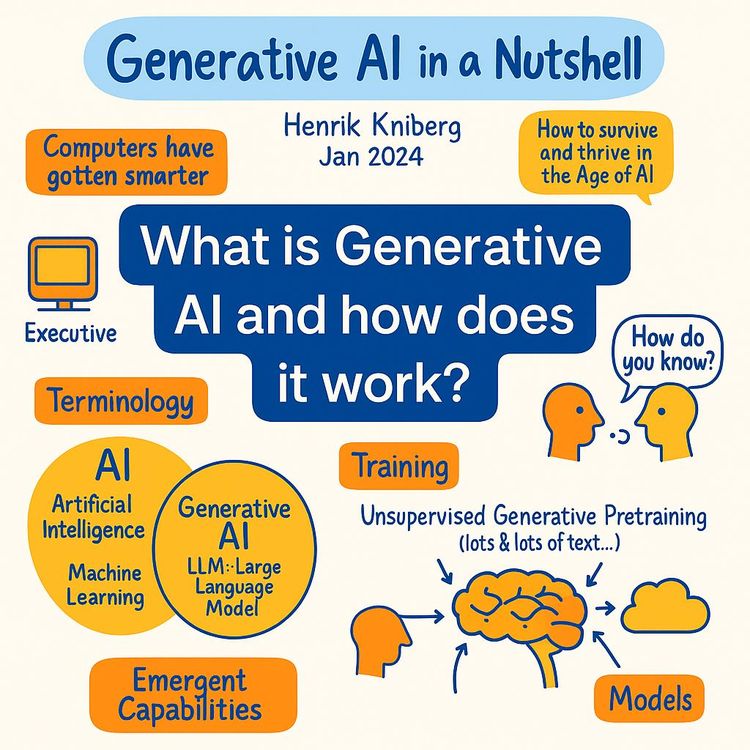
Video Course: What is Generative AI and how does it work?

Video Course: How to Use ChatGPT from Beginner to Professional
Video Course: How to Use Google Gemini for Google Workspace to Boost Productivity

Video Course: How to Use Claude 3.7 AI - Tips for Beginners!

Video Course: ChatGPT for Data Analytics: Full Course - from Beginners to Professional

Video Course: Generating Images and photos With ChatGPT?

Video Course: Generating Images & Photo's with MidJourney
Video Course: Generating Design's with Microsoft Designer and AI

Video Course: Generating Design's with Canva.com and AI
Join 20,000+ Professionals, Using AI to transform their Careers
Join professionals who didn’t just adapt, they thrived. You can too, with AI training designed for your job.