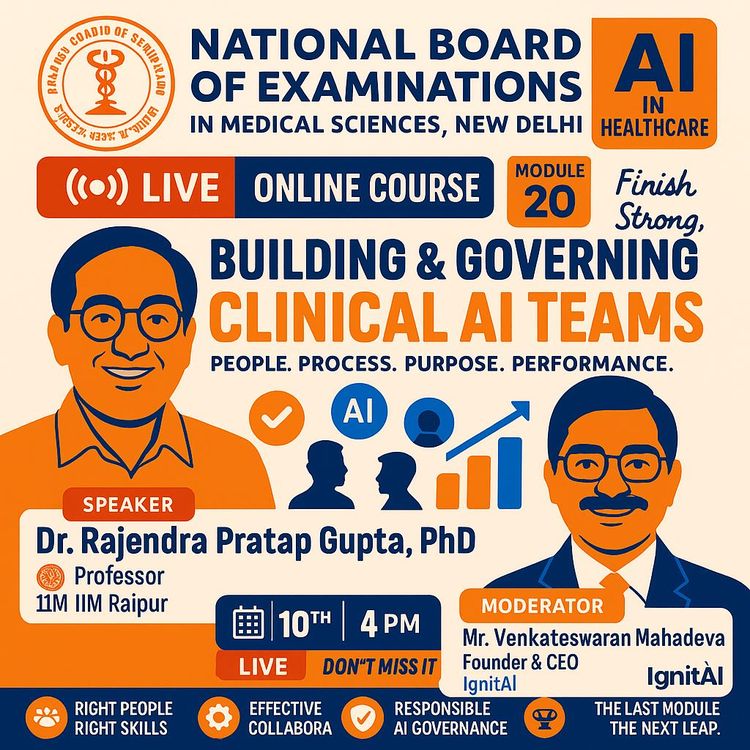
Building Clinical AI Teams: Leadership & Governance (Video Course)
Learn how to build and lead hybrid human-AI clinical teams, move from basic chatbots to AI that coordinates whole care systems, and put solid governance in place so innovation actually reduces burnout, costs, and risk while improving outcomes.
Related Certification: Certification in Leading Clinical AI Teams & Governance
Also includes Access to All:
What You Will Learn
- Use the five-level Functional AI Pyramid to guide AI integration in healthcare
- Differentiate digitization, digitalization, and digital transformation in clinical settings
- Design and govern multidisciplinary clinical AI teams with clear accountability
- Deploy conversational, reasoning, and autonomous AI to reduce documentation and improve care
- Create phased AI adoption plans addressing costs, governance, and workforce reskilling
Study Guide
Introduction: The Crossroads of Medicine and Machine Intelligence
You're standing at a crossroads. On one path, you keep doing what you've always done,seeing patients, documenting encounters, relying on the same workflows that have defined clinical practice for decades. On the other path, you learn to build, lead, and govern teams where humans and artificial intelligence work side by side. One path leads to obsolescence. The other leads to something far more interesting: the golden age of medicine.
This module isn't a theoretical overview of AI in healthcare. It's a practical playbook for understanding how AI integrates into clinical organizations, how you build teams that deploy it safely, and how you govern systems that increasingly think, act, and create on their own. You'll learn a five-level framework for AI integration that applies whether you're a practicing clinician, a hospital administrator, a medical educator, or a policymaker. You'll understand why digital health is bigger than AI, why digitization isn't the same as digital transformation, and why the teams you build today will determine whether your organization leads or lags in the decade ahead.
The stakes are enormous. Technology companies,including some of the most valuable corporations on the planet,have publicly identified health as their greatest potential contribution to humanity. Computing power has doubled every twelve to twenty-four months for over sixty years. Information that took five centuries to double in the fifteenth century now doubles every few hours. Major AI models are released roughly every sixty days. This isn't a slow drift. It's a flood. And the only way to survive a flood is to learn how to swim.
Why You Cannot Afford to Sit on the Sidelines
Let's start with the uncomfortable truth: the ground beneath clinical practice has shifted, and many professionals haven't noticed yet. When trillion-dollar technology companies decide that health is their most important contribution to humanity, they don't ask permission. They build. They hire. They ship products. And if healthcare professionals refuse to adopt these technologies themselves, the technology companies will define healthcare delivery for them.
Consider what's happening in plain sight. The same corporations that put computers in our pockets are now building health ecosystems,wearable devices that track every heartbeat, algorithms that detect disease patterns before symptoms appear, platforms that connect patients directly to AI-driven advice. These systems don't require a hospital visit. They don't require a referral. They meet patients where they already are: on their phones.
The acceleration is the story.
Moore's Law,the observation that computing power doubles every twelve to twenty-four months,has held true for more than six decades. But computing power is only half the picture. The Buckminster Fuller Curve shows that human knowledge, which took five hundred years to double in the fifteenth century, now doubles every twelve hours. Generative AI has compressed that further. Everything you learned in medical training, every protocol you memorized, every algorithm you internalized,it's all aging faster than any previous generation of medical knowledge.
Here's a concrete way to feel this. When you trained, you learned a static body of knowledge. You assumed that what you learned would serve you for decades. That assumption is now invalid. The span of technological development has compressed from years to weeks. The tools that govern data and information in healthcare are being rewired, revalidated, and reinvented on a near-monthly basis. If you're not learning continuously, you're falling behind,not gradually, but exponentially.
The Reality of Machine-Level Performance
Here's another uncomfortable fact: technology has already exceeded human expert-level performance across multiple domains. This isn't a prediction for the distant future. It's the current state of affairs. AI systems now outperform human experts in specific diagnostic tasks, pattern recognition, and data analysis. A generative AI model has demonstrated an IQ in the 155-to-160 range,and projections suggest that capability will multiply dramatically within a few years.
Now, you might be thinking: "But AI can't replace the clinical judgment of an experienced physician." You're right. It can't. Not yet, and perhaps not ever, in the full sense of what it means to care for another human being. But here's what AI can do: it can handle the tasks that consume your time, the patterns that escape your attention, the documentation that burns you out, and the data analysis that takes you hours. And when it does all of that, the question becomes: what are you adding on top of it?
The historical pattern is instructive. The nineteenth-century industrial revolution replaced physical labor. The technology revolution is replacing mental labor. Your competition is no longer the colleague down the hall who sees more patients. Your competition is the algorithm that never sleeps, never gets tired, never misses a pattern, and never asks for a raise. The only viable strategy is to master the technology,to make it your tool rather than your replacement.
The Building Blocks of Digital Health
Before we dive into the Functional AI Pyramid, you need to understand something fundamental: AI is not a standalone technology. It's a collaborative technology. It works with other digital tools to create outcomes that no single technology could achieve alone. This is why the most important distinction in digital health isn't between different AI models,it's between professionals who understand the full digital health ecosystem and those who only understand AI in isolation.
Think of digital health as a vast landscape with multiple interconnected domains. There's healthcare information technology: cloud systems, digital health records, patient portals, hospital management information systems. There are advanced technologies: IoT devices, medical devices, data analytics platforms, AI and machine learning systems, blockchain, chatbots, large language models. There are emerging sciences: genomics, nanomedicine, predictive and precision medicine, quantum computing. There are experiential technologies: augmented reality, virtual reality, mixed reality, metaverse applications, gaming. There are physical technologies: robotics, drones, 3D printing. There are care delivery tools: mobile health applications, digital consultations, consumer digital therapeutics, prescription digital therapeutics. And underneath all of it: ethics, privacy, and security frameworks.
Why does this matter to you?
Because a clinician who understands only AI is like a carpenter who owns only a hammer. The hammer is useful. But it can't saw wood, it can't drill holes, and it can't measure. When you understand the full ecosystem, you can combine AI with IoT devices to monitor chronic disease in real time. You can combine AI with genomics to personalize treatment. You can combine AI with telemedicine to reach patients who would otherwise never see a specialist. The magic isn't in any single technology. It's in the combination.
Digitization, Digitalization, and Digital Transformation
One of the biggest sources of confusion in healthcare technology is the difference between three terms that sound similar but mean very different things. Get this wrong, and you'll think you're making progress when you're actually just rearranging deck chairs.
Digitization is conversion.
It's the process of turning analog information into digital format. Scanning a paper medical record into a PDF is digitization. The information is now digital, but it's still unstructured. It's a picture of a document, not a searchable, analyzable dataset. Digitization is the foundation, but it's only the foundation.
Digitalization is adaptation.
It's the application of digital technologies to transform existing processes. Electronic health records are the classic example. When you move from paper charts to an EHR, you're not just converting information,you're enabling analytics, automated workflows, and streamlined operations. You can search for patients, track outcomes, flag drug interactions, and generate reports. Digitalization builds on digitization and adds functional capability. It makes existing processes better.
Digital transformation is creation.
It's the fundamental reinvention of processes and services through digital technology. Teleconsultation is the classic example. When you deliver healthcare through a video call, you're not just digitizing the old process or digitalizing it,you're creating an entirely new care delivery model that would be impossible without the previous two stages. Patients who couldn't travel can now see specialists. Clinicians who couldn't reach rural populations can now serve them. Digital transformation doesn't improve the old way of doing things. It replaces it with something new.
Here's the practical takeaway: most healthcare organizations think they're digitally transformed because they've implemented an EHR. They're not. They've digitized and digitalized. True transformation requires reimagining the entire care model. The Functional AI Pyramid we're about to explore is a roadmap for that transformation.
The Functional AI Pyramid: A Framework for Understanding AI Integration
Now we get to the heart of this module. The Functional AI Pyramid is a five-level model that describes how AI progressively integrates into healthcare organizations. It was developed for a simple reason: healthcare professionals need a non-technical framework for understanding AI that doesn't require a computer science degree. The pyramid gives you that.
Each level represents increasing autonomy and capability. The levels build on each other,you can't skip levels, and you can't understand the higher levels without understanding the ones beneath them. Here's the pyramid at a glance:
Level One: Conversational AI,the Talkers. Systems that communicate through natural language.
Level Two: Reasoning AI,the Thinkers. Systems that perform cognitive functions including logical reasoning and contextual analysis.
Level Three: Autonomous AI,the Doers. Systems that perform tasks independently without continuous human oversight.
Level Four: Innovating AI,the Creators. Systems that create new knowledge, clinical pathways, and medical solutions.
Level Five: Organizational AI,the Leaders. Systems that run entire organizations with minimal human oversight.
Let's explore each level in depth.
Level One: Conversational AI,The Talkers
Conversational AI is the most mature level of AI integration. These are systems that talk,chatbots, virtual assistants, symptom checkers, and AI systems capable of answering questions, providing information, and conducting basic interactions. You've interacted with these systems whether you realize it or not. That chat window on a commercial website? That's conversational AI. The automated response system on a hospital's patient portal? Also conversational AI.
In healthcare, the applications are extensive. Virtual health assistants can triage patients before a human ever gets involved. Chatbots can handle appointment scheduling, patient education, and insurance queries. Multilingual conversational agents can provide health information to patients who don't speak the dominant language of their region. Symptom checkers can guide patients toward appropriate care before they book an appointment.
The operational impact is immediate and measurable.
Conversational AI augments human communication from one-to-one to one-to-many. A single human agent can handle one conversation at a time. A conversational AI system can handle thousands simultaneously. It extends your services beyond office hours,patients can get answers at midnight. It reduces the cost of front-office and back-office functions. It assists patient educators and counselors with recordkeeping and documentation, freeing them to focus on actual patient interaction.
Here's the workforce implication you need to internalize: any role that involves desk-based communication functions is a candidate for automation. The pattern is already visible. Front-office and back-office positions in healthcare organizations are being eliminated or augmented by conversational AI. If your job involves answering the same questions repeatedly, scheduling appointments, or providing standard information, you need to understand that this level of AI is already mature and deployed at scale. It's not coming. It's here.
But here's the opportunity: conversational AI doesn't replace the human touch. It replaces the repetitive, transactional parts of communication. The clinician who uses conversational AI to handle routine queries has more time for the complex, emotionally demanding conversations that actually require human presence. That's the trade you want to make.
Level Two: Reasoning AI,The Thinkers
Level Two moves beyond communication to cognition. Reasoning AI systems perform logical reasoning, contextual analysis, and clinical decision support. These are the systems that process complex clinical data, identify patterns, and provide evidence-based recommendations. They don't just talk,they think.
The technical foundation here is neurosymbolic AI, which combines neural networks with symbolic reasoning. This matters because it means the system can not only recognize patterns (that's what neural networks do) but also reason about them using explicit rules and logic. The result is a system that can support clinical decision-making in ways that earlier AI could not.
The healthcare applications are broad and deep. Clinical decision support systems can assist with diagnostics and treatment planning across virtually every specialty. In primary care, these systems improve diagnostic accuracy,catching subtle patterns that human clinicians might miss. In chronic disease management, they monitor patient data and adjust treatment plans in real time. In fraud detection, they identify anomalous claims that warrant investigation. In medical research, they synthesize evidence from thousands of studies. In drug discovery, they simulate complex molecular interactions. In operations, they optimize resources, forecast demand, and predict disease outbreaks.
What does this mean for clinicians?
Reasoning AI enhances human judgment rather than replacing it. It's a support system for differential diagnosis, treatment logic, and medical research. The greatest beneficiaries are accuracy in primary care, early detection of disease, and improved clinical outcomes. But here's the key insight: the technology augments reasoning capabilities. It doesn't replace the clinician's role in patient interaction and care planning. The human still interprets the AI's recommendations, still weighs them against the patient's unique circumstances, still makes the final call.
Think of it this way. A reasoning AI can analyze a patient's symptoms, lab results, and medical history, and generate a list of possible diagnoses ranked by probability. But it can't sit with the patient and explain what those diagnoses mean. It can't read the fear in a patient's eyes. It can't understand that this particular patient is more worried about the cost of treatment than the treatment itself. That's your job. The AI makes you better at your job. It doesn't take your job.
Level Three: Autonomous AI,The Doers
Level Three is where things get genuinely transformative. Autonomous AI systems perform tasks independently, without continuous human oversight. They combine perception, reasoning, and decision-making to execute complex healthcare functions. At this level, conversational AI communicates with reasoning AI, and with all those capabilities combined, the system begins to act.
Consider the AI scribe. It listens to a clinical encounter, documents it automatically, and populates the electronic health record without the clinician typing a single word. This isn't hypothetical,it's deployed in real clinical settings. The impact on clinician burnout is enormous. Documentation has become one of the most hated parts of clinical practice. AI scribes eliminate it. And when documentation is automated, something interesting happens: the clinician can actually look at the patient during the consultation. Eye contact returns. The human connection that got buried under administrative burden comes back.
Autonomous AI also powers robotic surgery with minimal human intervention. It manages routine follow-ups and care coordination without human involvement. It replaces selected touchpoints across the care continuum,the follow-up call, the medication refill reminder, the post-operative check-in. It evolves beyond traditional electronic health records toward intelligent patient portals that don't just passively record information but actively engage with patients.
The "black box" becomes a "glass box."
One of the most important concepts at this level is transparency. Traditional healthcare has been criticized as a "black box",patients don't know what's happening inside the system. Autonomous AI, when properly governed, creates a "glass box." Every decision is logged. Every action is traceable. Every outcome is attributable. This transparency is essential for accountability, and it's one of the reasons autonomous AI can actually improve trust in healthcare systems.
The workforce implication at this level is direct: autonomous AI begins augmenting human execution in specific tasks, and eventually replaces it. The ultimate goal of replacing clinicians entirely remains distant,and may never be desirable. But the way clinical work is performed is fundamentally changing. The physician who used to spend an hour documenting for every hour of patient care now spends that hour actually caring for patients. That's not a threat. That's a gift.
Level Four: Innovating AI,The Creators
Level Four is the most transformative level in the pyramid. Innovating AI doesn't just execute existing tasks,it creates new knowledge, new clinical pathways, and new medical solutions. These are metacognitive systems, capable of "thinking about thinking," reflecting on their own processes and generating novel outputs that exceed current medical understanding.
Let me give you a concrete example of why this matters. Traditional medicine operates on an assembly-line model. If a patient has an HbA1c of 7.2, they receive the standard medication for that condition. This model works well for pharmaceutical companies,it's efficient, scalable, and profitable. But it has a fundamental flaw: it treats everyone the same. Two people with the same lab value might have completely different genetic profiles, different metabolic pathways, different lifestyles, different gut microbiomes. If they don't even break down food identically in their bodies, why would identical treatments make sense?
Innovating AI enables the treatment of eight billion people in more than eight billion ways. It shifts medicine from treating phenotypes,the observable traits,to treating genotypes,the genetic basis of disease. It generates new clinical pathways and treatment protocols that no human has conceived. It discovers new medical devices and pharmaceuticals. It develops novel diagnostic methods that could make traditional testing obsolete. Imagine a blood test that's replaced by a non-invasive sensor that continuously monitors your biomarkers and predicts disease before symptoms appear. That's Level Four.
This is the end of generalized treatment.
The operational impact is profound. Innovating AI augments human imagination itself. Scientists use it to push the boundaries of medical knowledge. Researchers use it to identify patterns in data that would take humans decades to find. Specialists use it to develop personalized treatment plans for individual patients. Senior management uses it to make strategic decisions based on predictive modeling rather than hindsight.
And here's the beautiful part: this level doesn't replace human creativity. It amplifies it. The AI can generate a thousand potential drug candidates, but a human scientist still has to evaluate them, test them, and understand which ones are worth pursuing. The AI can propose a novel clinical pathway, but a human clinician still has to determine whether it's appropriate for a specific patient. The machine generates possibilities. The human makes judgments.
Level Five: Organizational AI,The Leaders
At the top of the pyramid, AI runs entire organizations. This is what we call institutional intelligence,systems that coordinate people, processes, and entire health ecosystems without continuous human oversight. This is the level where AI doesn't just support the organization. It leads the organization.
The vision at this level is dramatic. Most hospital functions move outward to follow patients. Hospitals retain only accident and emergency services and complex surgeries. Everything else,routine care, chronic disease management, preventive health, follow-ups,happens in the patient's environment, coordinated by AI. The three-tiered healthcare system that has defined care delivery for generations is replaced by an integrated, seamless model.
AI-driven hospital administration handles resource allocation, staff scheduling, supply chain management, and patient flow optimization. Predictive health policy planning operates at national and global levels, using AI to forecast disease patterns, allocate resources, and design interventions before crises emerge. Strategic business units are managed without on-site human presence.
The workforce implications are staggering.
Within the next several years, most organizations will have more digital team members than physical team members. Your team will include AI systems that handle scheduling, documentation, data analysis, patient communication, and routine decision-making. Your job as a leader is to govern those digital team members effectively,to ensure they're working toward the organization's goals, following ethical guidelines, and delivering safe, high-quality care.
This level creates what we call "hypercognition",a state where every individual in the healthcare system has AI support. Every clinician has an AI assistant. Every administrator has an AI analyst. Every patient has an AI health coach. The gap between longevity (how long we live) and health span (how long we live well) narrows dramatically. We move from healthcare to health, from disease management to sustained human flourishing, from symptomatic treatment to preemptive care, from hospital-centric models to health-and-human-centric models.
But let's be clear about what this doesn't mean. AI at Level Five augments human leadership. It supports founders, C-suite leaders, clinicians, scientists, insurance companies, public health leaders, and policymakers. It doesn't replace them. The AI can analyze data and recommend strategies, but humans still set the vision, define the values, and make the ultimate decisions about what kind of healthcare system we want to build.
The Evolution of AI Technology: What's Changing Under the Hood
Understanding the pyramid requires understanding the technological shifts that make each level possible. Four transformations are happening simultaneously, and they're worth understanding even if you're not a technologist.
From passive to active systems.
Early AI was deterministic,it worked within defined frameworks and followed fixed rules. You told it what to do, and it did exactly that. Modern AI is non-deterministic. It learns processes and becomes intelligent. It doesn't just follow rules; it discovers rules. This shift from deterministic to probabilistic systems is what enables AI to handle the complexity and ambiguity of real clinical situations.
From unimodal to multimodal.
Generative AI has expanded into multimodal AI. Large language models have evolved into large multimodal models, large reasoning models, and large action models. This means AI can now process text, images, audio, video, and sensor data simultaneously. A single system can read a patient's chart, look at their imaging, listen to their description of symptoms, and analyze their wearable device data. That's a level of integration that no human clinician can match.
From programming to natural language.
Natural language processing,the ability to understand human language,has evolved into natural language programming,the ability to create software using human language. You no longer need to know Python or Java to build AI tools. You can describe what you want in plain English, and the AI writes the code. This is a game-changer for healthcare. Consider this real-world example: a clinician with fifty years of medical practice successfully learned to create AI tools when taught in accessible language. Fifty years of practice. No coding background. And yet, with natural language programming, they became a creator rather than a consumer of AI. If they can do it, so can you.
From prediction to probabilistic reasoning.
AI is moving from performing defined tasks to making predictions based on learned patterns. This is what enables Level Two reasoning and Level Four innovation. The AI doesn't just execute. It anticipates. It suggests. It creates. And as these capabilities compound, each level of the pyramid builds on the one before it.
Historical Context: Why This Moment Is Different
You might be thinking: "We've heard before that technology would transform healthcare. Why should I believe it this time?" It's a fair question. Let's look at the bigger picture.
Throughout history, power has shifted based on what technology dominated the era. In the agricultural era, land determined power,India held roughly twenty-seven percent of global GDP because of its agricultural strength. In the industrial era, military and industrial firepower determined power, which is why the US and UK rose to dominance. In the current era, trade determines power,you can see it in the trade wars that dominate global politics. And now, technology is emerging as the next determining factor. This isn't just an economic shift. It's an intergenerational cultural and societal transformation.
The industrial revolution replaced physical labor. The technology revolution is replacing mental labor. This is why the stakes are so high for knowledge workers, and especially for healthcare professionals. Your expertise, your training, your clinical judgment,these are forms of mental labor. And mental labor is exactly what AI is learning to perform.
The digital disability principle.
Here's a concept that should reframe how you think about your own skills: not knowing digital technology is a disability. That's a strong statement, but it's accurate. In the same way that a person who can't read faces barriers in a literate society, a clinician who can't use digital tools faces barriers in a digital healthcare system. Ignorance, arrogance, and a lack of digital pride have similar consequences. Regardless of how many years you've practiced or how many patients you've seen, if you're confined to desk-based work that an algorithm can perform, your role will eventually yield to the algorithm.
But here's the hopeful part: digital disability is treatable. You can learn. The clinician with fifty years of experience who learned to create AI tools proves that age and experience are not barriers. What matters is willingness. What matters is curiosity. What matters is the recognition that technology is a force to be harnessed, not a threat to be feared.
Building Clinical AI Teams: The Human Side of the Pyramid
Now let's get practical. How do you actually build a clinical AI team? What does it look like? Who's on it? How do they work together?
First, the composition. A clinical AI team is inherently multidisciplinary. You need clinicians who understand technology,not necessarily at a programming level, but enough to evaluate whether an AI tool is clinically valid. You need data scientists who understand medicine,not just the math, but the clinical context in which the math is applied. You need administrators who understand governance,how to manage risk, ensure compliance, and maintain accountability. And increasingly, you need patient representatives who can advocate for the patient perspective.
Second, the structure. Natural intelligence demonstrates cognitive flexibility. Different brain centers,the prefrontal cortex, the medulla oblongata, and others,attribute specialized functions. Neural networks in AI systems simulate this structure, distributing functions across layers. Effective clinical AI teams should do the same. Don't expect every team member to be good at everything. Build a team where specialized expertise combines into a coherent whole. The clinician brings clinical judgment. The data scientist brings technical rigor. The administrator brings governance. The patient advocate brings perspective.
Third, the limits of AI cognition. You need team members who understand what AI can't do. Here's a classic example. An AI system observes that a person ordered a masala dosa and tipped the waiter a hundred rupees. The AI might not infer why the tip was given,was it the excellent food? The exceptional service? The ambiance? The AI lacks common sense and contextual understanding without explicit information. Human team members provide this interpretive layer. They understand that a generous tip after a meal might reflect satisfaction, but it might also reflect the customer's mood, cultural norms, or a desire to support the staff. This is the kind of nuance that AI struggles with and humans excel at.
Hybrid teams are the future.
Start planning for teams that include digital members. Not as a distant possibility, but as an operational reality. A digital team member might be a conversational AI that handles patient queries, a reasoning AI that supports diagnostic decisions, or an autonomous AI that manages documentation. Your policies and procedures need to account for these digital members,how they're supervised, how their performance is evaluated, how their errors are handled, and how they integrate with human team members.
Governance and Accountability: Who's Responsible When AI Makes a Mistake?
This is the question that keeps healthcare leaders up at night. And it should. As AI moves through the five levels of the pyramid, accountability becomes increasingly complex.
At Level One, responsibility is clear. Humans own the outcomes of conversational systems. If a chatbot gives wrong information, the organization that deployed it is responsible. At Level Two, the picture gets slightly more complex. If a reasoning AI provides a flawed recommendation and a clinician follows it, who's at fault? The clinician who made the final decision, or the AI that suggested it? Most regulatory frameworks say the clinician. But as AI becomes more sophisticated, this becomes harder to justify. At Level Three, autonomy introduces new questions. If a robotic surgery system operates with minimal human intervention and something goes wrong, who bears responsibility? The surgeon who supervised? The hospital that deployed the system? The manufacturer who built it? At Levels Four and Five, the questions become even more challenging. If an AI creates a novel treatment protocol that harms a patient, who's accountable? If an organizational AI makes a strategic decision that leads to negative outcomes, who's responsible?
Current regulatory frameworks are inadequate.
They were designed for deterministic systems with clear human accountability. Probabilistic AI systems that learn and adapt introduce governance challenges that existing frameworks don't address. This is why AI governance must be a priority at organizational, national, and global levels. It requires understanding both the larger picture and the granular implementation details.
Here's a practical framework for thinking about AI governance. First, transparency: every AI decision should be traceable and explainable. This is the "glass box" principle we discussed earlier. Second, accountability: every AI system should have a designated human owner who is responsible for its performance. Third, oversight: every AI system should be monitored continuously, with clear escalation paths when something goes wrong. Fourth, ethics: every AI system should be evaluated against ethical principles,beneficence, non-maleficence, autonomy, and justice. Fifth, continuous improvement: every AI system should be regularly evaluated and updated based on real-world performance.
One of the most important governance principles is this: AI is only an enabler. AI can never replace human beings. This isn't just a philosophical statement,it's a governance principle. It means that AI systems should be designed to enhance human capability, not to remove human accountability. The human remains in the loop, even if the loop is smaller than it used to be.
The Economics of AI Adoption: What Does It Actually Cost?
Let's talk money, because governance and team building are meaningless if the economics don't work. Here's a comparison that should get your attention. A human executive assistant costs approximately five hundred thousand to one million rupees annually,salary, benefits, overhead. A premium AI assistant costs approximately twenty-five thousand rupees annually. That's a forty-fold difference. And the AI assistant doesn't take sick days, doesn't require vacation time, and doesn't leave for a better offer.
Now, I'm not suggesting that AI assistants can replace all human executive assistants. They can't. There are aspects of the role,emotional intelligence, judgment, relationship building,that AI can't replicate. But the routine, repetitive, transactional aspects of the role? Those are exactly what AI does best. The economic argument for AI adoption isn't about eliminating jobs. It's about reallocating human effort toward higher-value activities.
Where the ROI shows up.
In healthcare, the economics of AI adoption show up in several places. Reduced administrative costs from conversational AI handling routine queries. Improved diagnostic accuracy from reasoning AI catching patterns that humans miss. Reduced clinician burnout from autonomous AI handling documentation,burnout is expensive, and turnover is even more expensive. Better patient outcomes from personalized treatment enabled by innovating AI. And at the organizational level, the efficiency gains from AI-driven resource allocation and predictive planning.
The key economic insight is this: AI doesn't just reduce costs. It creates capacity. The clinician who spends less time on documentation sees more patients. The administrator who spends less time on scheduling focuses on strategic initiatives. The organization that automates routine tasks invests those savings in innovation. The question isn't whether you can afford to adopt AI. The question is whether you can afford not to.
Implications Across the System: Education, Administration, and Policy
The Functional AI Pyramid isn't just a framework for individual clinicians. It has profound implications for every part of the healthcare system.
For medical education.
The rapid pace of AI development demands fundamental changes to how we train healthcare professionals. Digital health must be integrated into medical curricula as a core competency, not an optional elective. And it's not enough to teach AI literacy in isolation,students need to understand the full ecosystem of digital health technologies. Teaching methodologies should leverage natural language programming, allowing clinicians to create AI tools without traditional programming skills. The clinician with fifty years of experience who learned to create AI tools proves that this is possible. Medical education should make it the norm, not the exception.
For hospital administration.
Hospital leaders face immediate decisions about AI adoption across all five levels of the pyramid. The framework provides a practical roadmap for phased implementation. Start with conversational AI for patient interactions and administrative functions. Progress to reasoning AI for clinical decision support. Then move to autonomous AI for documentation and routine tasks. Each level builds on the previous one, and each level requires different governance structures. Administrators must also plan for the workforce implications,the transition of desk-based roles and the creation of hybrid human-digital teams.
For healthcare policy.
Policymakers are responsible for creating regulatory frameworks that govern AI deployment across all five functional levels. This requires understanding the progressive integration of AI into organizational operations and the healthcare system overall. National and global health policy must address the digital disability principle, ensuring that healthcare professionals have access to digital health education and tools. And the technology's trajectory suggests that healthcare delivery models will evolve from the current three-tiered system toward integrated, seamless care delivery. Policy needs to anticipate this evolution, not react to it.
For individual clinicians.
Clinicians who fail to adopt AI technologies will face increasing challenges. Patients increasingly prefer providers who understand digital tools. Desk-based roles are being automated. The choice is stark: embrace technology as a creative force, or watch your relevance erode. But here's the encouraging part: the path forward is clear. Start with conversational AI in your daily practice. Use a chatbot for patient queries. Use an AI scribe for documentation. Then progress through the levels as your comfort and skills grow. You don't have to master Level Five tomorrow. You just have to start.
Action Items: What You Should Do Now
Let's translate everything we've covered into concrete actions. If you're a healthcare leader, here's your starting point.
For healthcare organizations:
First, adopt a tiered AI implementation strategy based on the Functional AI Pyramid. Begin with conversational AI capabilities and progress through reasoning, autonomous, and innovating AI as organizational readiness grows. Don't try to skip levels. Second, assess your current digital health maturity. Evaluate whether your existing electronic systems represent digitization, digitalization, or true digital transformation. You can't build on a weak foundation. Third, conduct workforce readiness evaluations. Identify the roles most immediately affected by AI integration and develop reskilling programs. Your people are your most valuable asset,invest in them. Fourth, invest in comprehensive digital health education that covers the full ecosystem of technologies, not just AI tools. Fifth, establish AI governance frameworks that address accountability, transparency, and ethical deployment across all five functional levels. Sixth, plan for hybrid teams that integrate digital members alongside human staff, developing policies and procedures for supervision and collaboration.
For medical educators and institutions:
Integrate digital health and AI literacy as core competencies in medical education curricula. Develop continuing education programs using natural language programming approaches that make technology accessible to clinicians of all experience levels. Partner with technology education providers to create specialized training aligned with real-world healthcare AI deployment. Incorporate the Functional AI Pyramid model into healthcare leadership training to enable informed governance decisions. And establish assessment mechanisms to ensure healthcare professionals achieve digital health competency.
For individual healthcare professionals:
Commit to continuous digital health learning as a professional obligation. Your existing knowledge becomes outdated rapidly,treat learning as a lifelong practice, not a one-time event. Identify immediate applications of conversational AI in your daily practice to build familiarity and skills. Develop a personal roadmap for AI adoption that progresses through the five functional levels of the pyramid. And advocate for institutional AI governance,participate in shaping AI deployment decisions at your organization. Don't be a passive observer. Be an active participant.
For policymakers and regulators:
Develop AI governance frameworks that address all five levels of AI functionality and the transition from patient-centric to health-centric care models. Create standards for AI accountability and responsibility, particularly for autonomous and organizational AI levels. And support digital health education initiatives to address the digital disability gap among healthcare professionals.
The Golden Age of Medicine: A Choice, Not a Destiny
Let's bring this all together. The Functional AI Pyramid gives you a framework for understanding how AI progressively integrates into healthcare. The five levels,Talkers, Thinkers, Doers, Creators, Leaders,represent a roadmap for organizational and individual evolution. But the framework is only useful if you act on it.
The golden age of medicine will be defined by the shift from treating diseases to sustaining human flourishing, from symptomatic treatment to preemptive care, and from patient-centric to health-and-human-centric models. This transformation will be driven by AI that converses, reasons, acts, creates, and leads. But only when healthcare professionals understand and govern these technologies effectively.
You face a definitive choice. You can become a leader in this transformation by embracing digital health as a core competency. Or you can surrender ground to technology companies and algorithms that will inevitably fill the void. There is no neutral option. Standing still is moving backward.
The most important takeaway from the Functional AI Pyramid is that AI is not adversarial. It's collaborative. It's an assistant, a guide, and a partner that enhances human capability rather than replacing it. Technology will gradually replace tasks, then jobs, then people, and finally expectations. But you don't have to use technology out of fear. You can use it out of curiosity, out of ambition, out of a genuine desire to provide better care to more people.
This is not the age of competitors. This is the age of creators. If you create, you will enjoy. If you compete, someone will outdo you. The clinicians, administrators, and policymakers who thrive in the coming era will be the ones who create,who build AI teams, who design governance frameworks, who develop new care models, who push the boundaries of what's possible.
As the three-tiered healthcare system evolves into integrated, seamless care delivery, the professionals who master the five levels of AI integration will find themselves at the forefront of medicine's most exciting era. Those who embrace technology as a creative force will not only preserve their relevance,they will lead the transformation of healthcare into the golden age of medicine.
The question isn't whether AI will transform healthcare. It already is. The question is whether you'll be a passenger or a driver. The framework is here. The tools are here. The path is clear. The only remaining variable is you.
Frequently Asked Questions
What does "building and governing clinical AI teams" actually involve?
It involves three intertwined responsibilities:
1. Understanding the technology landscape
Knowing what AI can do today and is likely to do in the next 3-7 years, while recognizing that AI is part of a larger digital health ecosystem, not an isolated tool.
2. Designing multidisciplinary teams
Combining clinicians, data scientists, engineers, ethicists, IT/security, and operations experts. Allocating which clinical and administrative tasks are best augmented or automated by AI, and which must remain human-led.
3. Creating governance structures
Policies and processes for safety, accountability, privacy, fairness, transparency, and oversight. Continuous monitoring and updating as models, data, and regulations evolve.
Without a clear mental model of how AI capabilities progress and integrate into workflow, organizations risk both under-utilizing AI and committing serious errors in deployment.
Why should clinicians treat digital health as a core specialization, not a side interest?
Three reasons make digital health a required competency:
1. AI is only a subset of digital health
Focusing on "AI" alone is like mastering a single drug class while ignoring diagnostics, monitoring, and delivery systems. To use AI effectively, clinicians must understand health IT (EHRs, hospital information systems, patient portals), data from wearables, IoT, and medical devices, telemedicine, mobile health, digital therapeutics, robotics, AR/VR, genomics, and other enabling technologies.
2. Clinical practice is being rewired at system level
National digital health missions, e-records, telehealth, and AI-enabled tools are becoming the default infrastructure. Clinicians who do not understand these systems will increasingly be unable to participate fully in care delivery, leadership, or policy.
3. "Digital disability" is becoming a real handicap
Not knowing how to use digital tools is now a professional disability, not a neutral choice. Patients are already favoring clinicians and facilities that use digital tools effectively (online access, clear portals, AI-aided communication, faster responses).
In short, digital health literacy is becoming as fundamental as pharmacology or physiology for modern clinicians.
Certification
About the Certification
Become certified in clinical AI leadership and governance. Prove you can build hybrid human-AI care teams, scale from chatbots to coordinated care systems, and implement governance that cuts burnout, cost, and risk while improving outcomes.
Official Certification
Upon successful completion of the "Certification in Leading Clinical AI Teams & Governance", you will receive a verifiable digital certificate. This certificate demonstrates your expertise in the subject matter covered in this course.
Benefits of Certification
- Enhance your professional credibility and stand out in the job market.
- Validate your skills and knowledge in cutting-edge AI technologies.
- Unlock new career opportunities in the rapidly growing AI field.
- Share your achievement on your resume, LinkedIn, and other professional platforms.
How to complete your certification successfully?
To earn your certification, you’ll need to complete all video lessons, study the guide carefully, and review the FAQ. After that, you’ll be prepared to pass the certification requirements.
Other AI Video Courses
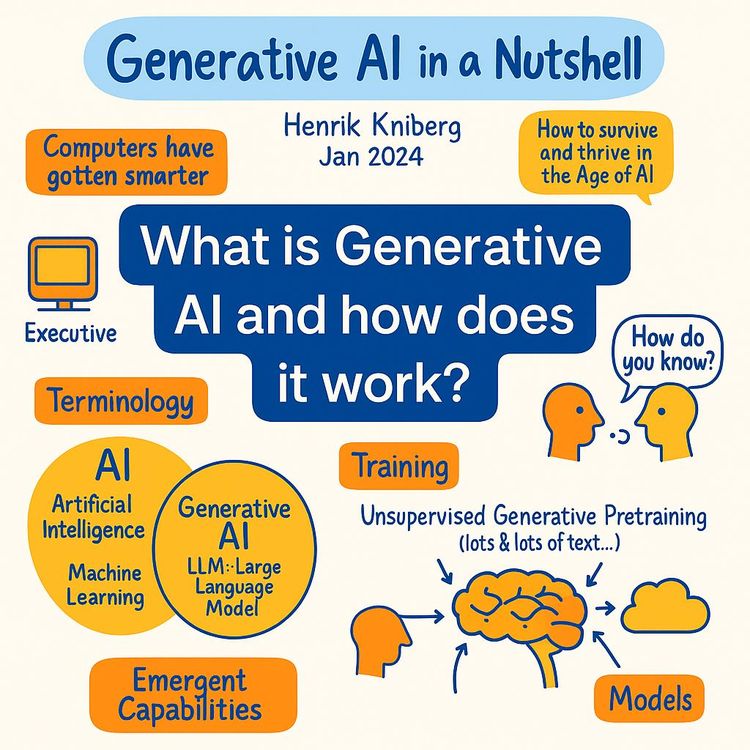
Video Course: What is Generative AI and how does it work?
Video Course: How to Use ChatGPT from Beginner to Professional
Video Course: How to Use Google Gemini for Google Workspace to Boost Productivity

Video Course: How to Use Claude 3.7 AI - Tips for Beginners!
Video Course: ChatGPT for Data Analytics: Full Course - from Beginners to Professional
Video Course: Generating Images and photos With ChatGPT?

Video Course: Generating Images & Photo's with MidJourney
Video Course: Generating Design's with Microsoft Designer and AI
Video Course: Generating Design's with Canva.com and AI
Join 20,000+ Professionals, Using AI to transform their Careers
Join professionals who didn’t just adapt, they thrived. You can too, with AI training designed for your job.