IAPP AIGP Certification Prep: AI Governance Online Course (Video Course)
Get clear on the AIGP v2.1 changes,no fluff. Learn the seven-stage OECD lifecycle, cross-region laws, and exam-style scenarios. Build the right artifacts, use the right roles, and walk in ready to lead with evidence.
Related Certification: Certification in Implementing AI Governance, Risk, and Compliance Programs
Also includes Access to All:
What You Will Learn
- Master the OECD seven-stage AI lifecycle and place activities correctly
- Implement Ethics-by-Design and Explainability-by-Design across stages
- Identify operator roles and jurisdiction cues (EU provider/deployer vs. generic)
- Translate global laws and standards (EU, US, China, NIST, ISO) into controls
- Create practical governance artifacts: AIIA, model/system cards, validation and monitoring evidence
Study Guide
AIGP v2.1 Full Course Update Explained
Let's cut to it. If you work anywhere near AI,privacy, risk, compliance, product, security, data science,governance is no longer optional. It's the difference between momentum and mess. This course breaks down the AIGP certification update (v2.1) into a complete, no-fluff learning path you can absorb, apply, and pass. You'll learn what changed, why it matters, and how to use it in the real world. We'll start from first principles and build to advanced, scenario-driven judgment,because the exam (and your job) rewards clear thinking, not trivia.
By the end, you'll know the seven-stage OECD AI development lifecycle cold, how to navigate multi-jurisdictional law and standards, what "Ethics by Design" looks like in practice, how to interpret operator roles based on context, and what GPAI providers are on the hook for. You'll also pick up study tactics and governance playbooks you can put in motion immediately.
What This Course Covers and Why It's Valuable
Here's the point of the AIGP v2.1 update: the field matured, regulations multiplied, and the IAPP brought the exam into line with how AI really gets built and managed across organizations. The old four-stage lifecycle isn't enough. The seven-stage OECD model is detailed, practical, and maps directly to modern MLOps and enterprise workflows.
This guide walks through every major change and every required area of competence. It also bridges the gap between "I get the concept" and "I can make decisions on the job." If you want a high-leverage credential in a field where demand far outpaces supply, this is worth mastering.
The State of AI Governance: Opportunity, Pressure, and Proof
Organizations are deploying AI everywhere. With that comes scrutiny,internal and external. Budgets for governance are rising, and leadership expects risk to be managed without slowing innovation. Most teams don't feel prepared. That's an opening for you.
Reports consistently show three things: a growing wage premium for AI skills, a significant average salary for AI governance roles, and the reality that only a minority of organizations feel ready. The message beneath those stats is simple: certified, execution-ready professionals are rare and valuable. The AIGP signal helps you stand out and contribute with confidence.
Exam Structure (v2.1): What You're Up Against
The AIGP exam contains 100 multiple-choice questions. Eighty-five are graded; fifteen are ungraded trial items. You won't know which is which, so treat every question like it counts. The exam draws from four domains, with a strong balance across technology foundations, regulatory knowledge, and the AI development lifecycle from planning to decommissioning.
Expect scenario-based questions that test whether you can place the right activity in the right lifecycle stage, apply the correct legal concept, and use the right operator terminology for the jurisdiction presented.
Examples:
* You're asked where "feature engineering" belongs. Under v2.1, you must map it to Stage 2: Data Collection and Preparation,not to "Develop," which is how it was framed in the older model.
* A scenario mentions a "provider" and a "deployer." If the question leans on EU terminology, those words have precise meanings. If it's more generic or US-focused, "developer" and "operator" might be used instead. Your job is to recognize the intended context.
From Old to New: The Big Shift to the OECD Seven-Stage Lifecycle
The single most important update is the move from a four-stage model (Plan, Design, Develop, Deploy) to a seven-stage model from the OECD. This isn't a cosmetic change. Activities are redistributed, responsibilities are sharper, and the exam now expects you to think like a lifecycle architect. The seven stages are:
1) Plan and Design
2) Data Collection and Preparation
3) Model Build and Validation
4) Testing and Evaluation
5) Deployment
6) Operation and Monitoring
7) Decommissioning
Why this matters: You'll be tested on what happens when, by whom, and with what evidence. Think artifacts, decision gates, controls, and documentation at each stage. If you learned the four-stage model, you must unlearn it and rebuild your maps.
Examples:
* Under the old framing, some teams tossed "data labeling" and "feature selection" into "Develop." Under v2.1, these are firmly in Stage 2 (Data Collection and Preparation).
* "Shadow testing" and "A/B evaluations" often get labeled as "monitoring" by habit. In v2.1 terms, pre-release shadow runs sit in Stage 4 (Testing and Evaluation), while live A/Bs belong in Stage 6 (Operation and Monitoring) with appropriate safeguards.
Domain 1: Foundations of AI,Why Technical Fluency Fuels Better Governance
This domain concentrates a large share of the key terms you'll see on the exam. It's not about turning you into a data scientist; it's about giving you the vocabulary and conceptual anchors to govern credibly. You should know what supervised vs. unsupervised learning means, what embeddings are, how training/validation/test splits work, and what drift, bias, and overfitting look like in practice. You should grasp the anatomy of an AI system: data pipelines, model artifacts, inference endpoints, and monitoring stacks. The goal is practical fluency, not math wizardry.
Examples:
* Bias risk starts with data. If your training data underrepresents a group, supervised models can learn patterns that exclude or misclassify. You need to spot this risk early,Stage 2, not after launch.
* Model drift shows up when the world changes faster than your model. A fraud model trained on last quarter's patterns can degrade quickly. Without monitoring and retraining triggers, both performance and compliance suffer.
Tips:
* Learn the language: confusion matrix, precision/recall tradeoffs, ROC curves, calibration, SHAP/LIME, embeddings, prompt injection. You won't derive formulas, but you must recognize what a team is talking about and ask sharp questions.
* Tie each technical term to governance evidence. If someone says "we performed validation," ask to see the validation report, test coverage, and acceptance criteria for the intended use case.
Domain 2: AI Laws, Standards, and Frameworks,Beyond a Single Jurisdiction
Version v2.1 expands the regulatory lens. Yes, the EU AI Act remains central. But the body of knowledge now includes US federal action, multiple US state laws, and a deeper view of China's regulatory framework, plus guidance from European regulators on data processing for AI training. Familiar standards like NIST and ISO sit alongside these laws to anchor good practice.
US Regulations: Federal and State
At the federal level, you're expected to recognize measures that address harms created by AI-enabled misuse,such as laws targeting the non-consensual sharing of intimate imagery and deepfakes. State activity is active and diverse: disclosure and labeling obligations for AI-generated content, election-related deepfake restrictions, algorithmic accountability or risk assessment requirements, and consumer rights around automated decision-making. You don't need to memorize every statute text, but you do need to understand the themes and what they imply for governance controls and incident response.
Examples:
* A marketing team wants to publish a realistic synthetic testimonial video. Certain states require clear disclosures that AI generated the content. Your governance process should mandate a disclosure review for AI media before release.
* A political advocacy group uses a voice clone in an ad. State laws may prohibit deceptive political deepfakes near election periods or require specific labels. Your compliance checklist for content teams must include these checks.
China's Regulatory Framework
China's approach features domain-specific rules for recommendation algorithms, deep synthesis, and generative AI services. Expect obligations around security assessments, content moderation mechanisms, transparency to users, record-keeping, and platform-level responsibility. If your product touches the Chinese market, your lifecycle must incorporate these controls explicitly,especially for generative systems that can produce synthetic media at scale.
Examples:
* A social app with a personalization engine must support algorithmic transparency notices and opt-out mechanisms under local requirements.
* A generative video tool hosted in China needs pre-release safety filters, content moderation workflows, and documentation of training data provenance.
European Data Guidance on Training and Anonymization
The curriculum highlights guidance from the European Data Protection Board on using legitimate interest for training AI models with publicly available personal data and on anonymization pitfalls. You must understand the legal basis analysis, reasonable expectation of the data subject, transparency requirements, and the fact that "publicly available" data is not a free pass. True anonymization is hard; if re-identification risk is non-trivial, you're still in personal data territory.
Examples:
* Your team scrapes public profiles for training. Even though the data is accessible, you must assess whether legitimate interest truly applies, document balancing tests, and ensure transparency and opt-out mechanisms where required.
* You "anonymize" logs by removing names but keep rare combinations of location, employer, and job title. That can be re-identifiable in practice. Proper anonymization requires rigorous techniques and documented risk analysis.
Standards to Know: NIST, ISO 42001, ISO 42005
NIST's AI Risk Management Framework offers a risk-based approach that complements legal requirements. ISO 42001 describes AI management systems,think policies, roles, continuous improvement. ISO 42005 focuses on conducting AI impact assessments. For the exam, you need high-level familiarity and the ability to map standards to lifecycle stages and artifacts.
Examples:
* Use NIST AI RMF to structure risk identification (harm types, likelihood, severity) during Stage 1 and Stage 4, and to align monitoring criteria during Stage 6.
* ISO 42005 can guide a structured AI impact assessment, defining system scope, affected stakeholders, foreseeable harms, mitigations, and post-deployment monitoring triggers.
Operator Terminology: Context Decides the Vocabulary
Here's a subtle but exam-critical update: you must differentiate between operator roles defined under the EU AI Act (e.g., provider, deployer) and more generic industry terms used elsewhere (e.g., developer, integrator, user). The correct term depends on the jurisdiction in the scenario. Mislabel the role, and you'll misapply the obligations.
Examples:
* In an EU context, a "provider" is the entity placing the AI system on the market or putting it into service under its name or trademark. A "deployer" uses the system in operations. An internal R&D team building a model for in-house use may be a provider if the system is put into service, even without external sale.
* In a generic US scenario, "developer" refers to the team or company building the model, and "operator" or "business user" is the team integrating it into workflow. Use these neutral terms unless the question clearly cues EU definitions.
Tip:
When reading a question, scan for location cues, references to CE marking, conformity assessments, or EU market language. That's your signal to switch to EU-specific operator terms.
Domains 3 & 4: The Seven Stages in Detail (What to Do, When, and How to Prove It)
Let's get tactical. You'll be asked to map activities, risks, and artifacts to the correct stage. Think of each stage as a decision gate with evidence. Below is a practical walkthrough of the seven stages with example activities, deliverables, and governance controls.
Stage 1: Plan and Design
Purpose: Frame the problem, define intended purpose and boundaries, identify stakeholders and harms, choose metrics, and set governance expectations. This is where Ethics by Design begins: define what "good" means before code is written.
Activities: Business case, intended use and non-intended uses, risk identification, legal basis and DPIA/AI impact assessment scoping, metric selection (accuracy, fairness, robustness), model card outline, human-in-the-loop design, data sourcing plan, documentation plan, and approval workflows.
Examples:
* A lender explores automated credit scoring. Stage 1 outputs include a risk assessment identifying fairness metrics (e.g., demographic parity difference) and a human review requirement for borderline scores.
* A healthcare chatbot's scope excludes diagnosis. Stage 1 defines deflection use only, with mandatory escalation rules to clinicians and clear disclaimers to users.
Best practices:
* Lock the intended purpose and out-of-scope uses in a single-page artifact that every stakeholder signs off on.
* Decide the minimal viable set of fairness, explainability, and robustness metrics now,don't improvise later.
Stage 2: Data Collection and Preparation
Purpose: Source, ingest, clean, label, and engineer features. Critically, this is where you treat data quality and bias. Privacy, consent, provenance, and documentation live here. Many teams under-govern Stage 2; the exam will punish that.
Examples:
* Feature engineering shifts here under v2.1. A hiring model team decides to drop features that proxy for protected attributes (e.g., college attended) and documents rationale and tests for disparate impact.
* A generative model team building a domain-specific LLM compiles a training set with clear licenses and performs PII scrubbing, logging transformations and residual risk analysis.
Best practices:
* Maintain a data lineage map: source → transformation → feature. Attach justifications for inclusion/exclusion.
* Run pre-training audits: sampling, imbalance checks, outlier handling, and sensitive attribute proxies. Document everything.
Stage 3: Model Build and Validation
Purpose: Train candidate models, tune hyperparameters, perform initial validation against defined metrics, and document results. Validation is not a handwave,produce evidence that the model meets acceptance thresholds set in Stage 1.
Examples:
* A fraud model is trained with gradient boosting; validation includes out-of-time testing, robustness to adversarial patterns, and fairness checks on approval/decline decisions across segments.
* A recommendation system is validated for coverage, diversity, and exposure fairness, not just click-through, with a written tradeoff analysis signed by risk and product.
Best practices:
* Separate training, validation, and test sets. Keep them clean. No leakage.
* Write a validation report that a non-technical reviewer can understand. Include charts, thresholds, and decisions made.
Stage 4: Testing and Evaluation
Purpose: War-game the system before live deployment. This includes red-teaming, security and privacy testing, abuse testing, and user acceptance tests in realistic environments. Confirm controls for explainability, fallback mechanisms, and incident response are wired.
Examples:
* A generative text bot is red-teamed for prompt injection, jailbreak attempts, and data exfiltration. The team tunes system prompts, adds content filters, and documents residual risks and mitigations.
* A vision model is tested under poor lighting and motion blur to evaluate robustness. Accessibility testing ensures screen reader compatibility for explanations.
Best practices:
* Test for "negative space": misuse, edge cases, and failure modes. Don't only test where you expect success.
* Tie every discovered issue to a remediation owner and a re-test date before go/no-go.
Stage 5: Deployment
Purpose: Release with controls engaged. This is where you complete conformity steps (where applicable), finalize technical and user documentation, set rate limits, and enable safe operations. Deployment is a controlled handoff, not a finish line.
Examples:
* A multilingual customer support bot launches with tiered guardrails: conservative default temperature, escalation to agents for low-confidence intents, and content labeling for AI-generated responses.
* A risk model rollout uses canary deployment for a subset of users with rollback gates if drift or fairness deviations cross thresholds.
Best practices:
* Ship with toggles: feature flags, safe modes, throttles, and trace logging. You'll need them.
* Publish a model card or system card that includes purpose, limitations, evaluation summaries, and contact points for issues.
Stage 6: Operation and Monitoring
Purpose: Sustain and control the system in production. Measure performance, bias, drift, explainability outcomes, user complaints, and incidents. Trigger retraining or de-tuning based on pre-agreed thresholds. Update documentation as the system evolves.
Examples:
* A loan underwriting model shows a slow decline in AUC and a spike in complaints from a specific region. Monitoring triggers an investigation, retraining with fresh data, and a fairness recalibration.
* A creative generative model starts producing borderline outputs due to trending prompts. Filters are updated, a safety policy change is recorded, and content labels are adjusted for transparency.
Best practices:
* Set numeric thresholds and tolerance bands for metrics at Stage 1 and enforce them here. No vague "we'll watch it."
* Maintain a runbook for incident response: detection, containment, notification, remediation, and postmortems with clear accountability.
Stage 7: Decommissioning
Purpose: Retire responsibly. Plan for model sunset, data retention and deletion, archival of documentation, and communication to users and stakeholders. Decommissioning is part of governance, not an afterthought.
Examples:
* You replace a legacy NLP classifier. You document the retirement rationale, disable endpoints, archive artifacts, and delete datasets per retention policy while keeping audit logs for compliance.
* An external vendor model is no longer supported. You plan a staged rollback, inform users, and preserve risk assessments, contracts, and test results in an immutable archive.
Best practices:
* Create a "sunset plan" at Stage 1. When the day comes, you won't scramble.
* Ensure that any dependent processes or products are mapped and updated during decommissioning.
Ethics by Design and Explainability by Design: Operational, Not Theoretical
Ethics by Design means you build ethical principles into decisions at each stage,purpose limits, fair data practices, meaningful oversight, and safe defaults. Explainability by Design ensures that explanations are not bolted on; they are a requirement for model selection, interface design, and user outcomes.
Examples:
* During Stage 1, you decide between a deep neural network and a gradient boosting model. If regulators and users need clear reasons for outcomes, you choose the more interpretable model or pair the complex model with robust explanation tooling and user-friendly summaries.
* During Stage 6, you monitor not only performance but the quality of explanations,are users satisfied, do explanations help them act, and are they consistent across similar decisions?
Tips:
* Tie ethics to measurable constraints: set fairness thresholds, document tradeoffs, and require sign-off from risk and product on each tradeoff.
* Design explanations for the audience: regulators need technical evidence; customers need clear, plain-language reasons.
AI Impact Assessments (ISO 42005): Make Risk Visible and Actionable
An AI impact assessment (AIIA) is your structured method to surface and mitigate risk. ISO 42005 offers guidance for how to do this well. The aim isn't paperwork; it's clarity on harms, affected stakeholders, mitigations, and monitoring.
Practical flow:
* Scope: define system purpose and context, stakeholders, and intended outcomes.
* Risk identification: enumerate potential harms,privacy, fairness, safety, security, manipulability, environmental, and societal.
* Mitigations: map controls to risks across lifecycle stages.
* Residual risk: quantify what remains and set monitoring triggers.
* Governance: assign owners, review cadence, and escalation paths.
Examples:
* A retail pricing optimizer might harm vulnerable consumers via personalized surcharges. Mitigations include guardrails to avoid protected-class targeting, audit logs, and human review for outlier price changes.
* A safety monitoring vision system at a factory raises privacy issues. Mitigations include on-device processing, data minimization, short retention, and transparent worker notices with feedback channels.
Best practices:
* Treat AIIA as a living document updated at Stage 4 (pre-release) and Stage 6 (post-release).
* Link AIIA outcomes to deployment gates. If residual risk exceeds thresholds, no launch.
GPAI and Foundation Models: Global Obligations and Enforcement Themes
General Purpose AI providers face heightened obligations. The bigger and more adaptable the system, the more guardrails and documentation are expected. Themes repeat across jurisdictions: transparency of capabilities and limits, documentation of training data sources and risk mitigations, safety testing at scale, and responsible downstream use guidance.
Examples:
* A foundation model provider publishes a system card detailing intended uses, known failure modes, red-teaming coverage, and content safety specifications. They provide reference filters and guidelines to integrators.
* A provider documents training data provenance and implements opt-out mechanisms for web content owners, plus a policy for handling takedown requests of harmful outputs or leaked personal data.
Enforcement commonalities:
* Risk-based oversight: the higher the impact, the tighter the controls expected.
* Documentation-first: if you didn't write it down, it didn't happen.
* Audits and assessments: be prepared to show process, not just outputs.
* Transparency and user redress: clear labels, channels for complaints, timely remediation.
Global Regulatory Scope: What Expanded Coverage Means for You
v2.1 makes it clear: don't study a single jurisdiction in a vacuum. Learn how different regions handle deepfakes, automated decision-making, data for training, and GPAI. The exam will present scenario cues and expect you to adapt your vocabulary and obligations. Build a simple mental model: purpose clarity + risk-based controls + evidence. Apply that model regardless of region, then fit the local specifics where needed.
Examples:
* Content disclosures for AI media may be required under certain US state laws and under China's deep synthesis rules. The control is the same: label synthetic media and keep logs of how and when it was generated.
* Using publicly available data for training may require transparency and a legal basis in the EU, while in other regions it may hinge more on contract, copyright, and consumer protection. Your workflow should always document data provenance and a legal assessment.
Process and Workflow Are Paramount: How to Think in Stages
Most wrong answers come from mixing stages. The fix is to map activities to the seven-stage flow and anchor your governance evidence accordingly. When in doubt, ask: what decision is being made right now, and what proof is required to make it responsibly?
Examples:
* A question about "rollback" belongs to Stage 5 or 6, not Stage 3. If the scenario involves live users, think Stage 6. If it's during release, Stage 5.
* "Balancing tests" for legitimate interest relate to Stage 1 scoping and Stage 2 data preparation,not Stage 4 testing.
Tip:
Draw a seven-box diagram on your scratch paper before you start the exam. Place tricky activities into boxes first. Then answer.
Operator Roles and Responsibilities: Getting the Labels Right
Reinforcing a core update: in EU contexts, "provider" and "deployer" mean specific things tied to obligations (e.g., technical documentation, conformity assessment for providers; usage controls and monitoring for deployers). In other contexts, stick to generic "developer," "integrator," "user," or "operator." Mislabeling = misapplied duties.
Examples:
* Your company builds an AI model and embeds it in a product sold to clients in the EU. You are acting as a provider. Expect obligations for documentation, risk management, and possibly conformity steps.
* Your operations team purchases a third-party AI moderation tool and uses it on your platform. You are the deployer (EU) or operator (generic). Your obligations include monitoring, impact assessment, and implementing usage policies.
Building a Practical Governance Operating Model
Certification is proof. Execution is power. A pragmatic operating model looks like this:
* Policies: a short stack of clear policies on AI use, data handling, human oversight, explainability, incident response, and model retirement.
* Roles: product owns intended use; data science owns model performance; risk and legal own thresholds and documentation; security owns threat modeling and testing; compliance owns review cadence.
* Stage gates: go/no-go criteria for each lifecycle stage, with artifacts required before passing to the next.
* Tooling: model registry, lineage tracking, evaluation dashboards, explainability tools, monitoring alerts, and ticketing for incidents.
Examples:
* A model registry entry includes: purpose, owners, datasets with provenance, evaluation metrics and results, known limitations, and links to AIIA and model/system cards.
* A monitoring dashboard shows live performance, fairness deltas, drift indicators, flagged user complaints, and SLA timers for incident response.
Best practices:
* Keep artifacts lightweight but consistent. One-page summaries beat scattered docs.
* Make stage gates visible to leadership. Accountability drives quality.
Exam Strategy: How to Study (and What to Stop Doing)
Here's how to prepare effectively:
* Master the seven-stage lifecycle. Build flashcards mapping activities to stages. Do daily drills until you can recall instantly.
* Unlearn the four-stage habit. If you catch yourself thinking "Develop," translate it into the correct Stage 2-4 breakdown.
* Practice context detection. When you see EU-wired cues, swap your vocabulary to provider/deployer. Otherwise, use generic terms.
* Read questions slowly. Most traps hinge on a single word indicating stage or jurisdiction.
* Expect 15 trial questions. Don't panic if something feels off. Keep moving and maintain pace.
Examples:
* Build a two-column sheet: left = activity (e.g., "stress test prompts," "shadow test," "delete training data"), right = lifecycle stage. Shuffle and fill daily.
* Write two explanations for the same scenario: one using EU roles (provider/deployer), one using generic roles (developer/operator). Notice how obligations shift.
Best practices:
* Simulate time pressure. Short sprints of 10 questions with strict timing will improve focus.
* After each practice session, categorize mistakes: stage confusion, law confusion, terminology confusion. Fix the root pattern.
Deep Dive: Stage-by-Stage Artifacts and Evidence
One powerful way to think about governance is: what single artifact proves we did the right thing at this stage?
* Stage 1: Problem definition + Intended Purpose Statement + Preliminary AIIA outline.
* Stage 2: Data Lineage Record + Bias and Quality Assessment + Consent/Legal Basis log.
* Stage 3: Validation Report + Fairness and Robustness Test Results + Model Selection Rationale.
* Stage 4: Red-Team Report + Security/Privacy Test Logs + UAT Outcomes + Go/No-Go Memo.
* Stage 5: Deployment Plan + System Card + Runbooks + User Communications.
* Stage 6: Monitoring Dashboard + Incident Log + Retraining Plan + Change Log.
* Stage 7: Sunset Plan + Decommission Checklist + Archival Index + Retention/Deletion Proof.
Examples:
* A system card that maps intended purpose, limitations, evaluation highlights, and contact channels satisfies disclosure expectations across multiple jurisdictions and helps downstream users operate responsibly.
* A red-team report that includes abuse cases, jailbreak response, safety filter changes, and residual risk notes becomes central evidence for both internal audits and external inquiries.
EDPB Guidance in Practice: Legitimate Interest and Anonymization
Two practical implications from European guidance matter for day-to-day decisions:
* Legitimate interest for training on publicly available personal data is not automatic. You need a balancing test, transparency measures, and opt-out handling where applicable.
* True anonymization requires a high bar. If meaningful re-identification risk remains, treat the data as personal and comply accordingly.
Examples:
* Your news summarizer trains on public articles that include bylines and quotes. You document a legitimate interest analysis, publish a clear notice, provide contact for opt-out, and minimize retention of identifiable elements.
* Your team tries to anonymize customer support logs. You run k-anonymity tests and simulated re-identification attempts. Results show risk remains for VIP customers; you adjust by aggregating sensitive fields and shortening retention.
Tips:
* Always link legal basis analysis to Stage 2 data preparation decisions. The assessment should drive what you keep, transform, or discard.
* Treat anonymization as engineered risk reduction, not a checkbox. Test, measure, document.
US State Laws and Practical Controls
State laws add obligations like disclosure labels for AI-generated content, restrictions on deceptive deepfakes in elections, and accountability expectations for automated decision systems. Translate these into controls early so content, marketing, and product teams move confidently.
Examples:
* Your platform watermarks AI-generated images and adds visible labels. You keep generation logs to support audits and user disputes.
* Your ad operations team uses a pre-flight checklist to scan for election-related content and enables "human review required" flags for sensitive campaigns.
Best practices:
* Build jurisdiction-aware playbooks. If your content is geo-targeted, apply the strictest applicable standard by default to reduce complexity.
* Maintain a matrix of obligations by content type (text, audio, video) and embed it into publishing workflows.
China Requirements and Productization
For teams touching China's market, expect rigorous obligations for deep synthesis and recommendation systems: user notices, content moderation systems, security assessments, and record-keeping.
Examples:
* A generative avatar app includes in-product notices when content is synthetic, plus a "report content" flow that triages to moderators with escalation SLAs.
* A news feed algorithm offers explanation features and user controls to adjust personalization, with logs to demonstrate compliance during inspections.
Tips:
* Design platform-level controls (labels, reports, moderation) that are reusable across products. It reduces compliance friction and creates consistent user trust patterns.
* Budget for documentation time. These markets expect evidence, not just features.
Integrating NIST, ISO, and Lifecycle Controls
Standards are your structure. Use NIST AI RMF to formalize risk thinking, ISO 42001 to define your management system (policies, roles, continuous improvement), and ISO 42005 to drive high-quality impact assessments. Then map each to the seven stages so your governance feels like one system, not a pile of paperwork.
Examples:
* In Stage 1, use NIST's risk framing to identify potential harms and define evaluation metrics with business impact in mind.
* In Stage 6, ISO 42001's continuous improvement loop guides how monitoring results feed back into retraining and policy updates.
Scenario Mastery: How the Exam Tests Your Judgment
You'll see realistic vignettes with missing information. Your job is to infer the stage, the role, the jurisdiction, and the control implied. Train your brain to ask: what's the intended purpose, where in the lifecycle are we, who has which obligations, and what artifact proves we did the right thing?
Examples:
* "A team plans to source data from public forums for a toxicity classifier." Stage 1-2. You'd expect a legal basis analysis, a data minimization plan, and consent/notice considerations. Under EU cues, also expect a balancing test and transparency.
* "The model's performance dropped after a product pivot." Stage 6. Trigger retraining, update monitoring thresholds, run a focused AIIA addendum for the new context, and notify stakeholders.
Implications and Applications: For Professionals, Educators, and Organizations
Professionals: this certification gives you a structured way to lead AI safely and credibly, even from non-technical roles. Educators and trainers: design scenario-based drills around the seven stages and cross-jurisdictional operator roles so learners develop judgment, not just vocabulary. Organizations: use the v2.1 framework to build or upgrade your governance program,clear stage gates, measurable thresholds, and reusable artifacts accelerate both compliance and delivery.
Examples:
* A privacy professional co-leads Stage 2 reviews, ensuring data provenance, minimization, and lawful basis are documented before any training starts.
* A training program runs "stage labs" where learners must produce a one-page artifact per stage, then peer-review for completeness and clarity.
Action Items and Recommendations (Direct From the Update)
Priority moves if you're preparing for v2.1 or modernizing your program:
* Prioritize the new lifecycle. Memorize the seven stages and map activities to each. Practice until you can place any task instantly.
* Rethink previous knowledge. Unlearn the four-stage model. Re-learn the distribution of tasks, especially data work now sitting in Stage 2 and testing separations between Stage 3 and Stage 4.
* Expand regulatory study. Go beyond the EU AI Act. Add US federal activity, a spread of state laws, and China's frameworks. Absorb the common patterns: transparency, risk assessment, and documentation.
* Focus on terminology and context. Train yourself to identify jurisdictional cues so you can apply the right operator labels and obligations.
Examples:
* Build a "stage split" cheat sheet that lists 20+ activities and their correct placements. Review daily.
* Create a role translation guide: EU provider/deployer vs. generic developer/operator with example obligations for each.
Governance in the Age of GPAI: What Good Looks Like
As foundation models become infrastructure, your governance must scale. Think platform guardrails, partner enablement, and transparent documentation. The themes remain the same: purpose clarity, risk-based controls, and strong evidence.
Examples:
* A GPAI provider offers a fine-tuning API with built-in content filters, rate limits, abuse monitoring, and a best-practice playbook for downstream deployers.
* An enterprise consuming a GPAI service implements prompt hygiene training, PII suppression middleware, and a logging layer to trace prompts and outputs to business impact and incidents.
Best practices:
* Provide model and system cards externally and internally. The same artifact doubles as documentation for customers and auditors.
* Maintain a change log with versioned evaluations so you can trace any behavior shift to a release event.
Common Pitfalls and How to Avoid Them
Watch for these traps on the exam and in real projects:
* Stage confusion: mixing validation and testing, or testing and monitoring.
* Operator mislabeling: using "provider" in a generic scenario or vice versa.
* Weak data governance: skipping provenance checks and bias assessments in Stage 2.
* Documentation gaps: solid controls but no artifacts to prove them.
Examples:
* A team writes a great red-team plan but never executes and records it. In an audit, it's as if it never happened.
* A project claims "we'll monitor for bias" but has no numeric thresholds, no ownership, and no dashboards. That's not monitoring; that's a wish.
Bringing It All Together: A Lightweight, High-Trust Workflow
Here's a simple, repeatable blueprint to operationalize everything you've learned:
* Start with a one-page Intent + Risk sheet (Stage 1).
* Add a Data Dossier with lineage and bias checks (Stage 2).
* Produce a Validation Summary with clear thresholds (Stage 3).
* Red-Team and UAT Report with a Go/No-Go memo (Stage 4).
* Deployment Packet: system card, runbook, labels, and toggles (Stage 5).
* Monitoring Dashboard + Incident Runbook (Stage 6).
* Sunset Plan + Archival Proof (Stage 7).
That's your governance backbone. It's lightweight, teachable, and defensible.
Examples:
* In a quarter, you roll out three models using the same backbone. Audit requests become easy: you hand over packets per stage.
* During an incident, your runbook guides containment and communication within minutes, not days. Postmortems feed directly into Stage 1 and Stage 6 improvements.
Final Exam Tips: How to Think Under Pressure
* First pass: answer the "obvious" ones to build momentum.
* Mark any question with jurisdiction or role ambiguity; revisit after you see more patterns.
* For lifecycle confusion, sketch the seven boxes and place the activity before reading answers.
* If two answers seem right, pick the one that produces better evidence and auditability. The exam rewards provable governance.
Examples:
* Faced with "Where should you assess re-identification risk?" choose Stage 2 and Stage 4 (data prep and pre-release evaluation), not Stage 6 only.
* Asked "Who is responsible for technical documentation in an EU scenario?" lean provider, unless the scenario clearly shifts responsibilities downstream.
Recap of Every Major Update You Must Know
* The lifecycle moved to seven OECD stages. Activities were redistributed (e.g., feature engineering now in Stage 2).
* Ethical concepts were elevated: Ethics by Design and Explainability by Design throughout the lifecycle.
* Regulatory scope widened: US federal action, a spread of state laws, deeper coverage of China's framework, and focused European guidance on legitimate interest and anonymization.
* Standards knowledge matters: NIST AI RMF, ISO 42001 for management systems, ISO 42005 for AI impact assessments.
* Operator terminology must match jurisdiction: EU's provider/deployer vs. generic developer/operator.
* GPAI obligations and global enforcement themes: documentation-first, risk-based, transparency, audits, user redress.
* The exam weights workflows and context recognition more than memorized trivia.
Examples:
* Lifecycle mapping questions: place activities precisely by stage and justify with artifacts.
* Role-and-law scenarios: identify EU vs. non-EU cues, then assign obligations accordingly.
Conclusion: Your Advantage Starts with Execution
AI governance is no longer a side quest. It's the operating system for scaling AI responsibly. v2.1 turned the AIGP into a practical roadmap: seven clear stages, sharper ethical expectations, and a realistic view of global law. If you internalize the lifecycle, learn to read jurisdictional cues, and build a habit of creating solid artifacts, you become the person teams trust when the stakes go up.
Take what you learned here and put it to work immediately: map your current projects to the seven stages, run a fast AIIA on one system, create a one-page system card, and set two monitoring thresholds you can defend. Small moves add up fast. The certification proves you know the path. How you apply it proves you can lead.
Frequently Asked Questions
This FAQ explains the AIGP v2.1 Full Course Update so you can quickly find clear answers without sorting through dense documentation. It prioritizes practical guidance, clarifies exam changes, and gives examples you can use at work. Each answer flags the key point up front, then adds context, so you can skim or study in depth.
Part 1: Foundational Questions about AIGP
What is the Artificial Intelligence Governance Professional (AIGP) certification?
Quick answer:
A credential that validates your ability to build and run AI governance across the full AI lifecycle.
The AIGP confirms you can orchestrate, implement, and manage an AI governance program end-to-end. It covers risk, accountability, controls, and oversight from design through decommissioning.
You'll be assessed on technical fluency (enough to govern, not to code), legal and standards awareness, and operational practices such as risk assessments, documentation, monitoring, and incident response. Real-world example: building a governance playbook for a customer-service chatbot,policy alignment, training data vetting, bias checks, explainability choices, human-in-the-loop, and ongoing monitoring.
Who offers the AIGP certification?
Quick answer:
The IAPP (International Association of Privacy Professionals) administers AIGP.
The IAPP expanded from privacy to include AI governance and digital responsibility. It brings established credibility, exam rigor, and a global professional network.
If you already know IAPP from CIPP/CIPM/CIPT, expect a similar exam experience: scenario-first questions, policy-to-practice orientation, and alignment with leading standards and regulations. Employers understand IAPP credentials, which helps hiring managers benchmark your governance capability.
What is the primary objective of the AIGP certification?
Quick answer:
To prepare professionals to manage AI responsibly across technology, policy, and operations.
You'll learn to connect AI design and data decisions to risk, law, and accountability.
That includes translating requirements into controls, choosing documentation artifacts that matter, and aligning governance to lifecycle stages. Example: turning a policy mandate ("avoid unfair outcomes") into measurable checks (bias metrics, representative sampling) with escalation paths and executive reporting.
Who should consider getting the AIGP certification?
Quick answer:
Professionals responsible for AI risk, compliance, or accountability,plus adjacent roles seeking AI governance fluency.
Primary roles include AI Governance Officers, AI Ethicists, and AI Risk Managers. Adjacent roles,privacy leaders, cybersecurity managers, GRC specialists, legal/compliance, IT project managers, auditors, data scientists/engineers,benefit by adding governance to their core skillset.
If your job touches AI decision rights, risk review, procurement, vendor oversight, or model monitoring, AIGP gives you a shared language and framework with product and technical teams.
Are there any prerequisites to take the AIGP exam or receive the certification?
Quick answer:
No formal prerequisites.
You don't need prior IAPP certs or specific experience.
That said, candidates with some exposure to privacy, security, risk, product, or data projects ramp faster. If you're new, use the course and official glossary to build core concepts first,AI basics, lifecycle stages, legal/operator roles, impact assessments,then map controls to real scenarios.
Part 2: Value and Career Impact of AIGP
Why is AIGP certification valuable in the current job market?
Quick answer:
There's a growing skills gap between AI adoption and governance talent.
Organizations are moving from pilots to production and need accountable AI. Independent research highlights governance as the catalyst that turns experiments into reliable, compliant operations.
Few teams feel fully prepared, so verified expertise stands out. Example: an enterprise wants to roll out an LLM-based assistant; AIGP-level pros build policy guardrails, vendor screening, safety testing, and monitoring,shortening time-to-value while avoiding public incidents.
Certification
About the Certification
Get certified in AI Governance (IAPP AIGP). Apply the OECD 7-stage lifecycle, align to cross-region laws, set roles, build required artifacts, draft policy, run risk reviews, and deliver audit-ready AI,ready to lead programs on day one.
Official Certification
Upon successful completion of the "Certification in Implementing AI Governance, Risk, and Compliance Programs", you will receive a verifiable digital certificate. This certificate demonstrates your expertise in the subject matter covered in this course.
Benefits of Certification
- Enhance your professional credibility and stand out in the job market.
- Validate your skills and knowledge in cutting-edge AI technologies.
- Unlock new career opportunities in the rapidly growing AI field.
- Share your achievement on your resume, LinkedIn, and other professional platforms.
How to complete your certification successfully?
To earn your certification, you’ll need to complete all video lessons, study the guide carefully, and review the FAQ. After that, you’ll be prepared to pass the certification requirements.
Other AI Video Courses
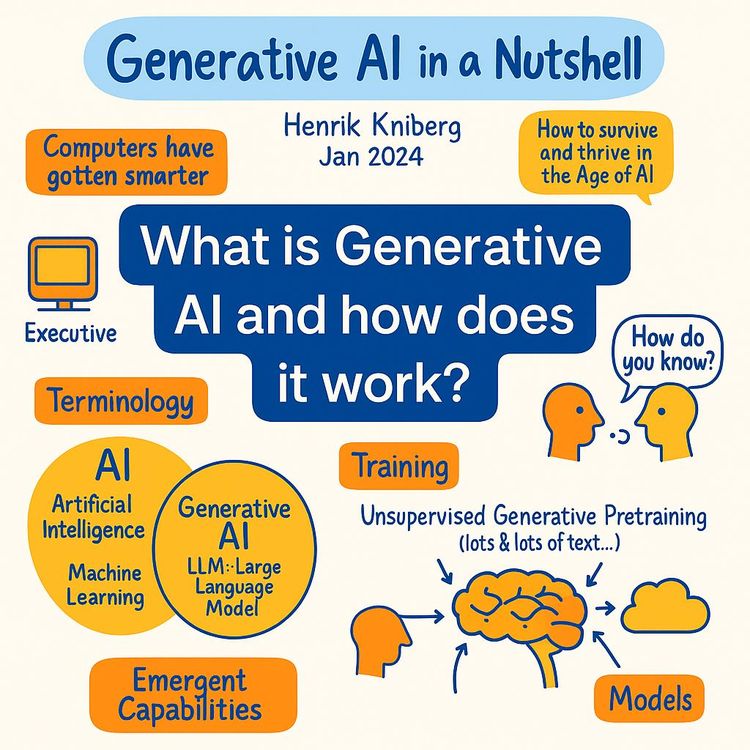
Video Course: What is Generative AI and how does it work?

Video Course: How to Use ChatGPT from Beginner to Professional
Video Course: How to Use Google Gemini for Google Workspace to Boost Productivity

Video Course: How to Use Claude 3.7 AI - Tips for Beginners!

Video Course: ChatGPT for Data Analytics: Full Course - from Beginners to Professional

Video Course: Generating Images and photos With ChatGPT?

Video Course: Generating Images & Photo's with MidJourney
Video Course: Generating Design's with Microsoft Designer and AI

Video Course: Generating Design's with Canva.com and AI
Join 20,000+ Professionals, Using AI to transform their Careers
Join professionals who didn’t just adapt, they thrived. You can too, with AI training designed for your job.