Self-Improving AI Agents: Open Problems & Future Directions (Video Course)
Self-improving AI hits walls. This final part tackles the frontier: diversity, verification, data, and intelligence per watt. See where the field breaks and what's next.
Related Certification: Certification in Building Self-Improving AI Agents
Also includes Access to All:
What You Will Learn
- Explain the three bottlenecks limiting self-improving agents: diversity, verification, and data
- Apply multi-agent fine-tuning and debate-style workflows to sustain diverse, improving trajectories
- Design meta-verification pipelines to make verifier feedback trustworthy and reduce hallucinated rewards
- Implement proposer-solver frameworks for self-generated curricula that scale without human experts
- Measure and optimize intelligence-per-watt and build hybrid local/cloud routing for efficient deployment
- Assess open research challenges: test-time scaling, continual learning, and new serving infrastructure
Study Guide
A Different Kind of Intelligence
We've spent the last eight parts of this journey building a mental model of self-improving AI. We've seen how agents go beyond simple chatbots, how they interact with environments, and how they use feedback loops to get better. But if you've been paying attention, you've probably noticed a pattern: the biggest wins happen in math and coding, places with clear right and wrong answers. And there's a dirty secret lurking underneath even those wins. The systems often plateau. They hit a wall where more training does nothing, or worse, they start to collapse in on themselves, generating the same solutions over and over until they're just spinning their wheels. This final part is about the frontier, the messy, exciting, and wide-open territory where the next generation of these systems will be built on. This is where we stop celebrating what works and start interrogating why it works, and more importantly, what breaks when we try to push further.
The material we're covering here is the capstone of everything you've learned so far. It synthesizes the concepts of test-time scaling, train-time scaling, verifiers, reinforcement learning, and multi-agent systems into a coherent picture of where the field is heading. You'll learn about the three critical bottlenecks that are holding back truly autonomous, self-improving systems. You'll learn about diversity, why it's not just a nice-to-have but the very fuel that keeps the improvement loop alive. You'll learn about verification, the hard problem of knowing whether the model's reasoning is actually sound, not just its final answer. And you'll learn about data, specifically how models can start generating their own curriculum, breaking free from the shackles of human expertise.
And then there's the efficiency problem. We're going to talk about a metric called "intelligence per watt," which might just be the most important number to understand in the coming years. This isn't just an academic exercise. Understanding these frontiers is how you position yourself to build the next big thing, whether that's a startup, a research lab, or just a smarter way of deploying AI inside an existing company. We're going to dig into the open questions, look at the promising solutions, and get you to a place where you can see the future of this field, not as a spectator, but as someone ready to build it.
Rethinking the Self-Improvement Loop
Before we dive into the future, let's anchor ourselves in the present. Remember the fundamental loop that defines a self-improving agent. It's deceptively simple. Generate a bunch of candidate outputs for a task. Verify them. Use the feedback from that verification to update the model. Repeat. That's it. This simple loop, powered by verifiers and rewards, has driven the remarkable progress in narrow domains. It's why models can now solve competition-level math problems and write complex code.
But this loop is built on a fragile foundation. It assumes that the verification is accurate, that the data being generated is diverse enough to teach new things, and that human curation isn't a bottleneck. All three of these assumptions are under severe strain. The single biggest problem is that when a model generates its own training data, it tends to generate the same kind of solutions. It's like a student who only studies one type of problem over and over. They get really good at that specific type, but they don't actually understand the broader principles. The model gets trapped in a local optimum. Its performance plateaus because it never sees anything new.
Then there's the verification problem. In math, we have ground truth. The answer is either 42 or it isn't. But the reasoning path to that answer can be completely flawed. A model can stumble upon the right answer through a series of illogical steps. And here's the kicker: large language models are terrible at judging their own reasoning. They're trained on vast amounts of text, but they haven't internalized the rules of formal logic. When you ask an LLM to verify a mathematical proof, it will often approve a completely invalid argument, because the language of the proof looks correct, even if the logic is nonsense. Human experts can spot the gap between steps, but they're expensive and slow.
And finally, data. The field's progress has been fueled by human-curated data. For math, you need math experts. For coding, you need software engineers. But what happens when the model gets so good that it surpasses the expertise of the very people who are supposed to be teaching it? We're already on the cusp of this. Finding experts who can generate tasks that are more challenging than a frontier model is getting harder and harder. These three bottlenecks, diversity, verification, and data, are the key problems of this era. They are the areas where the next major breakthroughs will happen.
The Diversity Bottleneck: Why One Brain Isn't Enough
Let's explore that first bottleneck in detail. The problem of diversity is insidious. When you fine-tune a single model on a dataset it generated itself, something strange happens. Even if you sample responses at a high temperature, encouraging randomness, the solutions tend to converge. It's not just that they arrive at the same answer, they arrive at the same *way* of solving the problem. They follow the same logic, structure their arguments similarly, and make the same kinds of minor errors. If you measure the "distance" between these solutions by looking at their embedding vectors, they're remarkably close together.
This homogeneity is fundamentally at odds with how human knowledge is created. The pre-training data that gives these models their base capabilities is human-generated, and humans are messy and diverse. We think about problems from many different angles. A single model, even a very powerful one, is just one perspective. When it's forced to generate data for itself, it can only ever see the world from its own limited viewpoint. It's locked in an echo chamber of its own thoughts.
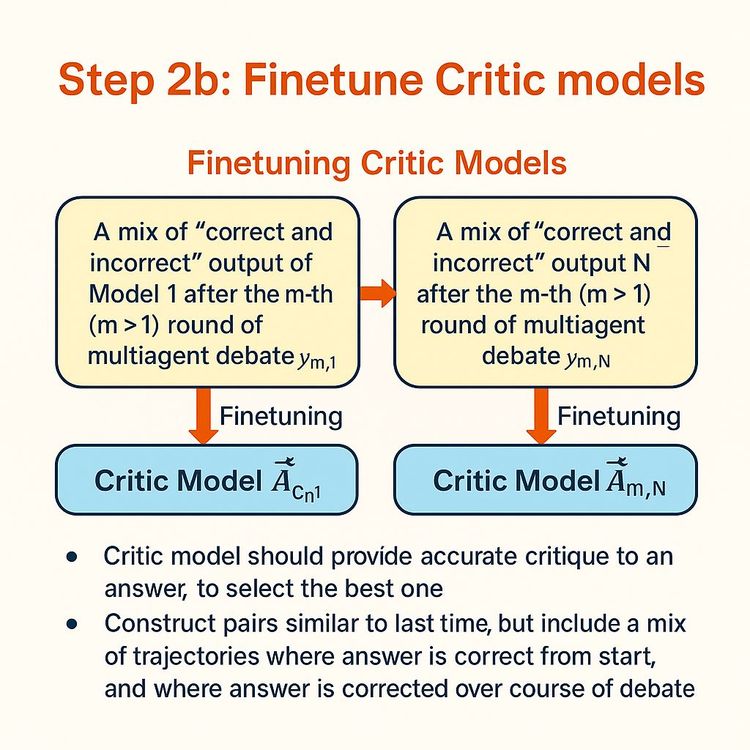
The most promising solution to come out of this analysis is the idea of multi-agent fine-tuning. The core insight is that you need multiple, distinct "points of view" to generate diverse training data. You can't just sample from the same model, because it's a single distribution. You need to create different distributions. The architecture for this is fairly straightforward and elegant. You start with a base model. Then you fine-tune several *generation agents* from it. You can't use the same fine-tuning data for each one, or you're back to square one. You have to give each one a different "personality" or a different set of experiences. You also create *critic agents*, which are trained specifically to evaluate and refine solutions, rather than generate them from scratch.
The process looks a bit like a debate. First, each generation agent produces its own initial answer to a problem, independently. This is where the diversity comes from. If you have five agents, you get five different approaches. Then you need to synthesize these. You could use another model to summarize the key points, or you could simply concatenate all the answers together into one long text. Once they're combined, the critic agent gets involved. The critic's job is to look at the combined set of answers and identify strengths and weaknesses. It critiques the individual solutions in the context of all the others. It might say something like, "Answer A has a correct methodology but makes an arithmetic error in step three. Answer B has the right final answer but its initial assumptions are flawed." This critique is then fed back to all the generation agents.
Now the generation agents get their second chance. They see the critique plus all the other agents' answers. This forces them to confront alternative approaches and learn from their own mistakes in light of others. They produce updated answers. This process repeats for a few rounds, and at the end, a simple majority vote determines the final answer. This multi-agent approach solves the diversity problem in two ways. First, it generates a diverse set of initial solutions. Second, the debate process itself creates rich training data. The trajectories where an agent starts with a wrong answer and is guided to a correct answer through the critique process are incredibly valuable. You can train the system to prefer these paths, teaching it how to self-correct.
The empirical results are clear. In experiments, single-agent fine-tuning on self-generated data would show performance gains for a few iterations and then collapse. Multi-agent systems, on the other hand, sustained improvement across many more iterations. The diversity of solutions, as measured by embedding dissimilarity, remained high throughout the training. And there's a beautiful side effect: majority voting, which is a powerful technique for improving accuracy, emerges naturally as a byproduct of the debate. You're not just getting diverse training data; you're getting a better inference-time strategy for free.
The key takeaway here is that diversity is not a luxury. It's the fuel for self-improvement. Without it, the loop will always stagnate. The question becomes, can you maintain this diversity at scale? In the future, this might not just mean training multiple agents from different data. It could mean evolving agents with completely different architectures, or agents that are rewarded specifically for proposing solutions that are novel and different from what's already been seen.
The Meta-Verification Problem: Who Watches the Watchmen?
Now let's move to the second bottleneck, which is verification. In a domain like theorem proving, a correct final answer isn't enough. The reasoning must be logically valid at each step. This is where LLM-as-judge approaches fall apart. You can take a model that's great at math, ask it to prove a theorem, and then ask it to verify that proof, and it will frequently tell you the proof is flawless, even when it isn't. This isn't because the model is dumb; it's because the model is a language model, not a logic engine. It recognizes the linguistic patterns of a convincing proof, but it can't reliably trace the logical connections.
This is a critical problem because most of the self-improvement systems we've discussed rely on some form of reward signal to guide training. If your reward model is fundamentally broken, you're just teaching the main model to hack the reward. So how do you fix verification? You build a verifier, and then you build a second layer to check the verifier's work. This is the meta-verification approach, and it's a game-changer.
The architecture here has three main components. First, there's the generator, which is the model you're trying to improve. It produces proofs. Second, there's the verifier, which is an LLM trained to score proofs on a scale, say from 0.5 to 1.0. Critically, the verifier is trained to find flaws *without* having access to a reference solution. This is important because it forces the verifier to reason about the structure of the proof itself, not just check the final answer. The third component is the new secret sauce: the meta-verifier. The meta-verifier's job is to review the analysis generated by the verifier. It checks whether the issues raised by the verifier actually exist in the proof. It checks whether the score awarded by the verifier is consistent with the issues it identified. In essence, it's verifying the verifier.
Why is this necessary? Because the verifier, no matter how well-trained, will hallucinate. It will occasionally flag a perfectly valid step as an error because it doesn't understand the context, or it will approve a flawed proof because the language of the proof aligns with what it knows. The meta-verifier filters out these hallucinated critiques. It acts as a quality control layer on the feedback that gets passed down to the generator.
The training process for this system is interesting. It starts with humans annotating issues in proofs. But here's the secret: they don't annotate the proofs by providing a correct reference proof. They just look at a proof and say, "Step four is unjustified," or "This inference doesn't follow from the previous line." This is an easier task than writing a proof, so it can be done by humans who are smart but not necessarily world-class mathematicians. Once you have a small amount of this human annotation, you train the verifier to do this task. Then you train the meta-verifier to check the verifier.
And this is where the magic happens. Once the meta-verifier becomes competent, you can remove the human. The loop becomes fully automated. The generator produces a proof. The verifier critiques it and gives it a score. The meta-verifier then checks the verifier's work, providing a more reliable signal. This feedback loop runs for multiple iterations. The results from this approach are remarkable. On the IMO shortlist problems, the proof scores continued to climb across eight rounds of iterative training. By using a best-of-32 selection strategy, the system achieved around a 42% proof score on the 2024 IMO shortlist, which is exceptional for an open-source system.
The generalizable insight here is huge. For any domain where you rely on LLM-based verifiers, you should consider adding a meta-verification layer. It reduces the risk of hallucinated feedback poisoning your training loop. It's a way to make your reward signals more trustworthy. This is most feasible in domains where verification is at least partially automated, like math or code, but the principle is worth keeping in mind for any system that uses one LLM to judge another.
Breaking the Human Data Barrier: The Proposer-Solver Framework
Our third bottleneck is the reliance on human-created data. Think about it. To make a model better at math, you need to feed it math problems. To make a model better at IMO-level math, you need IMO-level problems, which are incredibly hard to come by. They require elite mathematicians to create, write, and curate. As models approach or surpass the average human's capability in a task, this becomes a serious constraint. The "experts" you need to create your next training dataset are a vanishingly small group of people.
So what if the model could just generate its own tasks? This is the idea behind the proposer-solver framework. The core concept is that a single model can take on two roles. First, as a proposer, it creates new problems for itself to solve. Second, as a solver, it attempts to solve those problems. The trick is designing the reward and filtering mechanisms so that the model proposes *good* problems, not just easy or impossible ones.
The framework works in two distinct stages. In the proposal stage, the model generates tasks. To make this work in a coding domain, researchers defined three types of tasks. There's *deduction*, where the model generates a program and a specific input, and the output is determined by executing the program. There's *abduction*, which is similar, but the emphasis is on constructing the program and test case together to satisfy a certain output. And then there's *induction*, which is the most interesting. For induction, the model samples an existing program, generates new inputs for it, executes it to get the outputs, and also generates a natural language description of what the program does. This creates a triple of program, input, output, and description.
But the proposer isn't just generating random tasks. It's conditioned on past examples. It has access to a task buffer, which is a storage of successful tasks from previous iterations. This is crucial. A good proposer doesn't just generate any task; it generates tasks that are at the *frontier* of the solver's current abilities. If a task has a 100% success rate, it's too easy, and the model learns nothing. If the success rate is 0%, it's too hard, and the model gets negative feedback. The sweet spot is a moderate difficulty, tasks the model can sometimes solve but not always.
The reward signal for the proposer is calibrated to select these moderate tasks. If the solver's success rate on a task is zero, the proposer gets a reward of zero. If the success rate is non-zero, the proposer gets a reward of one minus that average success rate. So if the solver succeeds 80% of the time, the proposer gets a reward of 0.2. If it succeeds 50% of the time, the proposer gets a reward of 0.5. This favors tasks that are harder for the solver. As the solver improves, the proposer must propose harder tasks to get a better reward. This creates a beautiful, emergent curriculum learning loop. The model is constantly pushing itself to the edge of its capabilities. p>
The solution stage is more straightforward. The solver attempts the proposed tasks. For coding, the solutions are verified by actually executing the program. If it runs without errors and produces the correct output for the given input, it's a success. The accuracy on these tasks is used as a second reward signal. These two rewards, one for proposing good tasks and one for solving them correctly, work together to drive the model's improvement.
The results of this approach are stunning. Models trained entirely on self-proposed code tasks achieved state-of-the-art results on standard coding benchmarks, outperforming models trained on tens of thousands of human-curated examples. And here's the wild part: training on these self-proposed coding tasks also led to significant improvements in mathematical reasoning, even though the model never saw a single human-written math problem during this phase. This suggests that the ability to reason about code logic, decompose problems, and construct valid solutions is a transferable skill that enhances general problem-solving capabilities. The model wasn't just learning to code; it was learning to think. As an added bonus, larger models benefit more from this flywheel effect, suggesting that this approach compounds with scale.
The Efficiency Frontier: Making Every Watt Count
We've talked about the algorithmic frontiers of diversity, verification, and data. But there's a fourth frontier that is becoming just as critical, and that's the frontier of efficiency. We're entering the mainframe era of AI, where almost all inference runs in massive cloud data centers packed with thousands of specialized accelerators. The compute demand is exploding. We're talking about growth rates that are almost impossible to wrap your head around. But a lot of this compute is being wasted on tasks that don't actually require a frontier model.
An extensive analysis of roughly a million real user queries from a major AI chatbot revealed a profound insight. About 77% to 88% of user requests are for things like practical guidance, information retrieval, and writing assistance. They're not asking for the solution to an unsolved math problem or a complex codebase refactor. They're asking for help drafting an email or summarizing a document. These are tasks that don't require a trillion-parameter model running on a giant cluster. Smaller, local models can handle the vast majority of them with adequate accuracy. This isn't a prediction about the future; it's an analysis of the present.
At the same time, the hardware that sits in our laptops and phones is getting remarkably more capable. GPU memory in local accelerators has improved by a factor of over 100 times since 2012. My laptop can now carry around 100 gigabytes of memory. That's enough to run very large models locally, especially with quantization techniques that shrink the model's footprint without destroying its intelligence. The speed and capability of these local devices are improving faster than most people realize.
These two trends, the underutilization of cloud compute and the growing power of local hardware, have led researchers to define a new metric: intelligence per watt. The definition is deceptively simple. It's the average task accuracy a model achieves, divided by the average power draw required to run it. It's a measure of how much intelligence you get per unit of energy. This metric isn't just about saving electricity. It's the foundation for a new architecture of AI deployment.
The research used this metric to evaluate over 20 different local models on a suite of real-world queries and reasoning benchmarks, running on both enterprise hardware like NVIDIA B200s and local hardware like Apple's M4 Max. The findings are fascinating. First, local model capability is improving rapidly. In just a short period, local models achieved a 3.1 times improvement in the portion of chat queries they can solve. That's a massive leap. Second, while local accelerators still trail enterprise hardware in efficiency, the gap is shrinking. The M4 Max delivers about 1.5 times lower intelligence per watt than a B200, but that's largely because the B200 is a specialized chip engineered specifically for LLM workloads, while the M4 is a general-purpose processor that also has to handle things like video editing and gaming.
And here's the most important trend: overall intelligence efficiency is improving dramatically. The study found a 5.3 times improvement in intelligence per watt over two years. That improvement breaks down into roughly 3.1 times from better, more capable models, and 1.7 times from better, more efficient hardware. Both curves are accelerating, and they reinforce each other. Better models can run on smaller hardware, and better hardware makes it easier to deploy those models.
The implications are profound. The future isn't going to be all-cloud or all-local. It's going to be hybrid. You'll have a routing engine that sits between the user and the models. Simple queries, like "what's the capital of France?" or "draft a response to this email," get routed locally. This gives you near-instant latency, enhanced privacy, and consumes almost no energy compared to a cloud call. Only the truly complex queries, the ones that genuinely require frontier-level intelligence, get routed to the cloud. This hybrid approach could dramatically reduce the energy demands of AI, making it more sustainable and more accessible.
The Open Questions: Where Do We Go From Here?
So we've laid out the vision. Multi-agent systems for diversity, meta-verifiers for sound reasoning, proposer-solver frameworks for endless data, and a focus on intelligence per watt for a sustainable future. But this is the frontier, which means it's messy. There are fundamental open questions that we, as a community, haven't cracked yet. These are the problems you could dedicate a research career to.
The first is the foundational principle of test-time scaling. We know that sampling multiple responses and taking a majority vote improves accuracy. But we don't have a strong theoretical understanding of *why*. Why do these models, which are trained on next-token prediction, behave in ways that are amenable to this kind of search-based decoding? What is it about the training distribution that makes this work? And relatedly, what's the optimal way to distill those successful test-time trajectories back into the model weights? There's a lot of engineering craft here, but not a lot of deep theory.
The second big question is how we move from offline fine-tuning to continual learning. Right now, the self-improvement loop is asynchronous. You generate a bunch of data, you stop, you fine-tune the model, you get a new model, and you start again. That's not how we learn. We learn continuously, incrementally, as we experience the world. We get feedback on a task and adjust our thinking immediately. Building systems that can do this without catastrophic forgetting, without losing the skills they learned earlier, is a fundamental challenge. It might mean moving inference and training together, where the model is updated as it's being used. It might mean building long-term memory systems that allow the model to access and reason over all its past experiences. But it's a completely different paradigm from what we have now.
Third, we need infrastructure that can handle the specific demands of test-time scaling. Current serving engines are optimized for single-turn chatbot interactions. But test-time scaling looks like a search process. It's iterative. You're sending request after request, generating tokens, feeding them back into the model, exploring different branches. This is a fundamentally different workload. It's more like a high-performance computing workload than a web server. We need new serving engines, new caching strategies, and new scheduling algorithms that are built for this kind of iterative reasoning.
And finally, we need to tackle the verification problem in domains that we can't easily automate. We talked about theorem proving, but what about scientific discovery? What if a research simulation takes four days to produce a result? You can't use that in a reinforcement learning loop where you need immediate rewards on every step. Or what about chip design, where physical emulation cycles are incredibly expensive? Or chemistry, where you have to go into a wet lab and physically mix chemicals? One proposed strategy is to train a reward model to *predict* the outcome of the simulation or the experiment. But this is dangerous because the main model can learn to exploit your reward model's inaccuracies. This is a massive open problem that requires us to rethink what constitutes a useful signal for learning in complex, slow, and subjective domains.
Putting It All Together: A Roadmap for the Future
If you take nothing else away from this, understand that the path to generalizable, self-improving AI is not about building a single, monolithic, super-intelligent model. It's about building a system. A system with diverse components that can check each other, critique each other, and generate new challenges for each other.
For research institutions, this means it's time to invest in multi-agent training infrastructure. The days of training a single model in isolation for everything are over. You need to be able to orchestrate multiple models, train them in parallel, and have them interact in adversarial or cooperative ways. It also means you should be open-sourcing your verification frameworks. The entire field moves faster when we have standard benchmarks not just for accuracy, but for the trustworthiness of the verification process itself.
For technology companies, the applications are immediate. You can start implementing routing systems today that send simpler queries to local models, saving money and improving user privacy. You should start building the tooling to measure intelligence per watt for your own models, right alongside your accuracy metrics. Energy is becoming the most valuable resource in AI, and the companies that figure out how to deliver intelligence efficiently will have a massive competitive advantage. Every engineering team should also be exploring self-proposed task generation for their specialized, internal use cases. Why wait for a human expert to write training data when your model can generate its own, at the frontier of its own ability?
For policymakers, the message is about energy efficiency standards. AI is on a trajectory to consume a significant portion of the world's energy. Encouraging local inference adoption, creating incentives for energy-efficient hardware, and funding research into verification for high-stakes domains like scientific discovery are all policy levers that will shape how this technology gets deployed.
And for you, as individuals working in this field, the advice is to get comfortable being uncomfortable. These open questions are your opportunities. The field is still so young that the tools and techniques we're discussing today will be considered primitive in a few years. Your chance to contribute isn't just in applying these methods, but in pushing back against their limitations and asking new questions. Can you design a better meta-verifier? Can you create a new task type for the proposer-solver framework? Can you build a routing engine that optimizes for both accuracy and energy?
The Road Ahead
Let's step back and take a final look at the big picture. We started this course by defining what an agent is and how it differs from a model. We moved through the mechanics of training, fine-tuning, and the self-improvement loop. And now we've arrived at the frontier, the place where the next breakthroughs will happen. The core message is one of optimism and urgency. The fundamental capabilities to create agents that learn from their own successes and failures, that generate their own challenges, and that verify their own reasoning processes are all on the table. We have multi-agent architectures that keep the data diverse. We have meta-verification systems that make our feedback signals more trustworthy. We have proposer-solver frameworks that can break the human-data barrier. And we have a new metric, intelligence per watt, that will guide us towards a more sustainable and accessible future for AI.
There is still a tremendous amount of work to be done. We don't fully understand why our methods work, a fact that should keep us humble. We haven't cracked continual learning, and the ability for a system to learn in real-time, integrated with its environment, remains one of the most exciting and elusive goals. And we're just beginning to scratch the surface of how to apply these techniques in domains that lack fast, automated verification.
But that's the point. This isn't the end of the course. This is the beginning of the next phase of your journey. You now have the language to understand the problems, the tools to start experimenting, and the context to see where the field is heading. The future of AI isn't just about the models. It's about the systems we build around them. It's about the diversity of reasoning we can cultivate, the soundness of our verification, the richness of the data we can generate, and the efficiency of the computation we consume. That future is not a spectator sport. It's a building project. And it's missing the people who are willing to dive in and start building. Go be that person. Go make the field smarter, more robust, and more sustainable. The frontier is yours to explore.
Frequently Asked Questions
This FAQ covers the core ideas, practical techniques, and open questions around self-improving AI agents. It moves from foundational concepts through advanced research directions, giving you a working framework for building systems that get better at what they do without constant human intervention. The questions are organized to take you from basic definitions through the most pressing research challenges in the field.Foundations of Self-Improving Agents
What is a self-improving AI agent?
A self-improving AI agent is a system that directs its own reasoning process, interacts with an environment, collects feedback, and uses that feedback to correct its future actions. It generalizes a standard LLM by adding a goal and a surrounding loop: the model generates a plan or prediction, an environment evaluates it, and the model adjusts.
The critical property is the ability to improve over time , sometimes at test time by thinking longer or searching more, and sometimes at training time by updating the model's weights based on collected feedback.
The same abstraction covers both simple workflows and fully autonomous systems. An agent may use tools, search over candidate answers, call knowledge bases, verify outputs, and invoke a reward model or other verifier before selecting the best action. The goal is not merely to generate text but to complete multi-step tasks successfully, and to get better at those tasks as new experience is acquired.
What is the difference between an agent and an LLM?
An LLM is a statistical reasoner that accepts sequences of tokens and produces new tokens. An agent uses that model as a subroutine; it takes large goals, breaks them into steps, selects tools or memories, checks the results at every step, and changes its own behavior based on those outcomes.
While the LLM is often the central brain, an agent is the whole animated system.
Think of it this way: the LLM is the engine, but the agent is the vehicle. The engine generates text, but the vehicle has a destination, a route, sensors, and a steering wheel. A business applying AI to customer support doesn't just need a model that writes good responses , it needs an agent that gathers context, looks up order history, checks inventory, and confirms the resolution actually worked.
What is the agentic loop and how does it work?
The agentic loop is the core operational cycle that makes an agent different from a plain LLM. It consists of four repeating phases: the agent sets or receives a goal, interacts with an environment, collects feedback from that interaction, and uses the feedback to correct its next steps.
This loop can be hand-written as a workflow or learned end-to-end.
In practice, the loop orchestrates LLM calls, verifiers or reward models, tool use such as code execution and knowledge bases, search algorithms, and parallel LLM calls for exploration. Even when the workflow is manually designed, the central requirements stay the same: the agent must plan, reason over multiple steps, self-correct, and improve its capabilities over time. The loop is what turns a static model into a dynamic system that can handle long-horizon, real-world tasks.
What are the foundational scaling strategies used by self-improving agents?
There are two broad scaling strategies.
Test-time scaling: at inference, the agent can improve by generating multiple samples, using majority voting, running search algorithms, or interleaving verification with reasoning. This allows the model to achieve better results on hard tasks without changing its weights.
Train-time scaling: the agent collects successful and unsuccessful trajectories, computes rewards from verifiers, and then uses reinforcement learning or supervised fine-tuning on that data to change the model's parameters.
Both strategies depend on a reward or verification signal. For math, code, and theorem proving, the signal can be discrete and automatic: the final answer is correct or incorrect. For more open-ended tasks, a learned reward model, a human preference model, or a tool-specific check may be needed.
What are the practical differences between test-time and train-time scaling for business use cases?
Test-time scaling is about spending more compute at the moment of answering. If you run a customer support chatbot, test-time scaling means generating multiple candidate responses, scoring them, and picking the best one before replying. You get better answers without retraining anything.
Train-time scaling is about making the model itself smarter over time. You collect the good and bad responses, feed them back into the model through fine-tuning, and the model improves permanently.
For a business, test-time scaling is a quick win , you can implement it in days. Train-time scaling is a strategic investment , it takes longer but compounds. Most organizations should start with test-time scaling to identify where quality gaps exist, then move to train-time scaling once they have enough verified data to make fine-tuning worthwhile.
Verification and Reward Signals
Why are verifiers and reward signals so important in agent learning?
To improve, an agent needs to know which of its many attempts were useful. Verifiers provide that learning signal.
Outcome reward models check the final output against ground truth. Process reward models try to grade each step of the reasoning chain.
However, rewards are often noisy. A model can find the correct answer through an invalid proof, or create a plausible proof with a false conclusion. When the reward signal is wrong, the agent may be trained towards bad rationale. In addition, good process reward models are much harder to construct than outcome reward models. The entire field is therefore moving toward building more automated, reliable, and scalable verification systems.
How do outcome reward models differ from process reward models in practice?
An outcome reward model (ORM) looks only at the final answer. Did the math problem end with the right number? Did the code pass the tests? It's binary and cheap to compute, but it misses everything that happened along the way.
A process reward model (PRM) evaluates each step of the reasoning chain. It can catch a model that arrives at the right answer through a flawed argument or a lucky guess.
The practical difference matters in domains where the journey matters as much as the destination. In theorem proving, a correct conclusion with an invalid proof is worthless. In code, a solution that passes tests but has hidden security vulnerabilities is dangerous. PRMs are much harder to build because they require step-level supervision, which is expensive to obtain. Most real-world systems start with ORMs and gradually add process-level checking as verification infrastructure matures.
What is the verification bottleneck?
In most self-improvement systems, the quality of learning is bounded by the ability to check whether the model's reasoning is correct. Many verifiers are binary: they check the final answer and ignore the steps. An LLM can produce an answer that is correct but invalid. It can also generate a highly plausible but mathematically invalid proof and still claim its own proof is valid.
Health checks, such as "Is this reasoning valid?" are expensive because they require human experts. The bottleneck exists wherever verification is hard, slow, or absent. It is one of the reasons that elegant self-improvement loops exist for math and coding but not for many other domains. Until verification becomes automated and trustworthy, self-improvement will remain limited to fields where correctness can be checked mechanically.
Why are LLM-as-a-judge methods unreliable for theorem proving?
LLMs are trained on text that includes many superficially plausible reasoning patterns. When asked to verify a proof, a typical LLM may be too easily convinced by the local coherence of each step and may fail to notice that a step does not logically follow.
This is especially dangerous in theorem proving, where small reasoning gaps are used to guarantee the truth of the final claim.
Expert humans can read a proof, identify a flawed inference, and pinpoint where the chain breaks. The goal of next-generation proof verification is to give the model the same ability: identify issues in a proof without being asked to compare with a reference solution. LLM-as-a-judge works reasonably well for creative writing or summarization, where quality is subjective. It fails for rigorous domains where logical validity is the standard.
What is meta-verification?
Meta-verification is an extra layer of checking on the verifier itself. In a standard setup, a verifier model sees a solution and produces an evaluation. With a meta-verifier, another model checks that the evaluation is reasonable: it checks whether the verifier was hallucinating a problem that did not exist, whether the reasoning actually supports the conclusion, and whether the scoring accurately follows from the discussion.
More generally, meta-verification means "checking the checker."
This reduces the chance that a verifier produces fabricated errors or biased scores. It is a step toward verification that can be automated and trusted, even in domains where the final answer does not capture the correctness of the reasoning chain. For anyone building self-improvement systems, adding a meta-verification layer is one of the highest-leverage investments you can make in data quality.
How does self-verification support a train-time scaling loop?
In a typical self-improvement loop, one component generates answers and another scores them. A meta-verifier can track those scores for consistency. The verifier then produces a more precise score for a proof, such as 0.5 to 1, rather than simply correct or incorrect.
The generator learns to make more rigorous proofs, and the training of these challenging proofs then improves the verifier still further.
Over multiple iterations, proof scores continue to climb. Even with relatively few iterations, a joint generator-verifier-meta-verifier structure can achieve substantially better scores on difficult theorem-solving benchmarks. The important implication is that the need for high-quality human labeling inside the loop can be reduced once a meta-verifier is trained.
Can meta-verification be generalized beyond theorem proving?
The same pattern can be applied whenever it is possible to define a meaningful check on an answer. The general requirements are:
* The verifier can be asked to root out potential weaknesses without relying on an oracle solution.
* A second model or process can evaluate the reasoning used by the verifier, to avoid hallucinated errors.
* The generator can be given an incentive to maximize quality rather than just to maximize reward.
Under these conditions, meta-verification can improve judgment in code review, mathematical proof, legal-style reasoning, and other domains where the final answer alone is insufficient. The key is that you need some structural way to check whether the verifier's critique is itself valid. In code, that might be running additional tests. In legal reasoning, it might be cross-referencing cited statutes.
Diversity and Multi-Agent Systems
Why is diversity in reasoning chains essential for self-improvement?
Diverse reasoning chains are the fuel for self-improvement. When a model generates synthetic data for its own next round of training, the data must cover a range of useful and non-trivial patterns. A single LLM, even at high temperatures, tends to sample from a relatively narrow part of its own output distribution. After a few fine-tuning iterations, the improvements begin to flatten or collapse.
The problem is not just the quantity of generated data but its diversity.
Human-written data is diverse because many people, styles, and strategies are involved. The model should ideally be forced, or encouraged, to produce reasoning trajectories that keep the training distribution wide. Diversity at the generation stage is what prevents the loop from circling back into the model's own habits.
What role does temperature play in generating diverse reasoning?
Temperature controls how random the model's token sampling is. A low temperature produces the most likely tokens, giving you consistent but repetitive outputs. A high temperature produces more varied outputs but also more errors.
Temperature alone is not enough to guarantee diversity. Even at high temperatures, a single model tends to fall into familiar patterns because the underlying probability distribution is shaped by the same training data and weights.
To get true diversity, you need structural variation , different model initializations, different fine-tuning directions, or different prompting strategies. Temperature is a useful dial, but it's not the complete solution. Think of it as adjusting the volume on a radio: you can make the music louder, but you can't change the station. Multi-agent systems change the station.
How can I measure diversity in my own self-improvement loop?
One practical approach is to compute embedding dissimilarity across generated solutions. Take the embeddings of your generated reasoning chains and measure how far apart they are in vector space. If the average pairwise distance is shrinking across iterations, your diversity is collapsing.
Another approach is to track the number of distinct solution strategies or code paths. In code generation, you can count how many different algorithms or function signatures appear. In math, you can count how many different proof techniques are used.
You can also look at downstream metrics: if your fine-tuned model's performance on held-out tasks plateaus or drops, that's often a lagging indicator of diversity loss. The best practice is to monitor both the diversity metrics and the performance metrics simultaneously, so you can catch collapse before it hurts your results.
How does multi-agent fine-tuning improve self-improvement?
Multi-agent fine-tuning is a practical way to restore diversity to synthetic data generation. Instead of instructing one model to generate many solutions, specialized agents are used:
Generation agents are fine-tuned from the same base model but in different directions. They propose initial answers for each question.
Critic agents then evaluate and refine those answers.
The generation agents handle multiple rounds of critique, with the model after each round being able to see a summary of all responses. The resulting trajectories, especially the ones that become increasingly correct after the debate, are filtered and used for supervised fine-tuning.
The core effect is that multiple agents bring complementary inductive biases, and this removes the single-model diversity bottleneck. Majority voting is obtained almost for free, simply by combining the outputs from agents that are not identical.
Why does multi-agent fine-tuning continue to improve when single-agent fine-tuning collapses?
Single-agent fine-tuning tends to saturate because the model's new training distribution is almost identical to the old one. The same model generates the solutions, filters them with the same reasoning patterns, and therefore learns an ever-narrower slice of the task space.
In multi-agent fine-tuning, the responses remain diverse even after many loops. Measurements of embedding dissimilarity show that the diversity of the generated solutions remains high across iterations, while a single-agent model loses diversity. Accuracy on mathematics tasks continues to rise over many iterations instead of dropping.
The sustained diversity is what keeps providing something new to learn. Each agent brings a slightly different inductive bias, and the critic's feedback pushes them in complementary directions. The system keeps finding fresh patterns to absorb.
Certification
About the Certification
Become certified in evaluating self-improving AI systems across diversity, verification, data, and energy constraints. You'll pinpoint where approaches fail, propose practical next steps, and translate trade-offs into engineering decisions.
Official Certification
Upon successful completion of the "Certification in Building Self-Improving AI Agents", you will receive a verifiable digital certificate. This certificate demonstrates your expertise in the subject matter covered in this course.
Benefits of Certification
- Enhance your professional credibility and stand out in the job market.
- Validate your skills and knowledge in cutting-edge AI technologies.
- Unlock new career opportunities in the rapidly growing AI field.
- Share your achievement on your resume, LinkedIn, and other professional platforms.
How to complete your certification successfully?
To earn your certification, you’ll need to complete all video lessons, study the guide carefully, and review the FAQ. After that, you’ll be prepared to pass the certification requirements.
Other AI Video Courses
Video Course: What is Generative AI and how does it work?

Video Course: How to Use ChatGPT from Beginner to Professional
Video Course: How to Use Google Gemini for Google Workspace to Boost Productivity

Video Course: How to Use Claude 3.7 AI - Tips for Beginners!

Video Course: ChatGPT for Data Analytics: Full Course - from Beginners to Professional

Video Course: Generating Images and photos With ChatGPT?

Video Course: Generating Images & Photo's with MidJourney
Video Course: Generating Design's with Microsoft Designer and AI
Video Course: Generating Design's with Canva.com and AI
Join 20,000+ Professionals, Using AI to transform their Careers
Join professionals who didn’t just adapt, they thrived. You can too, with AI training designed for your job.