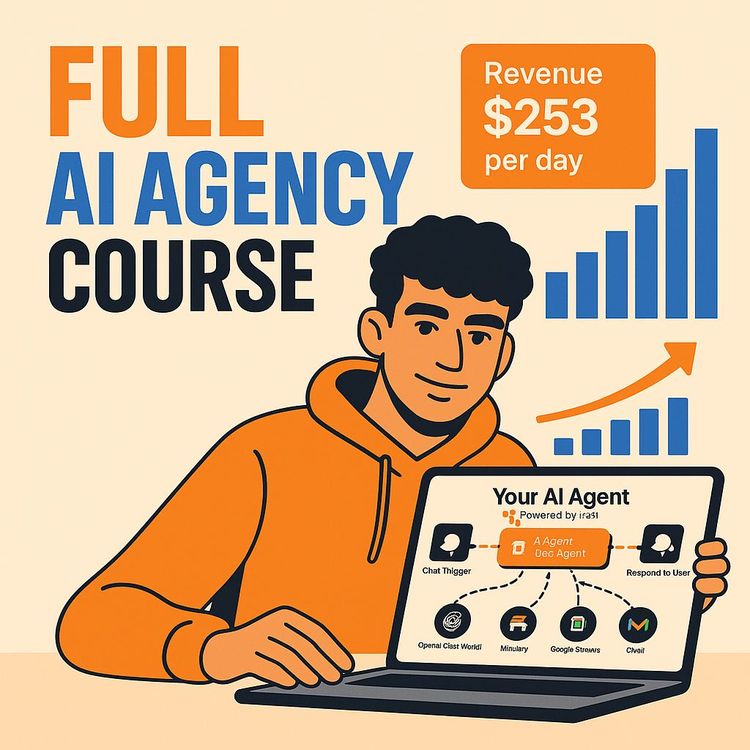
Start a Profitable AI Agency: Build & Sell AI Agents + Automations (Video Course)
Skip the tech jargon. This course shows you exactly how to build AI agents and automations clients actually pay for,and how to land those clients. It's a straight shot from your first build to your first invoice, no fluff.
Related Certification: Certification in Building and Deploying AI Agents
Also includes Access to All:
What You Will Learn
- Differentiate AI, LLMs, automations, agents, and hybrids
- Design and build profitable AI automations (support, email, invoice)
- Write effective prompts using role, goal, tone, audience, scope
- Integrate agents with apps via APIs, webhooks, and token management
- Acquire clients using targeted cold outreach and content funnels
- Deliver and scale projects: setup protocol, handoff, and retainers
Study Guide
This course is your complete, no-fluff playbook for building and selling AI agents and automations. It's not just about the tech,it's about the business. We're going to cover the exact same frameworks used to build profitable AI automation agencies, from understanding the core technology to landing your first client and delivering the work without pulling your hair out. Most people get this wrong. They dive into the tools, get overwhelmed, and never actually make a sale. Or worse, they build something elaborate that nobody wants to pay for. This course fixes that. You'll learn the foundations, the services you can actually sell, how to get clients consistently, and how to deliver efficiently. By the end, you'll have a crystal-clear roadmap to turn this skill into serious monthly income.Part 1: The Unshakeable Core Concepts
Before you even think about talking to a client or opening a platform, you need to get the basics down. You don't need to become a software engineer, but you do need to speak the language and understand the mechanics. This is what separates someone who can build from someone who just thinks they can. We're going to demystify the buzzwords so you can walk into any situation with confidence.
The Building Blocks: AI vs. LLM vs. Automation
Let's clear up the confusion. Artificial Intelligence (AI) is the big umbrella,the entire field of making machines do smart things. Think computer vision, robots, and speech recognition. A Large Language Model (LLM) is a specific, incredibly powerful branch of AI. It's the brain. Models like GPT, Claude, and Gemini are designed to understand and generate human language. They can reason, write, and even code.
Now, here's where a lot of beginners get tripped up: the difference between an automation, an AI agent, and an AI automation. An automation is a rigid recipe. It's a fixed sequence of steps that runs identically every single time. For example: A new lead fills out a form → the system saves their info to a spreadsheet → it sends a welcome email → it notifies your team on Slack. No thinking required. It's extremely reliable but totally dumb.
An AI agent is radically different. It's like a smart assistant with a goal. You give it a mission, and it figures out the path. For example, you say, "Book me a haircut for Saturday afternoon." The agent will check your calendar, call the barbershop, and if they're fully booked, it will proactively try the next shop. It uses judgment, picks tools, and adapts to new information. It's dynamic and autonomous. The catch? It can sometimes be unpredictable.
What we actually build and sell 90% of the time is an AI automation. This is a hybrid. It's a structured workflow (the recipe) with an AI agent inserted at decision points to handle complex steps. Think of it like a call center with scripts. The automation handles the routing and data transfer (the recipe), but a smart agent handles the part where a customer is asking a unique question. This is where the real commercial value lies.
How AI "Talks" to Other Software: APIs vs. Webhooks
For an AI agent to be truly useful, it needs to interact with the world,Gmail, calendars, CRMs. It does this through two main communication channels: APIs and webhooks. The difference is who initiates the conversation.
An API is a request-response. Your agent "asks" another application for something. The two most common actions are GET and POST. A GET request is pulling data, like asking Google Calendar for a list of today's events. A POST request is pushing data, like sending a new contact name and email to your HubSpot CRM. Think of it as your agent knocking on a door and asking for something.
A webhook is the direct opposite. It's the door opening itself and handing you a package. Your agent doesn't have to ask. For example, when a customer submits a form on a website, a webhook instantly fires the data to your automation workflow, triggering the next steps automatically. Master these two concepts, and you can connect anything.
The Prompt: Your Main Instruction Manual
Prompting is the skill of writing instructions for the LLM. This is not about finding some magic "hack." It's about clear communication. You can write a great prompt by ensuring you cover five key elements. First, the Role: who is the agent? (e.g., "You are a customer support agent for a high-end bakery"). Second, the Goal: what is the desired outcome? (e.g., "Politely answer the customer's question about today's specials"). Third, the Tone: what's the communication style? (e.g., "Warm, friendly, and enthusiastic"). Fourth, the Audience: who are you talking to? (e.g., "The customer is a local resident"). Fifth, the Limits/Scope: what are the constraints? (e.g., "Keep your answer under 50 words" or "Do not discuss discounts").
Think of this like briefing a new contractor. If you just say "fix my kitchen," you might get anything. But if you tell them the exact style, budget, and timeline, they'll do a much better job. The same principle applies to AI. Including at least three of these elements in any prompt will dramatically improve the consistency and quality of the output.
The Economics: Understanding Tokens and Cost
When you use an LLM, the API doesn't charge by the word. It charges by "tokens." A token is essentially a piece of a word. As a rule of thumb, 1,000 tokens equals about 750 words. This is crucial for pricing your services and keeping client costs low.
There's a dirty secret about tokens: output tokens (what the AI generates) cost 3 to 5 times more than input tokens (what you send to the AI). For example, GPT-4 might cost $2.50 for a million input tokens but $10.00 for a million output tokens. This means when you write your system prompt, you should actively instruct the agent to be concise. "Answer in as few words as possible." This small step saves your client money on every single interaction, which makes your solution more cost-effective and your profit margins more sustainable.
The Universal Anatomy of an AI Agent
Here's a secret that makes every platform easy to master. Every AI agent tool,whether it's n8n, Relevance AI, Vapi, or Voiceflow,is built on the same five components. Once you get this, you'll never be lost on a new interface again.
1. The Brain (The LLM): This is the underlying model,GPT, Claude, Gemini,that processes the data and decides what to do.
2. The Instructions (The Rules): This is your system prompt. It's the rulebook and master plan for how the agent should behave.
3. The Tools (The Hands): These are the integrations. This could be a Gmail connector, a Google Calendar API, or a Shopify integration. It's how the agent gets things done.
4. The Knowledge Base (The Library): This is the client's own data. You upload their PDFs, product specs, or FAQs, so the agent can look up accurate information instead of making it up. A vector store is where this data is searched.
5. The Memory (The Notepad): This is a database that stores context from previous conversations. It allows the agent to remember a customer's name or a past order, making interactions feel much more human.
Recommendation: Set up a free account on n8n and Vapi today. Don't just read about these concepts,click around. Try to identify each of these five parts in the interface. The time you invest here saves you days of struggle later.
Part 2: The Services You Can Actually Sell
Now we get to the good stuff. The tech is just a means to an end. Clients don't buy "agents," they buy results,time saved, more bookings, and cost reduction. There are three core technical services and one advisory service that make up the entire AI automation industry. Here's what they are, how to build them, and why they work.
The Workhorse: AI Automations and Agents
This is the bread and butter. Custom workflows built for specific business problems. You are applying AI to help an insurance agent process claims or help an HR team screen resumes. The critical rule here is a business one: never sell a pre-built solution. You have to get in the meeting, diagnose the problem, and then design a custom build. Let's take a look at the three highest-demand automations that prove the value.
1. The 24/7 Support Agent: This is a huge business. The workflow is triggered when a query comes in from WhatsApp or a website chat. The automation takes the customer's question, searches the client's knowledge base (in a vector store) for relevant answers, and asks the AI agent to compose a helpful response. The agent delivers the answer instantly. This saves clients thousands in support costs and ensures customers get instant answers for 24/7. Let's say you build this with n8n. It's a simple, repeatable architecture that you can tweak for any industry.
2. The AI Email Manager: Business owners waste hours on email. This automation keeps a watchful eye on a Gmail inbox. Here's the smart part: it scans emails labeled "pending." For each one, the AI agent reads the thread and drafts a response. It then places that draft directly in the user's Gmail account ready to send. This results in a human review, which sounds like a small thing, but it solves a massive pain point,the time it takes to draft thoughtful replies. The client just clicks "send."
3. The Invoice Autopilot: This targets the mess of financial admin. The trigger is a new email with a PDF attachment, e.g., a supplier invoice. The workflow downloads the PDF, uses an AI document processing tool to extract line items, and writes all that data to a Google Sheet. This turns a painful manual task into an automated, searchable log. For an accountant in your client's office, this "Autopilot" saves up to three hours a week every single week. That's a tangible result worth paying for.
The Closer: AI Voice Agents
A phone call holds more weight than an email. That's why voice agents are so profitable. They can handle about 70% of what a human receptionist does. They answer calls, answer questions, qualify leads, and book appointments without the business paying a salary or a commission.
The best tool for the job is Vapi, with n8n handling the back end. When you set up your Vapi assistant, you need to do three things super well. First, choose a low-latency model like GPT-4o mini. Latency is the time between when the caller stops talking and when the AI starts. It needs to be between 800ms and 1200ms. Any faster sounds robotic, any slower sounds frustrating.
Second, you need to dictate the system prompt. This defines the entire personality of the agent. "You are Riley, the assistant for Cornerstone Dental. You are responding to a call from a patient. You should be polite, upbeat, and your goal is to book an appointment." You'll also attach your Vapi tools here,the Google Calendar integration and the Google Sheets integration. This gives the agent the "hands" to check availability and log the lead's details.
Third, you test and deploy. You can attach a phone number directly and publish it on a Google Business Profile. The cost of this agent is roughly $0.15 to $0.20 per minute. If an appointment booking call lasts 3 minutes, that's $0.60 per booking. If the business gets 50 calls a month, that's about $30 per month in AI costs. Compare that to the price of a virtual receptionist or a part-time in-house person, and the ROI is astronomical. This is the service you can charge a premium for.
The Conversationalist: AI Chatbots
Chatbots are text-based support. They sit on a website, in WhatsApp, or in Messenger. They're ideal for handling multiple customers simultaneously. The most beginner-friendly platform is Voiceflow because of the visual builder. Before you open Voiceflow, you should decide on the "objective." I recommend setting it to "Resolution." That means the goal of every conversation is to solve the user's issue in one interaction, not just "qualify" them for a sales call.
When building in Voiceflow, consider this structure: First, the Global Prompt. This dictates the role, tone, and general safety rules. Second, your "Playbooks." These are sub-agents that handle specific topics. For example, if the user says "I want to cancel my subscription," the system routes to the "Billing Specialist" playbook. That playbook has its own specific instructions on how to handle that request and what tools to access. This allows one bot to serve many different intents.
The key to a powerful chatbot is the knowledge base. You can connect documents, webpages, or even the website sitemap itself. This is how the bot gets its custom "brain" data. Without this, it's just a general language model answering questions. With it, it's an expert on your client's business. When you're done, deploying is as simple as copying a small code snippet and pasting it into the client's Wix or WordPress site.
The Trust Builder: AI Consulting
This is your entry point into any business. Most business owners are smart. They know AI is important, but they're drowning in hype and don't know where to apply it. This is your opening. You can charge a consulting fee just to look at a business and produce a "Ai Opportunity Roadmap." You identify the high-time, low-thinking tasks that are perfect for automation.
The beautiful thing about consulting is that it builds massive trust. You go in, and sometimes the winner is not a complex automation. The best solution might be a simple "Custom GPT",a tailored chatbot you can create for cheap. You're the doctor who says "you don't need surgery." This makes the client trust you implicitly, and when you *do* recommend the big automation worth $3,000, they'll say "yes" without hesitation.
Example Application: Let's say you land a meeting with a real estate agent who is overwhelmed. You see they are manually typing up property descriptions online. You recommend a Custom GPT built on their past listings to generate new draft copy in minutes. That's a $500 project. But while you're there, you also see they manually scrub the MLS for expired listings,a process that takes 2 hours a day. That's an automation you can build for $2,500 because you've already proven you know what you're talking about.
Part 3: Mastering the Sales & Acquisition Game
You can build the most incredible automations, but if you don't have clients, you don't have a business. This is the part everyone avoids, yet it's the simplest. Let's break down how to get clients consistently with a two-pronged approach: direct outreach and inbound content.
The Mindset Shift: "Sell the Meeting, Not the Service"
You need to take all the pressure off. You are not a salesperson, you are a consultant. The entire goal of your outreach is to get one thing,a 15-minute Zoom call. Not a sale. Not a proposal. Just a conversation. This simple shift changes everything. Your email doesn't have to be perfect. It should be curious, low-pressure, and under-promise.
Your message should sound something like this: "I don't actually know if automation will work for your business,everyone's situation is different. But I'm happy to hop on a quick call to see if there's something we could automate to save you time. If we're not a fit, you will walk away knowing exactly how to use AI to your advantage." Who would reject that? Nobody. It positions you as a helpful peer, not a desperate salesperson.
Building Your Cold Email Machine
Cold email is still one of the highest ROI channels. But you have to do it correctly, or you'll burn your domain.
Here is the exact infrastructure. First, you need a professional domain. Don't use a random Gmail account. Buy a domain name that resembles your brand. Second,and this is mandatory,use an email warm-up service, like Instantly or Snackmail. A brand new domain that instantly sends 50 emails is going to look like spam. These warm-up services slowly build your domain's reputation. Third, get a sending tool like Mail Meteor ($6-$10 per month). It integrates easily with Sheets and offers good deliverability, making it perfect for beginners. Now, the strategy. Your volume starts low. Send about 20-30 emails per day to one targeted niche. Use Apollo.io to generate leads if you want to scale. You can filter by industry, company size, and location. Here's the secret to the body copy: the subject line is the most important part.
Your email should be conversational. For example: "I help accounting firms automate 50% of their admin work, typically saving 6-12 hours a week. I'm not sure if this is a good fit for you, but would it be okay if I sent over some information on how this might work inside your business?" Then, the follow-up is where the money is made. One day later, you send: "Hey [Name], sent you that information about AI automation in [Niche]. Would it be okay if we scheduled a quick 15-minute Zoom call this week? It's not a sales call, I just want to see if there's a fit."
Other Proven Subject Line Styles:
There are two main categories. First, the "Question" subject lines. "Are you using AI to automate repetitive tasks?" or "Are you busy?" These pique curiosity. Second, there are the "Personalized" ones. "Hi [Name]" or "[Company Name] AI inquiry". You want to test both to see which gets your open rate above 50%.
The Content Marketing Engine: The Black Box Principle
While cold outreach brings in a few sales, content marketing makes things passively flow to you. When a cold prospect looks you up, you need to have content that makes you look like an expert. This is where you steal like an artist. Treat viral content as a black box. You don't know why the algorithm loves it; you just know the input produces a certain output. All you have to do is copy the format and insert your original idea.
Here is a prime example. Let's say you see a viral post from a SaaS founder that says, "A single competitor analysis blog post made $1M in revenue." You don't copy that topic. You copy the format, the underlying "single asset created a massive result" concept. You create your own version: "A single AI automation saved 20+ hours a week for an HR team. Here's how it works..." It has the same hook structure, but it's about your niche. The rule of thumb is that if you copy one person, it's plagiarism. If you copy 50 people (blending different formats), it's research.
You also need an anchor. In the post, you need an explicit Call to Action. It can be text like "DM me for a free audit" or "Book a call," but you must have a link to a scheduling platform,Calendly, Cal.com, anything,on your profile. When people land on your content and like what they see, they need a clear, easy next step.
Niche Strategy: Narrow Outreach, Wide Content
There is a nuance to winning with content and outbound. For your cold outreach, you need to pick ONE niche and become a specialist. Whether it's orthodontists in Texas, or architectural firms in New York. You can write personalized copy because you understand their exact pain points. However, for your content, you should talk about broad business problems,"Save time with AI," "Automate your processes," etc. You want to appeal to the widest possible audience. You want to bring people in broadly, then convert them with your specialized pitch on the call.
Part 4: Operational Excellence: Delivering the Product
You got the meeting. You identified the problem. You made the sale. Now the real work begins: delivering a professional product. This is where you differentiate yourself from the hobbyist. There are specific protocols to follow to make this seamless.
The Post-Sale Setup Meeting Protocol
You never install automations during the sales call. You book a separate follow-up "Setup Meeting." This is a critical boundary that creates professionalism.
In this meeting, you are strictly in "ops mode." Your number one priority is having the client own all of the platform accounts. This is a business tip. The client creates the account on Vapi or n8n, and they enter their billing. You get added as an "Admin," but they own it. This means they are responsible for the monthly subscription, and they never get locked out of their own data. Then, you create a "shared communication channel." Set up a Slack or WhatsApp group where you, the client, and any additional stakeholders can message. This avoids having things hidden in email threads. This becomes your central hub for updates, questions, and fixes.
Installing Automations and Bots
For n8n automations, the key thing is the "Credentials" section. This is where your agent connects to external tools. You will ask the client for the API keys or use the "Sign in with Google" forms. For a chatbot, you'll build and publish the bot on your platform of choice, then copy the embed code and paste it into the client's website management system. I know this sounds simple, but this is a stage where a lot of beginners lose half a day. Make sure you know whether the client is on Wix or WordPress before jumping in.
Voice Agent Installation
When installing a voice agent, you assign the phone number. Vapi has free numbers built-in, but for higher quality and more control, you might use a Twilio number. You'll just attach it to your assistant in the Vapi dashboard. Then, the client gives this phone number to their "Google Business Profile" and any ads. This is how you turn their existing marketing channels into revenue-generating assets.
Final Tip for Scale: You don't want to have to be online to troubleshoot for every client every day. You want to create a "Support Package" or a monthly "Maintenance Retainer." This is a monthly fee for "monitoring' and "updating" the agent. You check the token costs, check the latency, and check the conversation logs on a weekly basis. This turns a one-time project into a recurring revenue subscription, which is the true long-term goal of any agency. It's what takes you from being a freelancer to being an agency owner.
Conclusion: The Call to Action
So there you have it. The entire map. You have the technical foundation, the knowledge of the three core services, the sales playbook to get in the door, and the operational plan to deliver. There's really one thing left to do: start. Don't just consume this course and move on to something shinier. The people who win in this space are the ones who open an account, build a test automation, and send one email to a business owner in their network today. The market is the sum of its problems,they're waiting for you to solve them. The only way to differentiate yourself is to get to work.
Frequently Asked Questions
Introduction
This FAQ answers the questions that come up most when people start building and selling AI agents and automations. It covers the technical fundamentals, the services businesses pay for, the platforms you'll use, and the sales and delivery process that turns knowledge into income. Questions progress from basic concepts to advanced operational details. If you're new to AI, start at the beginning. If you already know the basics, jump to the sections on sales and delivery,that's where most people get stuck.
Section 1: Fundamentals of AI
What is the difference between AI automation and an AI agent?
The distinction comes down to how tasks are executed.
AI automation
is like a recipe. You give the computer the exact steps it must follow every single time, and the AI only assists with one small job inside those steps,such as reading an email. For example, when a new lead fills out a form, the system saves it to a spreadsheet, sends a welcome email, and notifies you via WhatsApp. These same four steps run identically every time. Automation has existed for many years.
AI agent
is like an assistant with a goal. You tell it what you want, and it figures out the steps on its own. It can think, select tools, check whether its actions worked, and change its plan if needed. For example, if you say "book me a haircut for Saturday," the agent will check your calendar, look up nearby barbers, call one, and if that one is fully booked, try another. The path to the goal can differ each time it runs,it might take different steps based on context from previous runs.
AI automation
combines both: an agent embedded within a defined automation workflow. You place an AI agent at one or more points within a fixed sequence of steps, allowing the system to handle exceptions and make decisions within the broader structure.
What is the relationship between AI and LLMs?
Artificial Intelligence (AI) is the broad field of making machines act intelligently,mimicking human capabilities like reasoning, pattern recognition, and decision-making. It encompasses many approaches, including neural networks, which are computational systems inspired by the structure of the human brain.
A Large Language Model (LLM)
is one specific type of AI focused on understanding and generating human language. Modern LLMs like ChatGPT, Claude, and Gemini have expanded beyond text to create images, music, and video. The relationship is simple: AI is the entire category, and LLMs are a specific tool within it. When you build AI agents, the LLM serves as the "brain" that processes language and makes decisions.
What are APIs and web hooks, and how do they differ?
Both APIs and web hooks are ways for two applications to communicate. The only difference is who initiates the conversation.
API (Application Programming Interface):
Your application asks first for information. Your agent "knocks on the door" and requests something, and the other app responds. Two types of API requests are used most frequently:
POST request:
Your agent sends data to another application. For example, pushing a new contact into a CRM like Monday.com or Salesforce.
GET request:
Your agent asks another application for data. For example, an agent queries Google Calendar to determine how many meetings are scheduled on a given day.
Web hook:
The other application sends data automatically without being asked. You connect it once, and from then on, when a specific event occurs (like someone submitting a form), the data is pushed directly to your workflow. For example, when a Typeform submission is received, the data flows instantly into your agent without any polling or requests.
Understanding these concepts is essential because they are how every automation you build communicates with your client's tools.
What is prompting, and what are the five key elements of an effective prompt?
Prompting is how you write instructions for an LLM. Since LLMs essentially predict word combinations, the clarity and structure of your input directly affect the quality of output. You don't need to buy expensive courses on prompting,a basic understanding of how to explain things clearly is sufficient.
The five elements of an effective prompt are:
1. Role:
Tell the AI who it is acting as. For example, "You are a real estate assistant" or "You are an HR manager."
2. Goal:
Define what you want it to accomplish. For example, "Reply to this lead and book a call."
3. Tone:
Specify how it should sound,friendly, professional, concise, etc.
4. Audience:
Identify who the response is for. This helps the AI adjust its language and level of detail.
5. Limits/Scope:
Define what the response should and shouldn't include. For example, "Keep it under three sentences" or "Don't mention pricing."
Not every prompt requires all five elements. Sometimes two or three are enough. As a general rule, aim to include at least three. Prompting is essentially the same as explaining to a new employee how you want them to behave,give enough context for the desired outcome, but avoid over-engineering it.
What are tokens, and how does AI pricing work?
Tokens are the small chunks of words or letters that an LLM breaks your text into before reading it. Understanding tokens is critical because they directly determine cost.
One token is roughly 0.75 words.
So 1,000 tokens equals approximately 750 words. The word "hello" is one token. "Unstoppable" might be three or four tokens.
Pricing model:
Output tokens (what the AI generates) cost three to five times more than input tokens (what you send). For example, with GPT-4, input costs approximately $2.50 per 1 million tokens, while output costs approximately $10 per 1 million tokens,four times more expensive.
Practical implication:
When building AI agents, tell the LLM in your system prompt to be concise. Shorter replies mean fewer output tokens, which means lower costs. This matters because your client ultimately pays for the API usage. Work out how much text goes in versus comes out before you close the deal so there are no hidden cost surprises later.
What are the five parts of every AI agent?
Every AI agent, regardless of the platform it's built on, consists of five components working together:
1. LLM (The Brain):
ChatGPT, Claude, or Gemini,the model that decides what to do.
2. Instructions (The Rules):
The system prompt that tells the agent what to do and in what order.
3. Tools (The Hands):
Connections to external platforms like Gmail, Google Calendar, Notion, Salesforce, Monday.com, or HubSpot that allow the agent to perform actions.
4. Knowledge (The Library):
The client's own information and documents, stored so the agent can reference them. For example, a customer support agent uses a knowledge base about company products to answer inquiries.
5. Memory (The Notepad):
Stores conversation context. This is a simple pre-built node in most platforms,you attach it and the agent automatically remembers information from previous interactions.
Once you understand these five concepts, every platform becomes easy to learn. The buttons and interfaces change, but the underlying concepts remain the same across N8N, Relevance AI, Vapi, Voiceflow, and others.
What is a vector store and why does it matter for AI agents?
A vector store is a database that stores embeddings,numerical representations of text. When you upload a client's documents, the content is converted into vectors and stored so the AI can search through them instantly.
Think of it as a library where every book has been summarized into a mathematical code.
When a customer asks a question, the agent converts the question into a vector and finds the most similar vectors in the store,essentially retrieving the most relevant information.
This matters because LLMs are trained on general internet data, not your client's specific business information. A vector store gives the agent access to proprietary knowledge without retraining the model. Platforms like Pinecone make this simple, and most automation platforms have pre-built nodes for vector storage and retrieval.
The 24/7 support agent template uses this exact architecture: a file is uploaded to Google Drive, converted to vectors, stored in Pinecone, and then retrieved when a customer asks a question. Without a vector store, the agent would have no way to access the client's specific information.
What is latency and why does it matter for voice agents?
Latency is the time delay between when a user speaks and when the AI responds. It's measured in milliseconds.
The sweet spot for voice agents is 800 to 1,200 milliseconds.
Below 800ms sounds robotic and unnatural,humans need a brief pause to process. Above 1,200ms feels sluggish, and callers get frustrated.
Latency is affected by four factors: the transcriber (converting speech to text), the LLM (processing the text), the voice provider (generating speech), and the transport (how audio travels). If your voice agent feels slow, you can switch to a faster LLM, use a more efficient voice model, or change the transcriber.
Latency also affects cost. Slower models often cost more per minute. Keeping latency in the optimal range isn't just about user experience,it's about keeping the per-minute cost low enough that the agent remains profitable for your client.
What is the difference between a knowledge base and memory in an AI agent?
Knowledge and memory serve different purposes.
Knowledge base
is the library,static documents, FAQs, product information, and company data that the agent references to answer questions. It doesn't change during a conversation. You set it up once by uploading documents or connecting to a platform like Zendesk or Shopify.
Memory
is the notepad,it stores the ongoing conversation context so the agent can remember what was said earlier. Most platforms have a simple memory node you attach to the agent.
For example, a support agent uses its knowledge base to understand your client's return policy, and its memory to remember that you already provided your order number earlier in the chat.
Both are essential for agents that handle anything beyond one-off questions. A chatbot without a knowledge base gives generic answers. A chatbot without memory forgets what the customer just said. Build both into every agent you create.
Section 2: Services an AI Agency Sells
What services does an AI agency actually sell?
There are four main services that businesses pay for:
1. AI Automations and AI Agents:
Built primarily on N8N or Relevance AI. These streamline internal workflows, automate repetitive tasks, and handle processes that previously required manual effort.
2. AI Voice Agents:
Built on Vapi, Retell, or ElevenLabs. These pick up phone calls, answer customer questions, book appointments, and qualify leads in a human-sounding voice.
3. AI Chatbots:
Built on Voiceflow or Botpress. These sit on a website or inside WhatsApp, answer questions, and book appointments through text conversations.
4. AI Consulting:
Advising business owners on where AI fits and doesn't fit in their operations. This can be sold before building anything,you're selling guidance and strategic information.
The fundamental rule across all services: look before you build. Never sell a pre-built automation. The key difference: voice agents and chatbots can be somewhat templated because a dental clinic's chatbot and a real estate agent's chatbot share the same structure,only the knowledge base and branding change. However, AI automations are almost always custom because no two businesses run the same way.
Why should you never sell pre-built automations?
Building an automation first and then hunting for someone to buy it is backwards. This approach fails because:
Pre-built systems don't fit the specific way a business operates.
You'll get "no" after "no" because the automation doesn't address their actual pain points. You lose trust by presenting a solution before understanding the problem.
The correct approach is to consult first. Sit with the client, understand their manual work processes, identify bottlenecks, and then build a solution specific to them. This is like a doctor who diagnoses you before prescribing medicine. When you demonstrate that you understand their business, they trust you,and that trust is what closes deals.
This approach also has a secondary benefit: sometimes the solution is simpler than you expect, and you can charge less, which builds even more trust and goodwill.
What are the three most sellable automation templates?
Three automation types work in almost every business:
1. 24/7 Support Agent (built on N8N):
Triggered when a file is created or updated in Google Drive. The file is downloaded and its content is converted into vectors stored in a Pinecone vector store. When a customer sends a chat message, the AI agent retrieves relevant information from the vector store and generates an accurate response. This reduces the time spent on customer support tickets.
2. AI Email Manager:
A trigger checks Gmail every minute for emails with specific labels. The system loops through each conversation, finds the latest message, and uses an OpenAI assistant to draft a reply. The draft is placed back into Gmail for human approval,it never sends automatically. This prevents hallucinations and ensures quality control. Once handled, the label is removed.
3. Invoice Autopilot:
A Gmail trigger detects emails with PDF attachments (invoices). Using a document-processing AI like Credal AI, the system extracts line items and prices from each invoice and writes them to a Google Sheet. This saves business owners 20-30 minutes daily, which stacks to roughly 3 hours per week,time that can be redirected to revenue-generating activities.
What platforms should an AI agency learn?
You don't need to learn dozens of platforms. Focus on the industry leaders:
N8N and Relevance AI:
For building AI automations and agents. N8N is more capable but has a steeper learning curve; Relevance AI is simpler and more beginner-friendly. Knowledge of one transfers roughly 70% to the other.
Vapi, Retell, and ElevenLabs:
For voice agents. Retell is a simpler version of Vapi. ElevenLabs produces excellent voices but is more expensive.
Voiceflow and Botpress:
For chatbots. Voiceflow is simpler and excellent for spinning up a demo in 30 minutes. Botpress has more features but is more developer-heavy.
Make and Zapier:
For backend automation that connects to voice agents and chatbots when tools like calendar booking or spreadsheet updates are needed.
The key insight: an AI agent can never perform a task unless it's connected to the outside world through tools. Choose the most efficient platform for each specific client need.
How does the "front end talks, back end does the work" concept work for voice agents and chatbots?
Voice agent platforms like Vapi and chatbot platforms like Voiceflow excel at the conversational part,listening, understanding, and replying in a natural-sounding voice or text. However, they are weak at performing actions like booking appointments, updating spreadsheets, or sending emails.
The solution is to split the build into two parts:
Front end:
Vapi or Voiceflow handles the conversation with the customer.
Back end:
N8N, Make, or Zapier handles the actionable tasks,booking slots in Google Calendar, saving entries to Google Sheets, and sending confirmation emails via Gmail.
This two-part architecture is essential for any voice agent or chatbot that needs to do more than just talk. A voice agent that can't book an appointment is just a talking FAQ page. The back end is where the real value gets created.
What is a custom GPT and when should you recommend one?
A custom GPT is a tailored version of ChatGPT that you configure with specific instructions and knowledge. You upload documents, write a system prompt, and the GPT answers questions based on that information.
It's the simplest AI solution you can sell.
For a small business that needs help drafting customer responses, summarizing documents, or generating content, a custom GPT might be all they need,no complex automation required.
This is where the "look before you build" principle matters. Recommending a custom GPT instead of a full automation can save a client hundreds of dollars per month. It also builds trust. When you tell a client they don't need the expensive solution, they'll trust you when you say they do need something bigger.
AI consulting often leads to custom GPT recommendations. You sit with the client, identify the bottleneck, and realize the fix is simple. That honesty positions you as an advisor, not a vendor. And when they eventually need a full automation, you're the first person they call.
How do you price AI services?
Pricing depends on the service type and the value delivered.
AI automations
are typically priced as a one-time setup fee plus a monthly maintenance fee. The setup fee reflects the complexity,a simple workflow might be $1,000-$2,000, while a complex multi-tool automation could be $5,000 or more. The monthly fee covers hosting, maintenance, and updates.
Voice agents and chatbots
are usually priced with a setup fee plus a monthly subscription based on usage. The usage cost (API calls, voice minutes) is passed through to the client.
AI consulting
is simpler,charge a flat fee of $300-$500 for a business review and recommendations.
The key is to anchor pricing to value, not hours. If an automation saves a business 20 hours per week, that's worth thousands per month in labor costs. Charge accordingly. You're not selling time,you're selling outcomes.
What's the difference between a voice agent and a chatbot?
Both are conversational AI, but they operate in different channels.
A voice agent
talks on the phone. It uses speech-to-text, an LLM for processing, and text-to-speech to respond. It handles phone calls,appointment booking, front-desk duties, after-hours support.
A chatbot
communicates through text,on a website widget, WhatsApp, Messenger, or Instagram. It handles website visitors and messaging,answering FAQs, qualifying leads, routing complex issues.
The building blocks are similar: both have an LLM, instructions, tools, and knowledge. The main differences are the interface and the use case.
Many businesses need both. A clinic might use a chatbot on its website for general questions and a voice agent to answer phone calls after hours. When you sell to a client, assess which channel their customers actually use. Don't sell a voice agent to a business that gets all its inquiries through web forms. Don't sell a chatbot to a business that lives and dies by the phone.
Section 3: Voice Agents
How do you build a voice AI agent?
Building a voice agent on Vapi involves several key steps:
1. Create an assistant:
Name the agent (e.g., "Riley") and start from a blank template.
2. Configure the LLM:
Select a conversational model with good latency. GPT-4 Turbo is recommended for appointment setters because it balances speed, cost, and quality.
3. Set the system prompt:
This is the most important part. It defines the agent's behavior, the information it should collect, and how it should handle the call. System prompts can be generated for any industry using AI tools.
4. Select the voice:
ElevenLabs provides the most realistic voices. You can add a specific voice ID manually. The voice model choice affects latency and cost.
5. Control latency:
The time between when the user speaks and when the agent responds should be between 800 and 1,200 milliseconds. Below 800ms sounds robotic; above 1,200ms feels too slow.
6. Create tools:
For an appointment setter, you need three tools: Google Calendar Create Event, Google Calendar Check Availability, and Google Sheets for saving caller details.
7. Connect integrations:
Link Vapi to Google Calendar and Google Sheets through the platform's integration settings.
8. Test the agent:
Use the built-in testing feature to have a conversation and verify that appointments appear in the calendar and sheets.
9. Attach a phone number:
Vapi provides free numbers, or you can import one from Twilio. Connect the number to your assistant, and the agent is live.
What does it cost to run a voice agent, and how do you calculate ROI?
The cost per booked appointment depends on call duration and the AI model's rate. Generally:
Rate:
$0.15-$0.17 per minute (can reach $0.21 per minute in some cases).
Average call length for appointment setting:
2-4 minutes.
Cost per booked appointment:
$0.40-$0.74.
Monthly cost projections:
50 bookings:
$25-$35 per month
100 bookings:
$45-$70 per month
300 bookings:
$135-$200 per month
To keep costs low, maintain latency between 800ms and 1 second. This cost breakdown is essential for pitching to businesses,you can demonstrate exactly how much value the agent provides relative to its cost. A dental clinic missing 10 calls a day is losing thousands in revenue. An agent that answers those calls for $35 a month is a no-brainer investment.
What is the role of the system prompt in a voice agent?
The system prompt is the most important component of a voice agent. It defines:
The agent's role and personality.
How it should handle different call scenarios.
What information it needs to collect
(name, date of birth, phone number, appointment type).
How to confirm appointments and provide instructions
(e.g., "arrive 20 minutes early").
When and how to end the call.
You can generate system prompts for any industry,real estate, pest control, insurance, healthcare,by providing the time zone and industry niche to an AI tool. The prompt ensures the agent behaves consistently and professionally across all calls.
A weak system prompt produces a weak agent. It forgets to collect key information, rambles, or gives incorrect instructions. Invest time in writing a thorough prompt before you touch any other part of the build.
Should you build inbound or outbound voice agents?
Focus on inbound voice agents.
Inbound agents
answer calls that come to the business,they act as a receptionist. A dental clinic's phone rings, the agent answers, books appointments, and answers common questions. This is easy to sell because the value is obvious: no missed calls, no busy signals, 24/7 availability.
Outbound agents
make calls to potential customers. They're harder to sell because people don't trust unknown numbers, and when they realize they're talking to AI, they often hang up. Outbound also has regulatory complications in many regions.
Start with inbound. It's simpler to build, easier to demo, and the ROI story is clearer. A business owner can see exactly how many calls were answered and how many appointments were booked. That's a measurable result you can report on.
Section 4: Chatbots and Consulting
Certification
About the Certification
Get certified in Profitable AI Agency Development. You'll know how to build client-ready AI agents, automate real business workflows, and close paying clients,taking projects from first build to final invoice.
Official Certification
Upon successful completion of the "Certification in Building and Deploying AI Agents", you will receive a verifiable digital certificate. This certificate demonstrates your expertise in the subject matter covered in this course.
Benefits of Certification
- Enhance your professional credibility and stand out in the job market.
- Validate your skills and knowledge in cutting-edge AI technologies.
- Unlock new career opportunities in the rapidly growing AI field.
- Share your achievement on your resume, LinkedIn, and other professional platforms.
How to complete your certification successfully?
To earn your certification, you’ll need to complete all video lessons, study the guide carefully, and review the FAQ. After that, you’ll be prepared to pass the certification requirements.
Other AI Video Courses
Video Course: What is Generative AI and how does it work?

Video Course: How to Use ChatGPT from Beginner to Professional
Video Course: How to Use Google Gemini for Google Workspace to Boost Productivity

Video Course: How to Use Claude 3.7 AI - Tips for Beginners!

Video Course: ChatGPT for Data Analytics: Full Course - from Beginners to Professional

Video Course: Generating Images and photos With ChatGPT?

Video Course: Generating Images & Photo's with MidJourney

Video Course: Generating Design's with Microsoft Designer and AI

Video Course: Generating Design's with Canva.com and AI
Join 20,000+ Professionals, Using AI to transform their Careers
Join professionals who didn’t just adapt, they thrived. You can too, with AI training designed for your job.