MCP server · Analytics
P2Predict MCP server
Ask your AI what a part should cost, based on your own past purchase prices.
P2Predict is a helper that learns from the prices your company has already paid for parts, then tells you what a new or quoted part should cost. You ask your AI assistant in normal words, and it answers with a target price and a likely range. It is handy for procurement and engineering teams who negotiate with suppliers and want a number they can defend.
What is an MCP server? The 30-second version
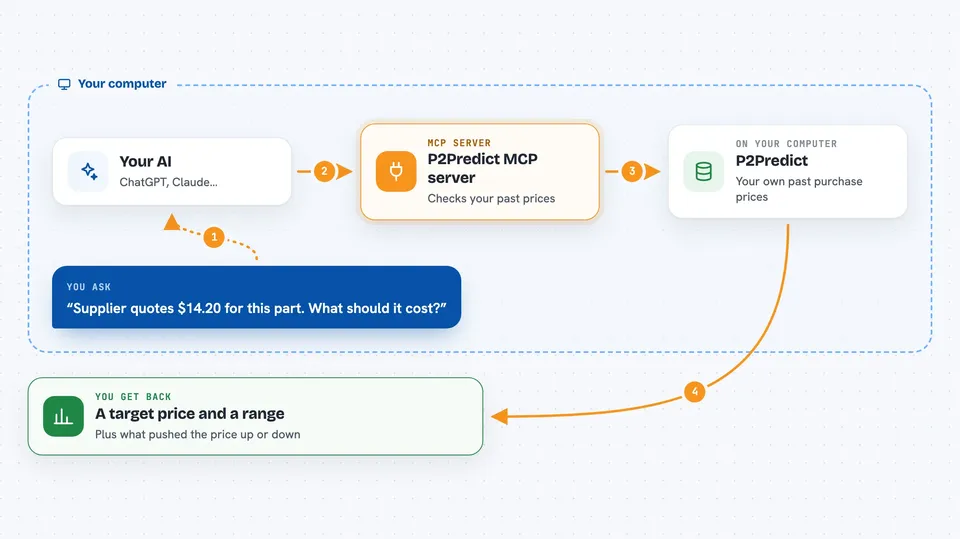
On its own, your AI can only chat with you. An MCP server is a small helper program that gives your AI a new skill or a connection to something useful. This one connects your AI to P2Predict, which runs on your own computer and studies your purchasing history. Once it is connected, you can ask your AI about part prices and it will use P2Predict to work out the answer for you.
What this MCP server does
You ask your AI a question in plain language, for example what a quoted part should cost. Your AI passes that question to P2Predict, which looks at the prices you have paid before for similar parts. P2Predict works out a target price, shows which things like supplier or spec are pushing the price up or down, and puts a likely range around the number. Your AI then explains all of this back to you in the chat. The more of your own purchase history you give it, the better its answers get.
 Click to zoom
What you can do with it
- Check whether a supplier quote looks fair
- See a breakdown of what is driving a part's price
- Compare what a part would cost from a different supplier
- Estimate how a design change, like a tighter tolerance, affects cost
- Get a likely price range so you know how much to trust the number
- Screen a long list of RFQ lines and spot the ones worth a call
Try asking your AI
- “Supplier quotes $14.20 for this part. What should it cost?”
- “Why is that the price? Break it down for me.”
- “What happens to the cost if we move this part from Supplier A to Supplier B?”
- “We want to go from plus or minus 0.1mm to plus or minus 0.05mm. What does that do to cost?”
What it gives back to you
You get a target price in the chat, plus a likely range, for example a number and the range the real price usually falls in. You can also ask for a breakdown that shows how much each spec and the supplier add or subtract. If your data is thin for that kind of part, it tells you the range is wide or suggests getting a real quote instead of guessing.
Before you start
What you need
- Python installed on your computer
- Your own purchasing history data (prices you have paid before)
- An AI assistant that can use MCP servers, such as the Claude desktop app
Good to know
It only knows what your purchasing history shows, so for parts unlike anything you have bought before it may give a wide range or tell you to get a quote rather than a firm number.
Install it with your AI
Add P2Predict MCP server to your AI, no technical skills needed
You don't install anything by hand. You copy one prompt, paste it into an AI that can work on your computer, and it checks, installs and connects the server for you, asking you when it needs something.
Sign in to get the install prompt
Members get a ready-made prompt that lets the Claude desktop app check P2Predict MCP server, install it and connect it for them, step by step. You don't need any technical skills: you copy, paste and answer a few questions. Your connected AI can also find and install any of the 4,361 MCP servers here for you.
Who it's for
Procurement and category managers, cost engineers, and design teams in manufacturing who negotiate part prices and want data behind their numbers.