MCP server · Analytics
Predictive Maintenance MCP server
by LGDiMaggio
Let your AI read vibration signals, spot bearing faults, and write diagnostic reports with ISO-cited severity.
This is a helper for people who look after machines. It lets your AI assistant read vibration recordings from equipment, point out likely bearing faults, and put together a diagnostic report. It is made for reliability and maintenance engineers, but the everyday language parts are friendly enough for anyone who works with rotating machinery.
What is an MCP server? The 30-second version
On its own, your AI can only chat. An MCP server is a small helper program that gives your AI a new skill or a connection to a tool. This one connects your AI to vibration analysis for machines, so it can load a signal file, look for fault patterns, and check how serious the vibration is. You ask in plain words, and the AI uses this helper behind the scenes.
What this MCP server does
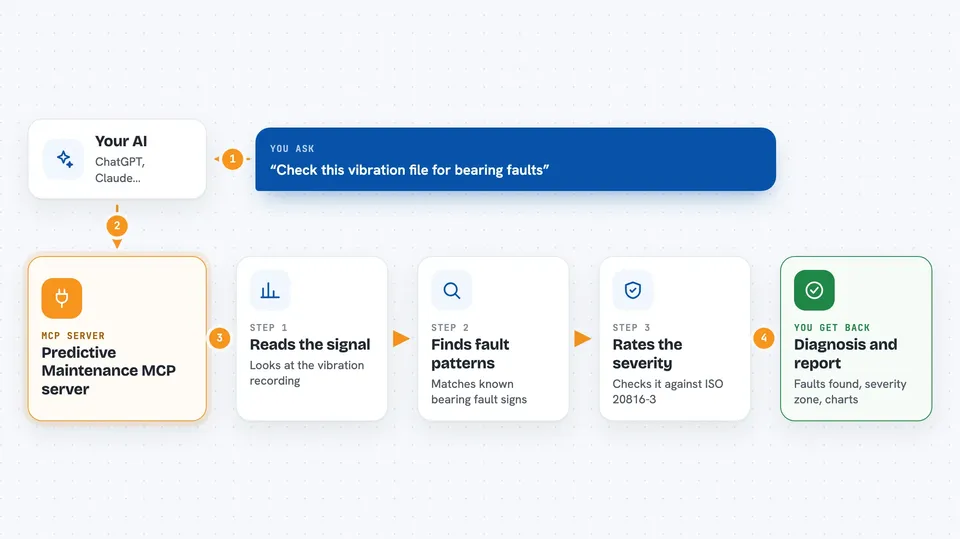
You point your AI at a vibration signal file, like a CSV recording from a bearing test. The AI passes it to this helper, which runs a spectral analysis and looks for the telltale frequencies that match known bearing faults. It then checks the vibration level against ISO 20816-3 severity zones and writes up what it found. You get back the detected frequencies, the matched fault patterns, and a severity rating, all in the chat or in a report you can open.
 Click to zoom
What you can do with it
- Check whether a bearing looks healthy from a vibration file
- Detect inner race and outer race bearing faults
- Rate vibration severity against ISO 20816-3 zones
- Generate an interactive HTML diagnostic report with charts
- Read an equipment manual and look up expected fault frequencies
- Train an anomaly detector on your healthy baseline signals
- Compare a new measurement with a machine's recorded history
Try asking your AI
- “Load real_train/OuterRaceFault_1.csv and check if the bearing is healthy.”
- “Generate a full diagnostic report for this signal.”
- “Extract specs from test_pump_manual.pdf and diagnose the signal.”
- “What changed on pump P-101 since the baseline?”
What it gives back to you
You get answers in the chat: which fault frequencies were detected, which fault patterns matched, and which ISO 20816-3 severity zone applies. It can also produce an interactive HTML report with charts and fault markers, or a Word document with the full write-up. The wording of the severity judgement comes from the server, not from the AI guessing.
Before you start
What you need
- Python installed on your computer
- The uvx tool (a small Python runner)
- A vibration signal file, like a CSV recording (sample data is included)
- An MCP-compatible AI app, such as Claude Desktop
Good to know
The tool gives evidence and severity ratings, but the final judgement about a machine should stay with a qualified engineer.
Install it with your AI
Add Predictive Maintenance MCP server to your AI, no technical skills needed
You don't install anything by hand. You copy one prompt, paste it into an AI that can work on your computer, and it checks, installs and connects the server for you, asking you when it needs something.
Sign in to get the install prompt
Members get a ready-made prompt that lets the Claude desktop app check Predictive Maintenance MCP server, install it and connect it for them, step by step. You don't need any technical skills: you copy, paste and answer a few questions. Your connected AI can also find and install any of the 4,361 MCP servers here for you.
Who it's for
Reliability engineers, maintenance technicians, and condition monitoring specialists who work with rotating machinery.