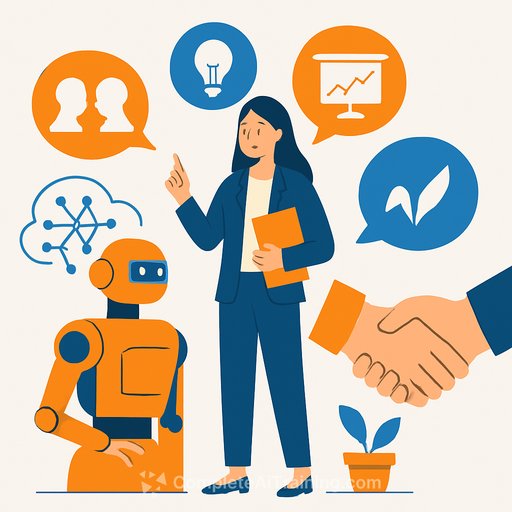
3 Systems-Related Business Skills That AI Can’t Replace
Almost 10,000 U.S. tech workers lost their jobs in the week of July 9, many of whom were involved in building AI that now automates their tasks. Amazon’s CEO highlighted this trend, noting that as generative AI and agent technologies roll out, workforce reductions are expected due to efficiency gains.
Skills once prized in MBAs—data analysis, process optimization, strategic planning—are increasingly performed better by machines. This shift challenges the long-held belief that mastering models and data leads to better decisions. Business schools have focused on frameworks and quantifiable insights, but AI now handles much of this heavy lifting.
The new essential skills are those AI cannot replicate—skills that involve dealing with uncertainty, ambiguity, and complex human systems. These abilities go beyond what can be measured or codified. They are relational, cognitive, and behavioral capabilities that remain uniquely human.
1. Listening Deeply And Building Empathy
Executives are often trained to speak clearly and assertively, but deep listening holds greater transformative potential. In systems thinking, listening is active and intentional. It means fully focusing on what is said and unsaid, tuning into tone, body language, and emotional undercurrents to build trust and stronger relationships.
Deep listening requires presence—setting aside judgment and distractions to truly hear others. It applies beyond conversations, extending to any situation where understanding subtle signals matters. This skill helps leaders detect relational dynamics across teams and ecosystems that influence behavior but aren’t immediately visible.
A 2023 meta-analysis in the Journal of Business Psychology found that people who feel truly heard perform better and build stronger workplace relationships. Netflix co-founder Reed Hastings credits deep listening—encouraging dissent and tuning in carefully—as a key factor in avoiding mistakes and spotting opportunities. His experience with Netflix’s failed Qwikster rebrand underscored the cost of not listening to doubts and concerns.
Deep listening also connects leaders to natural systems. Marine biologist Rachel Carson noticed the silence of missing birdsong, signaling environmental shifts invisible to traditional data. Her book Silent Spring contributed to the creation of the EPA by revealing patterns missed by conventional analysis.
Unlike AI, which processes data, humans sense weak signals from emotions, context, and the environment. This embodied listening creates a unique edge for leaders managing complex systems.
2. Thinking Critically And Recognizing Patterns
Frameworks and models simplify complex problems but often disguise assumptions that limit insight. Critical thinking challenges these assumptions by stepping outside habitual models and reframing problems. It resists premature simplification and asks better questions rather than rushing to solutions.
While AI excels at pattern recognition within data, only humans can think critically about those patterns—questioning, connecting dots across domains, and spotting feedback loops over time. Systems thinkers scan broadly, reflect deeply, and integrate new insights to refine their mental models.
The 2008 financial crisis showed the danger of relying solely on standard models. Wall Street missed systemic risks that hedge fund manager Michael Burry identified by noticing unusual patterns in home prices, lending practices, and investor behavior. Burry’s insight came from seeing the system as a whole, not just analyzing isolated data.
MIT scholars Erik Brynjolfsson and Andrew McAfee argue that while machines perform defined tasks well, humans excel at creative thinking and analogical reasoning—making meaningful connections across unrelated areas. This cognitive edge allows leaders to spot emerging risks and opportunities AI may miss.
3. Embracing Uncertainty And Adapting To Change
Business leaders often seek certainty through defined goals and detailed plans. But in fast-moving environments, waiting for perfect data can delay action and cause missed opportunities. Embracing uncertainty means becoming comfortable making decisions without full clarity and staying flexible amid change.
This requires psychological flexibility: maintaining focus on long-term goals while adjusting to shifting circumstances. Adaptive leaders pause, reflect, and experiment rather than over-planning or reacting hastily to every new input.
Reid Hoffman, LinkedIn’s co-founder, describes this mindset as “permanent beta”—constantly learning and adjusting in response to market shifts. He advises leaders to stay alert to changes and “never stop starting,” emphasizing continuous adaptation as a key to success.
Developing Systems Thinking Skills
These three capabilities—deep listening, critical thinking, and adaptability—form a new leadership approach. As AI commoditizes technical analysis, leaders must cultivate the human skills needed to manage complex, nonlinear systems.
Developing these skills requires practice and intention: hearing beyond words, asking insightful questions, connecting disparate ideas, and staying flexible while anchored in clear values and purpose. This approach moves beyond traditional “soft skills” to essential survival skills for today’s business environment.
Leading institutions recognize this shift. Stanford’s d.school focuses on human-centered design, MIT includes mapping interdependencies in business courses, and companies like Unilever and Google train leaders in mindfulness and emotional intelligence alongside strategy.
To stay effective, executives must learn to work with uncertainty, sense subtle signals, and build strong relational networks. These are the edges that AI cannot replace.
For those seeking to enhance their AI-related business skills with a human edge, exploring courses on Complete AI Training can provide practical tools that complement these uniquely human capabilities.
Your membership also unlocks: