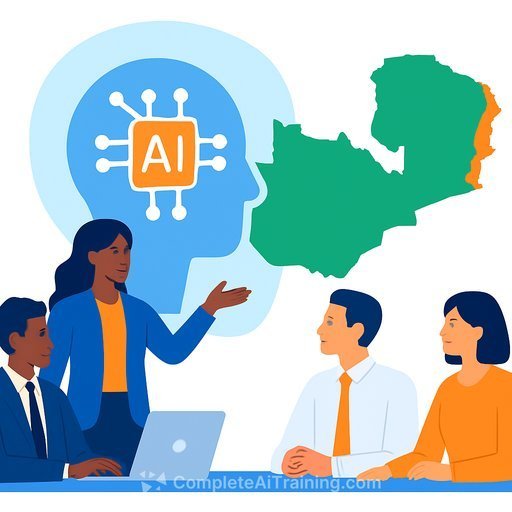
5 Moves HR Leaders Must Make in the AI Era
AI in the workplace isn't a future plan. It's here, and HR has to set the pace or watch competitiveness slip.
The corporate environment is shifting from traditional management to tech-integrated leadership. For HR, that means clear strategy, faster decision cycles, and visible outcomes-especially where efficiency gains are already table stakes.
In Kenya's digitizing economy, this is urgent. If HR doesn't close the skills gap now, local businesses will struggle to compete as hubs like Nairobi push for leaner operations and smarter customer experiences.
1) Make Upskilling a Core Business Strategy
The myth that AI replaces people is fading. The reality: people who use AI will replace those who don't.
Go beyond basic digital literacy. Equip teams to use generative AI for data analysis, customer service automation, and process optimization. Treat learning spend as an investment in survival, not a cost center.
- Run a skills inventory by role; define the "AI use-cases per job" you'll support this quarter.
- Pick 2-3 approved tools for each function (e.g., analytics, content, support) and standardize access.
- Deliver role-based training with hands-on labs and real work samples, not theory-heavy slides.
- Set up mentoring pods and internal "office hours" to unblock teams quickly.
- Track ROI: time saved, error rates, cycle times, and customer CSAT tied to AI use.
- Build internal playbooks and a prompt library; update them monthly as workflows improve.
For structured learning paths and HR-specific AI skills, see AI for Human Resources.
2) Redefine Talent Acquisition for AI Fluency
Hire for learning agility, critical thinking, and ethical judgment. AI fluency is now a core competency, not a bonus.
Use AI to screen at scale, but keep human oversight to reduce bias and confirm fit. Rewrite job descriptions to value problem-solving over years-in-seat.
- Update JDs to highlight AI collaboration, data literacy, and responsible decision-making.
- Add work samples: prompt-writing tasks, data interpretation, and scenario-based assessments.
- Shift interviews to structured formats; score explicitly for adaptability and reasoning.
- Pilot potential-based hiring for non-traditional candidates with high learning velocity.
- Partner with Kenyan universities and TVETs to align curricula to AI-augmented roles.
- Check tools for fairness across languages and dialects common in Kenya; document results.
3) Build Ethical Guardrails and Protect Employee Data
AI can accelerate bias if left unchecked. HR has to be the conscience of the system-clear rules, tight controls, and full transparency.
Ensure compliance with Kenya's Data Protection Act and set expectations with vendors before any rollout. Publish how AI is used in hiring, performance, and learning so employees trust the process.
- Form an AI governance group (HR, Legal, IT, Data) with decision rights and escalation paths.
- Run Data Protection Impact Assessments before deploying high-risk tools.
- Keep a human-in-the-loop for hiring, promotion, and discipline decisions.
- Audit vendors for training data sources, bias testing, model updates, and data retention.
- Adopt data minimization and clear retention policies; train managers on compliant use.
- Maintain an AI tool register and employee-facing FAQs on what data is used and why.
Guidance and standards worth reviewing: Kenya's regulator at Office of the Data Protection Commissioner and the NIST AI Risk Management Framework.
For a strategic program view-governance, risk, and adoption-see the AI Learning Path for CHROs.
4) Foster a Culture of Practical Experimentation
If people fear AI, they'll hide it or avoid it. Create safe space to try, learn, and ship small wins fast.
Leaders should model curiosity and share their own tests. Celebrate useful experiments, not perfect ones.
- Launch an AI sandbox with approved tools and sample datasets; make it easy to start.
- Give teams 10% time for experiments tied to clear business outcomes.
- Run monthly "AI sprints" with demo days; reward measurable impact and reusable playbooks.
- Publish a gallery of before/after workflows; recognize contributors visibly.
- Offer drop-in coaching and community channels so knowledge spreads across sites and shifts.
5) Redesign Work and Performance for Human + Machine Teams
AI changes how work gets done, not just who does it. Redraw roles, workflows, and metrics to reflect shared tasks between people and tools.
Make it specific: where AI drafts, where humans review, and where final accountability sits.
- Map priority processes end-to-end; flag steps where AI can assist, automate, or advise.
- Define human checkpoints for quality, ethics, and customer outcomes.
- Update SOPs, RACI charts, and job descriptions to include AI duties and decision rights.
- Add "AI effectiveness" to KPIs: accuracy, time saved, escalation rates, and rework.
- Stand up light MLOps practices for HR-owned tools: versioning, access control, and audits.
- Plan change management-brief managers, train on new scorecards, and measure adoption monthly.
The future of work isn't human versus machine. It's human and machine working together to deliver outcomes we couldn't reach before.
HR's edge comes from clear moves: upskill with intent, hire for AI fluency, guard ethics and data, build a culture of testing, and redesign work. Start with one function, prove value in 90 days, then scale.
Your membership also unlocks: