AI is now central to SME marketing - but customers aren't impressed
SMEs have moved fast on AI, but the audience hasn't followed with applause. Adoption is surging while trust is sliding. That gap is where campaigns quietly lose money.
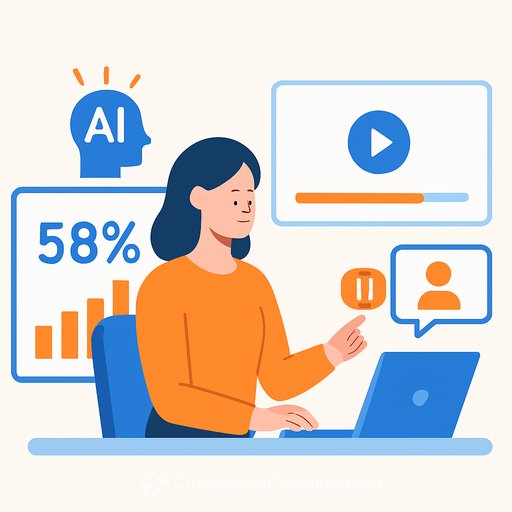
Recent research shows AI became the third most used marketing tool among domestic SMEs in 2025. Usage hit 58% - up 38% in a year - and only 2% say they've never touched AI. Budgets reflect it too: roughly 10% of marketing spend now goes to AI.
What marketers are using AI for
- Drafting copy and content outlines
- Image creation and editing
- Translation and localization
- Research and information gathering
Bottom line: teams are buying speed and volume.
But customers push back
There's friction on the demand side. About 24% of SMEs already see resistance to AI-made ads and content.
- In a 300-person control study, 41% found ads with "visible AI" especially annoying - more so among younger and highly educated groups.
- Only 3% say AI makes an ad more credible; 53% say it hurts credibility.
- 28% auto-scroll or close such content; just 11% lean in.
As Gábor Wolf puts it: "People's problem is not that an advertisement was made with artificial intelligence, but that it is bad. AI only enhances this." He's right. AI amplifies quality - good or bad.
The practical playbook: use AI as a support, not the show
- Human-in-the-loop editing: Every AI draft needs a sharp editor. Tighten claims, check facts, add lived experience, and rewrite for clarity.
- Lead with the offer: Strong value props beat shiny tools. Make the benefit obvious in the first line and first visual.
- Signal expertise: Add expert quotes, data points, and named sources. Credibility is the currency AI can't mint by itself.
- Be transparent when material: If AI use could affect how people interpret content, disclose it plainly. See guidance from the FTC on AI-related claims here.
- Test for "AI tells": Run creative with and without obvious AI artifacts (uncanny hands, over-smooth faces, generic phrasing). Kill versions that trigger annoyance.
- Measure trust, not just clicks: Track saves, replies, branded search, and post-purchase survey signals. Cheap clicks with low trust won't compound.
Channel shifts to watch
- Facebook holds the crown at 84% usage among SMEs (+8% YoY). AI-made content likely helps teams keep pages active.
- Websites sit at 68% and remain the backbone.
- AI climbed to third.
- Instagram slipped to fourth at 50%.
- Google fifth at 46%.
- Newsletters sixth at 42%.
- Offer creation seventh at 38%.
- Recommendations/referrals fell to eighth at 37%.
- SEO ninth at 35%.
- Blogging reentered the top ten. TikTok dropped out.
Interpretation: channels you can feed with frequent, low-cost content are winning. Tactics that rely on heavy personal presence are thinning out.
How to make AI-driven content actually work
- Start with a crisp brief: Offer, audience, proof, call to action. No brief, no leverage.
- Draft with AI → then compress: Shorten 30-50%. Remove clichés and filler.
- Insert proof: Data, before/after, named clients, screenshots (where allowed).
- Localize tone: Use audience vocabulary. Swap "feature lists" for outcomes.
- Design for the scroll: First 1-2 seconds need a hook that's specific to the pain or payoff.
- Ship A/B tests: Rotate 3-5 hooks and 2 offers. Keep the winner, iterate weekly.
- Set guardrails: Brand voice rules, claims policy, disclosure triggers, and a fact-check checklist.
Budgets, workflows, and what changes inside the team
With ~10% of spend going to AI, output scales fast. The trap is confusing volume with value. Make your KPI tree explicit: acquisition cost, conversion rate, and trust signals first - impressions last.
Competent teams now handle more work in-house that used to be outsourced: first drafts, asset variations, simple design, translations. Keep specialists for strategy, high-stakes creative, and performance tuning.
Five experiments to run next quarter
- Disclosure test: Add a simple "This ad includes AI-generated visuals" line in 50% of variants. Measure CTR, CPC, CVR, and sentiment.
- Human proof layer: Insert a named expert quote or founder note in AI-assisted posts. Track saves and replies.
- Hook library: Build 25 hooks per offer with AI, shortlist 5 via quick polls, then A/B on paid.
- Image realism pass: Run an "uncanny check" before publishing. Replace any asset that distracts from the offer.
- Post-purchase survey: Add "Did this content feel trustworthy?" with a free-text field. Pipe insights back into prompts and edits.
The takeaway
AI is now a standard tool. The edge comes from how you brief it, how you edit it, and how clearly your offer lands. Keep the tech in support of strong ideas, human-proof your outputs, and let trust be the metric that guides scale.
If you want a structured path to level up your team's AI skills for marketing, explore the AI Certification for Marketing Specialists at Complete AI Training.
Your membership also unlocks: