Seven key benefits of AI in healthcare for patients and healthcare professionals
AI is reshaping day-to-day healthcare. The biggest gains show up where time, accuracy, and access matter most. Below are seven practical ways AI is improving patient care and supporting clinical, IT, and development teams responsible for delivery.
1) Saving time by streamlining administrative tasks
Documentation drains energy. More than one-third of clinicians now spend less time with patients and more on paperwork compared to five years ago, and those losing patient time report higher stress. AI steps in with transcription, note summarization, and auto-drafted reports and referrals.
Less manual entry means faster throughput and fewer clicks. For IT teams, the wins come from FHIR integration, single sign-on, secure PHI handling, and human-in-the-loop review with audit trails. The goal: give clinicians time back without adding new burdens.
2) Speeding up diagnostic exams and image processing
Radiology teams face rising volume and staffing pressure. In CT, AI-guided patient positioning helps reduce repeat scans, while AI-based reconstruction can lower dose and sharpen images. In MR, accelerated reconstruction helps scan more patients in less time with higher consistency.
That translates into shorter exams and better experiences for anxious or uncomfortable patients. For engineering teams, think seamless DICOM routing, protocol governance, and automated QC dashboards that surface issues before they hit report turnaround times.
3) Elevating the skills of less experienced staff
AI can standardize steps that normally depend on years of experience. In echocardiography, auto-measurements provide fast, reproducible quantification with clinician review and override. Real-time image quality feedback helps users course-correct during the scan.
This broadens access in settings with limited specialists. To make it stick, pair on-device guidance with lightweight training, clear confidence indicators, and versioned change logs so teams can trust updates and trace results.
4) Enhanced diagnostic accuracy and early detection
AI can flag patterns humans may overlook and ease reading workload. In breast screening, studies show AI can support earlier findings and reduce read volume for clinicians, with safety checks in place. In lung imaging, AI-based nodule detection has been shown to find missed nodules and speed search time.
Patients are still less comfortable with AI in diagnostic calls than in admin tasks, so human oversight remains central. Practical approach: use AI for triage, prioritization, and second reads-clinicians make the final call.
- Evidence: AI-supported breast screening workload reduction in The Lancet Digital Health study.
5) Supporting more personalized treatment plans
NLP can extract clinically relevant signals from unstructured notes and discharge summaries, then pair them with structured EHR data. The result is a fuller picture of risk, comorbidities, and care history to guide more precise decisions.
This complements guidelines rather than replacing them. For developers, key enablers include de-identification pipelines, terminology mapping (e.g., SNOMED CT, LOINC), confidence scoring, and in-UI rationale so clinicians see why a suggestion appears.
- Overview of clinical NLP methods and use cases: read more.
6) Enabling more predictive and preventive care
Moving care upstream changes outcomes. 82% of clinicians believe AI and predictive analytics can save lives by enabling earlier interventions, and 75% say they will help reduce admissions. Models can surface subtle risk signals long before deterioration.
Remote data from wearables makes this actionable: think cloud analysis of ECGs to flag atrial fibrillation and route alerts into the care team's workflow. Focus on alert thresholds, false-positive management, and clear escalation paths to avoid alert fatigue.
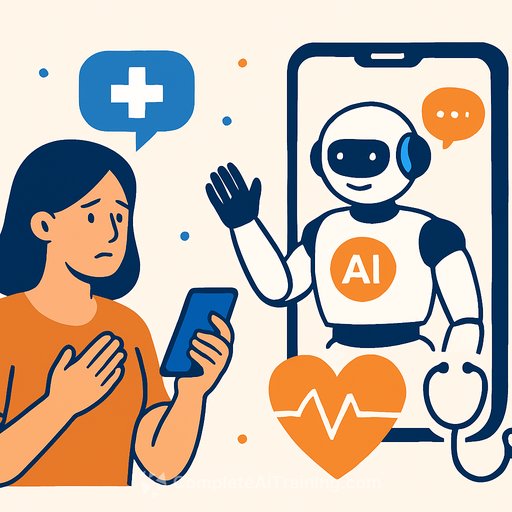
7) Supporting personalized self-care
Virtual health assistants can deliver reminders, education, and mental health check-ins that keep people engaged between visits. With the right integration, they can bridge self-management and clinical oversight without adding friction for staff.
Two cautions: protect data privacy and avoid over-monitoring that creates anxiety. Build consent into onboarding, explain what's tracked, and give users control over alerts and data sharing.
Implementation checklist for healthcare IT and development teams
- Start with a narrow, high-friction workflow (notes, imaging triage, or scheduling) and define a single success metric (e.g., report TAT, time-on-notes, first-time-right rate).
- Integrate via FHIR/DICOM; log all prompts, outputs, and overrides for audit and QA.
- Use PHI-safe architectures: encryption, role-based access, and data minimization.
- Stand up a model governance path: bias testing, performance baselines, drift monitoring, rollback strategy.
- Design for clinician trust: show confidence, rationale, and easy accept/edit flows.
- Measure outcomes continuously: staff time saved, diagnostic agreement, patient throughput, alert precision/recall, and patient-reported experience.
- Plan change management: short training loops, champions on each shift, and a feedback inbox wired to your product backlog.
Level up your team
If you're building or deploying clinical AI and want structured upskilling for roles across product, data, and engineering, explore our curated catalog by job function: AI courses by job.
Your membership also unlocks: