
AI news ·
92% of tech executives say managing AI agents will be an essential workplace skill by 2031
Ninety-two percent of tech execs see managing AI agents as critical within five years. A KPMG survey of 2,500 leaders shows 88% already invest in agentic AI.
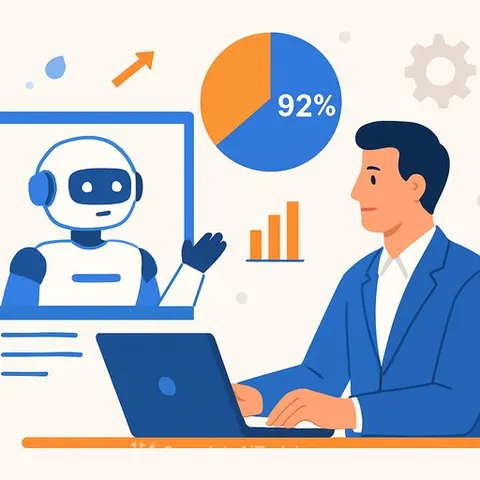
Ninety-two percent of technology executives now view managing artificial intelligence agents as a critical workplace skill within five years, according to a new KPMG report that surveyed 2,500 leaders across 27 countries. The finding signals a rapid restructuring of corporate priorities, as 88 percent of organizations already invest in weaving agentic AI into their systems.
A workforce reshaped by digital assistants
The report projects that digital assistants will grow from 28 percent of core technology teams in 2025 to 36 percent by 2027. This shift is accelerating executive focus on AI for Management as a central competency, not a peripheral skill. Umesh Sachdev, co-founder and CEO of Uniphore, underscored the competitive stakes. "Companies that learn to use AI and AI agents and all these architectures effectively are likely to leave their peer groups behind," Sachdev said. "Right now that is coming down to the leadership of companies and departments and teams."
Smaller teams, flatter structures
Zack Kass, a global AI advisor and former Head of Go-To-Market at OpenAI, recommends that organizations play smaller and adopt flatter structures to increase agility. "The future will not be defined by what machines can do. It will be defined by what we want machines to do," Kass said. The report echoes that the real value of agentic AI emerges when efforts move beyond boosting individual productivity toward broader operational shifts.
Partnerships, security, and the quantum horizon
To manage this integration, 90 percent of tech executives plan to expand partnerships and tap external expertise. Noelle Russell, an AI solutions architect and strategic advisor, advised a selective approach. "Pick the areas that you want to keep in-house for domain expertise, then choose trusted partners to fill in the gaps across your portfolio," Russell said. "Paying attention to what you build means applying rigor and discipline to every model you select."
Reliance on third-party collaborators also raises concerns around data protection and governance. Meanwhile, 41 percent of executives worry they are falling behind on quantum-related encryption threats, a long-term challenge that compounds immediate agentic AI risks.
Why this matters for executives and strategy
Leaders who treat AI management as a core leadership discipline rather than a technical add-on will set the competitive pace. The report's data makes clear that AI for Executives & Strategy is no longer a future consideration - it is a budget and talent priority right now. Concrete next steps include auditing team structures for AI collaboration readiness, vetting external partners against strict security standards, and building in-house expertise in high-stakes domains. Guy Holland, Global Leader of the CIO Center of Excellence at KPMG International, captured the moment: "We stand at the threshold of the Intelligence Age, a period defined by an unprecedented pace of innovation and profound uncertainty, where technology is no longer just a tool, but a force reshaping the very fabric of business and society."