Product Managers Are All In on AI-But Skills Gaps and Shadow AI Put Teams at Risk
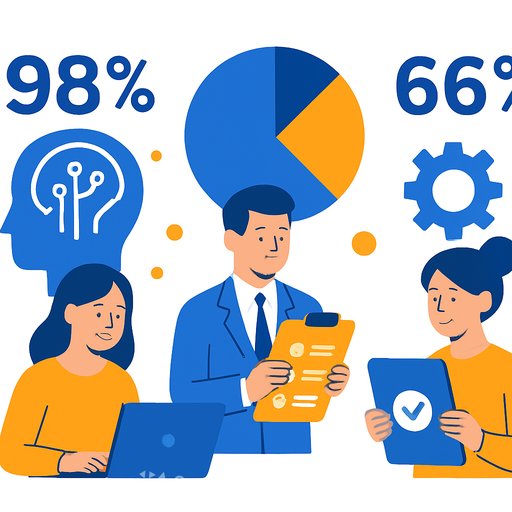
A new survey from General Assembly shows what most product leaders feel day to day: AI is everywhere, but structured enablement is lagging. While 98% of product managers use AI at work, only 39% have received comprehensive, job-specific training. Two-thirds (66%) also admit to using unapproved AI tools-classic shadow AI.
As one PM leader put it, the work's complexity, scale, and accountability demand more than informal learning. If you want results beyond quick productivity spikes, you need real fluency, grounded in your workflows and guardrails.
How PMs Use AI Right Now
On average, PMs tap AI 11 times per day. Many are already going beyond basic prompts to more agentic, integrated use cases.
- Managing product development cycles, sprint planning, and delivery - 54%
- Cross-functional collaboration - 52%
- Creating product strategies and roadmaps - 48%
- Developing customer interviews or role-playing interviews - 46%
- Backlog grooming, ticket creation, or QA support - 44%
- Analyzing customer feedback - 42%
Advanced adoption is growing fast: 78% use AI agents, and 31% build custom language models, specialized agents, domain-adapted GPTs, or CustomGPTs.
Skills Gaps: Where PMs Want to Go vs. What They're Doing
The biggest delta isn't interest-it's enablement. For example, 47% want to learn "vibe coding" (prototyping and validating product concepts without waiting on engineering), but only 38% do it today. That gap slows discovery, delays validation, and pushes more work into engineering queues that don't need it.
Impact Is Real: Faster Decisions, Better Lifecycles, Same Headcount
The upside is clear. 97% say AI helps their department make decisions faster, and 98% say it improves the product lifecycle. Only 1% report smaller teams since adopting AI, while 66% see productivity gains without headcount growth and 26% report team expansion.
What's Keeping PMs Up at Night
- "AI could replace me" - 26%
- "AI could make it harder for entry-level PMs to learn" - 25%
- "AI could replace my colleagues" - 22%
Add the 66% using unapproved tools, and you've got real risk: data leakage, inconsistent quality, and decisions made without oversight.
What Product Leaders Should Do Next
- Formalize job-specific training. PMs want regular updates as tools evolve (64%), peer learning sessions (51%), self-paced training with product examples (49%), ongoing support (40%), and hands-on workshops for specific use cases (37%). Build that into your enablement calendar.
- Set AI governance and tool approval. Publish a short list of approved tools, data handling rules, and review checkpoints. Use frameworks like the NIST AI Risk Management Framework and the OWASP Top 10 for LLM Apps.
- Create a PM AI playbook. Provide reusable prompts and templates for sprint planning, backlog grooming, discovery interviews, PRDs, release notes, and support summaries. Include expected outputs and quality bars.
- Launch a "vibe coding" track. Teach prototyping with LLMs, spreadsheet agents, and no-code builders. Pair PMs with engineering for feasibility checks and secure deployment paths.
- Instrument outcomes. Track cycle time, throughput, defect escape rate, and decision latency before and after AI adoption. Review weekly and retire low-value use cases.
- Secure data and prompts. Sanitize customer and internal data, set retention rules, and red-team prompts that touch sensitive information. Require human-in-the-loop for material decisions.
- Define agent policies. Scope data access, log actions, and set escalation paths. Treat agents like junior team members who need accountability.
- Consolidate tools to cut shadow AI. Offer approved alternatives and make them easy to access. Incentivize migration with better integrations and support.
A Simple 30-60-90 Plan
- Days 1-30: Publish an AI acceptable-use policy, approve a starter toolset, and run a baseline assessment of current AI use by team and workflow.
- Days 31-60: Ship a PM-specific enablement sprint: 2 peer sessions, 1 workshop, and a prompt/playbook drop for planning, research, and QA support.
- Days 61-90: Pilot vibe coding in discovery, define agent guardrails, and stand up metrics reviews. Promote wins and retire dead weight.
Training Resources
This snapshot comes from General Assembly's survey of PMs across the U.S., U.K., Canada, and Singapore. If you're building a skills program for your org, you can browse role-aligned options here:
Survey Methodology
General Assembly surveyed 117 product managers from October 2-13, 2025, across the United States, United Kingdom, Canada, and Singapore. Respondents worked at companies with at least 100 employees and managed software or digital service products.
Your membership also unlocks: