
AI news ·
Adobe stock drops to multi-year low amid AI and DaVinci Resolve pressure
Adobe's stock fell 37% in 2026 even as Q2 revenue hit a record $6.62 billion. AI tools and Blackmagic's free/$295 DaVinci Resolve challenge its creative lock-in.
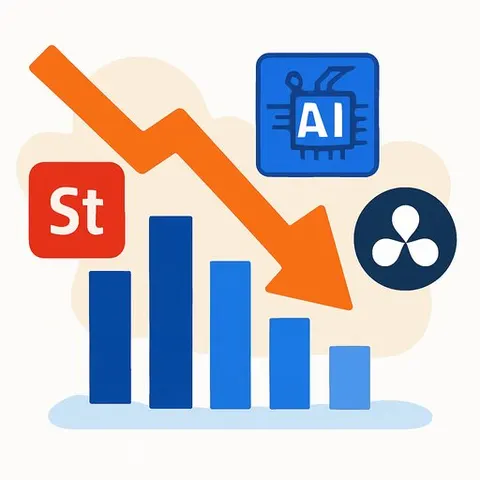
Adobe's stock has fallen roughly 37% in 2026, reaching multi-year lows despite the company posting record Q2 revenue of $6.62 billion - a 13% increase year over year. The sell-off matters for creative professionals because it reflects growing doubts about whether Adobe can defend its dominance in an era of AI-generated content and free alternatives like Blackmagic Design's DaVinci Resolve.
Adobe raised its full-year revenue forecast to between $26.50 billion and $26.60 billion, with annualized recurring revenue at $27.10 billion. AI-first recurring revenue passed $500 million. By conventional measures, the business is performing well. Yet the stock decline, which some reports pegged as the lowest in several years, signals that investors believe the company's competitive moat is narrowing.
Strong financials, weak stock
Adobe's non-GAAP earnings reached $5.96 per share, and the company counts an estimated 33 million Creative Cloud subscribers. The Q2 FY2026 results included a boost from the acquisition of Semrush. But these numbers did not reassure Wall Street. The stock's fall suggests that investors are pricing in slower future growth, not a current cash crunch.
Compounding the uncertainty, CFO Dan Durn is leaving and will be replaced on an interim basis by Steve Day. CEO Shantanu Narayen also announced plans to step down once a successor is named. A leadership transition at a time of rapid platform change rarely sits well with markets.
AI shifts the starting point of creation
Adobe's historic strength came from being the default creative workspace. If you edited video, retouched photos, or designed layouts, you probably started inside an Adobe app. That default position is now under attack. New creators may begin with a text prompt in an AI image generator rather than opening Photoshop. A social media video producer might edit inside a browser-based AI tool without ever launching Premiere Pro. A marketing team might generate dozens of asset versions automatically, bypassing motion designers who use After Effects.
These tools are not yet replacing professional film finishing, color grading, or complex compositing. But they are siphoning away the early stages of creation - storyboards, mood boards, rough cuts, ideation - that traditionally pulled users into Adobe's ecosystem. As that starting point moves outside Creative Cloud, the subscription lock-in weakens.
For photographers, designers, and motion artists, the shift demands new skills - many are exploring AI to stay competitive. Adobe itself is responding with Firefly, its generative AI family, but the market remains unconvinced that AI will preserve its old pricing power.
Blackmagic's DaVinci Resolve attacks the subscription model
The most direct threat to Adobe's post-production dominance may come from Blackmagic Design's DaVinci Resolve. Resolve is not simply a low-cost alternative; it compresses editing, color correction, visual effects, motion graphics, and audio post-production into a single application. The free version supports projects up to Ultra HD 3840 x 2160 at 60 fps, with professional color grading tools, HDR support, and Fairlight audio.
Adobe charges Creative Cloud Pro at $69.99 per month after an introductory period. For a solo filmmaker or small studio, that recurring cost adds up. Blackmagic offers Resolve Studio as a one-time $295 purchase. That price difference reshapes how new editors learn the craft - a student can download Resolve free, edit a short film, grade it, mix sound, and deliver without ever entering the Adobe ecosystem.
Resolve's rise also draws on its pedigree in high-end color grading. It feels close to the image, which appeals to cinematographers and camera reviewers. As Blackmagic continues integrating cloud collaboration and creator tools, Resolve is becoming a full pipeline, not just a piece of it. For professionals weighing the shift between Premiere Pro and DaVinci Resolve, understanding the new AI-assisted workflows is becoming essential.
Leadership uncertainty adds pressure
The departure of CFO Dan Durn and the planned CEO transition amplify the market's nervousness. Shantanu Narayen has led Adobe for over 15 years, steering it through the transition to subscriptions and building Creative Cloud into a recurring revenue machine. His eventual exit, combined with the CFO change, leaves a vacuum at a moment when Adobe needs to convince the market that its AI strategy will offset competitive erosion.
None of this suggests Adobe is in financial danger. It remains a highly profitable company with massive enterprise reach. But the stock's free fall is a real-time vote of confidence - or lack of it - in the old creative software model.
Why this matters for creatives
The stock slide has practical implications for the people who use these tools daily. If Adobe feels pressure to defend its subscription base, it may alter pricing, bundle offerings, or accelerate feature development in ways that affect daily workflows. Meanwhile, the growing viability of Resolve and AI-native creation tools means that skills built exclusively on Adobe apps become a career risk. Editors, colorists, photographers, and designers who ignore the shift may find themselves tied to a shrinking professional standard. Learning where AI fits into creative work - both inside and outside Adobe - is no longer optional.