
AI news ·
Advita Ortho presents research on AI-generated shoulder digital twins and surgical navigation at CAOS 2026
Advita Ortho presented nine studies at CAOS 2026 showing AI-generated shoulder digital twins, automated surgical planning, and navigation systems. The research includes a method to flag where AI is less confident, earning the ISTELAR Emerging Research Best Technical Podium Award.
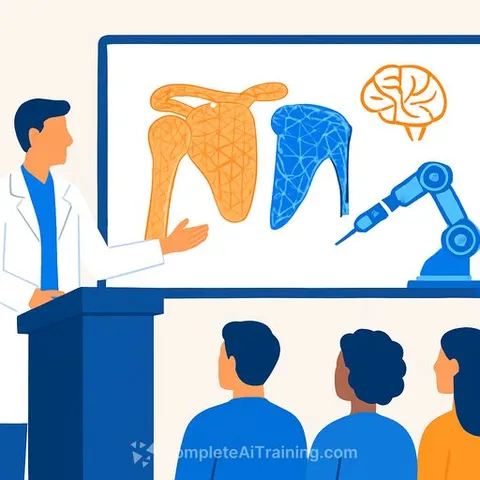
Advita Ortho presented nine scientific studies at the 26th Annual Meeting of the International Society for Computer Assisted Orthopaedic Surgery (CAOS) on June 19, 2026, revealing new data on AI-generated shoulder digital twins, automated surgical planning, and navigation systems. The research targets a central problem in modern surgery: how to convert vast amounts of procedural data into reliable clinical intelligence that helps surgeons plan and execute joint replacements with greater precision.
"AI is helping unlock new possibilities for personalized orthopedic care," said Laurent Angibaud, Senior Vice President of Advanced Surgical Technologies at Advita Ortho. "Our goal is to transform data into practical clinical insights that support surgeon decision-making, enhance confidence and ultimately improve patient care."
Assessing the reliability of AI-generated shoulder twins
A featured presentation explored methods to evaluate the quality and uncertainty of AI-generated shoulder twins. As these models move deeper into surgical workflows, the ability to flag areas where the AI is less confident becomes a practical necessity. The work received the ISTELAR Emerging Research Best Technical Podium Award, a signal of growing interest in tools that support responsible AI adoption in orthopedics.
The research aligns with a broader push across AI for Healthcare to build verification layers around predictive models before they influence clinical decisions. Rather than treating AI output as a black box, the studies emphasize transparency about what the model knows and where it remains uncertain.
Navigation accuracy and surgeon learning curves
Separate shoulder studies examined the intraoperative accuracy of the Advita GPS surgical navigation system during complex arthroplasty cases involving augmented glenoid components. Researchers also measured the learning curve for navigated reverse total shoulder arthroplasty. The combined findings add to evidence that navigation technologies can improve precision without disrupting established surgical routines.
In total ankle arthroplasty, new research demonstrated automated bone segmentation for planning and navigation. The AI-driven automation reduced the manual effort required for image processing while maintaining support for patient-specific procedures-a step toward faster preoperative workflows.
Machine learning and knee alignment data
Multiple studies used GPS-derived intraoperative data and machine learning to analyze dynamic knee alignment patterns. Researchers evaluated functional alignment strategies in total knee arthroplasty and examined how soft tissue management affects outcomes in patients with severe varus deformity. The work reflects a shift toward understanding joint mechanics as they function under load, rather than relying solely on static imaging.
For professionals working in AI for Science & Research, the studies illustrate a concrete pattern: surgical data, captured in real time, feeding into models that help surgeons understand what works and why. The convergence of navigation hardware, intraoperative data streams, and machine learning is making personalized surgical plans more practical across shoulder, knee, and ankle procedures.
Why this matters for science and research professionals
The CAOS presentations signal a maturation in how orthopedic research handles AI. Instead of simply demonstrating that an algorithm can generate a model, the focus has shifted to measuring that model's reliability, quantifying surgeon learning curves, and linking intraoperative data to clinical outcomes. For researchers building or evaluating AI systems in any domain, the same questions apply: How do you measure model quality? What happens when the system encounters edge cases? And does the technology actually change decisions in the real world? The methods Advita Ortho applied to shoulder twins and knee alignment data offer a template for answering those questions with empirical rigor rather than promotional claims.