
AI news ·
African countries debate ownership and resource costs of foreign AI infrastructure
African nations seek digital sovereignty amid foreign AI investments like a $1bn Kenyan data centre. Africa holds 18% of the population but under 1% of data capacity.
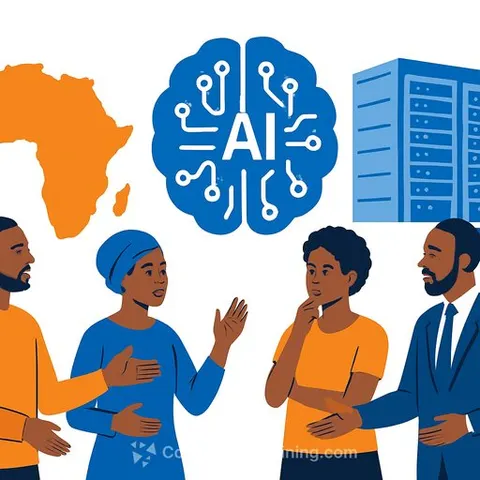
In April 2026, African Union ministers gathered in Tangier, Morocco, to discuss artificial intelligence as governments across the continent race to develop AI strategies, attract investment and expand digital infrastructure. Beneath the enthusiasm sits a fundamental question: as foreign technology companies build data centres, cloud services and AI systems, how much control will African countries have over the infrastructure that underpins these technologies?
The debate reflects a shift from adoption to ownership and governance. Nigeria, Kenya, Egypt and Ghana have all released national AI strategies that highlight the need to build local capacity and reduce dependence on foreign providers. Ghana's strategy, launched in April, describes AI as a "sovereign capability". Forty-nine countries, along with the African Union, have endorsed the Africa Declaration on Artificial Intelligence, which calls for greater investment in African AI infrastructure, talent and innovation. For policymakers navigating these issues, an AI Learning Path for Policy Makers provides structured guidance on AI governance and strategy.
Translating ambition into policy has not been straightforward. South Africa's draft national AI policy was withdrawn earlier this year after officials identified references that appeared to have been generated by AI tools, highlighting the practical challenges governments face in regulating fast-moving technologies.
Global competition, local negotiating power
Global competition over AI is intensifying, with major technology companies and governments competing for data, computing power and new markets. For African countries, that competition may create space to negotiate. Priyal Singh, a geopolitical analyst at Signal Risk, said the fragmented nature of the global AI industry could strengthen that position.
"African states will indeed be provided with greater room for manoeuvre on AI and data infrastructure, precisely due to how contested and fragmented this industry is amongst global leaders," he said. Singh pointed to regulatory tensions over Starlink's expansion in parts of Africa as an example of governments becoming more assertive. "Major tech companies will need to bend to local concerns much more often than they would otherwise expect," he said.
The infrastructure gap
Influence in the AI era is not just political. It is also infrastructural. Africa accounts for less than one per cent of global data centre capacity, despite holding roughly 18 per cent of the world's population. Research by McKinsey found that Africa's five largest data centre markets combined have less capacity than France. Unreliable electricity supply remains a major constraint across much of the continent.
These limits help explain why negotiations over data centres and cloud infrastructure have become more sensitive.
Kenya's contested data centre deal
One of the most closely watched projects is a proposed $1bn data centre development involving Microsoft and Emirati technology company G42 in Kenya. President William Ruto highlighted the project's energy demands, warning that infrastructure of that size would require substantial additional power generation. Reports have pointed to discussions over commercial arrangements and long-term commitments linked to computing capacity. Kenyan officials say talks remain ongoing.
The episode illustrates the trade-offs governments face: attracting AI infrastructure investment while weighing energy needs, financing costs and long-term strategic dependence.
What countries gain and what they give up
The question of who builds Africa's digital future extends beyond Western technology companies. Sanusha Naidu, a senior research fellow at the Institute for Global Dialogue, told Al Jazeera that debates about diversification are more complicated than they appear. "Whether it's seen as diversifying from Western tech companies or shifting towards Chinese-based companies, I think it's generally part of the cost-benefit factor," she said.
For governments, Naidu argued, the key issue is what is returned through these partnerships. She compared current AI infrastructure debates with earlier waves of foreign investment. "What we saw in the 1990s around the textile industry is investment comes in, but there's a lot of subsidisation by the recipient country. With data centres, it's much more intense. It's also how big consumers of water these data centres are, and how that impacts socioeconomic issues within African countries."
Data, surveillance and sovereignty
Over the past decade, African governments have adopted a growing range of foreign-built digital systems, from cloud computing platforms and digital public services to surveillance and smart city technologies. Debates over data governance, digital sovereignty and where sensitive information is stored and processed have become more prominent. Similar arguments have been made by supporters of plans for an Africa Credit Rating Agency, designed to offer African-led assessments of sovereign creditworthiness.
The missing public
Much of the discussion about AI governance remains among policymakers, regulators and technology companies. Joseph Asunka, chief executive of Afrobarometer, said the debate is far removed from everyday citizens. "These negotiations should not just be conducted at the elite level and dumped on citizens," he said. "If citizens do not trust their government's actions in this space, it creates a trust gap, which could have negative implications for the adoption of fintech, e-commerce and e-government tools."
Asunka added that concerns about data protection and digital security are already widespread across African populations, even if AI itself is not yet widely understood.
Beyond dependency
The debate echoes older questions about economic sovereignty. Independence-era leaders argued that political freedom meant little without control over economic resources. Similar questions now emerge around data, computing power and digital infrastructure. Projects such as the United Nations Development Programme's timbuktoo initiative aim to strengthen African technology ecosystems through support for innovation, entrepreneurship and digital infrastructure. These efforts remain modest compared with global AI investment, but they reflect a broader attempt to ensure African countries participate not only as consumers of AI systems, but also as contributors to their development.
Africa is unlikely to become self-sufficient in artificial intelligence, nor is that the objective for most governments. The continent remains deeply integrated into global technology supply chains and will continue to rely on international investment, expertise and partnerships.
Why this matters for government, IT, and development professionals
Decisions made now about AI infrastructure will shape digital sovereignty, energy policy and public trust for decades. AI for Government Courses can help policymakers and civil servants understand the trade-offs between attracting foreign investment and maintaining control over critical infrastructure. IT and development professionals must also consider how water and energy demands from data centres affect local communities, and how to bring citizens into decisions about their data privacy. The terms of today's partnerships will determine who controls the technologies that influence economies, public services and everyday life.