Science Funding in Crisis
Science funding is facing severe challenges across the U.S. and parts of Europe. In the U.S., planned cuts totaling $18 billion to federal research budgets have already stopped clinical trials, caused widespread layoffs, and forced entire programs to shut down. Europe’s Horizon program, a key source of funding for research and innovation, is also encountering budget reductions.
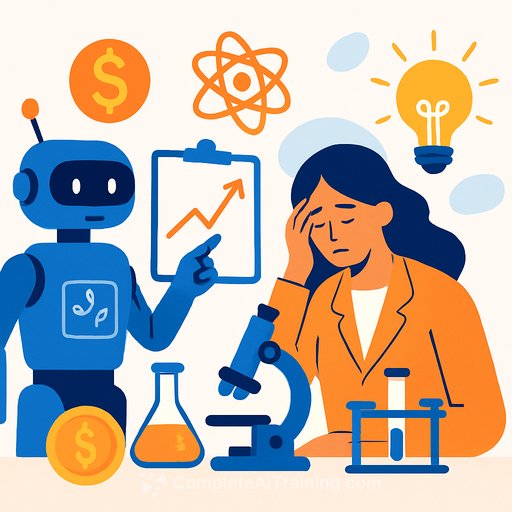
These cutbacks are stretching researchers thin and slowing innovation at a time when progress is critical. Breakthroughs in areas like cancer, rare diseases, and drug development require dedicated time, freedom, and resources. Instead, scientists are burning out, with a recent survey revealing that 75% of U.S.-based researchers are considering relocating. Meanwhile, China is increasing its investment in AI, putting the U.S. and Europe at risk of falling behind as science enters a pivotal phase.
Agentic AI Could Ease the Burden
Scientific research is slow and expensive not because ideas are lacking, but because the existing tools haven’t kept pace. Knowledge remains trapped in siloed papers, scattered datasets, and disconnected systems. Bringing this information together demands significant time, money, and manual effort, which slows even the most promising discoveries.
Agentic AI offers a new way forward. Unlike standard AI, agentic systems can independently plan and execute tasks from a single prompt. Researchers can use AI agents to handle repetitive tasks—such as writing reports, reviewing literature, or designing and running initial experiments—freeing up time for creative and complex work.
Several AI tools are already making an impact. Owkin’s K Navigator, Google’s AI co-scientist, and Stanford’s Biomni demonstrate a shift towards AI co-pilots that let scientists interact with their data as naturally as they would with a colleague. K Navigator, for example, can boost productivity by up to 20 times by exclusively analyzing spatial multiomic data from MOSAIC Window, a major spatial omics dataset in oncology. This helps researchers better understand cell interactions within the tumor microenvironment, accelerating cancer research.
Agentic AI supports hypothesis development, complex data analysis, and insight discovery without requiring a dedicated data science team at every step. This acceleration helps researchers meet tight deadlines and explore scientific questions that might otherwise be overlooked. Across cancer centers and university labs, where time is the scarcest resource, embedding agentic AI into workflows can reduce friction and speed up progress.
More Time on What Matters
AI agents won’t replace critical thinking or peer review. But with proper safeguards—like accurate referencing and clear data visualization—they can reduce administrative burdens. This lets scientists focus on advancing treatments and diagnostics rather than paperwork.
Since increasing budgets doesn’t seem likely in the near term, improving impact is the alternative. That means equipping researchers with tools to do more with less, avoiding burnout and maximizing output. If this opportunity is missed, the consequences aren’t just slower progress—they include lost cures, missed breakthroughs, and a generation of researchers choosing to leave the field.
For those interested in learning how AI tools can support research and improve productivity, resources such as Complete AI Training offer courses on AI applications that may prove valuable.
Your membership also unlocks: