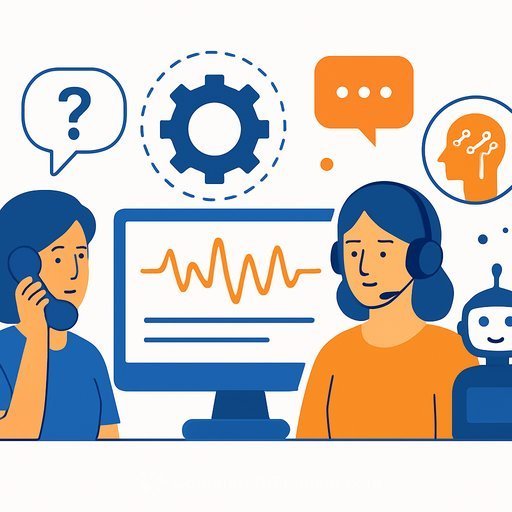
AI agents for automation, augmentation - and collaboration
Let's drop the old argument: humans vs. bots. The real win is humans with bots. Amazon Connect put that on display at AWS re:Invent 2025 with agentic AI - a shift from passive guidance to AI that actually takes action alongside your team.
Across 30 major launches (23 specific to Connect), the message was simple: agentic AI isn't a theoretical future. It's a practical way to finish more customer requests in one interaction, with AI and humans working as a unit.
Agentic AI is about action
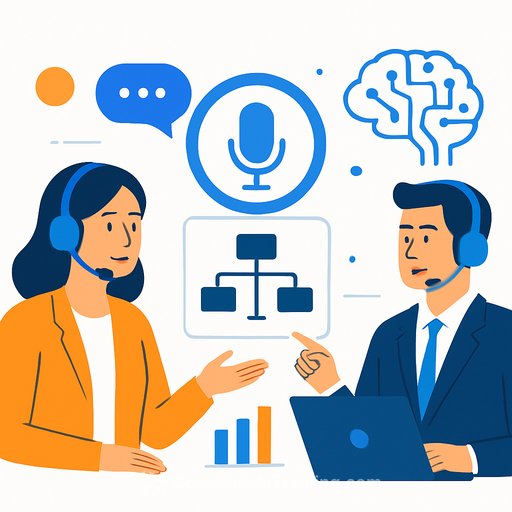
In a live demo, a voice AI agent greeted the customer, captured the intent, and collected key details. The call then moved to a human agent with full context, and multiple AI agents went to work in the background.
One AI agent fetched options for a new primary care physician. Another checked open appointment slots. No callbacks. No handoffs to other departments. One conversation, completed.
"Agentic is really about action," said Pasquale DeMaio, vice president, Amazon Connect. The approach spans fully autonomous flows to hybrid models, with companies choosing the pace. MCP (Model Context Protocol) enables AI agents to tap into tools and data safely - from scheduling to CRM - to carry out tasks on your behalf.
Learn more about Amazon Connect
Proof from the field: Priceline
Priceline is using Connect's AI for real gains in speed and quality. Live transcription helps agents capture tricky details instantly - think "Tulalip Inn in Puyallup, Washington" - reducing friction and repeat questions.
Automated summarization cut 50 seconds per interaction on average. That's real money and a calmer post-call workflow. Agents can stay present with the customer, while the notes write themselves in real time.
Quality assurance is moving from sampling a tiny fraction of calls to near-total coverage with AI. Real-time coaching and micro-learning snippets a few seconds after the call help agents spot wins and fix issues immediately.
Proof from the field: Centrica
Centrica migrated nearly 11,000 omni-channel agents to Amazon Connect and flipped on generative features. Web chat fulfillment doubled overnight, handle time dropped from 140 to 87 seconds, and some journeys saw NPS jump by 89 points.
Call summarization saves 30 seconds per interaction. The team reinvested that time into cross-sell motions, using the reduced cognitive load to grow revenue without burning out agents.
Centrica also tested agentic voice-to-voice with Nova Sonic. AI handled about eight percent of queries end to end - taking speech in, reasoning on intent, using tools, and replying in natural speech. "It works fantastically well," said James Boswell, director of cloud, Centrica. The goal: a fully agentic AI contact center that also gives employees smarter assistance.
What this means for support leaders
Agentic AI reframes your operation: AI handles routine tasks and executes actions; humans handle empathy, exceptions, and judgment. That mix trims handle time, reduces transfers, and closes loops inside a single interaction.
- Let AI do: intent detection, data lookups, verification, form-filling, scheduling, policy checks, and after-call work.
- Let humans do: de-escalation, edge cases, nuanced decisions, and relationship-building.
A practical rollout plan
- Weeks 0-2: Turn on live transcription and automated summaries for voice and chat. Measure handle time, after-call work, and agent satisfaction.
- Weeks 3-6: Expand AI QA to near-100% coverage. Deliver quick-hit coaching within seconds of the call. Update your scorecards to reflect both AI and human performance.
- Weeks 6-10: Add two high-impact "actions" through MCP-connected tools (e.g., scheduling and refunds). Keep a human in the loop. Define clear guardrails and escalation paths.
- Weeks 10-14: Pilot a voice AI agent for one intent with low risk but high frequency. Track containment, CSAT, and first contact resolution.
Guardrails you'll actually use
- Set "allowed actions" per intent and per tool. Log every AI action with a trace.
- Require confirmation for sensitive steps (payments, policy overrides, data updates).
- Use real-time handoff rules: confidence thresholds, customer sentiment, or time-in-flow triggers.
Metrics that matter
- Customer: first contact resolution, CSAT/NPS by intent, repeat contact rate.
- Operations: handle time, after-call work, transfer rate, containment for AI-led flows.
- Quality: time-to-coaching, coaching acceptance, error rate on AI actions, compliance flags.
- Revenue: conversion on assisted flows, cross-sell/upsell per contact.
Team enablement
Agents should see AI as a teammate, not a critic. Explain what the AI does, where it helps, and how handoffs work. Coach agents on "speaking to be summarized" and on verifying AI-proposed actions without slowing the call.
Leads and QA teams need new muscles too: reading AI traces, spotting bad prompts or tool setups, and turning insights into quick micro-lessons.
The takeaway
This isn't humans vs. bots. It's humans with bots. The contact centers that win will be the ones that make AI an active participant in every interaction - doing the work, not just whispering in the ear - while keeping people focused on judgment, empathy, and outcomes.
If you're building skills for AI-assisted support roles, explore the AI Learning Path for Training & Development Managers at Complete AI Training.
Your membership also unlocks: