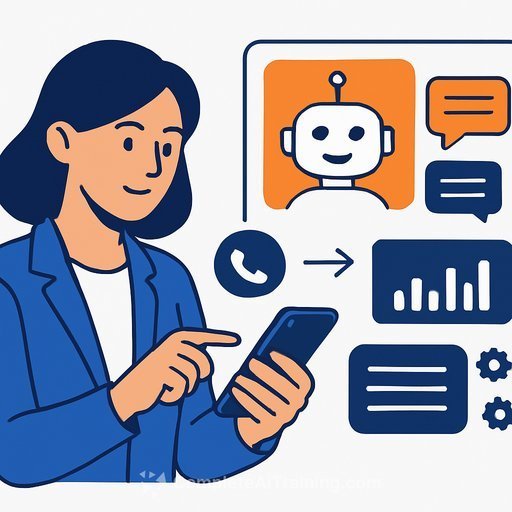
FMI Midwinter: Agentic AI is coming fast - and it could make or break grocery sales
Agentic AI isn't a buzzword anymore. It will sit between your buyers and your brand within two to three years - and by 2030 it will have their full attention.
That was the clear message at the FMI Midwinter Executive Conference in Chula Vista, Calif. The takeaway for sales leaders: your product data, trust signals, and offer mechanics will decide who wins when machines assist every cart.
What "agentic AI" means for sales
Dan O'Connor predicted shoppers could have their own AI agents as early as 2028, likely built into the next wave of smartphones. After a short setup, these agents will recommend products and handle repetitive purchases based on rules set by the consumer - and, increasingly, by retailers.
His point was blunt: "The competitiveness of agentic commerce is such that data and decisions are going to come together and happen instantaneously." The time between a product page and a purchase vanishes.
Trust is the new shelf space
Agents will pick products they trust. That trust rides on the recency and credibility of your content, transparent claims, clear use occasions, and what other customers actually say. If your data is thin, stale, or inconsistent, you'll get filtered out before a human ever sees you.
"Data is now your product," O'Connor said. Treat it with the same rigor as packaging and price. Begin with rigorous Data Analysis to identify gaps in completeness, freshness, and governance.
Retailers are already moving
Walmart has rolled out a framework with four "super agents" to reduce cognitive burden for customers, employees, and partners. Desiree Gosby framed it simply: agents will orchestrate and streamline tasks.
Guy Peri added the other side of the deal: suppliers and retailers must feed accurate, complete data so customers trust algorithms enough to let them buy on their behalf. "In this agentic era, trust is elevated."
The stack behind the scenes: LLMs + knowledge graphs
Retailers will lean on large language models paired with knowledge graphs that connect internal and external data. You can't control the LLM, O'Connor noted. You can control your knowledge graph - and how discoverable it is.
For sales teams, that means clean attributes, machine-readable offers, and consistent taxonomy aren't "ops tasks." They're revenue levers. Learn more about the underlying models in Generative AI and LLM.
90-day action plan for sales leaders
- Audit product data for completeness, freshness, and truthfulness. Prioritize top 20 SKUs by revenue and velocity.
- Lock core attributes: size, claims, allergens, nutrition, use occasions, substitutes, complements, packaging images, and GTIN consistency.
- Implement machine-readable structure: GS1 alignment, schema attributes, and promotion metadata agents can parse.
- Tighten content governance: who owns updates, how fast you refresh, and how you validate claims across retailers.
- Syndication readiness: ensure the same facts render the same way on every retailer and marketplace.
- Review strategy: increase recent reviews and Q&A coverage; flag and fix common objections in copy.
- Pilot with retailer sandboxes or internal agents: test how your SKUs rank in agent recommendations and auto-replenishment.
- Co-sell with IT: request access to retailer knowledge graph requirements; publish your product graph where buyers and agents can find it.
- Agent-friendly offers: write promotions so agents can match them to shopper rules (budget, diet, brand, pack size).
- Update SLAs: time-to-correct bad data, image swaps, and claim changes measured in hours, not weeks.
KPIs to track before agents dominate
- Share of agent-driven recommendations within category (ask retail partners for visibility).
- Auto-replenishment share and reorder repeat rate.
- Content freshness: average age of images, nutrition panels, and top 10 attributes.
- Coverage: percent of SKUs meeting mandatory attribute sets across top retailers.
- Time-to-fix: speed from flagged error to live correction.
- Review recency and Q&A resolution time.
How this changes your sales motion
Pitch meetings shift from "features and funding" to "data quality and agent performance." Bring a one-page data scorecard to every line review. Show you can improve the retailer's agent outcomes: fewer substitutions, higher satisfaction, cleaner returns.
Trade budgets move toward agent-targeted offers and structured promotions that slot into shopper rules (value, health, sustainability). Retail media doesn't go away - it gets scored on agent pickup, not just clicks.
Your next three conversations
- With the retailer: What schema, attribute priorities, and knowledge graph endpoints will you support in 2026-2027?
- With marketing: Are claims and images consistent across PDPs, packs, and ads so agents don't down-rank us for conflicts?
- With operations: Can we guarantee weekly data refresh and 24-hour fix SLAs for our top 100 SKUs?
Level up your team
Train sellers to speak data, not just deals. If your reps can explain how your SKUs improve agent decisions, you'll win more distribution and protect base business as auto-replenishment grows.
Want a quick way to get your team fluent? Explore role-based programs at Complete AI Training.
Helpful resources
- GS1 product data standards: gs1.org/standards
- What a knowledge graph is and why it matters: Wikipedia: Knowledge Graph
The bottom line
Agents will buy for your customers. If your data is current, complete, and consistent - and your offers are machine-readable - you'll get the recommendation and the reorder. If not, you'll never even show up.
Control what you can control: your knowledge graph, your content, and your speed. That's how you sell in an agent-first market.
Your membership also unlocks: