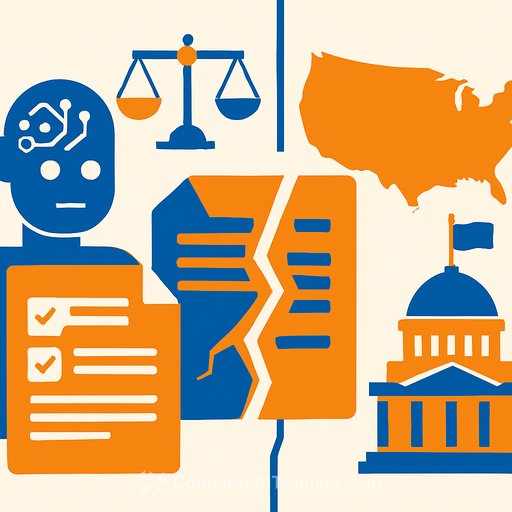
The AI Action Plan and Federalism: A Constitutional Analysis
On July 23, the Trump administration unveiled its AI Action Plan, a strategy focused on accelerating AI innovation to secure global leadership. Central to this plan is deregulation—specifically, removing domestic obstacles that could slow AI development. While the policy applies nationwide, its greatest effects may hit the states hardest, as most AI regulations currently come from state governments.
This plan flips the usual cooperative federalism model on its head. Traditionally, Congress uses its spending power to encourage states to adopt federal standards through collaborative programs. Here, the administration aims instead to create a regulatory void at the state level by executive order, pushing states to refrain from implementing AI regulations it deems burdensome.
Key Provisions Impacting States
- The Office of Management and Budget (OMB) is tasked with limiting AI-related funding to states that impose what the administration calls “burdensome” AI regulations.
- The Federal Communications Commission (FCC) is directed to assess whether state AI regulations interfere with federal authority, potentially setting the stage for administrative preemption.
These moves raise serious constitutional questions, touching on separation of powers, administrative law, and federalism.
Separation of Powers Concerns
The Constitution grants Congress the spending power, not the executive branch. Congress has long appropriated funds across sectors like infrastructure, healthcare, and education, each with its own conditions. The AI Action Plan attempts to add an executive-imposed condition: states must avoid AI regulations the administration finds restrictive to innovation.
The plan’s vague criteria for what counts as “burdensome” leave room for arbitrary enforcement. This ambiguity can chill state regulatory efforts and enable the executive to punish states after the fact for policies it disfavors. Yet, under the Constitution and federal law, the executive cannot unilaterally impose new funding conditions or withhold funds Congress has appropriated.
Notably, Congress recently rejected a similar spending condition on state AI regulation, signaling clear legislative intent against such executive overreach.
Administrative Law Challenges
The plan’s directive for the FCC to identify state AI regulations interfering with federal mandates raises further issues. While agencies can preempt state laws, they must do so under valid federal authority. The FCC lacks explicit authority over AI under the Communications Act, and Congress has not delegated such power.
Legal doctrines now limit agency power more strictly. The Supreme Court’s 2024 Loper Bright v. Raimondo decision overturned Chevron deference, meaning courts no longer automatically defer to agencies’ interpretations of ambiguous statutes.
Additionally, the major questions doctrine requires agencies to show clear congressional authorization before regulating issues with vast economic and political impact—like AI regulation. Since AI touches nearly every sector and states actively legislate in areas such as consumer protection and civil rights, the FCC would struggle to justify federal preemption here.
These legal developments act as safeguards against unauthorized executive action, leaving room for states to fill policy gaps.
Federalism at Stake
The AI Action Plan’s funding restrictions conflict with key federalism principles. Federal spending conditions must be:
- Unambiguous: The plan’s terms are purposely vague about what “burdensome” regulations trigger funding cuts and which funds qualify as “AI-related.”
- Germane: Conditions must be relevant to the federal interest in the funded program. The plan’s broad scope risks disconnecting funding from specific federal objectives.
- Non-coercive: Conditions cannot be so severe as to compel states to comply. The plan’s potential to cut funding across diverse programs raises coercion concerns.
For example, a state regulating AI in employment might risk losing transportation grants—an unrelated area. The absence of clear limits invites confusion and could undermine states’ ability to govern effectively.
Retrospective application of funding conditions or clawbacks would further destabilize state planning and increase constitutional risks.
Balancing Innovation and Constitutional Limits
Sidelining states may seem efficient for AI governance, but it clashes with foundational democratic and constitutional principles. The administration emphasizes “American values” in AI, yet its approach risks suppressing the diverse legislative choices states make to reflect their populations.
The AI Action Plan challenges legal pillars across separation of powers, administrative law, and federalism. It tests presidential authority to impose conditions Congress has refused and pits executive power against state sovereignty.
If upheld, this approach could erode vital checks on executive power and reshape the balance between federal and state authority in technology regulation.
Executives and strategists should watch these developments closely, as the outcome will influence how AI policies evolve and how states participate in shaping AI’s future.
Your membership also unlocks: