What Happens When A.I. Agents Take the Corner Office?
As A.I. agents step into leadership roles, businesses must rethink what leadership means and who is best suited to lead. From giants like Salesforce to IBM, companies are already placing bets on A.I. leaders to drive strategy and operations.
While an average CEO might spend weeks analyzing market data before making a major decision, A.I. agents can process the same information in minutes and move straight into action. The question is no longer whether A.I. can run entire business processes, but when competitors will adopt these systems and how fast they will gain an advantage.
Can A.I. Leaders Outperform Human Counterparts?
Typically, A.I. waits for instructions. But new A.I. leaders like O.CEO operate differently. They monitor market dynamics, allocate resources, and execute strategies autonomously. Human leaders often take days or weeks to decide; A.I. can analyze multiple markets and regulations instantly and act immediately.
The crypto sector is already a testing ground for this shift. A.I. agents manage decentralized finance portfolios, execute high-frequency trades, and adapt faster than any human trader refreshing dashboards. In 2025, A.I. activity on blockchains jumped 86%, fueled by agent-led projects raising $1.39 billion—marking a leap from simple productivity tools to full autonomy.
Despite this, many business leaders still view A.I. as advanced assistants rather than potential replacements.
Bounded Autonomy: Balancing Control and Independence
Giving A.I. full authority raises concerns. The solution may lie in creating constitutional frameworks for artificial intelligence, a concept called bounded autonomy. For instance, O.CEO operates within strict boundaries but makes decisions independently within those limits.
This approach is similar to constitutional law: the A.I. can hire, fire, and reallocate budgets, but only within pre-established limits. It can enter new markets only if they meet specific regulatory or geographic criteria. Crucially, these constraints are built into the system architecture, preventing circumvention.
Research predicts that over 40% of agentic A.I. projects will be canceled by 2027 due to poor risk controls. Organizations that implement effective guardrails early will deploy A.I. models that are autonomous enough to be effective yet trustworthy.
Web3 digital agents already set an example: decentralized finance agents operate under smart contracts that enforce risk limits automatically. Enterprise A.I. systems need this model of bounded autonomy to operate safely and confidently.
Boardroom Decisions Without the Boardroom
The shift from A.I. assistant to A.I. executive changes how decisions are made. Traditional A.I. tools wait for instructions. Executives set direction and report on actions taken. A.I. executives analyze data, identify issues, plan responses, and act—all before a human leader finishes reading reports.
This shifts the board’s role from active decision-making to oversight and course correction. Legal firms like Allen & Overy already use A.I. tools to autonomously draft contracts and develop case strategies, leaving lawyers to review rather than initiate.
Interest in A.I. agents is rising fast: 93% of enterprise IT leaders are exploring them, and 25% plan live pilots in 2025, redistributing authority from humans to machines. Companies embracing this shift will operate at speeds competitors can’t match. Those resisting risk falling behind.
By 2028, 10% of global boards aim to integrate A.I. agents, signaling an urgent need for preparation. Early adopters will hold a major advantage over those still treating A.I. as mere productivity tools.
Preparing for A.I. Operatives in 2026
Some companies are already testing A.I.-driven leadership. Salesforce’s Agentforce offers over 150 pre-built A.I. units for various tasks. IBM’s WatsonX helps enterprises build custom A.I. programs quickly. Finance leads the pack, with 86% of teams planning to scale A.I. investments by 2026.
Success depends on culture as much as technology. Firms that treat A.I. as partners and experiment with bounded autonomy while training their people to collaborate with machines have the best chances to thrive. Predictions include billion-dollar businesses run by a single human alongside A.I. within a few years.
The Executive Suite Is Changing
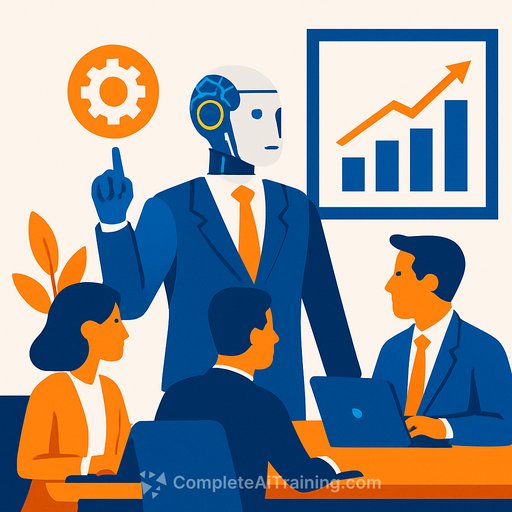
Leadership is moving into new territory. A.I. agents like O.CEO rethink governance and accelerate decision-making. They handle vast data, evaluate countless scenarios, and avoid many human blind spots.
Tasks once seen as impossible are becoming routine. A.I. is no longer a futuristic idea but part of daily operations. The big question: what happens when A.I. joins the executive team? Organizations preparing now will likely lead tomorrow.
For executives interested in staying ahead, exploring the latest A.I. courses can provide practical knowledge on integrating A.I. into leadership and strategy.
Your membership also unlocks: