
AI news ·
AI agents could lift hotel operating profit margins by up to 25%, authors argue
Hotels running AI agent networks across pricing, staffing, and guest services could boost gross operating profit by up to 25%, yet only 32% have meaningfully embedded AI in operations.
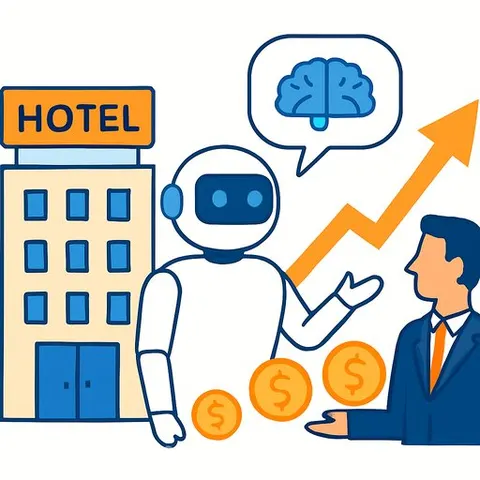
Hotels Face a 20% Profit Opportunity They're Mostly Ignoring
Financial stress is mounting across the hotel sector. Sircle Hotels, which operates the W Hotel Amsterdam, recently failed to meet rental obligations to landlords. Revo Hospitality filed for bankruptcy in Germany. These aren't isolated incidents-they reflect a wider squeeze on operating margins across the industry.
Revenue growth has stalled. Labor costs are climbing due to collective agreements and tight job markets. Energy, food, and raw materials have become more expensive. Governments are raising taxes: the Netherlands increased VAT on hotel stays from 9% to 21% in 2026. European cities are hiking tourist taxes. Hotels can't simply pass these costs to guests without losing bookings.
The instinctive response-cutting staff and reducing costs-has hit a wall. Beyond a certain point, fewer employees means worse service, lower reviews, and lost revenue that exceeds payroll savings.
A different approach exists: deploy networks of AI agents to reduce operating costs and grow revenue at the same time, without degrading the guest experience.
The Math Works
Take a typical 150-room upscale hotel generating €10 million in annual revenue with a 37% gross operating profit (GOP) margin-€3.7 million in profit.
A 5% revenue increase through better personalization, dynamic pricing, and upselling brings revenue to €10.5 million. A 3 percentage point reduction in operating expenses through task automation, optimized staffing, predictive maintenance, and smarter procurement adds more than €700,000 to GOP. Combined, these changes push GOP above €4.4 million-a 19-25% uplift.
This isn't one chatbot. It's networks of specialized, autonomous agents that handle repetitive work across scheduling, pricing, maintenance, procurement, and guest services. Modern AI agents coordinate with each other and human teams, learning from your standard operating procedures.
Where AI Agents Add Value
Personnel management. AI agents handle shift scheduling, time-off requests, payroll queries, training, and onboarding. One supplier reports housekeeping teams gaining 45 minutes to 1.5 hours daily for actual guest interaction instead of administrative work. This improves employee satisfaction and retention-critical in an industry with chronic staff churn.
Customer satisfaction. Agents automate check-in and checkout via WhatsApp, apps, or voice. They issue digital keys, assign rooms, and handle billing in seconds. They answer questions about amenities, policies, and services instantly. They detect problems-a delayed flight, a late arrival-and offer solutions before guests ask. They recommend personalized experiences based on previous stays, driving higher satisfaction and ancillary spending.
Response rates and marketing. Agents achieve near-100% response rates within seconds across channels. They analyze guest data to create targeted campaigns, improve online visibility, and match preferences. This lifts conversion rates on direct bookings.
Revenue management. Agents continuously analyze booking curves, competitor rates, events, and demand forecasts to enable dynamic pricing beyond traditional tools. They suggest upsell opportunities during stays-spa services, dining, experiences.
Facility and cost management. Predictive maintenance agents monitor HVAC, energy use, and equipment to prevent breakdowns. Inventory agents reduce waste and optimize purchasing. Cash-flow forecasting agents provide real-time visibility and scenario modeling.
Investment decisions. Agents analyze proposed investments, calculate return on invested capital, compare it to risk, and identify the highest-value options.
Real Examples
Inhotel.io has built an agent platform specifically for hospitality. Their agents handle complex workflows across property management systems and coordinate between departments. Guest-facing agents handle reservations and guest relations. Back-of-house agents orchestrate operations. Hotels using the platform report faster response times, reduced friction, and staff freed from administrative tasks.
SOUS, an Amsterdam-based startup, raised €2.75 million to build AI-driven software for restaurants and food service. Its agent acts as a digital co-pilot for independent operators, consolidating review monitoring, competitor tracking, and visibility optimization into one system. It helps build direct ordering and delivery infrastructure, eliminating high commissions from platforms like Uber Eats. Fixed monthly pricing around €100 lets smaller venues compete with major chains.
Why Adoption Lags
Despite the financial case, AI adoption in hospitality remains low. Research from Hotelschool The Hague shows the Dutch hospitality sector ranks second-to-last on AI adoption rates, ahead only of construction.
While 82% of hotels expect AI usage to increase in 2026 and 85% plan to allocate at least 5% of IT budgets to AI, deep implementation lags. Nearly 98% of hotels have experimented with AI, but only about 32% have embedded it meaningfully across operations. Retail, banking, and technology sectors report 78-88% of organizations using AI in at least one business function.
Four barriers explain the gap:
- Chronic understaffing. General managers are consumed with daily operations and lack bandwidth to evaluate and implement new systems.
- Cultural resistance. Hospitality values human connection. There's genuine fear that technology erodes the personal touch that defines great hotels.
- Fragmented technology. Many properties run outdated property management systems and siloed software that is expensive and risky to integrate.
- Risk aversion. High staff turnover discourages investment in training. Past failed technology projects have created skepticism about ROI claims.
Yet hotels already have substantial software in place. The problem isn't the lack of tools-it's that they don't talk to each other. AI agents can solve this by allowing different systems to communicate, unlocking value from existing investments.
The First-Mover Edge
Hotels that move decisively with well-designed AI agent systems will protect margins in a challenging cost environment. They'll create structural competitive advantages in guest experience, operational efficiency, and talent attraction.
If every hotel adopted AI simultaneously, competitive advantages at the revenue level would diminish. Cost control benefits would remain. But that scenario is years away. Right now, there's a first-mover advantage-and potential severe consequences for those who lag.
The winners of the next decade won't necessarily be hotels with the best real estate in the best locations. They'll be the ones that combine human hospitality with AI-powered operational efficiency.
The 20% GOP opportunity is available now. For hospitality professionals, understanding how to evaluate and implement these systems has become a strategic skill. Learn more about AI for Hospitality & Events and AI Agents & Automation to stay ahead.