
AI news ·
AI agents enter the B2B buying process, pushing marketers to rethink account-based strategies
AI agents from ChatGPT, Gemini and Copilot now handle early-stage B2B research before any salesperson gets involved. Adobe reports AI-driven site traffic rose 269% year-on-year in March 2026.
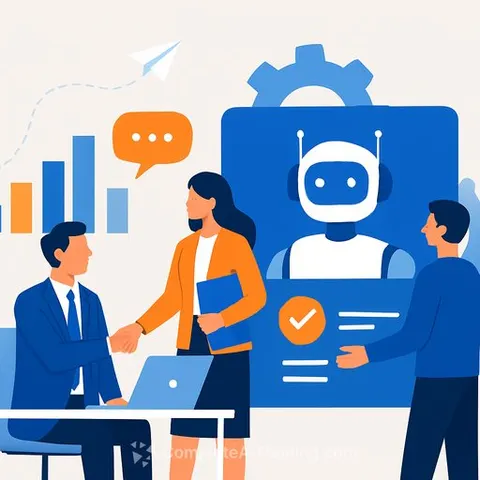
AI Agents Are Rewriting B2B Marketing Rules
Enterprise buying groups now include AI systems. ChatGPT, Gemini, Perplexity and Microsoft Copilot conduct the initial research and evaluation for corporate purchases long before a sales team gets involved. Internal AI agents built by enterprise technology teams operate as decision support tools. This shift is forcing marketing leaders to rethink both their technology stack and the definition of their audience.
The change is not theoretical. Bain & Company found that 80 percent of consumers rely on AI-written results for at least 40 percent of their searches. Adobe Digital Insights reported AI-driven traffic to US websites surged 269 percent year-on-year in March 2026.
What this means: buyers arrive with higher intent, fewer alternatives under consideration and opinions already shaped by AI recommendations. The customer journey has compressed.
Visibility Has Moved Inside AI Answers
For marketers, appearing in search results matters less than being surfaced inside conversational interfaces and AI-generated responses. The homepage is no longer the front door to an enterprise.
Instead, the first brand interaction may happen inside an AI-generated answer the customer never clicks through to reach. This forces enterprises to reconsider how content is structured, distributed and trusted online.
Content must now be machine-readable, context-rich and supported by credible third-party validation. Large language models increasingly prioritise trusted external sources over corporate websites. Influence now depends heavily on credibility and external reputation.
Marketing Teams Are Becoming Orchestrators
Inside marketing departments, AI agents are changing how work gets done. Teams use generative AI to accelerate content production, create campaign variants, analyse customer behaviour and automate repetitive workflows.
This shifts the role of human marketers. Instead of manually executing campaigns, they focus on strategy, governance and orchestration. AI systems execute workflows at scale while humans define objectives, establish controls and oversee brand standards.
The problem: most organisational structures were not built for this model. Many companies remain stuck in what executives call "pilot purgatory"-dozens of AI experiments exist, but few reach production scale.
Four Areas Demanding Reassessment
Data and signal intelligence. AI interactions generate richer contextual signals than traditional clicks or web visits. Many of those signals occur on external platforms companies do not own or control.
Content strategy. Large language models prioritise trusted third-party sources. Corporate websites alone no longer drive influence.
Brand. In an AI-driven environment, brands are shaped not just by advertising but by what customers, publishers and communities say across the broader digital ecosystem.
Operating model design. Organisations need clearer role definitions between humans and AI systems, along with governance structures capable of managing automated decision-making at scale.
The Competitive Stakes Are Rising
In the previous generation of digital marketing, companies competed for search rankings and web traffic. In the next phase, they may compete to become the preferred answer generated by an AI system.
That creates a fundamentally different competitive environment where trust, authority, structure and machine interpretability become strategic assets.
Chief marketing officers and chief information officers now face a dual challenge: modernise organisations for an AI-driven customer environment while ensuring governance, security and brand trust are maintained.
For marketing professionals looking to understand this shift, resources on AI for Marketing and an AI Learning Path for CMOs can help clarify how to adapt strategy and operations to this new reality.