
AI news ·
AI agents join workforce as a new category of worker alongside humans
AI is becoming a new category of digital worker alongside human staff. HR leaders focusing only on 5% cost cuts miss this broader structural shift.
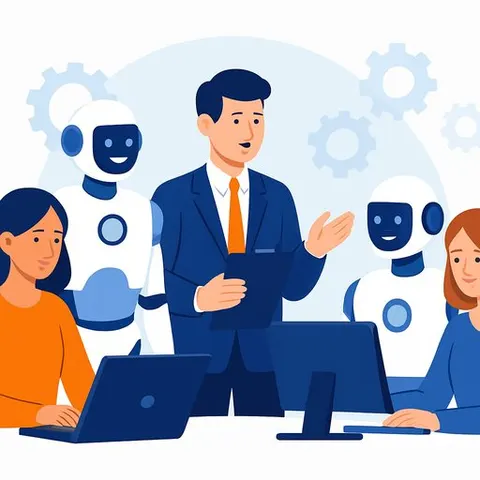
Companies are approaching a turning point where AI is no longer viewed simply as a productivity tool but as a new category of worker - sitting alongside permanent employees, contractors and freelancers. The shift, accelerated by global talent pools and outcome-based work models, will fundamentally reshape how organisations hire, structure teams and deliver work, according to Thomas Jajeh, CPTO at HeadFirst Global.
"(In 2026) hiring is more global, talent accessibility more global, more and more work is being executed remotely," Jajeh said. "The expectation towards technology is it needs to be easy, simple, fast to use, and agents entering the workforce are completely changing how organisations deliver work outcomes."
Global talent pools and changing expectations
The move to remote and digital work began before 2020, but COVID-19 stripped away geographic advantages that once benefited local recruiters and labour markets. Recruitment was historically fragmented, with agencies building advantages through relationships with nearby universities, businesses and workers. As organisations hire globally, those traditional boundaries are disappearing - and employee expectations have shifted in parallel.
Workers now expect the same convenience, pace and transparency in workplace systems that they get from consumer platforms like ride-sharing, eCommerce and streaming services. "Almost always there are three ingredients to success: convenience, pace, and transparency," Jajeh said. Traditional recruitment and workforce management processes often fall short on all three.
AI agents become active participants in the workforce
The most significant disruption is still coming through the emergence of AI agents capable of performing work independently. Rather than assist employees, these systems are increasingly deployed as active participants in business operations. This shift from tool to participant will force businesses to rethink organisational structures built around hierarchical information flows - where instructions move from executives through management layers to frontline workers.
AI agents depend on direct access to context and information to perform effectively. As a result, organisations may centralise knowledge and data resources, creating shared intelligence layers that both humans and AI systems can access. Teams will likely shrink and focus on managing and orchestrating AI capabilities rather than performing repetitive work themselves. The AI Agents & Automation courses available for professionals highlight how quickly this capability is evolving.
"You will need humans to build the agent fleet, and you will need humans to run the agent fleet, but they won't do the actual work," Jajeh said.
Which industries face the most change?
Not all specialised professions are equally vulnerable to automation. Fields built around structured data, repeatable processes and established rules - such as law, where legislation, precedent and case law can be analysed by AI - may be more susceptible than many assume. Roles requiring significant judgement, improvisation or nuanced decision-making may prove harder to replicate.
Human-centred skills are becoming more valuable, especially in recruitment. While many hiring processes could theoretically be automated end-to-end, candidates and hiring managers do not want a completely AI-driven experience. People still want to understand culture, build relationships and assess personal connections. "People want to know, 'Is this someone I'd like to have a beer with?'" Jajeh said. That insight is central to the evolving AI for Human Resources conversation, where technology must augment rather than replace the human touch.
In the near term, demand will be strong for technical skills tied to building and managing AI systems, including machine learning engineering, data science and AI infrastructure expertise. Leadership, consulting and relationship-building capabilities will remain important human differentiators.
Outcome-based work replaces job titles
The concept of work itself is moving away from traditional job descriptions and permanent roles toward project-based outcomes delivered through combinations of workforce types. Jajeh, who previously found success in start-ups, is now building a marketplace at HeadFirst that brings together permanent employees, contingent workers, AI agents and even robotic systems.
Future platforms could deconstruct projects into tasks and allocate the most suitable mix of human and digital resources to deliver specific outcomes. "The job market of the past decade was driven by job titles," Jajeh said. "In the future, it will be more project work and more driven by outcome-based work."
Under that model, organisations would increasingly resemble consulting firms, maintaining pools of specialist talent that can be deployed to projects as required. Companies would retain expertise tied to core intellectual property while augmenting capabilities with external workers and AI agents when needed. The result is a more flexible workforce model focused on delivering outcomes rather than filling positions.
Why this matters for HR professionals
HR leaders who focus only on using AI to shave 5% off costs are missing the bigger picture. "There's a lot of discussion around, 'Can we deploy AI to make this five per cent cheaper?' It's a big missed opportunity," Jajeh said. "The bigger change is actually the change to how work is being done, and that's going to have a big impact on our current markets."
For HR, the shift demands new capabilities: designing workforce ecosystems that blend human and AI talent, building the skills to manage agentic AI alongside people, and shifting from role-based hiring to outcome-based work models. The professionals who treat AI as a new category of worker - not just a tool - will lead the transition.