
AI news ·
AI agents take over marketing execution as enterprises shrink human teams
AI agents are now running live marketing workflows at major companies - not just assisting humans. Salesforce reports 40% faster lead qualification; one agency owner went from a full team to a single employee.
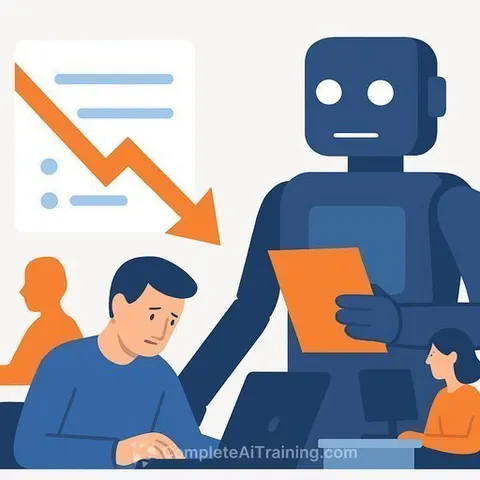
AI Agents Are Replacing Marketing Teams Faster Than You Think
Marketing work is moving from humans operating tools to software operating workflows. In the last 18 months, AI agents have escaped pilots and begun running in production-not just in customer service, but in lead funnels, audience segmentation, and campaign operations that marketing teams have long controlled directly.
This is not a story about copywriting bots. It is a story about digital labour shifting from people to systems.
The work has outgrown the team
A year ago, most marketing leaders discussed AI as a content accelerator. By early 2026, the conversation has moved to end-to-end execution. Gartner research shows 81% of marketing technology leaders are piloting or already implementing AI agents in their organisations.
The reason is practical. Channels have multiplied. Personalisation expectations have spiked. Measurement pressure has increased while budgets are constrained. Agents promise leverage: more experiments, more segments, faster response to signals-without adding headcount.
The agency world has felt the squeeze first. Alex Cohen, who runs Xander Marketing in Kent, said clients pushed for lower fees as AI entered their expectations. He cut staff and is now the only full-time employee, relying on freelancers. Where he previously used three copywriters, he now has one.
Gartner predicts 40% of enterprise applications will include task-specific AI agents by the end of 2026, up from less than 5% in 2025. Many vendors are "agentwashing"-labelling assistants as agents when they cannot take action in your environment.
What counts as an agent
An AI agent is not just a language model. It is a system designed to plan, decide, and act across tools to achieve a goal. It has memory, monitoring, and the ability to trigger workflows.
In marketing terms, an agent identifies high-value segments, generates personalised content, deploys campaigns across channels, and continuously optimises spend in real time within guardrails. If the system cannot take a permitted action in your environment, it is a suggestion box, not an agent.
What the metrics show
HubSpot announced outcome-based pricing for two agents in March 2026, saying customers pay when tasks are completed. The company's Breeze Customer Agent resolves over 50% of customer conversations autonomously, including top-of-funnel work like welcoming visitors and answering questions about webinars and subscriptions.
Max Bolten, Head of Marketing at Stübben, said the agent "makes people feel welcome by responding right away." Andrew Downing of Camp Network credited the agent with handling "60-70% of inquiries automatically," freeing the team to focus on sales and marketing.
Salesforce deployed its Agentforce agent on its own website and published internal metrics: more than 100,000 AI-powered visitor conversations since launch and 40% faster lead qualification compared with previous workflows. If lead qualification speeds up by 40%, someone's manual triage work is disappearing into the system.
Salesforce's internal employee survey showed 81% of staff said AI tools boost productivity. The company's CEO previously claimed half of Salesforce's work was being done by AI and that 4,000 support roles had been eliminated due to AI agents.
Holland America Line built "Anna," a Copilot Studio agent that acts as a digital concierge on its website. The agent was handling thousands of conversations per week. The company's CMO, Kacy Cole, said the agent lets them localise marketing and get to market faster because AI helps define audiences, product offerings, and media opportunities in a fraction of the time.
How organisations are restructuring
As agents become capable of end-to-end execution, marketing organisations are changing shape around them. Integration becomes the strategy.
Microsoft and Publicis Groupe announced an expanded partnership in April 2026 to build a "full-stack marketing solution" unifying legacy systems, AI agents, and identity data. Publicis is putting Microsoft 365 Copilot into the hands of more than 114,000 employees. The partnership explicitly contrasts "fragmented AI point solutions" with connected transformation and describes a future where agents are deployed "across the entire flow of work."
Adobe announced Adobe Experience Platform Agent Orchestrator in March 2025, enabling businesses to build, manage, and orchestrate AI agents from Adobe and third-party ecosystems. The company released ten purpose-built agents aimed at augmenting marketing and creative teams.
A new operating model is emerging. Marketing starts to look less like a department of specialists each running tools and more like a small leadership group supervising a fleet of agents. Job titles are already shifting: organisations talk about deployment, monitoring, audit trails, and skills to "work with, govern or create AI agents."
Gartner has been direct about the leadership gap. In February 2026, Gartner reported that 65% of CMOs expect AI to dramatically change the CMO role in the next two years, yet only 32% think significant skill changes are needed. Gartner warned that a lack of AI literacy could become a top-three reason CMOs are replaced at large enterprises by 2027.
Rajesh Jain, founder of Netcore Cloud, said in January 2026 that "2026 is when Agentic Marketing becomes operational for CMOs" and "Software becomes a workforce, not a tool."
The trust tax and the limits
The agentic story also carries a growing trust tax. Gartner predicted in June 2025 that more than 40% of agentic AI projects will be cancelled by 2027 due to escalating costs, unclear value, and inadequate risk controls. Many projects are hype-driven proofs of concept.
Brand risk is the marketing-specific version. Gartner reported in March 2026 that 50% of US consumers would prefer brands that do not use generative AI in consumer-facing content. Gartner analyst Emily Weiss advised transparency about when AI is used, what it does, and giving customers a choice to opt out. A fully autonomous campaign machine becomes a reputational liability unless governed tightly.
Regulation is tightening the bind. The European Commission's AI Act entered into force on 1 August 2024 and is fully applicable on 2 August 2026. Agentic marketing that touches customer interactions, profiling, or automated decisioning needs to be designed with documentation and oversight in mind.
Agents are only as reliable as the data, permissions, and systems they can access. Many teams are stalled by the real cost and complexity of connecting fragmented customer data, inconsistent taxonomies, and partially integrated martech stacks.
Holland America Line refined its agent through a multi-wave rollout, tested it internally before customer launch, and paired it with multiple monitoring systems so the team could update content and training. HubSpot's outcome-based pricing is tied to the claim that these agents are different because they are "built into HubSpot" and have context.
The limit is not whether an agent can do a task once. The limit is whether it can do that task correctly, safely, and repeatedly inside a real brand with real constraints.
What comes next
Gartner's forecast that task-specific agents will be embedded in a large share of enterprise applications by the end of 2026 sits beside its expectation that many agentic projects will not make it to production. The winners will not be organisations that proclaim they have replaced marketing teams. They will be the ones that quietly redesign the work, shrink the manual surface area, and treat governance as a product discipline.
What replaces the marketing team is not a single bot. It is an operating model where the human job becomes leadership, judgement, and accountability, and the software job becomes execution. That is happening faster than most organisations' org charts can admit.
Learn more about AI for Marketing or explore the AI Learning Path for CMOs to understand how to lead through this transition.