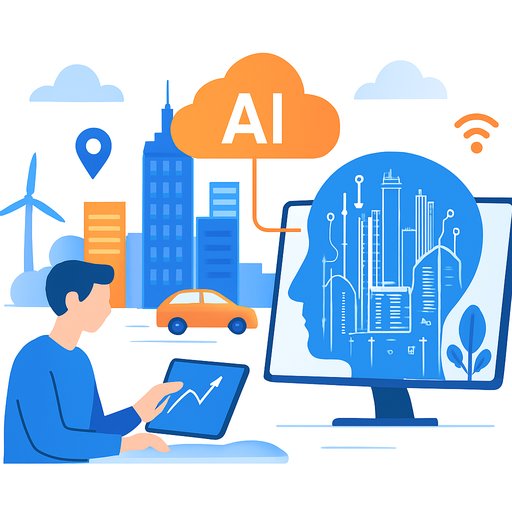
AI and digital twins: a practical partnership for urban management
Digital twins give you a live, 3D blueprint of your city's assets and networks. Add AI, and you get faster design cycles, sharper operational insight, and a safer way to test decisions before they hit the street.
For managers, the value is simple: fewer surprises, tighter budgets, and decisions grounded in data, not guesswork.
Why AI matters for digital twins
- Accuracy: AI ingests huge, messy datasets and reconciles them into one coherent model.
- Speed: Models update as new data arrives, cutting design and review time.
- Clarity: Teams see conflicts, risks, and trade-offs in plain view, not buried in reports.
Improve and accelerate design
AI-enabled twins compare design options against changing requirements-capacity, safety, sustainability, cost-and surface the best trade-offs. They can optimise for environmental impact (for example, reducing the carbon footprint) while keeping operational constraints in check.
Owners often struggle to communicate requirements. Engineers struggle to illustrate trade-offs. A shared twin makes both visible. As Nicholas Cumins, CEO of Bentley Systems, notes: "There is so much data generated in infrastructure, especially during the design phase - consider all the models and iterations created, of which only one will ultimately be selected from thousands." AI helps teams make the right call faster.
Maintenance and safety at scale
Drones and ground robots can capture imagery, LiDAR, thermal, and acoustic data from assets that are costly or risky to inspect. AI flags corrosion, cracks, spalling, joint failures, and other anomalies quicker and at lower cost than manual checks.
Fire risk from vegetation near transmission lines is another example. AI turns raw visuals and sensor streams into alerts, feeding a live dashboard in the twin so operators can act early and prioritise the right fixes.
Reporting and documentation without the drag
Compliance and documentation drain engineering time. "AI can handle documentation and annotation of drawings, freeing engineers from these routine duties and allowing them to concentrate on more critical aspects of their work," says Cumins.
Pietro Borghesani, associate professor of engineering at the University of New South Wales, puts it simply: "A digital twin doesn't just simulate, it lives with the machine." With a digital history of wear, load, and context, teams move from reactive repairs to planned interventions with better accuracy.
Plan with "what if" scenarios
AI-enabled twins let you test decisions safely: What if a sluice gate had closed earlier? What if evacuation routes had changed? The results build playbooks for operations and emergency response.
Twins also preserve institutional memory. When key staff move on, their experience stays encoded in models, workflows, and annotations. As Borghesani adds, "A well-designed digital twin acts as both a performance monitor and a training tool for the next generation of engineers."
Real projects to reference
- New Bullards Bar Dam (California): Drone imagery processed into a twin, populated with live sensor data for safety in a remote, earthquake-prone area.
- Sacramento Regional Waste Treatment Plant: A twin matched on-site changes to the digital model to guide decisions across 22 related projects.
- Colorado I-70 upgrade: A twin helped align agencies and the public around design in a mountainous corridor with waterways and tight turns. As Bentley's CTO Julien Moutte notes, realistic 3D views help stakeholders visualise options and reduce risk.
- Urban heat islands in Enschede (Netherlands): Researchers tested layouts, materials, and greenery placement in a city-scale twin to lower street-level temperatures and improve airflow.
Costs, ROI, and risk
Digital twins improve return on infrastructure by coordinating many stakeholders, running scenario tests, and surfacing side effects before they become expensive. Analysts at McKinsey's public sector practice point to gains in ROI when twins support planning, delivery, and operations across networks.
See McKinsey's perspective on capturing value from IoT and twin-enabled operations.
On the risk side, twins reduce rework, shorten inspection cycles, and improve incident response times. They also help with permitting and public trust by showing communities what will actually change.
What managers should do next
- Pick one high-value use case to start (for example, bridge inspections, flood response, or utility corridor management). Define a clear before/after metric.
- Inventory the data you already have (CAD/BIM, GIS, sensors, maintenance logs) and set a plan to close gaps.
- Set governance early: data quality, model ownership, cybersecurity, and privacy.
- Pilot with a small, cross-functional team. Run weekly value reviews, not just tech reviews.
- Negotiate interoperability into contracts. Prefer open formats (for example, IFC, CityGML) and clear APIs.
- Upskill your team on AI fundamentals for operations and planning. A curated track by job role helps. Browse AI courses by job role.
KPIs worth tracking
- Design review cycle time and number of iterations to approval
- Construction change orders and rework percentage
- Inspection cycle time and cost per inspected asset
- Mean time between failures and incident response time
- Safety events and near-miss rates
- Energy or water efficiency gains and CO2e reductions
- Community approval time and number of stakeholder objections
- Engineer hours spent on documentation vs. analysis
- Urban heat reductions in target zones (peak and mean)
Common pitfalls to avoid
- Building a beautiful model no one uses-tie every feature to a decision or workflow.
- Lock-in-ensure you can move your data and extend models over time.
- Poor data hygiene-bad inputs will erode trust quickly.
- Overkill fidelity-start with "fit for decision," then add detail where it pays off.
- Ignoring change management-train field teams, planners, and contractors early.
- Security and privacy as an afterthought-treat the twin like a high-value system.
Tooling notes
Several platforms support BIM-to-twin workflows, sensor integration, and reality capture. Whatever you choose, plan for APIs, model versioning, and standards so you can add assets, cities, and partners without rework. Keep the stack simple enough for your teams to run, not just your vendors.
Want a team that can read a twin, ask better questions, and make cleaner calls with AI? Explore practical AI courses.
Further reading on mitigation of urban heat islands: University of Twente's geo-information research.
Your membership also unlocks: