
AI news ·
AI and Healthcare: British and Irish Leaders Weigh Opportunities and Challenges at Council Summit
British-Irish Council leaders discussed AI's role in improving healthcare, especially cancer screening, and its potential to support workforce efficiency amid demographic challenges. They emphasized AI as a tool to assist, not replace, workers.
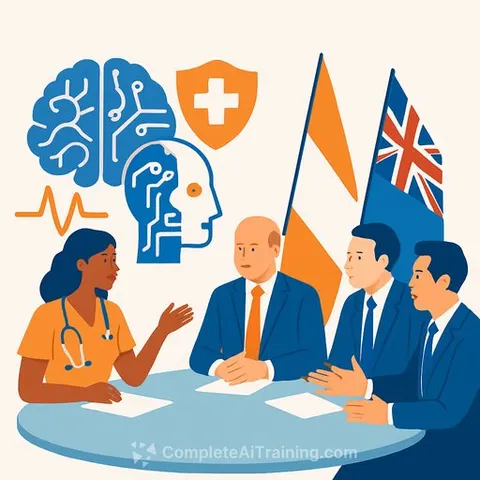
British-Irish Council Leaders Discuss AI’s Role in Healthcare and Workforce Efficiency
At the 43rd meeting of the British-Irish Council (BIC) in Co Down, political leaders from across the British Isles focused on the practical impacts of artificial intelligence (AI), especially in healthcare and workforce management. The council, established under the Good Friday Agreement, considered AI’s potential to improve cancer screenings and address challenges posed by aging populations.
Healthcare Applications of AI
Leaders highlighted AI’s ability to support medical professionals, particularly in breast cancer screening. Northern Ireland First Minister Michelle O’Neill pointed out that AI should assist rather than replace traditional healthcare roles, emphasizing collaboration with trade unions to ensure workers are included in the transition.
O’Neill noted, “Some of the examples that we’ve cited today are around breast screening and how that can be done efficiently with AI supporting an individual.” This reflects a broader goal to improve efficiency in public health services without sacrificing quality or jobs.
Changing Nature of Work
Irish premier Micheal Martin took a cautiously optimistic stance, describing his outlook as “glass half full.” He acknowledged that AI will change the nature of work but emphasized historical patterns where technology created new job opportunities rather than just eliminating existing ones.
Martin recalled predictions from the 1980s about reduced working hours due to technological advances, but instead, new jobs emerged as the economy evolved. His message is clear: while AI will reshape work, it won’t simply shrink employment.
Government Strategies and Workforce Concerns
Northern Ireland deputy First Minister Emma Little-Pengelly stressed the need to embrace AI’s benefits while addressing ethical concerns and risks. She shared that an AI unit has been established within the government to explore how AI can enhance productivity and service delivery, especially in public sectors.
Little-Pengelly reassured workers, saying, “This is not about just simply getting rid of people and making them redundant. This is about doing things better and harnessing an agenda which is happening at the moment.”
Addressing Demographic and Workforce Challenges
Scottish First Minister John Swinney highlighted demographic challenges, noting a shrinking working-age population. AI offers a way to meet societal demands despite these limitations, particularly by improving early health interventions and reducing pressure on healthcare systems.
He also noted the importance of migration policies and the impact Brexit has had on workforce availability. AI, in this context, is seen as a tool to supplement human resources and maintain service levels.
Collaboration and Future Steps
Participants including Northern Ireland Secretary Hilary Benn, Ireland’s deputy premier Simon Harris, and representatives from Wales, Jersey, and the Isle of Man attended the conference. Micheal Martin remarked that relations across the islands are positive but stressed the need to deepen cooperation to maximize benefits from AI and other technologies.
For healthcare professionals interested in expanding their skills with AI tools and training, resources are available at Complete AI Training, which offers courses tailored to healthcare and other job sectors.