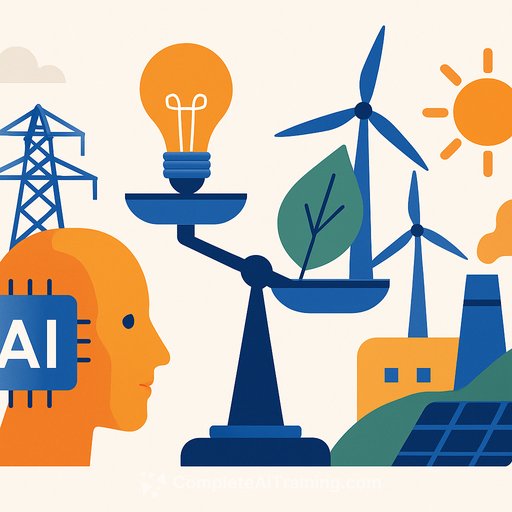
How AI’s Growth Poses Both Risk and Promise for Global Sustainability
Artificial intelligence (AI) drives efficiency across sectors such as healthcare and logistics. Yet, as AI systems become more complex and widely used, their energy consumption grows substantially, raising concerns about environmental impact. The Arm Global AI Readiness Report highlights a key contradiction: AI presents environmental risks but also offers tools to advance sustainability efforts.
AI’s Soaring Energy Demand: A Threat to Climate Goals
AI’s environmental footprint largely stems from its high energy use. Data centers worldwide consume about 460 terawatt-hours (TWh) annually, matching the entire electricity consumption of Germany. In the U.S., data centers accounted for 2.5% of electricity use in 2022, with estimates projecting a rise to 7.5% (390 TWh) by 2030—equivalent to the electricity needs of 40 million households.
This growth strains electrical grids, especially as countries shift to intermittent renewable energy sources. Some regions have even paused new data center developments due to grid congestion. Without coordinated investments in grid infrastructure and energy efficiency, AI’s unchecked expansion could hinder climate targets.
Smart Solutions: Efficiency at the Edge and in the Cloud
AI's energy consumption is not limited to large data centers. Edge computing and Internet of Things (IoT) devices push energy demands into homes, vehicles, and factories. As more AI processing happens locally, cumulative energy use increases.
However, targeted strategies can reduce this impact:
- Smarter hardware: AI accelerators and low-power chips lower electricity requirements while maintaining performance.
- Efficient models: Techniques like pruning and quantization streamline algorithms, cutting energy use without losing accuracy.
- System-wide management: Dynamic power allocation and distributed processing help balance loads and prevent waste.
AI as a Climate Enabler
Despite its energy demands, AI supports climate resilience in meaningful ways. Machine learning improves wind and solar forecasting, optimizes grid operations, and enhances energy storage management, all of which facilitate the clean energy transition.
AI also advances climate modeling, enabling more precise simulations of extreme weather and aiding disaster preparedness. It transforms supply chains, transportation, and environmental monitoring—from satellite detection of illegal deforestation to predictive models in urban transit—reducing emissions and boosting efficiency across sectors.
A Call for Global Collaboration and Responsible Innovation
Sustainable AI requires collaboration across countries and industries. Initiatives like the Coalition for Sustainable AI, involving France, UNEP, and the ITU, work to align technology development with climate goals. Regulatory frameworks such as the EU AI Act are setting standards for transparency, ethics, and environmental accountability.
Industry stakeholders promote Environmental Product Declarations to track and reduce emissions from data center infrastructure. Investments like the $100 million U.S. NIST project to develop sustainable semiconductor materials using AI signal a shift toward climate-conscious innovation.
The future of AI’s environmental impact depends on choices made today. Embedding sustainability into AI design—from hardware architecture to software—and fostering international cooperation are crucial. AI can either deepen climate challenges or become a key tool for climate action. The question is no longer if AI can be sustainable, but whether the necessary steps will be taken to ensure it is.
Your membership also unlocks: