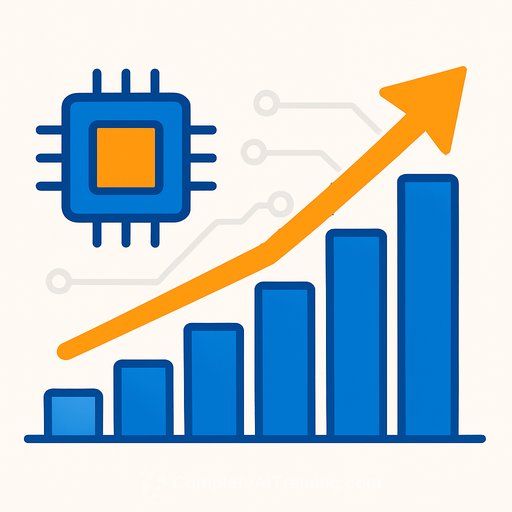
AI buildout set to lift chip equipment sales 9% in 2026 - and what sales teams should do now
Equipment used to make semiconductor wafers is projected to reach $126 billion in 2026, up about 9%, and $135 billion in 2027, up another 7.3%, according to industry group SEMI. The driver: capacity expansions for logic and memory chips that feed AI demand.
Most production remains in Asia. China, Taiwan, and South Korea are expected to stay the top equipment markets through 2027, with China investing the most overall.
Where the money is going
- China: Largest overall equipment investment through 2027.
- Taiwan: Expanding leading-edge capacity, anchored by TSMC.
- South Korea: Focused on advanced memory for AI, driven by Samsung and SK Hynix.
- Everywhere else: Spending rises in 2026-2027, backed by government incentives, regionalization moves, and specialty capacity builds.
Who stands to benefit
- ASML: Roughly a quarter of global equipment sales; core to advanced lithography. Company site: ASML.
- U.S. suppliers: Applied Materials, KLA Corp, Lam Research.
- Japan: Tokyo Electron.
Why this matters for sales teams
Budgets are moving to advanced logic and memory tied to AI training and inference; sales teams should be fluent in training and research needs (AI Research Courses) to better position services, spares, and validation offerings. That means more tooling cycles, bigger spares and services envelopes, and new vendor qualification windows across fabs and OSAT partners.
If you sell into semis or adjacent markets (materials, components, testing, automation, software), this is a live pipeline event across 2026-2027-not a distant trend.
Talk tracks you can use
- Capacity + AI demand: "We help you de-risk ramp schedules for AI-linked nodes while holding yield and cycle time."
- Total cost per wafer: "Here's how we lower cost-of-ownership across uptime, consumables, and process windows."
- Compliance and incentives: "Our solution aligns with current incentives and local content requirements to accelerate approvals."
- Speed to qualify: "We cut validation time with proven recipes at peer fabs in Taiwan and Korea."
Account and territory priorities
- Taiwan: Target leading-edge programs (GAA, advanced packaging). Map vendor lists tied to TSMC and key ecosystem partners.
- South Korea: Focus on HBM and advanced DRAM lines. Position around throughput, overlay, metrology, and contamination control.
- China: Track domestication roadmaps and local procurement rules. Be specific about availability, service coverage, and compliance.
- Secondary regions: Tie outreach to new fabs approved under government programs; watch specialty nodes (power, RF, sensors).
Proof points buyers expect
- Uptime and yield data at equivalent nodes.
- Clear total cost-of-ownership model (capex, spares, utilities, training).
- Lead times, install timelines, and service SLAs by region.
- References from fabs with similar process windows.
Timeline snapshot
- 2026: ~$126B in equipment sales as AI-driven capacity ramps.
- 2027: ~$135B as expansions continue across logic, memory, and specialty capacity.
Quick sales checklist
- Refresh ICPs around AI-related nodes and HBM demand.
- Align talk tracks to incentives and local sourcing rules per region.
- Package ROI with concrete yield/throughput deltas and references.
- Pre-book technical resources to speed vendor qualification.
- Build joint plans with channel/service partners in Taiwan, Korea, and China.
If you want sharper buyer conversations around AI and semis, explore role-specific training here: Complete AI Training - Courses by Job.
Your membership also unlocks: