
AI news ·
AI datacentre expansion strains Australia's energy and water supplies
Australia's 286 datacentres will triple energy and water use by 2030. The boom creates few local jobs and strains the power grid without government scrutiny.
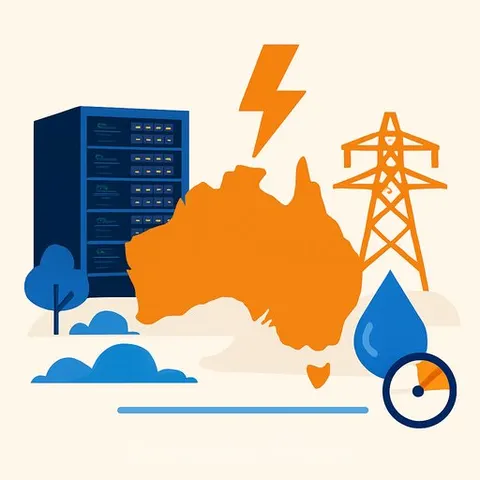
Datacentres are multiplying across Australia - 286 are active or planned - as global AI firms like Anthropic eye the country for model training. The boom is set to triple energy and water consumption by 2030, yet governments are largely letting it unfold without rigorous cost-benefit scrutiny.
Worldwide, more than 10,000 active datacentres are expected to increase by 3.5 times at an estimated cost of US$7 trillion, roughly 5% of annual global GDP. The United States hosts most of these facilities, but Australia is attracting growing interest. Anthropic, one of the leading AI developers, is looking to Australia as a potential training ground for its models.
Governments in Australia and elsewhere have taken a laissez-faire approach to the expansion. Proponents often label datacentres as "infrastructure," but they do not fit neatly into either hard infrastructure like roads and power grids or soft infrastructure like healthcare and education. Unlike those public goods, it remains unclear who benefits from the investment beyond the technology companies driving it.
The hidden costs of the datacentre boom
Datacentres consume enormous amounts of energy and water. In Australia, their combined use of both resources is forecast to triple by 2030. This comes as the country tries to electrify rapidly with renewable energy and storage to meet climate targets. Allowing energy-intensive facilities to strain grids could slow the transition to net zero emissions and push up costs for households.
While fossil fuels still supply about half of Australia's energy, adding datacentre loads means adding greenhouse gas emissions. Queensland has signalled it is happy to keep using fossil fuels for datacentres, resisting federal government expectations for cleaner power. Any honest cost-benefit analysis must account for the collective climate impact of those emissions.
Waste heat is a related problem. The intense energy flowing into datacentres turns into heat. In cold climates such as Finland, that heat can warm homes. In most parts of Australia, where extreme heat days are already rising, the output only adds to urban heat loads.
The Australian Prudential Regulation Authority has written to banks warning of accelerating cybersecurity risks linked to AI. Its recommendation, without irony, is to use AI tools to counter the AI threat.
What economic growth?
The datacentre boom has lifted business investment off the floor over the past year, but most of the equipment must be imported. That means the direct effect on the size of Australia's economic pie is close to zero. Beyond the construction phase, datacentres create few jobs - far fewer than sectors such as manufacturing.
When politicians and industry advocates talk up the benefits of datacentres, they are really pointing to the possible benefits of the AI those centres enable. Productivity gains from AI are widely expected, but their size and timing remain uncertain.
AI's real promise - and who pays for it
AI can deliver genuine public value. In Shanghai, it is reducing traffic congestion. Around the world, it is improving the accuracy and speed of diagnosis for X-ray, CT, MRI and other imaging. It is helping optimise energy grids to avoid blackouts. But those benefits cannot be weighed without assessing the costs.
Andrew Charlton, assistant minister for science, technology and the digital economy, told the Australian Business Economists in February that Australia was at a crossroad. The country could remain a "technology taker," capturing some productivity benefits, or become "a world-class adopter and creator and exporter of AI technology." Australia's poor record on commercialising ideas and keeping profits at home suggests the harder path is also the more likely one.
Charlton also said the government should ensure "that technology works for the Australian people, and not the other way around." Looking at the datacentre and AI expansion and their associated costs, it has not succeeded.
Why this matters for IT, government and science professionals
For IT and development teams, the datacentre boom will reshape energy demands and infrastructure planning. Skills in energy-efficient model deployment and workload optimisation will become critical as organisations face pressure to cut AI's environmental footprint. Government professionals need to demand rigorous cost-benefit analyses for every major datacentre proposal, including emissions, water use and grid strain, rather than accepting infrastructure labels at face value. Science and research professionals must lead the push for transparent accounting of AI's full lifecycle costs, from training runs to cooling, and advocate for computing choices that align with climate commitments. The decisions made now will determine whether AI delivers net public good or concentrates costs among communities that see few of the gains.