
AI news ·
AI design copilots push product engineering teams toward parallel iteration and system-level thinking
Most AI design pilots stall because teams treat AI as a replacement for CAD and simulation tools rather than an extension of them. A new workflow pairs human engineering judgment with AI models that explore many design options in parallel.
Product Engineering Teams Face a New Design Challenge
Product development teams are caught between competing demands: deliver more complex products, faster, using processes built for a different era. Three capabilities now separate competitive manufacturers from the rest: speed of design iteration, early detection of system-level problems, and the ability to encode and scale internal engineering expertise.
Most engineering teams have increased their investment in AI tools over the past two years. Yet few can point to measurable impact. Many initiatives stall at the pilot stage, proven only in isolated cases rather than at scale.
Why AI Design Projects Fail Early
Organizations often treat AI as a plug-and-play replacement for existing design and simulation software. This creates misaligned expectations about what AI can actually do.
AI is not an alternative to 3D modeling or physics solvers. It's an opportunity to extend CAD and CAE tools to unlock faster, smarter design decisions at unprecedented scale. Realizing this opportunity requires rethinking the engineering process itself.
A New Engineering Playbook: Quantitative Design
CAD and CAE moved product design from paper to digital workflows. They enabled greater scale and efficiency, but gradually fragmented the end-to-end engineering process.
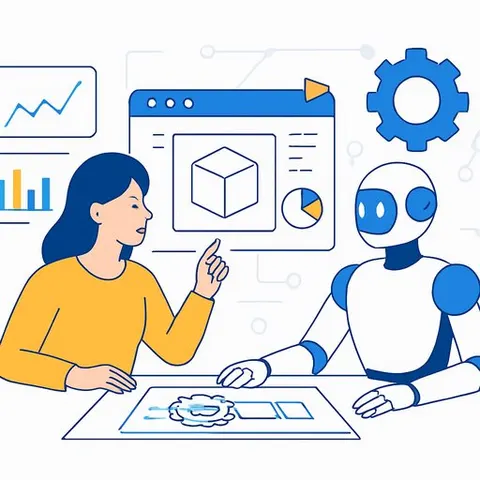
An alternative is emerging: an AI-native workflow built around continuous iteration and system-level thinking. Instead of one engineer working through a long chain of CAD work, simulation setup, and reporting, teams now use AI models that understand geometry and physics to explore many options in parallel.
Engineers describe their intent, constraints, and performance targets. AI then proposes groups of designs that fit those conditions. Rather than perfecting a single 3D model over weeks, teams define a design space and let algorithms populate it with viable options. Human judgment then selects promising directions and refines the brief.
The Intelligence Layer
A new "intelligence layer" is emerging across engineering toolchains. Rather than replacing existing CAD, simulation, or lifecycle systems, this layer connects to software engineers already use and augments them with AI design copilots.
These copilots can generate CAD-ready geometries, predict physical behavior, and surface trade-offs across teams. Teams explore design alternatives faster, anticipate trade-offs earlier, and bring system-level insight into everyday decisions without rebuilding workflows from scratch.
Early adopters report that this approach drastically reduces manual modeling work and allows engineers to explore far more variants per project.
AI design copilots don't hand decisions to a black box. They reveal non-intuitive options and accelerate repetitive tasks, giving engineers more mental space for system thinking. Humans retain control of final design choices.
New Roles, Unchanged Fundamentals
Two new roles are emerging inside engineering teams. The "quantitative designer" creates value by shaping and exploring whole design spaces and encoding domain expertise into AI-ready workflows. The AI builder bridges IT, data, and engineering to integrate these systems securely and at scale.
The fundamentals of good engineering have not changed. AI cannot replace the tacit knowledge that comes from experience or the ability to weigh messy trade-offs between user comfort, safety, cost, and performance.
What AI can do is reduce friction between human judgment and the digital tools that turn ideas into products.
What Success Looks Like Now
AI in engineering is moving beyond one-off pilots into a repeatable playbook. In the near term, success comes from choosing a few strategically important workflows, proving that AI-supported quantitative design delivers better outcomes, and investing in people so they become confident users and shapers of these tools.
The ability to pair human creativity with AI-powered exploration will determine how quickly better products reach the market.
For product development teams looking to build these capabilities, AI for Product Development and AI Design Courses can provide structured training on integrating AI into existing workflows.